Skip to product information
1 of 3

Vintage and Antique Gifts

Vintage Red Wagon Fruit Crate Label 🍇 Reedley California Grape Lug Label, 1950s Royal Valley Fruit Growers

Vintage Red Wagon Fruit Crate Label 🍇 Reedley California Grape Lug Label, 1950s Royal Valley Fruit Growers

Regular price 7.00 USD
Regular price Sale price 7.00 USD
Sale Sold out
Shipping calculated at checkout.
Quantity

🍇 What Kid Wouldn't Want to Climb Aboard That Wagon? 🚃

There's a reason this little scrap of paper stops people in their tracks. That grinning, tousle-haired boy tearing along in his red wagon, grapes spilling over the sides, has a kind of joy baked right into the ink — the kind of pure, uncomplicated delight that doesn't really get printed onto anything anymore. We've had this label in the shop drawer more than once, and every single time, it's the first thing anyone reaches for. If we let our own kids near it, honestly, it would end up taped to every wall in the house — inside and out. Something about that boy's face, that flash of speed, those little blue sneakers kicking up behind him — it just refuses to be ignored.

This is an original "Red Wagon" brand fruit crate label, produced for the Royal Valley Fruit Growers Ass'n of Reedley, California, dating to the postwar 1950s — the golden, closing chapter of California's wooden-crate era. It measures 13 x 4 inches, a narrow, elongated format that marks it as a classic grape-lug end label, the kind pasted to the short end of the shallow wooden lug boxes used to ship table grapes to market. This example is New Old Stock (NOS) — printed, boxed, and set aside, never pasted to a crate, never sent out into the produce world it was made for. It has simply been waiting, all this time, for someone to notice it again.

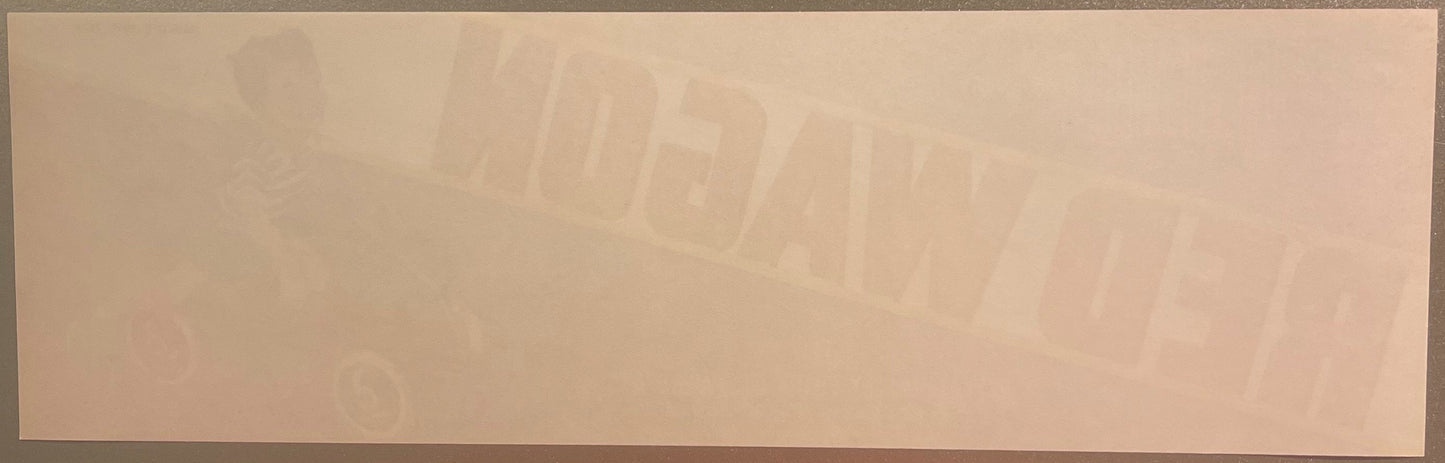
The artwork itself is a small master class in mid-century commercial color. A boy in a blue-and-white striped shirt and green shorts is riding the wagon, not walking it: one knee rests on the wagon bed, the other leg is kicked straight back with the sneakered foot pushing off the ground, and his right hand grips the pull-handle, doubled back over the load so he can steer while he scoots, his green neckerchief snapping out behind him like a flag.

The wagon itself is fire-engine red with whitewall wheels, loaded with clusters of blue-purple and green grapes still trailing their vine leaves. Behind him, the word RED WAGON cuts across the label in bold red block lettering set on a sharp diagonal, framed by a yellow stripe against a deep magenta ground — the whole composition a lesson in how far a lithographer could push color before offset printing made it a science rather than an art.

Set around the sheet — UNITED STATES OF AMERICA at the upper left, REG. U.S. PAT. OFF at the upper right, and BRAND with the association block in the lower centre-left — are the words UNITED STATES OF AMERICA, BRAND, ROYAL VALLEY FRUIT GROWERS ASS'N., REEDLEY, CALIFORNIA, and, tucked in the upper corner, REG. U.S.

PAT. OFF. — the era's standard notice that the "Red Wagon" name had been staked out as a registered trademark.


🚂 From Wheat Fields to the World's Fruit Basket

To understand why a fruit label from a small San Joaquin Valley town carries this much personality, you have to understand Reedley itself. The town takes its name from Thomas Law Reed, a Civil War Union veteran who came west and settled the district to grow wheat for the hungry mining camps of the Gold Rush. When the Southern Pacific Railroad pushed a branch line into the area in 1888, it was Reed's donated land that gave them a depot site — and in gratitude, the railroad named the new station after him. Reed himself began selling off town lots that same year, and a farming settlement was born along the rail line.

But wheat wasn't destined to be Reedley's legacy. In the early 1880s, local ranchers pooled their money to divert water from the Kings River, building the irrigation canals that would utterly transform the district. Once water could reach the fields on demand, dryland grain gave way to something far more valuable: irrigated orchards and vineyards. Grapes, plums, peaches, and figs took root where wheat once stood, and the local economy diversified almost overnight. That single decision — to irrigate rather than keep dry-farming — is the reason a "grape lug label" like this one exists at all. Without the Kings River water, there would have been no grapes to pack, and no Royal Valley Fruit Growers Ass'n to pack them.


🌾 A Colony Built on Faith, Family, and Fruit

The new irrigated farmland needed farmers, and Reedley's founders went looking for them. Among the families recruited to the valley was a colony of German Mennonites, arriving from Kansas, Nebraska, Minnesota, the Dakotas, and the prairie provinces of Canada. They brought with them a work ethic and a set of close-knit community values that shaped the town from its earliest years — by 1909, just a handful of years after the first families arrived, Reedley already supported two Mennonite churches. That Mennonite thread is still visible in Reedley's character today, and it was these immigrant farming families — alongside other European settlers drawn by the promise of irrigated land — who built the orchards and vineyards that the valley's packing houses like Royal Valley Fruit Growers Ass'n would come to depend on. The town formally incorporated in 1913, by which point Reedley had fully remade itself: no longer a wheat depot, but a fruit-growing community proud enough of its output to eventually crown itself "The World's Fruit Basket," a nickname it still carries with real affection.


🍇 The Grower's Cooperative Behind the Wagon

The "Ass'n" in Royal Valley Fruit Growers Ass'n stands for Association — and that word tells its own quiet story. In this era, individual growers rarely had the capital or the reach to pack and ship their own fruit under a national brand. Instead, they banded together into cooperative associations, pooling their grapes and stone fruit under a single roof, a single packing operation, and a shared portfolio of brand names designed to catch a produce buyer's eye from across a crowded rail yard. Royal Valley Fruit Growers was one of these cooperative packers, based right in Reedley, and "Red Wagon" was one of the brands it put its name behind — cheerful, memorable, built to make a wholesale buyer smile before they'd even opened the crate. The Royal Valley name itself has stayed connected to Reedley agriculture in the decades since, a small thread of continuity in a valley that has always run on family farming and cooperative packing.


📦 Why the Labels Disappeared — and Why This One Survived

Here's the twist in the story that makes labels like this one so collectible today: the entire wooden-crate-label industry ended almost overnight. By the mid-1950s, the cost of lumber and hand-assembled wooden crates had climbed too high, and packers discovered that sturdy cardboard cartons — with a company's logo printed directly onto the box itself — could survive the same rough rail and truck shipping just as well, for a fraction of the cost. Almost as soon as that shift happened, the printed paper label became obsolete. Warehouses across California found themselves sitting on enormous stockpiles of labels that would never be pasted to anything, and in the years that followed, most of that surplus was simply thrown away or burned as scrap. The labels that escaped that fate — tucked into a drawer, a filing cabinet, a forgotten box in the back of a packing shed — are the reason any of this artwork survives at all. This particular label is one of those survivors: never used, never applied to a crate, simply set aside at the exact moment the industry turned a corner and never looked back.


🎨 The Lithographer's Craft

Look closely at the color in this piece and you're looking at the peak of an entire printing tradition. This label was produced using color lithograph offset printing, a process that let artists layer flat, saturated color — that magenta ground, the sunshine yellow diagonal, the cream white space, the blues and greens of the grape clusters — with a precision hand-drawn advertising art rarely achieved before it. Between roughly 1872 and 1972, dozens of West Coast printing houses, most of them clustered in San Francisco, turned out label after label for the valley's fruit packers, competing to make each brand's crate the most eye-catching one on the dock. That century-long print run has left us a genuine, if largely uncredited, body of American commercial art — bold sans-serif lettering set on daring diagonals, cartoon figures rendered with real warmth and personality, and color combinations bright enough to be seen from across a rail platform. This label, with its confident diagonal banner and its unmistakably 1950s streamlined typography, sits right at the tail end of that tradition — one of the last, brightest gasps of the wooden-crate label before cardboard took over for good.


🏛️ Reedley Today — Where the Story Still Lives

Reedley hasn't let this history fade quietly. The Reedley Museum keeps original wooden fruit crates on display, each one still bearing the proud label of a Reedley grower or packing company — a direct, tangible link back to the era this very label comes from. Out in the valley, the vineyards and orchards that made "The World's Fruit Basket" a fitting nickname are still very much in business, still shipping stone fruit and table grapes out across the country. And in collector circles, crate labels like this one have quietly graduated from packing-house scrap paper into recognized folk art — museums and art institutes now devote entire gallery walls to them, and collectors actively seek out the surviving examples precisely because the supply is finite and shrinking. Every label that gets framed and hung is one more piece of that story pulled back from the scrap heap it so narrowly escaped.


🖼️ Display Ideas

  • 🍇 Framed above a kitchen island or pantry door, right where fruit bowls and cutting boards live
  • 🚃 Hung in a child's room or nursery — that little red wagon has been a beloved toy across generations
  • 🍷 Grouped with vineyard and wine-country decor for a California-grown gallery wall
  • 🏡 Mixed with other fruit crate labels for a farmhouse-style collage of vintage advertising art
  • 🚪 Mounted in a mudroom or breakfast nook as a small, cheerful daily greeting
  • 🎨 Matted and framed on its own as a standalone piece of mid-century commercial art

🎁 Who Collects These

Fruit crate label collecting draws a wonderfully wide crowd. There are the dedicated Californiana collectors chasing every packing house and every brand that ever shipped fruit out of the San Joaquin Valley. There are advertising-art and ephemera collectors who prize crate labels as some of the boldest commercial lithography this country ever produced. There are Reedley and Fresno County locals and expats who want a piece of their own hometown's agricultural history on the wall. There are folks drawn purely by the little-red-wagon nostalgia of it — the toy, the childhood memory, the simple joy on that boy's face. And there are kitchen and farmhouse decorators who've discovered that a bright, well-composed crate label does more for a wall than almost anything you can buy new. This one, with its grinning boy and its grape-laden wagon, tends to appeal to nearly all of them at once.


❓ FAQ

What exactly is a fruit crate label?

Before cardboard cartons took over in the mid-1950s, fruit and produce shipped in wooden crates, and packing houses pasted colorful printed labels to the ends of those crates to advertise their brand to wholesale buyers. This is one of those original labels — in this case, a narrow grape-lug label meant for the shallow wooden boxes used to ship table grapes.

Is this a real vintage label or a reproduction?

This is an original, period-printed label from the Royal Valley Fruit Growers Ass'n of Reedley, California, produced in the 1950s during the closing years of the wooden-crate era.

What does "New Old Stock" mean here, and what condition is it in?

New Old Stock means this label was printed and set aside decades ago but never applied to a crate or put into use — it comes straight from that original, unused stock. It stands today as a genuine, uncommonly complete example of mid-century California advertising art.

What fruit did the Red Wagon brand ship?

The artwork and format — a narrow end label loaded with grape imagery — identify this as a grape-lug label, tied to Reedley's long history as one of California's major table-grape-shipping districts.

How old is this label exactly?

It dates to the 1950s, based on its lithography style, its bold diagonal sans-serif lettering, and its cartoon illustration style — all hallmarks of that final postwar decade of wooden-crate label production before cardboard cartons took over the industry.

Why did companies stop making labels like this?

By the mid-1950s, cardboard cartons proved cheaper and sturdier than wooden crates, and brands could print their logo directly on the carton instead. The wooden-crate label trade ended almost overnight, and most unused surplus labels were discarded — which is exactly why surviving, unused examples like this one are treasured today.

How should I display a piece this shape?

At 13 x 4 inches, it's a natural fit for a narrow frame hung horizontally — over a doorway, above a run of kitchen cabinets, or as one panel in a grouped gallery wall alongside other crate labels.

🏷️ What Is Printed on This Label

Read off the sheet itself, verbatim — this is the label's own printed text, not a description of it:

  • UNITED STATES OF AMERICA
  • REG. U.S. PAT. OFF  [printed without a full stop after OFF]
  • RED WAGON
  • BRAND
  • ROYAL VALLEY FRUIT GROWERS ASS'N.
  • REEDLEY, CALIFORNIA

He is riding the wagon. His left knee and shin rest on the wagon bed, his right leg is extended straight back with the sneakered foot pushing off the ground, and the pull-handle is doubled back over the load so he can steer while he scoots. Short dark-violet motion dashes float behind the boy and the wheels. He wears a blue-and-white striped tee, green shorts, white ankle socks and blue sneakers — he is not barefoot.

The sheet names no fruit in type. Grapes appear only in the illustration — one dark blue-purple bunch, one pale green bunch and vine leaves, loaded in the wagon. There is no product line, no variety, no count and no net weight anywhere on the label.

No printer's imprint appears anywhere on the sheet, and there is no printed date; the 1950s dating rests on the trade record and the owner's notes.

Shipping

🚚 Shipping & Handling

  • Shipping costs and timing are calculated at checkout.
  • Items curated and shipped directly by me include U.S. shipping at no additional cost, professionally packed to ensure safe arrival of your artifact.

Items from Vetted Pro Collectors
Shipping for items offered by vetted Pro Collectors is determined at checkout. All Pro Collector listings are reviewed to ensure fair, reasonable shipping practices.

For full details, please refer to our Shipping Policy.

Returns & Exchange

Take your time — you've got a full six months. If a piece isn't right for you, send it back the way it reached you and we're good.

In the first 30 days your money goes straight back the way you paid. After that it's store credit, so you can put it toward something you'd rather have.

Return shipping we sort out between us, case by case. I don't make this difficult.

If something arrives damaged, or it isn't what I said it was, send me a photo within 48 hours and I'll make it right.

Email info@vintageantiquesgifts.com or call 802-356-9872 — that's me answering, not a call center.

The only things I can't take back are custom or special-order pieces and gift cards.

View full details