Skip to product information
1 of 5

Vintage and Antique Gifts

Vintage 1950s Gold Dredger California Fruit Crate Label ⛏ H.J. Cheim, Yuba City CA, Gold Dredging History

Vintage 1950s Gold Dredger California Fruit Crate Label ⛏ H.J. Cheim, Yuba City CA, Gold Dredging History

Regular price $9.00 USD
Regular price Sale price $9.00 USD
Sale Sold out
Shipping calculated at checkout.

Size: 13" x 4"

🚚 Free US Shipping — ships within one business day. International shipping calculated at checkout.

Quantity

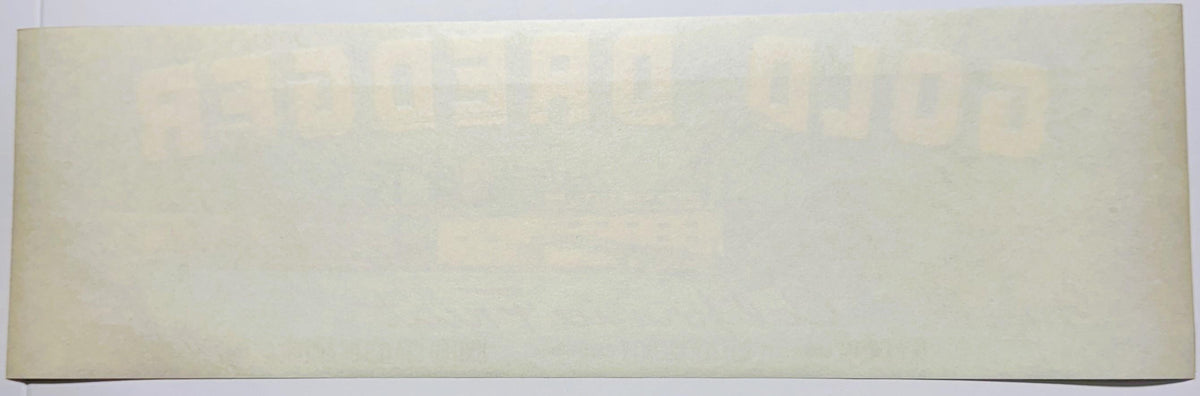
Gold Dredging and Fruit? ⛏ Vintage 1950s Gold Dredger Crate Label, H.J. Cheim, Yuba City CA

Size: 13" x 4" ~ little to no wear.

Most fruit labels sell you on the fruit: a pretty girl, a heaped bowl, a sunset over the orchard. This one sells you a gold dredge — a floating, clanking, rock-spitting mining machine — under huge nugget-speckled letters that shout GOLD DREDGER. I think it is one of the boldest things anybody ever pasted on the end of a fruit box, and the man behind it is every bit as interesting as the picture.

These are unused 1950s lug-box labels for the Gold Dredger brand of Harry J. Cheim of Marysville, California, a lumberman's son who went into orchards and registered both the name GOLD DREDGER and this dredge picture as United States trademarks for his fruit.

⛏️ What's On the Label

The dredge floats in its own pond: a long hull with rows of small windows, steel A-frames and a tall tower amidships. Off one end the long lattice stacker reaches out over the bank and drops a stream of rock onto big tailing piles, with floating pontoons curving along the water's edge; off the other a heavy beam leans up from the digging gantry, its hoist lines hanging straight down into the pond, and a little rowboat sits alongside. Behind it run cut banks, fields and a band of hills. That is a true gold dredge at work, drawn by someone who had seen one.

The lettering does the rest:

  • GOLD DREDGER — big bevelled block capitals across the sky, every letter flecked with orange like a pan of nuggets, with white highlights and a brown edge
  • California Fruit — dark red brush script across the water
  • H.J.CHEIM YUBA CITY SUTTER COUNTY CALIFORNIA — alternating tall and small capitals
  • UNITED STATES OF AMERICA — set off by itself at the right

Each one is a single sheet of paper that was never pasted to a box, with a plain blank back. Little to no wear.

📜 Harry Cheim's Trademark, Born in Wartime

Harry first used the Gold Dredger name and picture on January 19, 1944. He filed on the picture by itself — a drawing with no words in it at all — in April 1944, and the U.S. Patent Office registered that drawing on February 27, 1945 as trademark No. 412,243. It is this same scene, stacker, tailings, gantry and all, kept on file in black and white. The words GOLD DREDGER followed as a second mark: filed December 26, 1944 and registered August 7, 1945 as No. 415,360.

Both registrations were for "fresh deciduous fruits." That is the old trade term for the fruit of trees and vines that drop their leaves in winter, orchard and vineyard fruit as opposed to oranges and lemons. Neither registration names a single fruit.

Now look at the timing. On October 8, 1942 the War Production Board issued Order L-208, and California's gold mines were shut down. So in January 1944, when Harry hung a gold dredge on his fruit, the real ones had been shut down by federal order for more than a year. L-208 was lifted effective July 1, 1945 and some of the bucket-line dredges went back to work; his word mark was registered five weeks later. I love a man who names his brand after a machine the government had switched off.

The brand outlived him. By June 1955 Harry had died, and the joint executors of his estate, Lee Cheim and J. J. Madigan, had both Gold Dredger marks published in the Patent Office's Official Gazette in their own names. His widow, Lea, renewed the picture mark on November 10, 1964 and the name on June 1, 1965, keeping Gold Dredger alive into the 1960s. The Patent Office finally marked both registrations expired in 1986.

🌲 The Cheims of Marysville

Harry came out of one of Marysville's pioneer families. His father, Heiman Cheim, arrived in Marysville on Thanksgiving Day, November 26, 1868, a sixteen-year-old from Posen, in the town where his cousin Joseph Lask had been since 1849 running a clothing business. Heiman entered the Marysville Grammar School in January 1869, became bookkeeper of the Union Lumber Company, was one of its owners by about 1878, and after the fire of September 19, 1887 owned the corporation and rebuilt it. Union Lumber was started in 1852 and is said to be the oldest retail lumber yard west of the Mississippi. Heiman married Rosa Koenigsberger back in Posen in 1889 and died on September 20, 1928, leaving five sons.

Harry was one of those five. He served in France with Truck Company F in the First World War and came home after a year away. He managed the lumber yard, and by 1924 he had turned it over to his younger brother, I. B. Cheim, and taken up farming.

The Cheims were in the thick of town life. When Marysville went looking for an airport, the committee picked the Cheim property in East Marysville, and Heiman offered the town the use of it for free. Cheim Airport was ready for planes in the late spring of 1928 and dedicated on August 25 that year. At another dedication on the morning of September 23, 1930, in front of a thousand spectators, it was Harry who presented Mayor Chester A. Smith with the deed to the airport land, and on September 29 the Ford Tri-Motor "Pride of Marysville" left Cheim at 7:20 in the morning for Sacramento and Oakland, the first airliner to leave Marysville on a regular, advertised schedule. The field served until it officially closed in 1954, and after the great flood of Christmas 1955 crews tore it up with bulldozers and rippers for dry dirt to strengthen the weakened levees.

Harry also sat on the board of the Northern California Bank of Savings in Marysville in 1930, the bank where his father had been vice-president. And the family had a foot on both sides of the Feather River: in 1923 Heiman and Cooper Nasan started the Nasan Lumber Company in Yuba City, and when Nasan sold his interest to the Cheims in 1929 it became Sutter Union.

Harry married Lea (Leah) Murphy, and that tied the Cheims to the very name of their town. Lea descended from Levinah Murphy, who set out for California with her children in the Donner Party. Levinah's daughter Mary survived that winter, married Charles Covillaud in 1848, and Marysville is named for her. Harry and Lea's son Heiman worked alongside his father and uncles at Union Lumber and on the Cheim Ranch.

Union Lumber burned again on October 4, 1949, and in the family's own telling "all the old documents, ledgers and family history went up in flame." So paper labels like these carry a piece of the Cheim story that the fire never got.

🌳 Orchard Country on the Feather River

Yuba City sits across the Feather River from Marysville. It was incorporated on January 23, 1908 and is the county seat of Sutter County, one of California's original counties from 1850, named for John Sutter. Sutter's Hock Farm, begun in 1841 on the Feather south of present-day Yuba City, was the first major farm in the Central Valley, and Sutter planted Northern California's first peach orchard there. A Marysville paper of August 7, 1860 ran the headline "Large Shipment of Fruit": 6,800 pounds of peaches gone downriver on the morning boat.

The fruit kept coming. The Sutter Canning and Packing Company formed in Yuba City in 1883. The Phillips cling peach was found in 1888 in the Abbott orchard south of Yuba City, and the Walton, Johnson and Gaume peaches turned up locally in 1900, 1911 and 1913. Eight miles west of Yuba City, William Thompson got three grape cuttings from New York in 1872; one lived, and after its fruit was shown in Marysville in 1875 it became known as Thompson's Seedless. Cherries, pears, plums, prunes, olives, figs and almonds all had their orchards, and by 1951 Sutter County counted more than 14,000 acres of peaches and over 39,000 acres of fruit, walnut and almond orchards all told. That is how it came to be called the "Peach Bowl of the World." Sunsweet's dried-fruit plant is in Yuba City still.

Harry Cheim was right in the middle of it. In 1945 he was named to the Pear Commodity Committee of the California Fruit Exchange, the Blue Anchor growers' cooperative founded in 1901 to market the state's fresh deciduous fruit. Margaret Kimerer's 1951 newspaper history of Sutter County fruit names Harry as the recent owner of 16 acres of productive pear trees on the Feather River bottom land east of Marcuse Station, said to be part of the original orchard the Marcuse brothers planted in the early 1890s; two years before she wrote, those trees turned out more than 400 tons of first-quality pears. She also puts part of Wesley Wilson's old ranch southeast of Tudor, where Wilson planted prunes in 1880 and gave his name to the Wilson district, in Harry's hands. And in 1959 the Jewish Agricultural Society's annual report found a Cheim of Marysville farming 700 acres of fruit — peaches, pears, prunes, almonds and plums — plus 500 acres of field crops, on a start his father had made in 1923.

⛏️ Why a Gold Dredge? The Yuba Goldfields

Because the dredges were the neighbors. Six to twelve miles up the Yuba River from Marysville lie the Yuba Goldfields, the largest gold dredge field in California. Gold Rush miners worked the Yuba first. Then hydraulic mining sent so much gravel and mud downstream that the river channels filled and the floods came; a particularly bad one hit Marysville in 1875. The old orchards on the Yuba River bottom lands were lost to the water, and fruit growing came back on the Sutter County side of the Feather. On January 7, 1884 Judge Lorenzo Sawyer's decision in Woodruff v. North Bloomfield put a stop to the dumping.

All that washed-down gravel still held gold. In 1903 bucket-line dredging began in the district under W. P. Hammon, "the Dredger King," who with his partner Thomas Couch had started the first successful bucket-line gold dredge in California on the Feather River near Oroville in 1898. In 1905 his Yuba interests were taken over by the newly organized Yuba Consolidated Gold Fields, and by 1908 fourteen dredges were at work. In 1906 Hammon helped found the Yuba Construction Company, with his own steel-casting foundry in Marysville behind it, and Yuba-built dredges were shipped to Malaya, the Philippines, Bolivia, Colombia, China and Russia.

The company even built its own town, Hammonton, once called Dredgertown: a village of 600 people in 1911, all of it built and owned by the company. Then the dredges came for the town itself. In 1938 the residents had to move two miles so the original townsite could be dredged, and in 1957 they moved again, to Linda, so the new site could be dredged too. Hammonton ceased to exist.

That is the machine on this label. Steel buckets on an endless line dig at the front, a revolving screen sorts the gravel, the fines run over sluices where the gold settles, and a belt called the stacker carries the leftover rock out the back and dumps it in long tailing piles — exactly the purple mounds at the left of the picture. By 1963 the three big Yuba dredges at Hammonton were the only major sources of gold left in California, and on October 1, 1968 the last one was shut down, ending the last sustained commercial gold mining in the state. All told the Yuba dredges chewed through more than a billion cubic yards of sediment and hydraulic mining debris for an estimated 5.14 million ounces of gold. Gold Rush fever lasted a long, long time on the Yuba.

📖 Label Lore

  • Ralph and Terry Kovel put the Gold Dredger label in their 1998 book The Label Made Me Buy It. They wrote that Cheim used it on crates of cherries and melons, pointed out the little gold nuggets in the lettering, and read the words UNITED STATES OF AMERICA as a sign the fruit went out for export. The long, narrow lug is certainly the box you would want for cherries.
  • Joe Davidson's 1990 book Fruit Crate Art reproduces the Gold Dredger label too, and in the trade it sometimes gets called a grape label, since 13 x 4 is the classic grape-lug size.
  • How the Yuba got its name depends on who is telling it. The story goes, the way General Vallejo told it, that an exploring party in 1824 found wild grapes, uvas silvestres, growing thick on the banks and named the river "Uba." The other account traces the name to a Maidu village, Yubu, Yupu or Juba, near where the Yuba runs into the Feather.
  • It used to be said that as late as 1924 nearly every grocery store in the United States sold figs packed in Yuba City.
  • Local history remembers Joseph Duke Phillips, whose Phillips cling became world famous, as a man who spent his last years in comparative poverty, living on the kindness of friends, and was buried in an unmarked grave in a local cemetery.

Here is a fun one: the Pfau Library at Cal State San Bernardino keeps an H.J. Cheim Gold Dredger label in its special collections, in the Collection of Citrus Labels. That collection runs to about 300 crate labels, and it leans hard toward the Inland Empire towns down south - Redlands, Corona, Riverside, East Highland, Rialto. So a Yuba City label from way up in Sutter County ended up filed in with all those Southern California citrus labels, which I think is a pretty good trick for a brand called Gold Dredger.

📦 About These Labels

A lug box was the flatter, longer crate used for tender fruit like grapes and cherries, so its labels ran long and narrow, usually about 13 by 3 3/4 inches; these measure 13 x 4. Paper crate labels stayed in use up until the 1950s, when printed cardboard boxes took over, and these Gold Dredger sheets come from that last stretch of the paper-label years. The Center for Sacramento History keeps one of these same labels in its collection and dates it to the 1950s too. They frame up long and low, and I think one looks terrific over a kitchen window or a doorway: the Yuba goldfields and the Feather River orchards in one strip of paper.

Shipping

🚚 Shipping & Handling

  • Shipping costs and timing are calculated at checkout.
  • Items curated and shipped directly by me include U.S. shipping at no additional cost, professionally packed to ensure safe arrival of your artifact.

Items from Vetted Pro Collectors
Shipping for items offered by vetted Pro Collectors is determined at checkout. All Pro Collector listings are reviewed to ensure fair, reasonable shipping practices.

For full details, please refer to our Shipping Policy.

Returns & Exchange

Take your time — you've got a full six months. If a piece isn't right for you, send it back the way it reached you and we're good.

In the first 30 days your money goes straight back the way you paid. After that it's store credit, so you can put it toward something you'd rather have.

Return shipping we sort out between us, case by case. I don't make this difficult.

If something arrives damaged, or it isn't what I said it was, send me a photo within 48 hours and I'll make it right.

Email info@vintageantiquesgifts.com or call 802-356-9872 — that's me answering, not a call center.

The only things I can't take back are custom or special-order pieces and gift cards.

View full details

Preserving History: Authentic Objects Across Eras

— Curated by Travis Weigel