Skip to product information
1 of 3

Vintage and Antique Gifts

Vintage 1950s Robin Hood Brand California Fruits Crate Label 🍎 Ivanhoe Fruit Association, Ivanhoe CA, Archer Art

Vintage 1950s Robin Hood Brand California Fruits Crate Label 🍎 Ivanhoe Fruit Association, Ivanhoe CA, Archer Art

Regular price $8.00 USD
Regular price Sale price $8.00 USD
Sale Sold out
Shipping calculated at checkout.

Size: 13" x 4"

🚚 Free US Shipping — ships within one business day. International shipping calculated at checkout.

Quantity

Who Packed Robin Hood Brand Fruit in Ivanhoe? 🏹 A California Town Named for Ivanhoe Shipped Its Fruit Under Robin Hood

Size: 13" x 4"

In Sir Walter Scott's Ivanhoe, Robin Hood walks into the story as a yeoman called Locksley, wins the archery contest at the tournament of Ashby, and later leads his outlaws against the castle of Torquilstone. In Tulare County, California, a farm town carries the name of that same novel, and its growers' association put the archer on its fruit. This label reads Robin Hood Brand California Fruits, "Packed and Shipped by Ivanhoe Fruit Association, Ivanhoe, California." The association's other brands included Ivanhoe and Lady Rowena. A packing house in the San Joaquin Valley was shipping a whole Scott novel, one box at a time.

🖼️ The Label

A paper crate label, 13 x 4 inches, printed and stored and never pasted to a box. Across a deep night-blue ground, Robin Hood stands at the right beside a great many-trunked tree, drawing a longbow with the arrow aimed off toward the lettering. He wears a red cap with a long pale feather, a red tunic with a scalloped yellow-green collar, green and yellow striped hose and red boots, with a leather quiver slung across his back and a sword at his hip. Green grass runs under his feet and leaves hang from the branches above.

The printing on the sheet:

  • Robin Hood in big dimensional yellow letters outlined in red-orange, with BRAND set small beneath
  • California Fruits in yellow script
  • REG. U.S. PAT. OFF., the registered-trademark notice, just under the end of the name
  • PRODUCE OF U.S.A. stacked at the upper left
  • PACKED AND SHIPPED BY IVANHOE FRUIT ASSOCIATION, IVANHOE, CALIFORNIA along the bottom

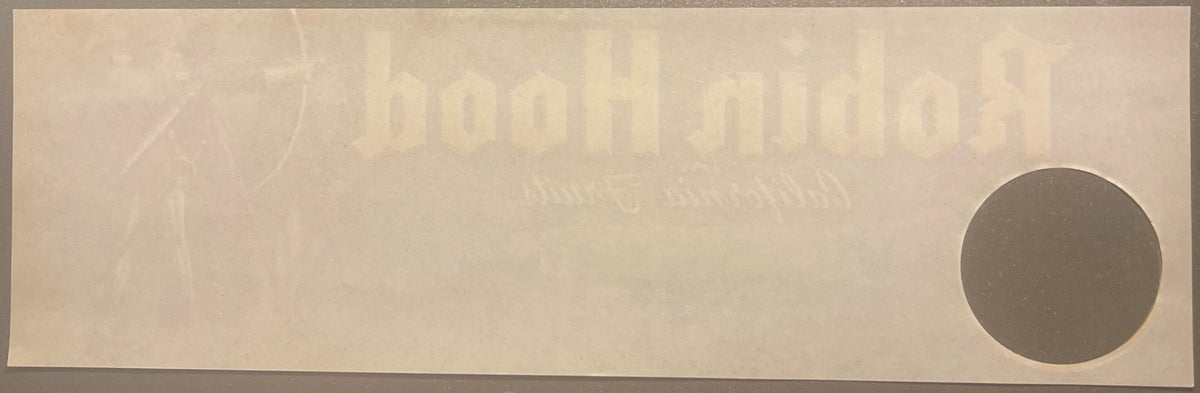
A blank chartreuse panel under the script was left for a packer's stamp. The round shape at the far left is a die-cut hole through the paper, ringed by a printed yellow crescent, made that way when the label was cut. The back is unprinted, with the front's colors showing faintly through, and the sheet carries no lithographer's imprint.

🍇 Grapes, Not Oranges: What the Shape Says

The label says only "California Fruits," and no fruit appears in the picture. Its proportions say more. Long, narrow labels of about 13 x 4 inches were made for the ends of lug boxes, the shallow crates used for table grapes and vegetables. Citrus packers used near-square labels of about 10 x 11 inches, and apple packers about 10 x 9. Dealers who handle the Ivanhoe association's labels list this Robin Hood as a grape label and date it to the 1950s.

🏭 The Ivanhoe Fruit Association

The shipper was a working packing house in the town. A 1940s photograph in the Tulare County Library's collection shows the Ivanhoe Fruit Association packing plant, known locally as "F.A.P.," and identifies it as the precursor to Klink's Citrus in Ivanhoe. Associations like it let growers pool their fruit to be packed, graded and shipped under shared brands, so a small grower's crop went to market with the same bright label as everyone else's.

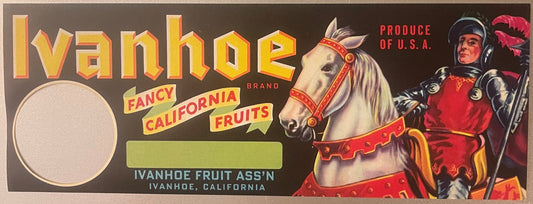
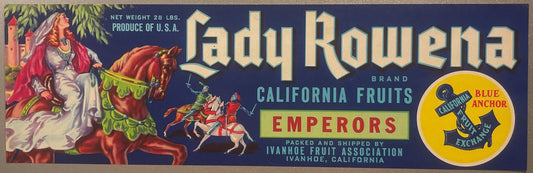
The Ivanhoe association took its brand names from the same book as its town. Besides Robin Hood, its labels included Ivanhoe himself and Lady Rowena, the Saxon heiress at the heart of Scott's romance. An older Lady Rowena design from the association, printed in the 1940s, shows her on horseback while knights battle behind her. The association's Lady Rowena label was used on its Emperor grapes. That Emperor grape label was lithographed by the Louis Roesch Company of San Francisco around the 1950s, in the same long 13 x 4 lug size as this Robin Hood.

🏘️ Ivanhoe, California: A School, a Railroad Auditor and a Book

Ivanhoe lies in north-central Tulare County near the foot of the Sierra Nevada, 364 feet above sea level. Its first school opened on April 5, 1886, and was named Ivanhoe after Scott's novel. Two years later, in 1888, the Southern Pacific Railroad named its siding there "Klink," after George Klink, an auditor for the railroad.

Locals tell a second version. Spent coal from a steam engine is called clinker, and it is said that in the 1880s the Southern Pacific dumped a good deal of its waste along that stretch of line, so the siding's name and the cinder heaps have been tied together in the town's telling ever since. In 1926 a Mrs. Boaz suggested that the town be named after its school, and Ivanhoe it became.

The railroad name never quite left. The packing house that followed the Ivanhoe Fruit Association was Klink Citrus, and its labels read "Grown and packed by Klink Citrus Assn., Ivanhoe, Tulare Co., Cal.," putting George Klink's name on crates from a town that had taken Scott's. Klink Citrus Association went on to pack lemons in Ivanhoe, including under its own Ivanhoe Brand label. The town's name still rides on citrus today, too. Over in Exeter, a group of growers formed the Exeter Citrus Association in October 1925 to pick, pack and sell their fruit together, and in 2000 it merged with the Ivanhoe Citrus Association to become the Exeter-Ivanhoe Citrus Association. That's a different outfit from the Fruit Association on this label, but it's the same Tulare County idea of neighbors pooling their crops. Ivanhoe first appeared as an unincorporated place in the 1950 census and became a census-designated place in 1980. In 2020 it counted 4,468 residents, 88.5 percent of them Hispanic or Latino.

📖 Scott, Locksley and the Robin Hood We Picture

Robin Hood is far older than Scott. "Rymes of Robyn Hood" are already mentioned in William Langland's Piers Plowman in the late 1370s, and the ballad cycle A Gest of Robyn Hode was in print in the early 1500s. Scott's Ivanhoe, published in 1819 and set in twelfth-century England, drew the outlaw into a novel of Saxons and Normans, King Richard and Prince John. And Scott did more than borrow him. The legend keeps Robin and his Merry Men in Sherwood Forest in Nottinghamshire, forever at odds with the Sheriff of Nottingham, but Ivanhoe helped turn him into a Saxon standing up to Norman lords, with King Richard himself hailing him as "King of Outlaws and prince of good fellows." That book did a lot to shape the Robin Hood most of us still picture today. Scott took his title from an old rhyme about three manors a nobleman forfeited for striking the Black Prince with a tennis racket: "Tring, Wing, and Ivanhoe."

The novel's success sent Scott's names across the map. Settlers and developers named towns, streets and neighborhoods for his books throughout the English-speaking world, and a one-room school in the San Joaquin Valley was one of them. The archer on this label belongs to that long tradition, dressed the way twentieth-century picture books dressed him: feathered cap, scalloped collar, striped hose and a longbow at full draw.

🍊 The Other Robin Hood Label

A separate Robin Hood Brand label came from Consolidated Orange Growers of Orange, California, a citrus shipper in the southern part of the state. The two share a hero and nothing else. The shipper line naming the Ivanhoe Fruit Association is what marks this one.

📦 Why Unused Labels Survive

A crate label had one job: to be glued to the end of a wooden box that went to market and was broken up or thrown away. Once printed cardboard cartons replaced wooden crates in the middle of the twentieth century, packing houses no longer needed their paper labels, and the unused stock left behind in warehouses is where labels like this one come from. Crate labels are kept as historical records in public collections, from the Smithsonian's National Museum of American History to the label collections of UC Riverside's library, Cal State Dominguez Hills and the Corona Public Library.

🔎 Size and Condition

13 x 4 inches. New old stock, never applied to a box, with bright color on the front and a clean back. The round opening at the left is part of how the label was cut.

❓ Questions People Ask

Is this the Ivanhoe Robin Hood or the Orange, California one?
Ivanhoe. The bottom line names the Ivanhoe Fruit Association of Ivanhoe, California.

What fruit was packed under it?
The sheet prints only "California Fruits." Its lug-box proportions match grape and vegetable lugs, and it is cataloged in the trade as a grape label.

Why does a California town have an English novel's name?
Its first school, opened in 1886, was named for Scott's Ivanhoe, and in 1926 the town adopted the school's name.

What was the green panel for?
A packer's stamp. It was printed blank so it could be marked in the packing house.

Shipping

🚚 Shipping & Handling

  • Shipping costs and timing are calculated at checkout.
  • Items curated and shipped directly by me include U.S. shipping at no additional cost, professionally packed to ensure safe arrival of your artifact.

Items from Vetted Pro Collectors
Shipping for items offered by vetted Pro Collectors is determined at checkout. All Pro Collector listings are reviewed to ensure fair, reasonable shipping practices.

For full details, please refer to our Shipping Policy.

Returns & Exchange

Take your time — you've got a full six months. If a piece isn't right for you, send it back the way it reached you and we're good.

In the first 30 days your money goes straight back the way you paid. After that it's store credit, so you can put it toward something you'd rather have.

Return shipping we sort out between us, case by case. I don't make this difficult.

If something arrives damaged, or it isn't what I said it was, send me a photo within 48 hours and I'll make it right.

Email info@vintageantiquesgifts.com or call 802-356-9872 — that's me answering, not a call center.

The only things I can't take back are custom or special-order pieces and gift cards.

View full details

Preserving History: Authentic Objects Across Eras

— Curated by Travis Weigel