Skip to product information
1 of 3

Vintage and Antique Gifts

Vintage 1950s Robin Hood Brand California Fruits Crate Label 🍎 Ivanhoe Fruit Association, Ivanhoe CA, Archer Art

Vintage 1950s Robin Hood Brand California Fruits Crate Label 🍎 Ivanhoe Fruit Association, Ivanhoe CA, Archer Art

Regular price 8.00 USD
Regular price Sale price 8.00 USD
Sale Sold out
Shipping calculated at checkout.
Quantity

🏹 What if the Outlaw of Sherwood Forest Once Sold Your Grapes?

There is something quietly magical about holding a piece of paper that once wrapped a wooden crate of California grapes on its way to a grocer's loading dock — a crate that may have rolled off a Southern Pacific freight car somewhere in the San Joaquin Valley before most of us were born. This Robin Hood Brand California Fruits crate label, issued by the Ivanhoe Fruit Association of Ivanhoe, California, is exactly that kind of object: a workhorse of commerce elevated by the lithographer's art into something genuinely beautiful, genuinely collectible, and — now that the wooden crate era is long closed — genuinely irreplaceable.

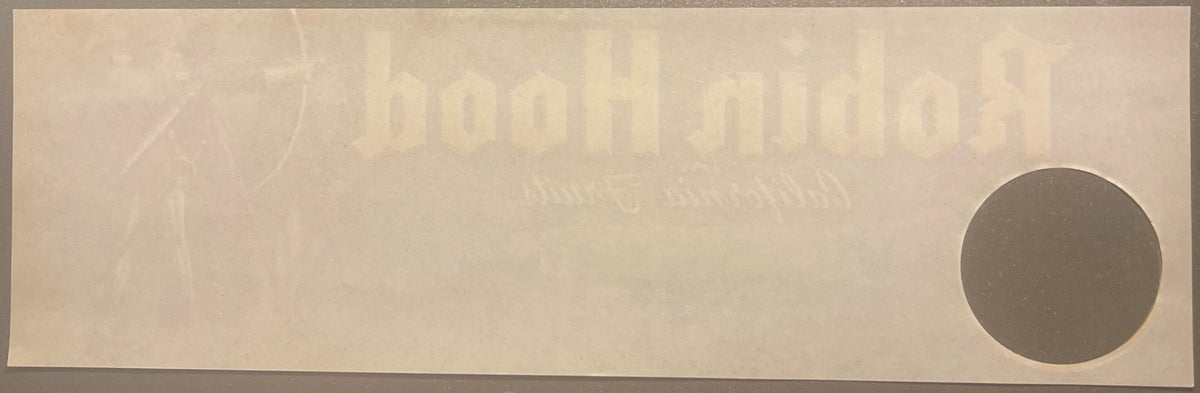
The label measures approximately 13" × 4" — the narrow "lug box" format used by California table-grape shippers — and was produced as a color lithograph in a rich palette of deep cobalt blue, bold yellow, vivid red, leafy green, warm orange, and earthy brown. The central image is pure storybook drama: Robin Hood, dressed in his iconic red tunic and green-jagged collar, striped hose, and feathered cap, stands beside the gnarled trunk of a great oak, drawing a longbow with an arrow at full tension. A quiver of arrows is slung across his back over the right shoulder, and a sheathed sword hangs at his hip. The scene pops against that deep blue background like a page torn from a illuminated manuscript, framed by lettering that reads Robin Hood Brand California Fruits, with the shipper credit — Packed and Shipped by Ivanhoe Fruit Association, Ivanhoe, California — anchoring the lower band. A blank chartreuse-green panel was left for the packer to stamp variety, grade or destination information. The round element beside it is not a printed panel at all: it is a die-cut hole punched clean through the paper, ringed by a printed yellow crescent, and nothing can be stamped in it.

This is New Old Stock (NOS) — a label that was printed for commercial use, stored, and never applied to a crate. It is an excellent, authentic example of California agricultural Americana and of the golden age of American commercial lithography.

The exact year of issue is not documented on this piece, and I won't manufacture a date I cannot prove. What the record supports is a mid-twentieth-century range — the closely related Lady Rowena grape lug label from the same Ivanhoe Fruit Association is dated to the 1950s by trade sources, and the broader wooden-crate-label era ran from the late nineteenth century into the mid-twentieth. A defensible window for this label is the 1940s–1950s, though the piece may yet reward closer dating by a specialist who can read the printer's imprint in the lower margin.


🍇 The Ivanhoe Fruit Association — A Cooperative Built on Literary Legend

The Ivanhoe Fruit Association was a grower-shipper cooperative rooted in the deciduous-fruit and table-grape culture of Tulare County's San Joaquin Valley. Like hundreds of small California agricultural cooperatives of its era, it existed to pool the resources of independent farmers, negotiate better freight rates on the railroads, maintain a shared packing house, and — critically — build brand recognition in distant markets through consistent, eye-catching label design.

What set the Ivanhoe Fruit Association apart from countless other valley cooperatives was the deliberate literary theme running through its entire brand family. The Association didn't just pick an attractive name for its fruit; it built a whole cast of characters around the town's own literary identity. Documented brand names from the cooperative include Robin Hood, Ivanhoe, and Lady Rowena — every one of them drawn directly from Sir Walter Scott's 1819 novel Ivanhoe. Lady Rowena, of course, is the Saxon noblewoman at the heart of Scott's romance; Ivanhoe is its returning Crusader hero; and Robin Hood — though a figure of English folklore long before Scott wrote a word — appears in the novel as a supporting character, the legendary yeoman Locksley, whose cameo Scott wrote with such infectious energy that it helped reshape the popular image of the outlaw for the entire nineteenth and twentieth centuries. The cooperative was, in its quiet way, packaging that mythology along with its grapes.

The Robin Hood name was not exclusive to Ivanhoe — collectors should note that a separate, unrelated firm, Consolidated Orange Growers of Orange, California, operated its own "Robin Hood Brand" citrus label between roughly 1930 and 1965, depicting a golden Robin Hood figure on a black background. The two labels are easily distinguished: only a label bearing the line Ivanhoe Fruit Association, Ivanhoe, California is the Tulare County cooperative's product. That shipper credit is the collector's authentication anchor.

Trade sources catalog the Robin Hood Brand from Ivanhoe specifically as a grape crate label, consistent with the lug-box format (roughly 13" × 4") standard for California table-grape shippers of the period. The Association's packing plant is documented in a 1940s photograph held by the Tulare County Library in Visalia, captioned as the Ivanhoe Fruit Association Packing Plant (known as "F.A.P.") — and the same record notes that the facility served as the precursor to Klink Citrus Association, the Sunkist-affiliated lemon shipper whose own "Ivanhoe Brand" lemon labels are dated to the 1925–1950 period. So the arc of this cooperative is traceable, even if its precise founding and closing dates have not surfaced in available records: a mid-twentieth-century deciduous-fruit and grape operation whose packing infrastructure carried forward into a citrus cooperative, both of them rooted in the same small Tulare County town.

The Association's related Lady Rowena emperor-grapes lug box label is documented as printed by the Louis Roesch Company of San Francisco — one of the great West Coast commercial lithographers of the era — making Roesch a plausible (though as-yet unconfirmed) printer for the Robin Hood label as well. If you are cataloging this piece for a collection or archive, the lower margin of the label itself is the place to look: that question has now been settled the other way. Every margin of this sheet — bottom-left, bottom-right, the top band, the extreme right edge and the whole lower margin — was cropped and read at 3x to 8x, and there is no printer imprint on this label at all. The only candidate mark near the right edge resolves at 8x to painted foliage rather than type, and the reverse is unprinted. No lithographer is named here, and none should be guessed. That tiny imprint, where one exists, is the printer identification on virtually all California crate labels of this period.


🌾 Ivanhoe, California — The Town That Named Itself After a Novel

The town behind this label has a provenance story almost as good as the label itself. Ivanhoe is a census-designated place in Tulare County, California, sitting in the broad San Joaquin Valley at an elevation of 362 feet, at approximately 36°23'N, 119°13'W — deep in the agricultural heartland that produces a significant share of the nation's table grapes, citrus, and stone fruit.

Its name did not come from a town council vote or a railroad company's marketing department. Local history tells it this way: it is the town that is named after the school that is named after the book — Scott's Ivanhoe came first, then a local school took the name, and the community that grew up around the school and its railroad siding inherited the name in turn. That layered, accidental quality — a medieval English romance lending its title to a California grammar school lending its name to a San Joaquin Valley grape town — is the kind of history that makes small American places worth knowing.

Before the town had Scott's name, it had a more prosaic one tied to the railroad. Old-timers recall that the Southern Pacific, running its coal-fired steam engines through the valley in the 1880s, deposited quantities of spent coal clinkers — the waste residue of combustion — along the siding here. Those clinkers gave the original rail stop its early name: Klink Station (or Clink Station, depending on who was writing it down). The echo of that industrial past survives in the name of the cooperative that eventually succeeded the Ivanhoe Fruit Association's packing plant: Klink Citrus Association, itself a Sunkist member whose lemon labels carry that old railroad-siding name forward into the mid-twentieth century.

Ivanhoe first appeared as an unincorporated place in the 1950 U.S. Census and was formally designated a census-designated place (CDP) in the 1980 U.S. Census — a timeline that dovetails neatly with the cooperative's mid-century peak activity and the probable issue window for this label. It is a genuinely small place, the kind of agricultural community where the packing house was the economic center of gravity, where the label on the crate was the town's face to the outside world, and where the people who ran the co-op were the same people whose names appeared on the freight manifests heading east to Chicago and New York.


🏰 Robin Hood, Sir Walter Scott, and the Making of a Legend

The figure on this label — arrow drawn, jaw set, ready to loose — carries more cultural history in those few square inches than most people realize. Robin Hood as we imagine him today: the yeoman outlaw of Sherwood Forest, the friend of the poor, the enemy of corrupt sheriffs, the loyal subject of a faraway king — that fully formed image is largely a creation of the nineteenth century, and Sir Walter Scott played a defining role in crystallizing it.

Scott's Ivanhoe, published in 1819, introduced English-speaking readers to a Robin Hood who was noble, principled, and romantically medieval in precisely the way that the Victorian imagination demanded. Scott's "Locksley," as he calls the character, appears at an archery tournament and again at the siege of Torquilstone, and his portrayal was infectious. The novel sold tens of thousands of copies, was translated across Europe, and generated stage adaptations almost immediately. Collectors and literary historians generally agree that Scott's Robin Hood — calm, chivalric, loyal to King Richard the Lionheart against the scheming Prince John — became the template from which virtually every subsequent Robin Hood in print, on stage, and eventually on film descends.

The Ivanhoe Fruit Association's choice to brand its grapes with this image was not accidental marketing. The cooperative was literally named for the novel, the town was named for the novel, and the label family — Robin Hood, Ivanhoe, Lady Rowena — was a coherent literary suite. When a grocer in Cincinnati or a produce buyer in Philadelphia saw a crate stamped with the Robin Hood label from Ivanhoe, California, they were receiving, along with their grapes, a small piece of that romantic myth: California sunshine, medieval English legend, and the cooperative pride of a San Joaquin Valley farming community, all compressed into a 13" × 4" sheet of lithographed paper.

Lore passed down among crate-label collectors holds that the deliberate character-naming strategy was also practical brand protection: by building a thematic family of names around a single literary source, the cooperative made it harder for a competitor to poach one name without the others revealing the imitation. Whether that was calculated or simply the enthusiasm of a community that genuinely loved its namesake novel, the result is a label family that holds together as a coherent collector suite in a way that many single-brand labels do not.


🎨 The Art of the Crate Label — A Craft Without Modern Equal

I've been collecting these labels for years, and I still believe — as I believed the first time I held one — that the lithographer's art on a California crate label has never been fully replicated by anything that came after it. The owner's instinct here is right: the process was extraordinary.

The color lithography used to produce labels like this Robin Hood piece required skilled craftsmen to draw each color separation by hand — on stone in the earlier decades, on zinc or aluminum plates later — and to align them with a precision that determined whether the finished image had that jewel-like, almost three-dimensional clarity that the best labels display. A complex label might require eight, ten, or twelve separate passes through the press, each adding one color layer to build up the final image. The deep cobalt blue ground on this label, the warm orange of the oak tree bark, the clean yellow of the lettering outlined in red, the nuanced flesh tones of Robin Hood's face — each of those is a separate stone or plate, a separate ink mix, a separate press run, aligned by eye and hand.

Museums and art institutes have long recognized the genre. Major institutions hold crate-label collections specifically because the labels represent both a documentary record of American agricultural and commercial history and a genuine artifact of commercial graphic art at its pre-digital peak. The Smithsonian, the California State Library, and numerous county historical societies have cataloged and displayed these labels as primary American ephemera — not curiosities, but documents.

And the supply is genuinely finite. The wooden-crate era ended decisively when corrugated cardboard boxes took over fruit and vegetable shipping in the mid-twentieth century. No new stock of these labels is being produced; what survives from the NOS warehouse finds and estate collections of the past few decades is all there will ever be. Collectors who have been in the hobby long enough remember when you could find stacks of them at farm auctions for a few dollars a bundle. Those days are history.


🖼️ Display Ideas

  • 🏹 Frame it as a standalone art print — the 13" × 4" horizontal format is unusual and striking in a simple black or dark walnut frame; it commands a wall the way a narrow landscape painting does, especially against a white or deep-colored wall.
  • 📚 Create a literary grouping — pair it with vintage editions of Sir Walter Scott's Ivanhoe, a Robin Hood storybook, or other medieval-themed ephemera for a reading-room or library corner that tells a coherent story.
  • 🍷 Wine room or bar cart display — the grape-shipping provenance makes this a natural fit for a wine cellar, tasting room, or kitchen bar area, alongside vintage wine labels or antique corkscrews.
  • 🌿 California agricultural history gallery — collectors of San Joaquin Valley or Tulare County history will recognize the Ivanhoe Fruit Association name; displayed alongside other valley crate labels it becomes part of a documentary collection of regional farming heritage.
  • 🎯 Archery or medieval enthusiast's den — for anyone who shoots traditional bows, practices historical martial arts, or simply loves the Robin Hood legend in any of its forms, this is a piece of genuine vintage Americana that speaks directly to that passion.
  • 🏡 Farmhouse or cottage kitchen gallery wall — grouped with other vintage fruit and vegetable labels in mismatched frames, it contributes to the layered, lived-in look that no reproduction print can replicate, because no reproduction carries the same history.

🎁 Who Collects These

Crate-label collectors are a passionate and knowledgeable community, and the Robin Hood Brand from Ivanhoe draws from several overlapping circles. California agricultural ephemera collectors seek out Tulare County and San Joaquin Valley labels specifically, tracing the rise and fall of the cooperatives that shaped the modern produce industry. Robin Hood and medieval legend enthusiasts are drawn to the character's specific visual iconography here — the longbow at full draw is one of the most dynamically composed figures in the California crate-label canon. Literary history collectors appreciate the Scott connection and the unusually coherent brand family (Robin Hood, Ivanhoe, Lady Rowena) that makes this cooperative's output a collectible suite rather than isolated pieces.

Beyond the specialist community, these labels have found a broad audience among interior designers and home decorators who want authentic vintage color — the specific cobalt-and-gold palette of this piece is genuinely difficult to source in reproduction — and among historians of American commercial graphic art who recognize the California crate label as one of the few surviving windows into pre-digital mass-market lithography at its most accomplished. Museums have their galleries; collectors have their walls. The difference is that a collector gets to live with it.


❓ Frequently Asked Questions

Q: Is this an original label or a reproduction?
A: This is an original vintage label — New Old Stock (NOS), meaning it was printed for commercial use, held in storage, and never applied to a crate. It is not a reproduction, reprint, or digital facsimile. The printing process, the paper stock, and the label's own text (including REG. U.S. PAT. OFF.) are consistent with genuine mid-twentieth-century California commercial lithography.

Q: What fruit was this label used on? The name says "California Fruits" — was it citrus or grapes?
A: Despite the general "California Fruits" wording, trade sources catalog the Robin Hood Brand from Ivanhoe specifically as a grape crate label. The 13" × 4" lug-box format is the standard narrow format used by California table-grape shippers, not the larger square format typical of citrus or apple crates. The companion Lady Rowena label from the same cooperative is documented as an emperor-grapes lug label in the same format.

Q: Can you tell me the exact year this was made?
A: A confirmed manufacture year is not documented for this specific label, and I won't invent one. The weight of available evidence — the dating of the related Lady Rowena label, the cooperative's documented mid-century activity, and the technical characteristics of the printing — supports a mid-twentieth-century issue, with the 1940s–1950s as the most defensible estimate. A specialist who can read the printer's imprint in the lower margin of the label may be able to narrow that window further.

Q: How does this Robin Hood label relate to other "Robin Hood Brand" labels I've seen?
A: The Robin Hood name was used by at least two entirely separate California shippers. The label you are looking at — from the Ivanhoe Fruit Association, Ivanhoe, California — is a Tulare County grape cooperative's product, and its Robin Hood imagery is set against a deep blue background with the cooperative's full name. A different, unrelated "Robin Hood Brand" was issued by Consolidated Orange Growers of Orange, California, for citrus, depicting a gold Robin Hood on a black background. The shipper credit line is the definitive way to identify which label you have.

Q: Who printed this label, and does the printer affect its value?
A: The Association's related Lady Rowena label was printed by the Louis Roesch Company of San Francisco, one of the major West Coast commercial lithographers of the era, making Roesch a plausible printer for this label as well — but that attribution is not confirmed for this specific piece. To identify the printer definitively, examine the lower margin of the label for a small printed credit. Among serious collectors, confirmed attribution to a major lithographer like Roesch, Schmidt, or Stecher-Traung does add historical interest and is worth documenting if the imprint is legible.

Q: Is this label connected to the town of Ivanhoe, or just named after it?
A: It is genuinely connected. The Ivanhoe Fruit Association was a real Tulare County cooperative physically located in Ivanhoe, California, and the town itself was named — by way of a local school — after Sir Walter Scott's novel Ivanhoe. The Robin Hood brand name is part of a deliberate literary theme the cooperative maintained across its entire label family: Robin Hood, Ivanhoe, and Lady Rowena are all characters from Scott's novel. The label's origin, the town's name, the cooperative's brand strategy, and the figure on the label all trace back to the same 1819 book.

Q: Is this the kind of piece that belongs in a collection or a frame on the wall?
A: Both — and that's the honest answer. Serious collectors do keep these flat in archival sleeves as part of documented regional or thematic collections. But the 13" × 4" horizontal format, the vivid cobalt-and-gold palette, and the dynamic Robin Hood figure make this one genuinely compelling as framed wall art. Museums have recognized the genre for exactly this reason: these labels were made with the full skill of the commercial lithographer's craft, and they hold up on a wall the way a fine print does. The difference between this and a reproduction is that every detail you see was put there by a craftsman's hand, layer by layer, in a process that no longer exists.

🏹 What the Sheet Actually Prints — and What It Does Not

  • Robin Hood in large yellow dimensional display lettering outlined in red-orange, with BRAND set small in dark capitals beneath
  • California Fruits in yellow script — this is the whole of the printed product line
  • REG. U. S. PAT. OFF., set with spaced periods directly beneath the ood of Robin Hood
  • PRODUCE / OF / U.S.A. in three stacked lines at the upper left
  • PACKED AND SHIPPED BY / IVANHOE FRUIT ASSOCIATION / IVANHOE, CALIFORNIA

No specific fruit is printed anywhere on this label, and no fruit of any kind appears in the artwork. The sheet says California Fruits and stops there. Trade sources catalogue the Ivanhoe Robin Hood brand as a grape label, which is consistent with the long narrow 13" × 4" lug format — but that is a trade-record reading, not something printed on the paper, and it is offered here as exactly that.

Two physical notes. The round element at the left is a die-cut hole through the sheet, ringed by a printed yellow crescent — the table surface is visible through it in both the front and reverse frames. It is a manufacture feature, not damage, and nothing was ever stamped in it. And there is no lithographer's imprint anywhere on this label; every margin was cropped and read.

Shipping

🚚 Shipping & Handling

  • Shipping costs and timing are calculated at checkout.
  • Items curated and shipped directly by me include U.S. shipping at no additional cost, professionally packed to ensure safe arrival of your artifact.

Items from Vetted Pro Collectors
Shipping for items offered by vetted Pro Collectors is determined at checkout. All Pro Collector listings are reviewed to ensure fair, reasonable shipping practices.

For full details, please refer to our Shipping Policy.

Returns & Exchange

Take your time — you've got a full six months. If a piece isn't right for you, send it back the way it reached you and we're good.

In the first 30 days your money goes straight back the way you paid. After that it's store credit, so you can put it toward something you'd rather have.

Return shipping we sort out between us, case by case. I don't make this difficult.

If something arrives damaged, or it isn't what I said it was, send me a photo within 48 hours and I'll make it right.

Email info@vintageantiquesgifts.com or call 802-356-9872 — that's me answering, not a call center.

The only things I can't take back are custom or special-order pieces and gift cards.

View full details