Skip to product information
1 of 3

Vintage and Antique Gifts

Antique 1920s Gold Cup Embossed Coffee Label ☕👑 Iowa Vacuum Pack

Antique 1920s Gold Cup Embossed Coffee Label ☕👑 Iowa Vacuum Pack

Regular price 5.50 USD
Regular price Sale price 5.50 USD
Sale Sold out
Shipping calculated at checkout.
Quantity

Gold Cup Coffee: a Burlington Roaster's Label, and the Iowa Grocery Story That Ends at Aldi ☕👑

Before there was a single Aldi in America, there were two rival coffee roasters in Burlington, Iowa. One was John Blaul's Sons Co., the German immigrant's wholesale house that roasted and packed the Gold Cup Vacuum Pack Coffee this label was printed for. The other was its competitor, the Benner Tea Company. In 1954 Benner bought Blaul's. In 1976 Benner's owner, Charles Fitzmorris, sold his 24-store chain to the German grocer Aldi, and in late March of that year the first Aldi in the United States opened in Iowa City. This embossed gold label, unused, is a piece of the older Burlington house.

What Is on the Label

The label is die-cut in the outline of a coffee cup sitting on its saucer, handle to the right, and measures 3 1/4" x 3". It is printed on metallic gold paper and embossed, so the lettering and the cup stand up off the surface and catch the light.

GOLD CUP runs across the rim in outlined brown capitals, with VACUUM PACK in gold beneath it. Across the bowl of the cup, a big outlined script spells Coffee. Fine radiating lines shade the sides of the cup and the saucer. A black panel along the base carries the particulars: 1 LB. on the left, NET WEIGHT on the right, and then ROASTED AND PACKED BY / JOHN BLAUL'S SONS CO. / BURLINGTON, IOWA — CEDAR RAPIDS, IOWA.

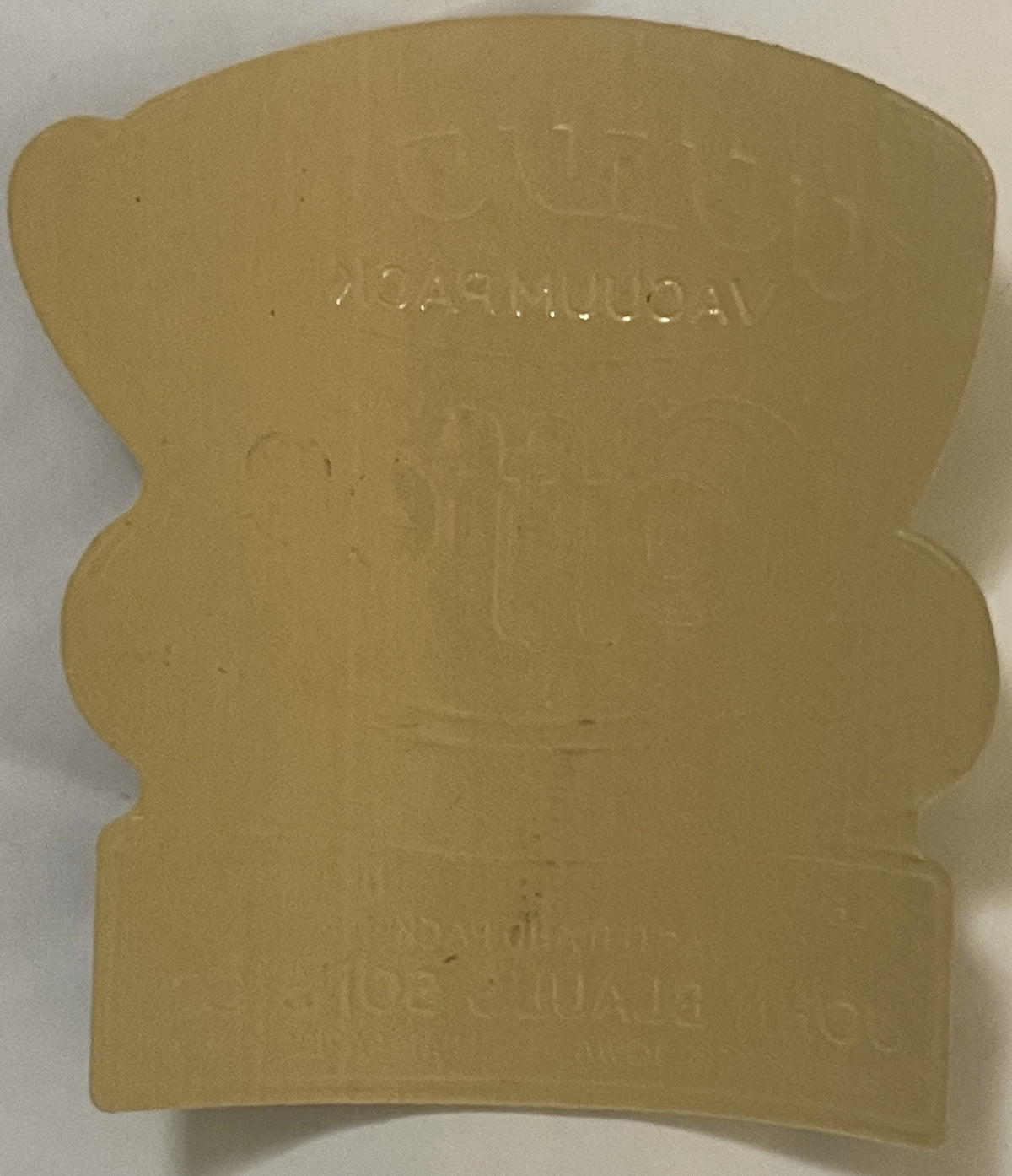
Turn it over and the back is plain cream-gold paper with the embossing pressed through in reverse, so GOLD CUP, VACUUM PACK, the Coffee script and the company name can all be read backward in the paper. It was never applied to a package.

John Blaul: From Machinist to Wholesale Grocer

John Blaul was born in Germany on December 18, 1826, in Hesse-Darmstadt near the old city of Worms. He trained as a machinist, emigrated to the United States in 1850, spent several years in the East, and then came west to Burlington, where he worked his trade for two years. In 1856 he opened a small retail grocery. In 1874 he went wholesale, and by 1879 the house was doing about $250,000 a year, selling principally in Iowa, Illinois and Missouri. He also served as treasurer of the city's Mutual Aid Association.

A county history published in 1888 described his rise from small retail grocer to the proprietor of one of the most important wholesale houses, and called his credit "gilt edged." John Blaul died in 1885, and his four sons, all of whom had joined the business, took it over.

John Blaul's Sons Co.: Roasters, Spice Grinders, Canners

John Blaul's Sons was a well-known Burlington wholesale grocery house. In 1892 the family began its landmark building in downtown Burlington, a Romanesque Revival warehouse with stone on the ground floor, brick above and a corner turret under a conical roof. Of all the buildings in what is now Burlington's wholesale historic district, it is the one not built in a plain utilitarian form. The firm incorporated in 1903 and described itself as wholesale grocers, manufacturers, coffee roasters, spice grinders and canners. By 1915 it employed 150 people and sent 18 traveling salesmen out across the territory, and it had put up a second Blaul building in downtown Cedar Rapids — which is why this label names both cities.

Gold Cup was one of several Blaul house brands. Surviving goods carry others: B.B.B.B. on coffee bins, spice labels and tobacco tins, Liner on catsup bottles and tea bins, and Plantation on coffee pails.

Vacuum Pack: the Idea That Changed Coffee

Roasted coffee goes stale fast once air reaches it. In 1898 Edward Norton of New York was granted a patent on a vacuum process for canning foods, and in 1900 Hills Bros. of San Francisco became the first to pack roast coffee in vacuum-sealed cans, under the Norton patents. Taking the air out kept the coffee fresh far longer. "Vacuum Pack" became a selling line in its own right, and regional houses like Blaul's printed it right on the label, as this one does.

1 LB. NET WEIGHT: the Line the Law Asked For

The small print in the black panel is history too. On March 3, 1913, President William Howard Taft signed the Gould Net Weight Amendment to the 1906 Pure Food and Drug Act. Sponsored by Representative Samuel W. Gould of Maine, it required packaged foods to be plainly marked on the outside with the quantity of their contents, by weight, measure or count. Federal inspectors had found short-weighted and under-filled packages to be a bigger problem than adulterated food, and the amendment is often counted as the beginning of mandatory food labeling in America. "1 LB. NET WEIGHT" on a coffee label is that law at work.

Burlington, Iowa: River Town, Railroad Town, German Town

Burlington was settled in 1833 as Flint Hills, just after the Black Hawk War, and renamed in 1834 for Burlington, Vermont. It had the only good steamboat landing on its stretch of the Mississippi, served as the capital of Wisconsin Territory from 1837 to 1838 and of the new Iowa Territory from 1838 to 1840, and grew into a rail hub on the Chicago, Burlington and Quincy line. Those tracks still cut through the Manufacturing and Wholesale Historic District, the brick warehouse quarter where Blaul's building stands; the district went on the National Register of Historic Places in 2012, and the Blaul building has been reborn as the Blaul Lofts apartments.

German immigrants like John Blaul shaped the town, and Burlington's best-known piece of local lore is their handiwork. Snake Alley, built in 1894 to climb a hillside too steep for a straight road between the residential heights and the manufacturing streets below, was the work of three German immigrants: architect Charles Starker, city engineer William Steyh and paving contractor George Kriechbaum. The story goes that its five half-curves and two quarter-curves were modeled on the winding vineyard paths of France and Germany. Robert Ripley later put it in his Believe It or Not! column as "The Crookedest Street in the World," and it joined the National Register in 1974.

What Came After: Benner Tea, and Aldi's First American Store

Blaul's Burlington competitor had coffee roots of its own. In 1899 Arthur J. Benner, a Burlington man who had worked fifteen years for a dry goods house, bought the Latona Coffee and Spice Mills and reorganized it as the Home Tea Company. It incorporated as the Benner Tea Company in 1908, ran its own roasting plant, and by 1915 had branches in Keokuk, Ottumwa, Waterloo and Cedar Rapids. By 1925 it operated six Benner Tea stores and 19 Benteco Kash Stores.

The grocery trade was changing around both houses. Chain stores such as Safeway, Kroger and National Tea were using cheap coffee to attract shoppers and break the hold of local stores on food sales. Blaul's carried on in its turreted Burlington building until 1954, when Benner Tea bought its old competitor and expanded its own wholesale grocery line with it. In 1964 another long-time Burlington wholesaler, Lagomarcino-Grupe Company, merged in as well.

Then came the turn nobody in 1856 could have imagined. Charles Fitzmorris, who had taken over Benner Tea, sold the company in 1976 to the West German discount grocer Aldi, which ran it as Aldi-Benner. In late March 1976 a former Giant Food store in the Kmart Plaza in Iowa City reopened as the first Aldi in the United States. The Gold Cup label comes from the Burlington grocery world that fed into that moment, from the house Benner Tea bought on its way there.

Questions People Ask

Who made Gold Cup Vacuum Pack Coffee?

John Blaul's Sons Co. of Burlington, Iowa, a wholesale grocer and coffee roaster that also operated in Cedar Rapids. The label says it plainly: "Roasted and packed by John Blaul's Sons Co."

Is John Blaul's Sons connected to Aldi?

Indirectly. The Benner Tea Company bought Blaul's in 1954, and Benner Tea is the Burlington company Aldi acquired in 1976 to open its first American stores.

Is the label used?

No. The back is clean paper showing only the reverse of the embossing, with nothing to suggest it was ever applied to a package.

How big is it?

3 1/4" x 3", die-cut to the shape of a cup and saucer.

What did "vacuum pack" mean on coffee?

The air was drawn out of the sealed package so the roasted coffee stayed fresh until opened, a method Hills Bros. first applied to coffee in 1900.

How would you display it?

Matted and framed on its own it reads like a little gold trophy; it also sits well in a coffee bar, a kitchen, an Iowa or Burlington collection, or among old tins, grinders and grocery advertising.

Shipping

🚚 Shipping & Handling

  • Shipping costs and timing are calculated at checkout.
  • Items curated and shipped directly by me include U.S. shipping at no additional cost, professionally packed to ensure safe arrival of your artifact.

Items from Vetted Pro Collectors
Shipping for items offered by vetted Pro Collectors is determined at checkout. All Pro Collector listings are reviewed to ensure fair, reasonable shipping practices.

For full details, please refer to our Shipping Policy.

Returns & Exchange

Take your time — you've got a full six months. If a piece isn't right for you, send it back the way it reached you and we're good.

In the first 30 days your money goes straight back the way you paid. After that it's store credit, so you can put it toward something you'd rather have.

Return shipping we sort out between us, case by case. I don't make this difficult.

If something arrives damaged, or it isn't what I said it was, send me a photo within 48 hours and I'll make it right.

Email info@vintageantiquesgifts.com or call 802-356-9872 — that's me answering, not a call center.

The only things I can't take back are custom or special-order pieces and gift cards.

View full details