
Skip to product information
1 of 6

Vintage and Antique Gifts

Vintage 1997 Coca‑Cola Calendar NOS 📅 | Factory Sealed Americana Photography

Vintage 1997 Coca‑Cola Calendar NOS 📅 | Factory Sealed Americana Photography

Regular price $12.00 USD
Regular price Sale price $12.00 USD
Sale Sold out
Shipping calculated at checkout.

🚚 Free US Shipping — ships within one business day. International shipping calculated at checkout.

Quantity

Remember the 1997 Coca-Cola Calendar? 📅 Vintage Factory Sealed Americana Photography

Size: 10 1/2" x 8"

Vintage 1997 Coca‑Cola Calendar NOS 📅

Long before his diner paintings entered the Whitney Museum of American Art, John Baeder was a New York advertising man quietly collecting old postcards of the American roadside — tourist inns, chicken-dinner stands, coffee shops with a Coca-Cola sign over the door. The Coca-Cola Company turned twelve of his postcards into this wall calendar for 1997, the Travel Refreshed Collection™. This one never made it to a kitchen nail: it is new old stock, still sealed in its factory shrink wrap.

What You Are Getting

  • Coca-Cola Travel Refreshed Collection™ wall calendar, printed "1997 Calendar" on the cover
  • Cover line: "Compiled from the Postcard Collection of John Baeder"
  • Black cover, red wire spiral binding, clear plastic hanger tab
  • Twelve monthly pictures on printed paper, each a sepia reproduction of a vintage roadside postcard carrying Coca-Cola signage
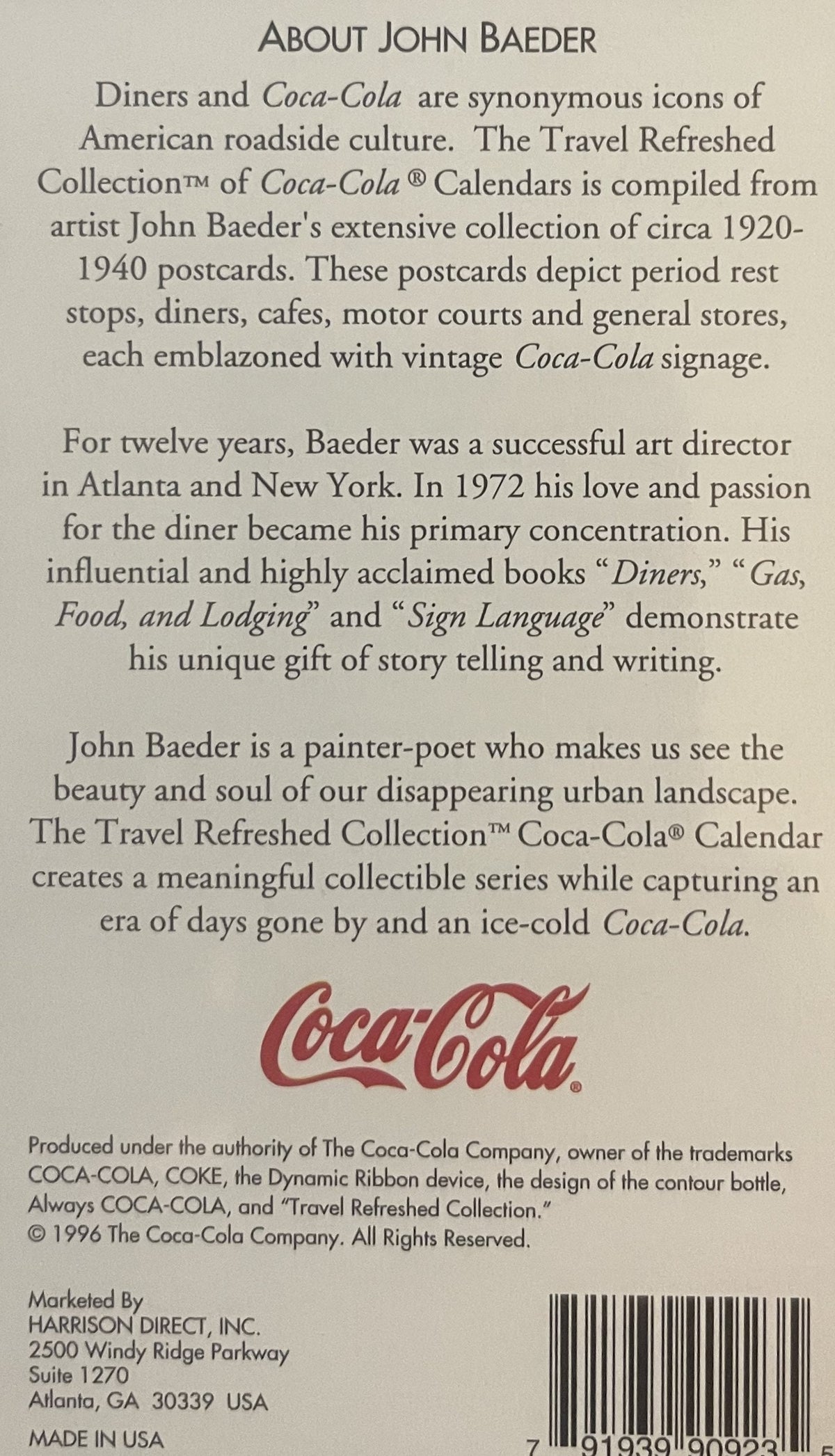
  • Back cover: thumbnails of all twelve months and an "About John Baeder" essay
  • Printed "© 1996 The Coca-Cola Company"; marketed by Harrison Direct, Inc., 2500 Windy Ridge Parkway, Atlanta, Georgia; marked Made in USA
  • Condition: new old stock, factory sealed and unopened

The Cover: Chicken Dinner, Steak Dinner, Drink Coca-Cola

The cover postcard is a low-slung roadside eatery on a gravel lot. A long sign reading CHICKEN DINNER sits over the left wing, STEAK DINNER over the right, and between them a big Drink Coca-Cola billboard shows a smiling woman with a bottle beside a man in a dark suit. Striped canvas awnings shade every window, a string of bare light bulbs runs across the sky, and a little hand-lettered Milk Shakes sign hangs under a window. It is the whole promise of the two-lane highway in one picture: a hot meal, a cold Coke, and you are back on the road.

Twelve Months on the Old Road

The back cover previews the year. January is a white stucco building lettered TOURISTS WELCOME, ALPINE INN and DANCING. February is a small-town main street lined with parked sedans. April is a big frame house with Coca-Cola signs at street level. In May three women in white uniforms stand at the door of a tiny restaurant. June is an open-sided stand under a Coca-Cola sign in a wide dirt lot. July is Joyce's, a white stand selling souvenirs. August wears a windmill on its roof. September is a long dining-car diner. October's stand promises WE SERVE GOOD COFFEE and points travelers to the lavatory. November is Lyle's Coffee Shops, with the painted slogan "Let Us Solve Your Eating Problems" stacked above a giant Drink Coca-Cola sign and an old car at the curb. December closes the year with a white clapboard house and a Coke sign out by the road.

The Man Who Kept the Postcards: John Baeder

John Baeder was born in South Bend, Indiana, on December 24, 1938, and grew up in Atlanta, Georgia. As an art student at Auburn University he drove the back roads between Alabama and his family in Atlanta, and the diners, gas stations and motels along the way stuck with him for life.

From 1960 he worked as an advertising art director, first in Atlanta and then in New York, where his agency work included campaigns for Coca-Cola Company brands such as Fanta, Sprite and Tab — which makes this calendar a homecoming of sorts. In the late sixties he began buying old postcards of roadside America as reference for his own painting. In February 1972 the gallerist Ivan Karp walked into his studio and offered him a solo show at OK Harris Gallery; Baeder quit advertising and painted full time from then on. He moved to Nashville, Tennessee, in 1980.

His books Diners (1978), Gas, Food, and Lodging and Sign Language (1996) made him the painter most associated with the American diner, and his work hangs in the Whitney, the Cooper-Hewitt, the High Museum of Art in Atlanta and the Yale University Art Gallery. He has pushed back on the idea that photorealism is copying: "People who are naive think I take a photograph and paint it." The postcards were his library of places, and the calendar's own back cover calls him "a painter-poet."

How the Diner Was Born

The diner started as a horse and a wagon. In 1872 Walter Scott, a former newspaper peddler in Providence, Rhode Island, loaded food into a small freight wagon and sold late-night meals to shift workers after the city's restaurants closed at 8 p.m. In 1883 Ruel B. Jones, who had quit the Providence police, had the first purpose-built lunch cart made. A Worcester, Massachusetts, wagon owner named T.H. Buckley patented lunch-car designs and found building them paid better than running them, and the Worcester Lunch Car and Carriage Manufacturing Company, formed in 1906, turned Worcester into the capital of the trade.

The Legend of the Railroad-Car Diner

The story goes — and plenty of diner regulars still tell it — that America's diners were retired railroad dining cars dragged off the tracks and set up by the highway. The legend has it mostly backwards. Diners were built new, in factories, and styled after railroad dining cars on purpose: around 1905 the builder Patrick J. Tierney borrowed the railroad's own word, "diner," for his lunch cars, and the name stuck to the whole trade. September's long, windowed car on this calendar is exactly the look that keeps the legend alive.

Coca-Cola and the Roadside Sign

Every stop in these twelve pictures carries a Coca-Cola sign, and that was no accident. In 1894 a Coca-Cola syrup salesman named James Couden paid to paint an advertisement across the side of Young Brothers Pharmacy in Cartersville, Georgia, facing the train depot where thirsty passengers stepped off. The Coca-Cola Company has authenticated it as the first painted Coca-Cola wall sign. The company's slogans kept chasing the traveler: "Around the Corner from Everywhere" in 1927, "The Pause that Refreshes" in 1929, and "Along the Highway to Anywhere" in 1949. The Travel Refreshed name on this calendar belongs to that same line of thinking.

The Penny Postcard and the Road That Changed

For the owner of a tourist court or a chicken-dinner stand, the postcard was the advertising budget. Cards like these typically sold for a penny or were simply given away at the counter. Curt Teich, a German-born printer who came to America in 1895, became the most prolific producer of American travel postcards from his Chicago firm, introduced his bright linen-textured cards in 1931 and published some 45,000 linen subjects in two decades. The back of this calendar dates Baeder's cards circa 1920–1940.

Then the road changed. The Federal-Aid Highway Act of 1956 began the Interstate system, and the new highways carried traffic around the small towns and two-lane routes that places like these depended on. Many of the stands, courts and coffee shops on old postcards are long gone. Baeder's legacy is that he saw it happening, kept the cards, and painted the survivors — and this calendar put a year of that record on kitchen walls in 1997.

Questions People Ask

What year is this Coca-Cola calendar?
The cover is printed "1997 Calendar," and the back carries a © 1996 The Coca-Cola Company line.

Are the pictures John Baeder's photographs?
No. They are reproductions of vintage postcards from his personal collection, which the back cover dates circa 1920–1940. Baeder is the painter and collector who assembled them.

Who produced it?
It was produced under the authority of The Coca-Cola Company and marketed by Harrison Direct, Inc. of Atlanta, Georgia.

Has it been opened?
No. The shrink wrap is the original factory seal, unbroken.

Could the 1997 grid be used again?
Yes — 1997 began on a Wednesday and was not a leap year, so its dates line up with 2025 and again with 2031.

Who is it for?
Coca-Cola collectors, diner and roadside Americana fans, admirers of John Baeder's paintings, postcard collectors, and anyone who remembers stopping for a chicken dinner on a two-lane road.

Shipping

🚚 Shipping & Handling

  • Shipping costs and timing are calculated at checkout.
  • Items curated and shipped directly by me include U.S. shipping at no additional cost, professionally packed to ensure safe arrival of your artifact.

Items from Vetted Pro Collectors
Shipping for items offered by vetted Pro Collectors is determined at checkout. All Pro Collector listings are reviewed to ensure fair, reasonable shipping practices.

For full details, please refer to our Shipping Policy.

Returns & Exchange

Take your time — you've got a full six months. If a piece isn't right for you, send it back the way it reached you and we're good.

In the first 30 days your money goes straight back the way you paid. After that it's store credit, so you can put it toward something you'd rather have.

Return shipping we sort out between us, case by case. I don't make this difficult.

If something arrives damaged, or it isn't what I said it was, send me a photo within 48 hours and I'll make it right.

Email info@vintageantiquesgifts.com or call 802-356-9872 — that's me answering, not a call center.

The only things I can't take back are custom or special-order pieces and gift cards.

View full details

Preserving History: Authentic Objects Across Eras

— Curated by Travis Weigel