Skip to product information
1 of 4

Vintage and Antique Gifts

Vintage Flood's Ointment Tin 🏥 NOS 1950s Beggs, Oklahoma Medicine Collectible — Burns, Felons & More

Vintage Flood's Ointment Tin 🏥 NOS 1950s Beggs, Oklahoma Medicine Collectible — Burns, Felons & More

Regular price 12.00 USD
Regular price Sale price 12.00 USD
Sale Sold out
Shipping calculated at checkout.
Quantity

What Did D.A. Flood of Beggs, Oklahoma Know That We've Forgotten? 🏥

There is a particular kind of stillness that comes over you when you hold something this old and this small and this utterly complete. A tin no bigger than a silver dollar, barely deep enough to hold a thumbnail's worth of salve, and yet it contains an entire world — a town's quiet ambition, a pharmacist's lifetime of work, a moment in American domestic medicine that has not existed for decades. The label is still crisp. The colors are still reading navy against cream. And right there in the center of the ailment list, between scalds and the broadly generous promise of many other uses, sits the word felons — waiting for you like a punchline only history knows. That is the hook. That is always the hook with the best pieces of Americana. They reach across seventy-odd years and make you feel something you didn't expect to feel when you picked up a half-inch tin on a Tuesday afternoon.

This is what collecting is. Not acquisition. Encounter.

---

What This Is — The Piece, Plainly and Precisely 🔍

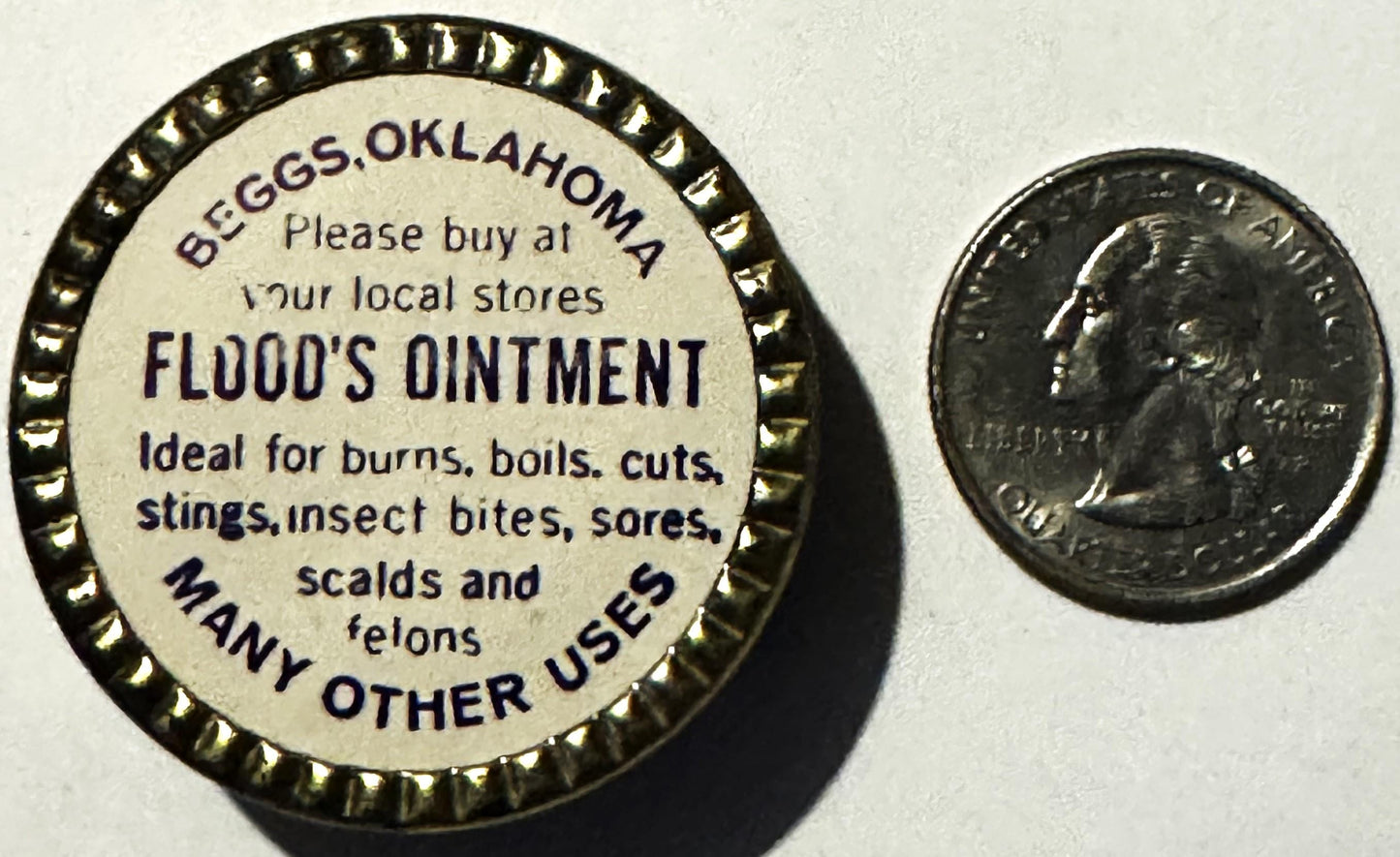
What you are looking at is a single small round tin of Flood's Ointment, produced by D.A. Flood of Beggs, Oklahoma, dating to the circa 1950s era and offered here in New Old Stock (NOS) condition — meaning it has never been used, never been opened for commerce, never sat on a drugstore shelf until some well-meaning clerk threw it in a clearance bin. It survived intact, sealed, and it found its way here. The tin itself measures 1.5 inches in diameter and just half an inch deep, with a crimp-edged lid and a serrated decorative edge running around the lid perimeter — a small flourish of craftsmanship that speaks to an era when even the packaging of a modest home remedy was expected to look like it meant something.

The label is a printed paper insert on a cream-white ground, the typography set in confident navy blue. FLOOD'S OINTMENT anchors the center in bold block lettering, and below it unfolds the ailment roster — burns, boils, cuts, stings, insect bites, sores, scalds — and then, memorably, felons. Arcing along the top of the label in matching navy caps: BEGGS, OKLAHOMA. Completing the circle along the bottom, the wonderful catchall: MANY OTHER USES. It is a masterpiece of small-town pharmaceutical self-presentation, and it is in extraordinary condition for a piece of this age. The printing is clear. The paper has not lifted. The tin is sound. This is the kind of NOS survival that makes a medical collectibles collection.


🏭 The Industry — Patent Medicine, Proprietary Ointments, and the American Home Remedy Tradition

To understand what Flood's Ointment was — not just as an object but as a cultural artifact — you need to understand the landscape it was born into. By the time D.A. Flood was compounding and tinning his ointment in Beggs, the great age of patent medicine had already crested and broken. The Pure Food and Drug Act of 1906 had forced manufacturers to disclose ingredients and had begun dismantling the most extravagant cure-all claims. But it had not ended the proprietary remedy tradition — not by a long way. What it did was force a kind of honesty onto the label. Gone were the sweeping promises of miracle cures. In their place came the specific, practical list: this for burns, this for boils, this for insect bites. The ailment roster on Flood's label is a direct product of that regulatory shift — careful, credible, local, and honest enough to survive scrutiny while remaining broad enough to move product.

Small-town druggists and pharmacists across Oklahoma, Kansas, Missouri, and the broader mid-continent corridor maintained their own proprietary formulations well into the mid-twentieth century. It was a point of community identity as much as commerce. The druggist who made his own ointment, his own cough syrup, his own liniment was a figure of genuine authority in small American towns — part chemist, part physician's adjunct, part trusted neighbor. These weren't snake-oil merchants. By the 1940s and 1950s, the era this tin represents, they were working within understood pharmaceutical traditions, compounding preparations that drew on petroleum jelly bases, botanical extracts, zinc compounds, and carbolic derivatives that had proven track records in wound care and skin ailments. The tins they put their remedies in were ordered from regional tin manufacturers — often out of Kansas City or Tulsa — and the labels were set by small print shops that served a half-dozen druggists in a given county. The whole ecosystem was local, interdependent, and deeply human.

And felons? A felon, in nineteenth and early twentieth century medical parlance, was a deep, painful infection of the fingertip — what we would today call a paronychia or whitlow in its more severe form. It involved the pulp space of the fingertip, caused significant throbbing pain, and in the pre-antibiotic era was genuinely feared by working people who needed their hands. A farmer with a felon was a farmer losing workdays. An ointment that addressed felons was speaking directly to the lives of the people reading it. D.A. Flood knew his customer. He knew what hurt them. He put it on the label.


🌾 The Town — Beggs, Oklahoma, and Why It Matters

Beggs, Oklahoma sits in Okmulgee County, in the Creek Nation territory of northeastern Oklahoma, roughly forty miles south of Tulsa. It is the kind of town that outsiders drive through without stopping and locals love with the quiet ferocity of people who understand what a place actually is. Founded in 1904, named for a Creek Nation judge named Beggs, the town rode the early Oklahoma land rush into existence and found its economic footing in a combination of agriculture, ranching, and — critically — the oil and gas industry that transformed northeastern Oklahoma in the early twentieth century.

The oil fields of Okmulgee County made Creek Nation territory one of the most economically significant patches of ground in the early American petroleum industry. Towns like Beggs, Henryetta, and Okmulgee itself were not backwaters. They were, for a particular window of time in the 1910s through the 1940s, genuinely prosperous communities with active Main Streets, professional classes, and the full range of commercial and civic institutions that prosperity produces — including local druggists who had both the clientele and the ambition to put their name on a tin.

By the 1950s, when this tin was most likely produced, Beggs had settled into the quieter rhythms of a small Oklahoma town — still there, still functioning, still proud. The oil economy had shifted. Agriculture continued. And D.A. Flood continued making his ointment, because people continued needing it, and because a small-town druggist's proprietary remedy was as much a statement of identity as it was a commercial product. That label arcing BEGGS, OKLAHOMA in navy caps around the top of this tin is not just provenance. It is a declaration. We are here. We make things. We take care of our own.

Local legend holds that D.A. Flood's ointment was a fixture in the medicine cabinets of oil field families throughout Okmulgee County for decades — that roughnecks with rope burns and rig cuts reached for the little tin the way their wives reached for it for kitchen burns and their children reached for it for bee stings. Lore passed down among Oklahoma pharmacy collectors suggests that Flood compounded the formula himself in the back of his drugstore and that the recipe was never formally patented, which is partly why it remained a regional artifact rather than expanding into wider distribution. Whether that story is precisely true in every detail, it carries the texture of truth — the way small-town proprietary formulas almost always stayed small on purpose, anchored to the trust of a specific community rather than the ambitions of mass production.


📜 The Label — Typography, Design, and the Semiotics of Trust

It would be easy to look at this label and see only its simplicity. Resist that impulse. What looks simple is in fact precisely calibrated. The cream ground reads as clean, pharmaceutical, professional — in the visual vocabulary of mid-century American medicine, white and cream meant sterile and trustworthy. The navy blue lettering carries authority without aggression. The bold centering of FLOOD'S OINTMENT gives the product its identity before anything else registers. And then the ailment list does something quietly sophisticated: it is specific enough to be credible and general enough to cover most of what a household medicine cabinet needed to address.

The circular layout of the label — town name arcing across the top, MANY OTHER USES arcing across the bottom — creates a complete, self-contained visual universe. You read the tin the way you read a coin: there is a front, a logic, a completeness. The serrated decorative edge on the lid adds a tactile dimension, the small corrugations of the crimp-edge giving your fingers something to register. This was designed to be handled, to be found in a drawer or on a shelf and recognized immediately. It succeeds. Seventy years later, you pick it up and know exactly what it is within three seconds.

Collectors of medical and pharmaceutical Americana will note the printed paper label affixed to the tin rather than lithographed directly onto the metal — a production choice common among small regional manufacturers who ordered plain tins in bulk and applied their own labels, keeping costs manageable while maintaining full control over their branding. These objects sit at the intersection of design history, social history, medical history, and regional identity in a way that almost nothing else does. A Flood's Ointment tin is not just a pretty object. It is a primary source document for the way ordinary American families managed health, pain, and household emergencies before the age of urgent care clinics and online pharmacies. It tells you what people feared (felons, scalds, boils — working people's injuries), what they trusted (the local druggist, the handmade remedy, the neighbor's name on the label), and how they organized their domestic lives around the medicine cabinet.

Collectors of small pharmaceutical tins are drawn to this piece immediately — the NOS condition, the crisp label, the unusual town provenance, and the memorable ailment list make it a standout in any collection of apothecary and remedy tins. Oklahoma history collectors and enthusiasts of Creek Nation and Okmulgee County heritage will recognize the significance of Beggs as a provenance and understand what this little tin represents in the commercial and social history of northeastern Oklahoma. Advertising and graphic design collectors appreciate the label's typography and layout as an example of regional mid-century commercial printing at its most honest and effective. And then there is the broad category of collectors who simply love Americana with a story — who want the objects in their homes and collections to have something to say, to open a conversation, to make a visitor stop and ask a question. This tin does all of that.

It is also, frankly, a remarkable gift option for the collector in your life who has everything — because the combination of NOS condition, unusual provenance, medical history interest, and that unforgettable vocabulary lesson on the label makes it specific and surprising in a way that generic antique gift-giving rarely achieves.


❓ Frequently Asked Questions — Flood's Ointment Tin, Beggs Oklahoma, circa 1950s

What does "NOS" mean, and does it apply here in the full sense?

NOS stands for New Old Stock — a term collectors use for vintage items that were produced and packaged in their era but never entered into retail use or were sold through to a consumer. In the full and proper sense of the term, yes, this tin qualifies. It was manufactured, labeled, and presumably stored or warehoused at some point in the distribution chain, and it has come to us with its label intact, its tin sound, and no evidence of use. NOS condition in pharmaceutical tins is particularly meaningful because these objects were made to be used — they had a functional life expectancy measured in months, not decades. When one survives unused and intact, it has beaten the odds significantly.

What exactly is a "felon" in the medical sense — and why is it on this label?

In nineteenth and early twentieth century American medical vocabulary, a felon referred specifically to a deep infection of the fingertip pulp — a painful, swollen, often throbbing abscess that formed in the closed space beneath the fingernail or in the fingertip itself. Today we would typically call this a whitlow or a deep paronychia. Before antibiotics, felons were genuinely serious: they could spread to the bone, they caused significant pain, and they were common among people who worked with their hands in agriculture, industry, and domestic life. A topical ointment claiming to address felons was speaking directly to a real and common problem for its audience. D.A. Flood knew his customers, and his customers knew what a felon was. The word has simply fallen out of common usage, which is precisely why it stops modern readers in their tracks — and why it makes this tin such a perfect little museum piece of medical language history.

Is the ointment still inside the tin?

This is genuinely one of the most common questions collectors ask about NOS pharmaceutical tins, and it is a fair one. The tin is offered as NOS — sealed and intact — which means the original contents remain as they were when the tin left production. As with any vintage pharmaceutical item of this age, the ointment inside is not represented as usable, and this tin is offered strictly as a collectible and display piece, not as a functional product. Humidity is the other major concern — significant humidity fluctuations can cause the paper label to expand and contract, eventually leading to lifting at the edges. A stable indoor environment — the same conditions that are comfortable for books and paper documents — is ideal. If you are displaying this tin on an open shelf, simply keep it away from windows with direct sun exposure and away from heat sources like radiators or vents. For long-term storage, a small archival or acid-free box provides excellent protection. The label on this tin is currently in exceptional condition and will remain so with modest, sensible care.

What makes Beggs, Oklahoma significant as a provenance for collectors?

Beggs is a small town in Okmulgee County in the Creek Nation territory of northeastern Oklahoma — a region with a layered and significant history involving Creek Nation governance, early Oklahoma statehood, and the oil industry that transformed the area in the early twentieth century. For collectors of Oklahoma Americana, Okmulgee County pieces carry particular weight because the county sits at the intersection of Native American commercial history and early petroleum industry history in ways that few American counties can match. A Beggs, Oklahoma provenance is genuinely unusual in the medical and pharmaceutical tin collecting space — this is not a product from Tulsa or Oklahoma City. It is a hyper-local, small-town artifact from a specific community with a specific history, and that specificity is exactly what serious collectors of regional Americana prize.

How does this fit into a collection of small medical antiques?

Exceptionally well — and on multiple dimensions simultaneously. For a collection focused on small pharmaceutical tins, the Flood's tin offers unusual provenance (a genuinely small and obscure Oklahoma manufacturer rather than a national brand), NOS condition, a crisp label, and that memorable ailment vocabulary that makes it an immediate conversation piece on any display shelf. For a broader medical antiques collection, it fills the mid-century domestic remedy niche — it is neither the Victorian-era patent medicine era nor the post-1960s modern pharmaceutical world, but the particular mid-century moment when small-town proprietary formulas still existed and still mattered. It pairs beautifully with apothecary bottles, pill tins, vintage medical instruments in their cases, and early prescription ephemera. It is small enough to fit anywhere and distinctive enough to anchor a grouping.

Is there any information available about D.A. Flood or the Flood's Ointment company beyond what's on the label?

D.A. Flood and Flood's Ointment represent exactly the kind of small-town proprietary manufacturer that tends to leave only the faintest traces in the documentary record — local newspaper mentions, county business directories, perhaps a line in a pharmacist's licensing registry. This is both the challenge and the appeal. The label itself is, in many ways, the primary document: it tells us the name, the town, the product, the era. Local legend holds that Flood compounded the formula personally in his Beggs drugstore and that the ointment circulated through Okmulgee County households for decades through word of mouth and community trust as much as through formal retail distribution. Whether a future researcher with access to Okmulgee County historical records will eventually piece together a fuller biography of D.A. Flood is genuinely possible — but for now, this tin is among the evidence. It is its own record. That is part of what makes preserving it matter.

Shipping

🚚 Shipping & Handling

  • Shipping costs and timing are calculated at checkout.
  • Items curated and shipped directly by me include U.S. shipping at no additional cost, professionally packed to ensure safe arrival of your artifact.

Items from Vetted Pro Collectors
Shipping for items offered by vetted Pro Collectors is determined at checkout. All Pro Collector listings are reviewed to ensure fair, reasonable shipping practices.

For full details, please refer to our Shipping Policy.

Returns & Exchange

Take your time — you've got a full six months. If a piece isn't right for you, send it back the way it reached you and we're good.

In the first 30 days your money goes straight back the way you paid. After that it's store credit, so you can put it toward something you'd rather have.

Return shipping we sort out between us, case by case. I don't make this difficult.

If something arrives damaged, or it isn't what I said it was, send me a photo within 48 hours and I'll make it right.

Email info@vintageantiquesgifts.com or call 802-356-9872 — that's me answering, not a call center.

The only things I can't take back are custom or special-order pieces and gift cards.

View full details
  • 5 stars: 14 (100%)
  • 4 stars: 0 (0%)
  • 3 stars: 0 (0%)
  • 2 stars: 0 (0%)
  • 1 star: 0 (0%)
E
Eve

Wonderful seller! The tins were in great condition and one of them is hysterical. I bought them as a gift for my wonderful pharmacist who does so much for me. I got a lovely note and 2 fabulous little stickers as a gift from this seller. The tins arrived very quickly. I will definitely buy from this seller again. I will get next year’s Christmas gift for my pharmacist here also.

R
Randy Condiff
Highly recommended!

This is a great little tin,a must have for anyone who likes these kind of things.After reading that it is ideal for felons like most of you I was thinking,WHAT?FELONS!but like most words in the English language it has more than one definition.So 🤓i Googled the definition for the word felon.This might clear up some of your queries that it is "Ideal for felons"also as usual everything was packaged properly and arrived sooner than I expected.Thanks everyone at V&A.G.(I got it right this time,in previous reviews I wrote V.A&G)😄I'm looking forward to seeing more of your stuff.

lol! I love this! I did the same thing the first time I saw them back in 2007 and it reminded me. Thanks for everything we appreciate it!

_
_***5 (97)

Thanks again..

R
Robyn

Great purchase and a nice personal touch!!

m
m***m (6819)

I thought it was going to be larger. OK

r
r***0 (57)

Very nice; ordered several items and they were well-packaged.

P
Patricia

The inclusion of “felon” in description is just funny and I had to have this tongue- in - cheek tin.
Delighted with my purchase.

k
klmward

Item matched description. Very happy with my purchase!

A
Ana

Came quickly and well-packaged. Would definitely order from them again!

E
Eve

Great seller Came quickly and I received a wonderful note. I will definitely buy from this shop again.

K
Kaitlyn

Excellent seller and awesome items! Will be back to shop again!

L
Larry

Lovely little sample tin, excellent condition. Lovely reminder of a time now past.

We are so happy you like it and hope to work with you again soon!

B
Becky

I had to have this tin, and was happy to receive it.

Thank you so much for the kind words! We really appreciate it. My dad had to take a break for a bit so I apologize for the delay in responding. We hope to work with you again in the future!

B
Bob

Excellent seller !! A pleasure to do business with !! GREAT service !!

Thank you so much! We really appreciate your business and feedback.