Skip to product information
1 of 4

Vintage and Antique Gifts

Antique Thor God of Thunder Cigar Label ⚡ Gold Embossed Litho, Heywood Strasser & Voigt NY

Antique Thor God of Thunder Cigar Label ⚡ Gold Embossed Litho, Heywood Strasser & Voigt NY

Regular price 17.00 USD
Regular price Sale price 17.00 USD
Sale Sold out
Shipping calculated at checkout.
Quantity

⚡ Ever Wonder Why a Cigar Box Needed a Norse God to Guard It?

Long before comic books and blockbuster films ever got hold of him, Thor was already doing commercial work in America — glowering out from cigar box lids in a smoky haze of gold foil, daring you not to notice. There was a time when the inside of a cigar box was as carefully art-directed as a magazine cover, when tobacco jobbers competed for a shopkeeper's eye with mythology, allegory, and enough metallic ink to make a five-cent smoke look like a coronation. This label is a survivor of that world — a small, dazzling piece of American commercial art that borrowed the god of thunder himself to sell a box of cigars.

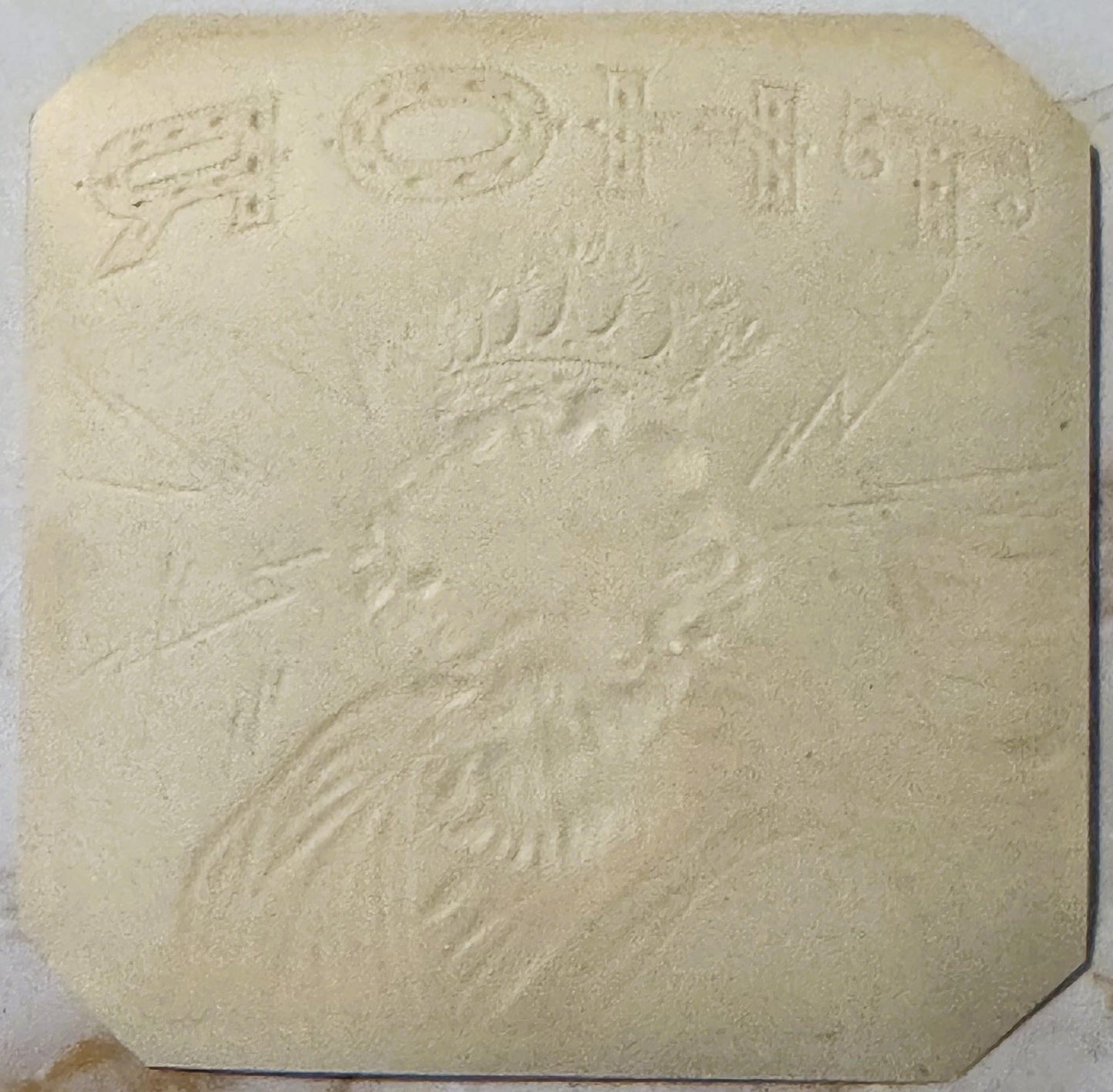
This is an original THOR cigar box label, printed by Heywood, Strasser & Voigt Litho. Co. of New York, N.Y., one of the city's most accomplished chromolithography houses of the era. It measures 4½ x 4½ inches and comes to you as new old stock — an unused label that never made it onto a box, pulled instead from the printer's own surplus and preserved ever since. The design itself is a small masterclass in what the trade could do at its peak: a bearded, blue-eyed Thor stares straight out at the viewer, crowned with a golden crown tipped in licking flames, a crimson robe swept back over one shoulder, and gold-embossed lightning bolts shattering outward across a stormy dark blue-black sky. The bold gilt lettering of "THOR" arcs above him in deep red and black, each letter outlined and dotted in raised gold, with the printer's own imprint — HEYWOOD, STRASSER & VOIGT LITHO. CO. N.Y. — set quietly along the base of the design. It is the kind of piece where the gold catches differently every time the light moves, which is exactly what these labels were built to do on a store shelf.

This particular example comes out of a small, old cache of early cigar label ephemera assembled long ago — the sort of stash a collector spends years piecing together one estate or paper show at a time, made up of genuine survivors from an age when labels like this were printed by the tens of thousands and almost none were expected to outlive the cigars inside the box.


🚬 The Golden Age of the Gilded Cigar Label

To understand why a Norse thunder god ended up staring out from a cigar box, you have to understand just how brutal the cigar business was at the turn of the last century. By the close of the 1800s, there were reportedly more than 50,000 cigar manufacturers operating across the United States — a staggering number of small brands all fighting for the same nickel in the same tobacco shop. A cigar itself couldn't be seen until the box was already open, so the label carrying the brand name became the entire sales pitch: the one surface that had to stop a buyer's eye and convince him this box, out of dozens on the counter, was the one worth his money.

The lithography houses that served this trade answered with everything they had. Chromolithography — printing in layered, hand-separated color from stone — let printers achieve a richness of tone that ordinary printing simply couldn't touch, and the best New York houses pushed it further still with metallic gold inks and raised embossing that gave a label real, tactile depth. Cigar makers of the era reached again and again for neoclassical figures, allegorical women, war heroes, royalty, and mythological gods — imagery meant to borrow a little instant grandeur and hand it to the brand. A crowned thunder god hurling lightning across a stormy sky, rendered in gold and red and flame-orange, was exactly the kind of showstopper this trade was built to produce. It told a buyer, before he'd read a single word, that this was a cigar worth reaching for.


🏙️ New York's Litho Row

Heywood, Strasser & Voigt operated out of New York City during a period when Manhattan was genuinely one of the great printing capitals of the world — a trade so concentrated that the blocks around lower Manhattan's printing district earned the old nickname "Litho Row" among the men who worked it. Dozens of competing chromolithography houses operated within a few blocks of one another, each with its own stable of stone artists, each racing to land contracts with tobacco jobbers, grocers, patent-medicine peddlers, and anyone else who needed color printed at scale. Archival collections that catalog this trade — including a major cigar label archive housed at a Delaware museum — place Heywood, Strasser & Voigt squarely among the top tier of these houses, named right alongside other major period firms like the American Lithographic Company, Heppenheimer & Maurer, Krueger & Braun, Louis E. Neuman, and George Schlegel. This was not a minor or regional print shop; it was one of the city's genuine heavyweights in an industry New York essentially dominated.

Old-timers in the printing trade used to say that a New York litho house lived and died by its stone artists — the skilled hands who could separate a single painted image into a dozen individual color plates, each one printed in careful register so the final sheet came out glowing rather than muddy. It was painstaking, highly specialized work, and the houses that mastered gold embossing on top of it — giving a flat printed sheet the shimmer and relief of hammered metal — set themselves apart from the pack. A label like this one, with its raised gilt crown and radiating bolts, represents that top tier of the craft.


🖋️ The Hands Behind the Presses

Cigar label artists of this era worked almost entirely without credit — their names never appeared on the finished sheet, no matter how elaborate the design. It was simply the custom of the trade: the lithography house's name went on the label, not the artist who painted the original figure the stone crew then separated into color. That's precisely why Thor stares out here with no signature in the corner, and it's worth knowing that isn't an oversight — it's how nearly every cigar label of the period was produced.

What we do know is what happened to this printing house once cigar work began to wind down. As the country turned toward the First World War, Heywood, Strasser & Voigt pivoted the same stone-printing skill toward government and civic work, and here the artists finally do have names attached. The firm produced Liberty Bond posters credited to the illustrator Joseph Pennell, Food Administration posters with artists like L.N.

Britton and Charles Livingston Bull, a U.S. Employment Service poster credited to Edmund M. Ashe, and a "Columbia Victorious" armistice banner credited to artist A. Buccini — all printed under the same Heywood, Strasser & Voigt imprint that appears at the base of this Thor label. It's a striking arc for one New York printing house: the same presses that gilded a thunder god onto a cigar box for a shopkeeper's counter were, within a few years, running off the patriotic posters that papered wartime America.

Institutions including the Library of Congress, the Metropolitan Museum of Art, the Detroit Institute of Arts, and Stanford's Cantor Arts Center all hold examples of this firm's later government-commissioned work today — a testament to just how far a New York cigar-label house could travel in the space of a couple of decades.


⚡ Thor Himself — Borrowed Thunder

Long before Madison Avenue, long before Marvel, Thor had already been doing this exact job for centuries — standing as the ultimate shorthand for raw, unstoppable power. In Norse mythology he is the son of Odin, the protector of gods and mortals alike, a red-bearded giant of a figure who rides a chariot pulled by goats and swings the hammer Mjölnir hard enough to summon the thunder itself. Old Norse legend held that every crack of lightning across the northern sky was Thor's hammer striking, and that his return was said to shake the very halls of Asgard. He was, without question, the loudest, most physically dominant figure in the entire Norse pantheon — which made him an obvious choice for a cigar brand that wanted its name to feel like a clap of thunder on a store shelf.

Interestingly, this particular label skips the hammer and gives Thor a flaming crown instead — a small artistic liberty that period illustrators took often, blending Norse thunder-god imagery with the visual language of a more familiar crowned king, since a monarch's crown read instantly to turn-of-the-century shoppers as a symbol of supremacy in a way a stylized hammer alone might not have. The lightning bolts radiating outward do the rest of the storytelling, tying the figure unmistakably back to his thunder-god roots even without Mjölnir in hand. Collectors of vintage tobacco ephemera have long noted how often this era reached for gods, kings, and warriors to sell what was, in the end, a rolled bundle of tobacco leaf — proof that borrowing mythology to build a brand is a trick advertising has been running for well over a century, long before "brand mythology" was ever a term anyone used on purpose.


🏛️ From Cigar Box to Museum Wall

Labels like this one were never built to last. They were glued to the inside of a cigar box lid, meant to sell the product once and then get thrown out along with the empty box — pure disposable commercial art, produced by the thousands and treated with no more ceremony than a candy wrapper. That's precisely why surviving examples in this kind of condition have become so sought after: the very thing that made them cheap and throwaway in their own time is what makes an intact one so scarce now. Major museum and archival collections — a cigar-label archive of some 85,000 pieces held at a Delaware museum among them — now preserve exactly this category of ephemera specifically because so little of it survived ordinary use.

Today, this same period of American chromolithography draws serious attention from collectors of tobacciana, advertising art, and Americana graphic design alike, precisely because it captures commercial art at its most fearless — a moment when a printing house would spare no gold ink to make a five-cent cigar look like it belonged to royalty. A label like this one sits at a genuinely fun crossroads: it's a piece of early American advertising history and a piece of enduring mythological pop culture in one small, gleaming square, which is exactly why it still stops people in their tracks well over a century after it left the press.


🖼️ Display Ideas

  • ⚡ Framed alone as a single gleaming statement piece where the gold catches the light from across the room
  • 🍷 Hung above a bar cart or in a cigar nook, playing off the tobacciana theme it was born into
  • 🎬 Grouped with comic art or modern Thor collectibles for a fun antique-meets-fandom wall
  • 🕹️ Added to a game room or den alongside other vintage advertising and poster art
  • 🚬 Anchoring a themed wall of cigar box labels and early tobacco advertising ephemera
  • 👑 Paired with other mythological or allegorical advertising figures from the same golden era of chromolithography

🎁 Who Collects These

This label draws in several different kinds of collectors at once, which is part of what makes it such a satisfying find. Tobacciana collectors chase cigar box labels specifically for the artistry — the gold embossing, the color depth, the sheer craftsmanship that went into something so briefly used. Americana and advertising-art collectors want the best surviving examples of turn-of-the-century commercial lithography, full stop, regardless of what the label was selling. Norse mythology enthusiasts and fans of Thor's long pop-culture afterlife are drawn to seeing him rendered in a completely different visual language than the one they grew up with. And ephemera collectors more broadly love a piece like this precisely because it was never meant to survive — every intact example is a small act of historical luck. It's also a natural gift for anyone who loves cigars, Norse legend, or old New York printing history, since it sits comfortably in all three worlds at once.


❓ FAQ

Is this an original antique label, or a modern reprint?

This is a genuine antique cigar label, offered as new old stock — original stock that was never used, held in reserve rather than applied to a cigar box, and never reprinted.

What size is the label?

It measures 4½ x 4½ inches (approximately 11.4 x 11.4 cm), a compact square format sized to fit inside a standard cigar box lid.

Who printed this label?

Heywood, Strasser & Voigt Litho. Co. of New York, N.Y., a well-documented top-tier New York chromolithography house whose name appears in print along the base of the design.

What cigar company originally sold "Thor" brand cigars?

The specific tobacco firm behind the Thor brand name has not surfaced in surviving trade records — a common gap for the smaller cigar brands of this era, most of which left far fewer traces than the printing houses that served them. What is well documented is the printer's own pedigree and standing in the trade.

Why does Thor have a crown of flames instead of his hammer?

Turn-of-the-century illustrators often blended Norse thunder-god imagery with the visual shorthand of a crowned king, since a crown read as instant supremacy to shoppers of the day. The radiating lightning bolts do the work of tying the figure back to his mythological thunder-god roots.

How was the gold detailing achieved?

The lettering and lightning bolts carry a raised, metallic gold embossing layered over chromolithographic color printing — a technique period New York houses used specifically to make a label catch and shift with the light.

Is this a good gift for a Thor or Norse mythology fan?

Very much so — it bridges more than a century of Thor's popularity, from a turn-of-the-century cigar shop counter to today's comics and film fandom, in a single framed piece.

Shipping

🚚 Shipping & Handling

  • Shipping costs and timing are calculated at checkout.
  • Items curated and shipped directly by me include U.S. shipping at no additional cost, professionally packed to ensure safe arrival of your artifact.

Items from Vetted Pro Collectors
Shipping for items offered by vetted Pro Collectors is determined at checkout. All Pro Collector listings are reviewed to ensure fair, reasonable shipping practices.

For full details, please refer to our Shipping Policy.

Returns & Exchange

Take your time — you've got a full six months. If a piece isn't right for you, send it back the way it reached you and we're good.

In the first 30 days your money goes straight back the way you paid. After that it's store credit, so you can put it toward something you'd rather have.

Return shipping we sort out between us, case by case. I don't make this difficult.

If something arrives damaged, or it isn't what I said it was, send me a photo within 48 hours and I'll make it right.

Email info@vintageantiquesgifts.com or call 802-356-9872 — that's me answering, not a call center.

The only things I can't take back are custom or special-order pieces and gift cards.

View full details
  • 5 stars: 1 (100%)
  • 4 stars: 0 (0%)
  • 3 stars: 0 (0%)
  • 2 stars: 0 (0%)
  • 1 star: 0 (0%)
1
1***o (3599)

Fabulous item at great price. A+ seller!