Skip to product information
1 of 5

Vintage and Antique Gifts

Antique Silver Prince Cigar Box Label Embossed Chromolithograph Heywood Strasser Voigt New Old Stock NOS circa 1910 🚬

Antique Silver Prince Cigar Box Label Embossed Chromolithograph Heywood Strasser Voigt New Old Stock NOS circa 1910 🚬

Regular price 6.00 USD
Regular price Sale price 6.00 USD
Sale Sold out
Shipping calculated at checkout.
Quantity

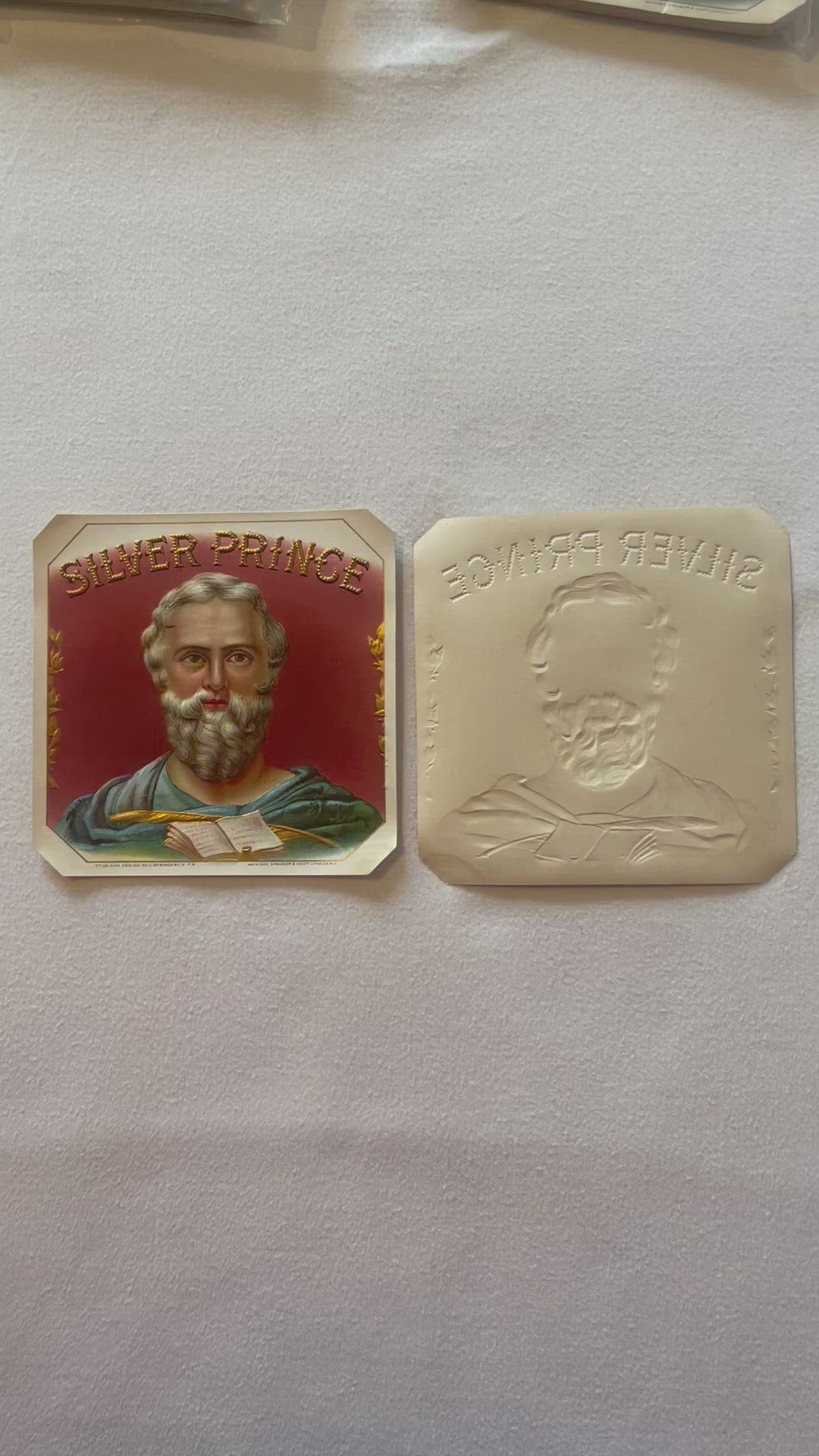
🎨 Antique Silver Prince Cigar Box Label — New Old Stock — Heywood Strasser & Voigt, New York — Embossed Stone Chromolithography — circa 1910 — 4.5 x 4.5 Inches

This is an antique Silver Prince outer cigar box label, produced by Heywood Strasser & Voigt Litho Company of New York, with the title and design registered by E.F.N. The label measures 4.5 x 4.5 inches, is die-cut to an octagonal format with clipped corners, and was lithographed during the firm's documented active window of approximately 1890 to 1919 — with this specific label dated by collectors to approximately 1910. It is a product of stone chromolithography at its most accomplished: full-color portrait printing with deep embossed metallic elements, the calling card of the great New York cigar label houses at the height of their craft. New Old Stock (NOS), never applied to a box, never placed in trade — it came out of old stock exactly as it left Heywood Strasser & Voigt's press.

🏛️ There is a presence to this label that stops you before you even know why. The central figure sits forward from a field of deep crimson, silver-haired and full-bearded, draped in a blue-green mantle that catches the chromolithographer's light the way fabric does in oil painting — layered, weighted, dimensional. Before him lies an open book, its pages rendered in careful, unreadable script. A quill rests nearby. The whole composition carries the gravity of antiquity, the kind of portrait that was meant to communicate something beyond brand identity — authority, learning, the weight of received wisdom.

🕍 Among collectors of antique cigar labels, the lore passed down through the decades holds that the figure is Moses — the Lawgiver — and the open book before him represents the Ten Commandments, its text left deliberately illegible as a matter of respect or perhaps manufacturing prudence. This is collector interpretation, not documented manufacturer intent. But it is a lore that persists, and when you hold the label and look at the figure — that white beard, that composed gaze, that posture of someone who has descended from somewhere high and formal — it is not hard to understand how the story took hold. The Silver Prince, in this reading, is not a prince of commerce but a prince of covenant. A remarkable piece of iconography to place on a cigar box, and exactly the kind of ambitious literary and cultural reference the great lithographic houses of the 1890s and 1900s traded in.

✨ The gold lettering of SILVER PRINCE arcs across the top of the label in embossed, studded block capitals that catch the light with the snap that only metallic period ink produces — not gilded flat printing, but raised and dimensional, the kind of detail you can feel beneath your fingertips. The octagonal form with its clipped corners was a prestige format in the cigar label trade of the era, a shape that communicated quality before a single color was printed, and this example executes it in full. The surrounding field carries embossed laurel-and-leaf decorative elements in warm gold, flanking the portrait on either side. The red ground is deep and saturated — the chromolithographic reds of this period, laid down stone by stone in careful registration, have a warmth and depth that modern offset printing has never quite replicated.

🏢 Heywood Strasser & Voigt occupied a particular position in the world of American commercial printing. Operating from New York City across a documented span that ran from approximately 1890 through 1919, the firm stood alongside American Lithographic Co., Heppenheimer & Maurer, and George Schlegel as one of the dominant houses serving the American cigar industry at its Victorian and Edwardian peak.

These were not job printers producing commodity work — they were lithographic studios employing skilled artists whose names rarely appeared in any record, their hands absorbed into the institutional output of the firm. Collector lore holds that the individual artists employed by houses like Heywood Strasser & Voigt were so distinctive in their technique that trained eyes can sometimes identify the same hand across different brand labels — recognizing the way a particular artist rendered beard hair, or the way a specific colorist handled the transition from shadow to highlight in a portrait.

Whether that lore is traceable to documented attributions or simply the enthusiasm of the collector community, it speaks to something real: the quality of artistry compressed into these small commercial pieces was genuinely exceptional.

🖨️ The firm's output extended well beyond cigar labels. Heywood Strasser & Voigt produced World War I poster work, examples of which survive in the collections of the Metropolitan Museum of Art and the Library of Congress — a fact that places the firm squarely in the company of the most significant commercial printers of the era. Their cigar label work, produced in the years before and during that same period, reflects the same ambition: no shortcut on color, no shortcut on embossing, no shortcut on the portrait artistry that distinguished one brand from the next on a tobacconist's shelf where competition was intense and visual impression was everything.

🔗 The firm's story has an ending that is itself a piece of American industrial history. Consolidated Lithographing Corporation ultimately absorbed Heywood Strasser & Voigt through the industry mergers that reshaped American printing in the early twentieth century — folding one of the great independent lithographic studios into a larger consolidated entity. The Silver Prince label predates that absorption. It is a piece of the firm when the firm was still itself, still independent, still producing work that bore its own name in small type across the lower margin: Heywood, Strasser & Voigt, Litho Co., N.Y. — exactly as it reads here.

📦 New Old Stock (NOS) condition. The label is clean and intact, carrying the full embossed relief and chromolithographic color the printer put into it more than a century ago. The octagonal die-cut form holds its shape. The embossed gold lettering reads crisply. The portrait glows with the warmth of period chromolithography at its best — that particular quality of color achieved by layering stone after stone in careful succession, each pass adding depth that no single printing could achieve.

🗂️ The bottom margin of the label carries two lines of fine-print text: the registration line reading Title and Design Registered by E.F.N., and the printer credit Heywood, Strasser & Voigt, Litho Co. N.Y. — the documentary record of a piece that was formally registered and properly attributed at the time of its production. These are the marks of a label that took itself seriously, produced by a house that did the same.

🌟 These labels were printed to dress the outside of a cigar box — the first thing a customer or a shopkeeper saw, before the lid was lifted, before a cigar was selected. They were the face of the brand, and the brand invested accordingly. The Silver Prince label, with its monumental portrait, its embossed gold typography, its deep crimson field and prestige octagonal format, was a declaration: that the cigars inside were worth the gravity of this image. Whatever the smoker made of the silver-haired figure before the open book — lawgiver, scholar, prince of some ancient realm — the label did its job. It made an impression. And more than a hundred years later, pulled from old stock exactly as it left the press, it is still making one.

🎭 There is something worth sitting with in the choice of imagery. The American cigar label trade of the 1890s and 1900s drew on every available well of cultural authority — Roman senators, Founding Fathers, opera heroines, Spanish grandes, classical goddesses. That a label designer and a brand registrant named only as E.F.N. chose this particular figure — ancient, bearded, draped, presiding over an open text — and named the brand the Silver Prince rather than the Golden King or the Royal something-or-other, suggests an intentional register of imagery. Silver is the color of age, of wisdom, of hair gone past its prime and arrived somewhere more considered. The prince who has become silver. The lore that places Moses at the center of this label is doing real interpretive work. Whether it was the intention of E.F.N. or not, the figure carries it.

📐 The format — 4.5 x 4.5 inches, octagonal, embossed — was a prestige specification in the cigar label world. Smaller labels served as inner labels, tucked inside the lid to greet the buyer when they opened the box. Larger, embossed, die-cut outer labels in the octagonal format were the primary brand declaration, the piece that faced forward on the shelf. At four and a half inches square with clipped corners and full embossing, the Silver Prince label occupied that prestige tier without apology.

🖼️ These pieces frame beautifully. The deep crimson ground, the embossed gold lettering, the dimensional portrait in blue-green and warm flesh tones — the color palette is rich enough to hold a wall, and the octagonal form provides a natural visual boundary that needs no additional matting to read as a finished composition. Cigar label collectors have understood this for decades; the framed label as a piece of chromolithographic art is one of the most satisfying ways to encounter what these printers actually achieved.

📅 Heywood Strasser & Voigt's active window — 1890 to 1919, with this label specifically placed at approximately 1910 — makes the Silver Prince label a document of the final flowering of American stone chromolithography before offset printing began to displace it. The old lithographic method was slow, expensive, and demanded extraordinary skill. Each color required a separate stone, carefully registered, carefully inked, carefully pressed. The embossed metallic elements required additional tooling and additional passes. A label like this one represented a significant investment in craft — and the market demanded it, because in the competitive world of late Victorian and Edwardian American tobacco, a label that looked cheap was a brand that felt cheap.

🌿 The cigar industry that produced this label was enormous by any measure. Billions of cigars were manufactured annually in the United States at the height of the era, with Pennsylvania, New York, Ohio, Florida, and New England all hosting major manufacturing centers. The label printers — Heywood Strasser & Voigt among them — served this industry with a steady output of chromolithographic work that represented some of the most ambitious commercial printing being done anywhere in the country. The surviving labels are what remain of that output, and among them the Silver Prince, with its formal portrait and its registered design, stands as a handsome example of what the New York houses were capable of.


❓ Questions Collectors Ask

What exactly is the Silver Prince cigar label, and who made it?

The Silver Prince is an outer cigar box label produced by Heywood Strasser & Voigt Litho Company of New York, one of the major American chromolithographic printing firms of the late nineteenth and early twentieth centuries. The title and design were registered by a party identified only as E.F.N. The label measures 4.5 x 4.5 inches, is die-cut to an octagonal format with clipped corners, and was produced during the firm's documented active period of approximately 1890 to 1919, with collector dating placing this specific label at approximately 1910. It was intended as an outer box label — the primary brand declaration facing forward on a tobacconist's shelf.

How do collectors date an antique cigar label to a specific era?

The primary dating method is printer attribution: when a label bears a printer's credit — as the Silver Prince does, with Heywood, Strasser & Voigt, Litho Co. N.Y. legible in the lower margin — the firm's documented operational window anchors the label to an era. Heywood Strasser & Voigt is documented as active from approximately 1890 to 1919. Secondary dating evidence includes the embossing style, the chromolithographic color palette, the die-cut format, and registration records — all consistent with the 1890s-to-1910s production window. The octagonal format with clipped corners and deep embossed metallic elements was characteristic of prestige-tier label production in that same period.

Who is the figure depicted on the Silver Prince label?

The figure is unidentified in any documented manufacturer record. Within the collector community, lore passed down through decades of label collecting holds that the central figure is Moses — the Lawgiver — and that the open book before him represents the Ten Commandments, with the text left deliberately unreadable. This is collector interpretation, not a statement of documented manufacturer intent. The imagery — white hair and beard, classical drapery, open text, quill — is consistent with iconographic depictions of ancient lawgivers and scholars from the same era of commercial lithographic portraiture.

What is New Old Stock (NOS) and why does it matter for a cigar label this old?

New Old Stock refers to items that were produced commercially and entered inventory but were never placed into actual use — in this case, a label that was never applied to a cigar box and never passed through the commerce it was printed to serve. For a chromolithographic paper label from approximately 1910, NOS condition means the embossed relief, the metallic inks, and the full chromolithographic color palette survive exactly as the printer produced them. Beyond cigar labels, the firm produced World War I poster work, examples of which are held by the Metropolitan Museum of Art and the Library of Congress. The firm was ultimately absorbed into Consolidated Lithographing Corporation through the industry mergers that reshaped American commercial printing in the early twentieth century, making Heywood Strasser & Voigt a significant feeder studio into the consolidated entity that dominated the field afterward.

How should an antique embossed cigar label like this be displayed?

Framing under UV-protective glass is the standard preservation approach for chromolithographic cigar labels. The embossed surface benefits from a frame with enough depth to avoid contact between the raised elements and the glass — a spacer mat achieves this while also visually isolating the octagonal format of the label. Direct sunlight will fade chromolithographic inks over time; indirect or artificial lighting preserves color. The 4.5 x 4.5 inch format fits standard small frame sizes and requires no trimming or alteration to present cleanly as a framed piece.

What makes the chromolithographic printing on antique cigar labels different from modern printing?

Stone chromolithography — the technique used by Heywood Strasser & Voigt — built up color through multiple successive passes, each requiring a separate limestone printing stone carefully inked and registered against the previous pass. This layering produced a depth and warmth of color that offset printing, which transfers ink in a single mechanical pass, does not replicate. The embossed elements on labels like the Silver Prince required additional tooling and pressing beyond the chromolithographic passes, adding dimensional relief to the metallic ink areas. The combination of layered color and raised embossing was both technically demanding and visually distinctive — which is why the surviving labels from the great lithographic houses remain collectible more than a century after production.

Shipping

🚚 Shipping & Handling

  • Shipping costs and timing are calculated at checkout.
  • Items curated and shipped directly by me include U.S. shipping at no additional cost, professionally packed to ensure safe arrival of your artifact.

Items from Vetted Pro Collectors
Shipping for items offered by vetted Pro Collectors is determined at checkout. All Pro Collector listings are reviewed to ensure fair, reasonable shipping practices.

For full details, please refer to our Shipping Policy.

Returns & Exchange

Take your time — you've got a full six months. If a piece isn't right for you, send it back the way it reached you and we're good.

In the first 30 days your money goes straight back the way you paid. After that it's store credit, so you can put it toward something you'd rather have.

Return shipping we sort out between us, case by case. I don't make this difficult.

If something arrives damaged, or it isn't what I said it was, send me a photo within 48 hours and I'll make it right.

Email info@vintageantiquesgifts.com or call 802-356-9872 — that's me answering, not a call center.

The only things I can't take back are custom or special-order pieces and gift cards.

View full details