Skip to product information
1 of 5

Vintage and Antique Gifts

Antique Christy Girl Cigar Label Embossed Chromolithograph Maryland Litho Co 1900s - 1920s NOS Octagonal Die-Cut 🚬

Antique Christy Girl Cigar Label Embossed Chromolithograph Maryland Litho Co 1900s - 1920s NOS Octagonal Die-Cut 🚬

Regular price 5.50 USD
Regular price Sale price 5.50 USD
Sale Sold out
Shipping calculated at checkout.
Quantity

🎨 The Christy Girl — An Antique Cigar Label from Baltimore's Golden Age of Lithography

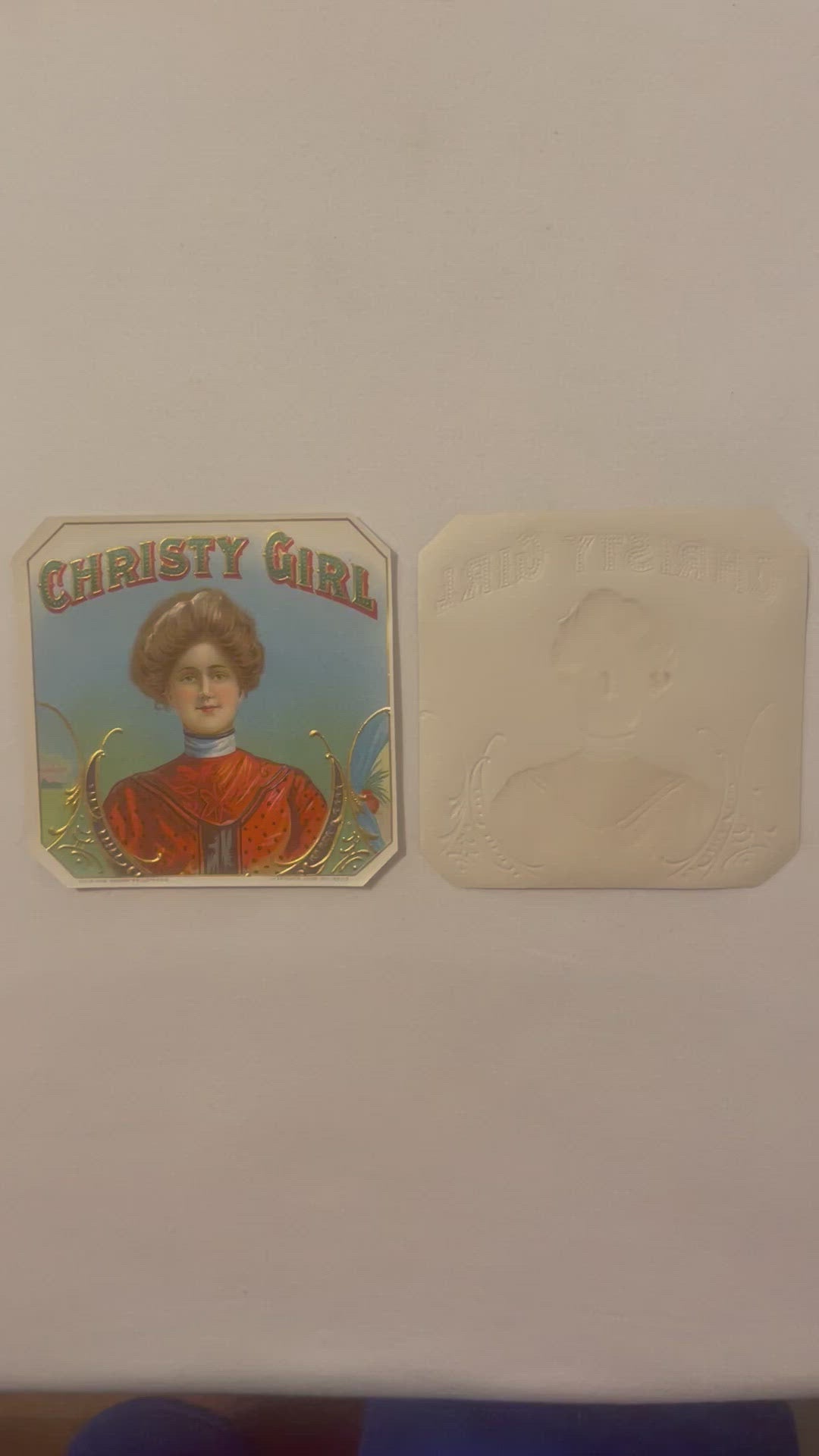
Antique chromolithograph cigar box outer label for the Christy Girl brand, produced circa 1900s - 1920s by the Maryland Litho. Co. of Baltimore, Maryland, measuring 4½ x 4½ inches in the die-cut octagonal format. The label is embossed — the portrait, the lettering, and the decorative scroll work all rise from the surface with the tactile relief that only period stone chromolithography could produce — and it carries the registration line "Title and Design Registered / Maryland Litho. Co., Balto." plainly printed at the base. It draws its name and its cultural weight directly from the phenomenon of Howard Chandler Christy's idealized American woman, which was one of the most powerful image brands in popular culture at the turn of the twentieth century. New Old Stock (NOS), never glued to a box, the color and embossing are intact exactly as the lithographers produced them.

There is a particular quality of light that only old embossed chromolithography carries. 🌟 Not a reproduction, not a scan, not a modern offset reprint — a genuine piece of printed paper from 1905, with the gold metallic ink catching the light the way the Maryland Litho. Co. lithographers intended when they set the stones and ran the press. You can feel the raised surface of the woman's portrait beneath your fingertip. The text arcing overhead stands up from the paper. The scrollwork at the lower flanks has depth. This is what the golden age of American cigar label printing actually felt like — and very little of it survives in this condition.


🏛️ Maryland Litho. Co. and the Baltimore Printing Tradition

Baltimore had a lithographic tradition as deep and storied as any city in America. The largest and most celebrated of the Baltimore houses was A. Hoen and Company — founded by Edward Weber in 1835 as E. Weber and Company, later taken over by August Hoen, and by 1853 operating as the largest printer of smoking and chewing tobacco labels in the western hemisphere. That is not marketing language — that is documented trade history. When the tobacco trade needed its finest printed work, it came to Baltimore.

The Maryland Litho. Co. was a distinct, smaller firm operating within that same tradition. 🖨️ The exact founding date has not been confirmed in available records, but the Christy Girl label itself provides the anchor: The Old Print Shop in New York, one of the most respected fine art and ephemera dealers in the country, dates this label to circa 1905 and confirms the Maryland Litho. Co., Baltimore registration. The base of this label carries that attribution in small but legible print — Maryland Litho. Co., Balto. — and the words Title and Design Registered sit alongside it, the formal language of a house that understood its work had commercial value worth protecting.

The octagonal die-cut format is itself a statement. Standard cigar labels were often rectangular; the clipped corners and shaped perimeter of the octagonal format were a deliberate premium signal, a way of telling the cigar buyer before the box was even opened that something with more care and expense had gone into the presentation. The gold embossed scrollwork that flanks the central portrait — flowing, organic, Art Nouveau in spirit — is the vocabulary of the Edwardian printing house at its most accomplished. 🌿


👩 Howard Chandler Christy and the Girl Who Sold Everything

Howard Chandler Christy was born in Morgan County, Ohio, on January 10, 1872, and by the early years of the twentieth century he had become one of the most recognizable illustrators in America. His painting The Soldier's Dream launched what became known as the Christy Girl — a figure who evolved over years of magazine covers, advertisements, posters, and books into the defining image of confident, elegant American womanhood at the turn of the century. She was a colorful successor to the Gibson Girl, warmer and more accessible, carrying the same idealized poise but with more warmth in the rendering.

From roughly the turn of the century through 1921, Christy's girls filled the pages of Scribner's, Century, and McClure's. They appeared on sheet music, on calendars, on recruiting posters during the First World War. 🎖️ They were the face that American men and women recognized as standing for a certain kind of ideal — healthy, beautiful, socially graceful, distinctly American. Which is precisely why a cigar manufacturer, working with the Maryland Litho. Co. around 1905, reached for that name and that image to sell tobacco.

The woman at the center of this label wears an elaborate deep orange-red garment with rich patterned detailing and a high, pale collar — the fashionable silhouette of the Edwardian moment precisely. Her auburn hair is swept up in the full, voluminous arrangement that defined the era, piled high with the kind of architectural confidence that the Christy Girl was known for. Her expression is composed and quietly assured. The rendering has the soft gradation that chromolithography achieved by layering one stone upon another, building color the way a painter builds glazes — a warmth and dimensionality that flat modern printing simply cannot replicate. 🎭

Collector lore holds that the Christy Girl label was among the most aspirational of the whole tobacco label era. The thinking went like this: the men who bought these cigars had seen Christy's women in magazines, on posters, on advertising cards — the name carried cultural cachet that advertising in 1905 would have paid dearly for. Putting it on a cigar box was borrowing that whole association, the social world of elegance and confidence that the Christy Girl embodied, and transferring it to the product in the buyer's hand. It is a strategy as old as advertising itself — and in this case, it was executed by one of Baltimore's finest printing houses at the peak of its craft.


🖼️ What the Label Actually Is — and How It Was Made

Stone chromolithography is a process that most people have never seen and almost no one practices today. Each color in the finished image was drawn separately onto a large flat limestone slab — the lithographic stone — and the paper was run through the press once for each color, picking up each successive layer in careful registration. A complex label like this one could require a dozen or more passes. The embossing — that raised relief you can feel on the portrait, the lettering, and the scrollwork — was added in a separate operation, pressing the printed sheet against a die to give the finished label its three-dimensional quality. ✨

The gold metallic elements — the scrollwork at the flanks, the frame around the oval portrait area, the gilded accents — are period metallic ink, applied as part of the chromolithographic process. This is not foil stamping. It is ink with metallic pigment, laid down in the same patient, stone-by-stone method as every other color, and it catches light with a warmth and softness that modern metallic printing does not replicate. Hold this label at an angle and the gold shifts the way old painted gold shifts — alive, warm, slightly irregular in the best way.

The palette of the finished piece is deep and warm: the rich orange-red of the woman's garment, a sky-blue background that grades toward the softer greens of the landscape visible at the edge, gold scrollwork, and the bold green and red lettering of Christy Girl arcing overhead with the dotted-letter decorative treatment that was a hallmark of the premium cigar label typeface traditions of the era. 🎨 The whole composition sits within the octagonal format with the precision of a house that had done this work thousands of times before.

It is worth noting that at least one other printing house worked with the Christy Girl brand. Art of the Print records a chromolithograph version attributed to the Schlegel Litho Company of New York, registered by one Lee Heine — a separate production, a separate registration, a reminder that popular brand names in the cigar trade were sometimes licensed to or appropriated by multiple producers in different markets. The Maryland Litho. Co. version, with its Baltimore registration, is its own distinct production — and the one in this listing is exactly that piece.


📦 New Old Stock — What That Actually Means

New Old Stock (NOS) is a term that gets used loosely in ephemera collecting, so it is worth saying plainly what it means for a piece like this one. This label was never glued to a cigar box. It was never placed inside a humidor. It never completed the commercial journey it was printed to make. It came out of old trade stock in the condition the lithographers left it — with the embossing intact, the chromolithographic color layers undimmed, and the metallic gold still carrying its original warmth. 🗂️

Old-timers in the tobacciana trade have long passed around the story of where labels like this come from. The lore holds that many of the finest surviving cigar labels arrived through warehouse finds — collections of leftover stock from cigar factories and printing houses that were gathered up, primarily in the 1970s and 1980s, before those buildings were cleared or demolished. Whether any individual label followed that exact path is unverifiable, but the condition speaks clearly: this is a piece that never traveled from the press to the counter, and that is no small thing for a piece of embossed chromolithographic paper that is now pushing a hundred and twenty years old.

A separate lore thread, well documented among lithography collectors, holds that printing houses of this era would sometimes produce sample runs of a label design — portfolio pieces to take to cigar manufacturers, selling the brand concept alongside the print contract. Some of those samples never made it to a factory at all. They came back to the printer's files, sat undisturbed for decades, and surfaced later as the cleanest surviving examples of the printer's craft. Whether the Maryland Litho. Co. worked that way is unconfirmed in available records — but it is a credible path to a piece in this condition. 🏺


🖼️ Collecting and Displaying Cigar Labels — The Edwardian Portrait Tradition

The portrait cigar label is its own recognized category within tobacciana collecting, and among portrait labels, the woman's portrait holds a place of special esteem. These labels were produced at a moment when chromolithography was the highest form of commercial printed art — when the finest printing houses employed artists of genuine skill to render faces with the same warmth and gradation that a painter would bring to a canvas commission. The cigar label was, in a very real sense, the democratic art of the Edwardian era: small, affordable to produce in quantity, and yet executed with a care and ambition that the genre's commercial origins sometimes obscure. 🌺

The octagonal 4½ x 4½ inch format of this label is ideal for framing. The die-cut edges give the piece a finished, self-contained quality that rectangular labels sometimes lack — it looks like what it is, a carefully designed visual object, and it sits beautifully in a standard square mat. Collectors in the tobacciana field have long treated labels of this caliber as legitimate examples of American commercial art history, which is exactly what the scholarship supports. The Old Print Shop — not a tobacciana dealer but a serious fine art and antiquarian print dealer in New York — lists this label in their holdings, which is a quiet but meaningful credentialing. ✅

Howard Chandler Christy himself went on to paint some of the most significant American historical canvases of the early twentieth century, including his monumental Scene at the Signing of the Constitution of the United States for the United States Capitol. He died on March 3, 1952. The fame of his name, and the cultural weight of the Christy Girl as a recognized American image type, gives this label a connection to a wider narrative of American visual culture that most cigar labels — however beautiful — simply do not carry. 🇺🇸


❓ Questions Collectors Ask

What exactly is a Christy Girl cigar label?

The Christy Girl cigar label is an embossed chromolithographic outer cigar box label produced circa 1905 by the Maryland Litho. Co. of Baltimore, Maryland, measuring 4½ x 4½ inches in a die-cut octagonal format. The name references Howard Chandler Christy's iconic Christy Girl illustration style, which was one of the dominant visual brands in American popular culture from roughly 1900 through the early 1920s. The label carries the printed registration line Title and Design Registered / Maryland Litho. Co., Balto. at its base. The Old Print Shop of New York has confirmed the circa 1905 dating and the Maryland Litho. Co. attribution.

How can I confirm this label is from circa 1905 and not a later reproduction?

Several physical characteristics identify this as a period original rather than a modern reproduction. Stone chromolithography — the process used here — produces a characteristic layered color depth and a softness in skin tone gradation that modern offset or digital printing cannot replicate. The embossing is genuine mechanical relief, not simulated embossing. The printed text at the base — Title and Design Registered / Maryland Litho. Co., Balto. — is period-authentic language consistent with registered commercial label production of the early 1900s. The circa 1905 date is confirmed by The Old Print Shop, and the Edwardian costume, hairstyle, and decorative vocabulary of the design are all consistent with that window.

Who was Howard Chandler Christy, and why does his name appear on a cigar label?

Howard Chandler Christy (January 10, 1872 – March 3, 1952) was an American illustrator who created the Christy Girl — a recognized ideal of elegant, confident American womanhood that filled magazine covers, advertising campaigns, and popular culture from roughly 1900 to the early 1920s. By 1905, the Christy Girl was a cultural phenomenon widely recognized by the cigar-buying public, making the brand name a deliberate and commercially calculated choice for a cigar label targeting that audience. The label appropriates the cultural cachet of Christy's famous women without requiring any formal licensing arrangement — the name itself was the signal, and the portrait style reinforced it.

What is chromolithography, and why does it matter for this label's value?

Chromolithography is a printing process in which each color in the final image is drawn separately onto a flat limestone slab and printed in successive layers, with the paper running through the press once per color. The finest labels of this era required ten to fifteen passes or more. The embossing is a separate mechanical operation that presses the printed sheet into a die to create raised relief. This process was labor-intensive, materially expensive, and produces color quality — particularly in skin tone gradation and metallic gold warmth — that modern printing methods do not replicate. For collectors, the chromolithographic process is both the authentication marker and the primary aesthetic appeal of Edwardian cigar labels.

Are there different versions of the Christy Girl cigar label?

Yes. At least two distinct productions of the Christy Girl brand are documented. This label is the outer box label in the 4½ x 4½ inch octagonal format, registered by the Maryland Litho. Co. of Baltimore. A separate, larger inner label version measuring approximately 6¼ x 10 inches also exists, intended for the inside lid of the cigar box. Additionally, Art of the Print records a chromolithograph version attributed to the Schlegel Litho Company of New York, registered by Lee Heine — a distinct production with a separate commercial origin. Collectors distinguish between these versions by format, size, and the printer attribution printed at the base of the label.

How should I display or store an antique chromolithographic cigar label?

Antique paper labels of this type are best stored flat, away from direct sunlight, humidity, and heat — all of which accelerate fading and paper degradation. For display, archival-quality matting with UV-filtering glass or acrylic is the collector standard. The 4½ x 4½ inch octagonal format fits well in standard square frames with a mat opening cut to the label's shape. Direct contact with acidic materials — newsprint, standard cardboard, rubber bands, or adhesive tape — should be avoided. The embossed surface is particularly worth protecting; pressure or folding will damage the relief detail in ways that are not reversible.

What makes the Maryland Litho. Co. significant within the history of American printing?

The Maryland Litho. Co. operated within a Baltimore printing tradition that was, by the mid-nineteenth century, the most productive tobacco label printing community in the western hemisphere. Baltimore's dominant house, A. Hoen and Company — founded in 1835 — had by 1853 established itself as the largest printer of smoking and chewing tobacco labels in the western hemisphere. The Maryland Litho. Co. was a distinct, smaller firm operating alongside that tradition, and its work on the Christy Girl label — with its fine portrait rendering, gold embossing, and octagonal die-cut format — reflects the high craft standards that characterized Baltimore label printing at its peak in the Edwardian era.


🏷️ This is an antique embossed chromolithographic cigar label, produced circa 1905 by the Maryland Litho. Co. of Baltimore, in New Old Stock (NOS) condition at 4½ x 4½ inches — a piece of Edwardian American commercial art carrying the name and image tradition of one of the most recognizable illustrators of the era, printed by one of the finest lithographic houses in a city that had been setting the standard for tobacco label printing for half a century before this label ever came off the press.

Shipping

🚚 Shipping & Handling

  • Shipping costs and timing are calculated at checkout.
  • Items curated and shipped directly by me include U.S. shipping at no additional cost, professionally packed to ensure safe arrival of your artifact.

Items from Vetted Pro Collectors
Shipping for items offered by vetted Pro Collectors is determined at checkout. All Pro Collector listings are reviewed to ensure fair, reasonable shipping practices.

For full details, please refer to our Shipping Policy.

Returns & Exchange

Take your time — you've got a full six months. If a piece isn't right for you, send it back the way it reached you and we're good.

In the first 30 days your money goes straight back the way you paid. After that it's store credit, so you can put it toward something you'd rather have.

Return shipping we sort out between us, case by case. I don't make this difficult.

If something arrives damaged, or it isn't what I said it was, send me a photo within 48 hours and I'll make it right.

Email info@vintageantiquesgifts.com or call 802-356-9872 — that's me answering, not a call center.

The only things I can't take back are custom or special-order pieces and gift cards.

View full details
  • 5 stars: 2 (100%)
  • 4 stars: 0 (0%)
  • 3 stars: 0 (0%)
  • 2 stars: 0 (0%)
  • 1 star: 0 (0%)
C
Christy Reynosa (Winston-Salem, US)
Love it!

Awesome label from a wonderful dedicated family business with fast shipping!!

M
Marthe

The cigar label was exactly as advertised. Great color.

Hello Marthe! Thank you tons for the perfect score. It feels great to know you're pleased with the Christy Girl Cigar Label Victorian Woman 1900's artifact. We take great pride in offering authentic, vintage pieces. Thank you for being an integral part of our customer family, looking forward to serving more of your vintage cravings!