Skip to product information
1 of 4

Vintage and Antique Gifts

Antique “Signal” Gold Embossed Cigar Label American Lithographic Co 1900s 1920s NOS 🚬

Antique “Signal” Gold Embossed Cigar Label American Lithographic Co 1900s 1920s NOS 🚬

Regular price 5.50 USD
Regular price Sale price 5.50 USD
Sale Sold out
Shipping calculated at checkout.
Quantity

What Does a Single Label Tell You About an Entire Era? 🏷️

Pick up this little rectangle of embossed paper and hold it at an angle toward the light. Watch what happens. The gold rises. The red letters seem to breathe. The scrollwork catches and releases the glare in a slow, rolling shimmer that no photograph ever quite captures. In that moment you are not looking at a piece of printed cardboard — you are looking at the distilled ambition of an entire industry at the height of its confidence. Cigar makers of the early twentieth century believed that the label was the brand, that the box was the billboard, and that the printer was the artist. This Signal label, produced for J. T. Stier & Son by the American Lithographic Company of New York, is one of the finest small survivors of that belief. It has been sitting quietly, waiting for someone who understands what it represents. That person is probably you.


🔍 What Exactly Is This Piece?

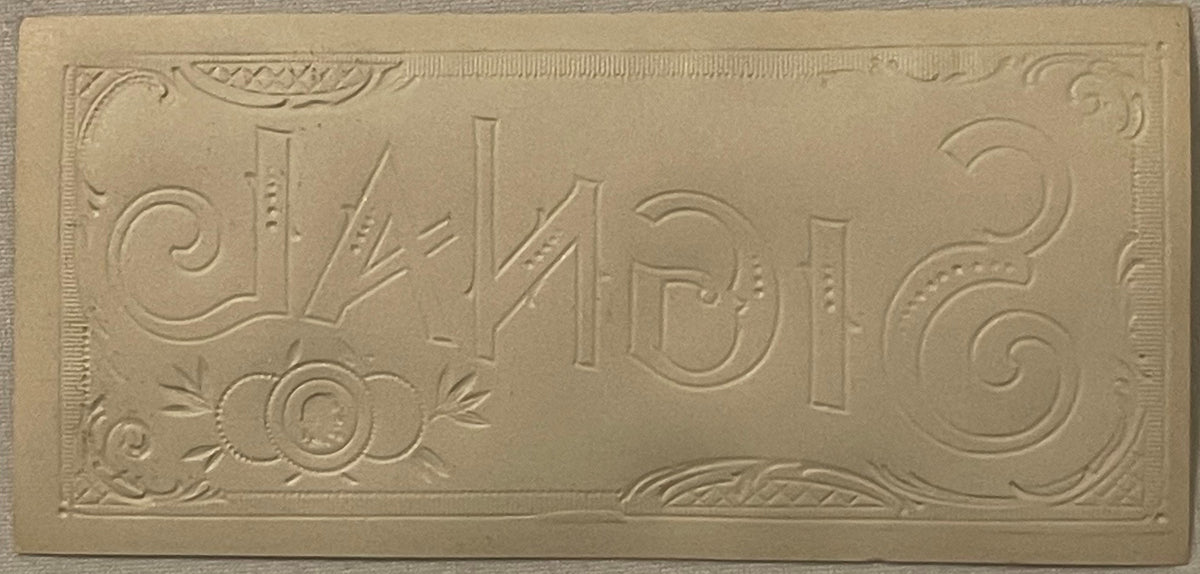
This is an original, unused antique cigar box label — referred to in the trade as a nameplate or rache label — produced in the early 1900s through approximately the 1920s. Its specific function was to wrap across the edge or inner lip of a cigar box, repeating the brand name in bold, unmistakable fashion so the box announced itself from every angle. It measures approximately 5¼ inches by 2¾ inches, a slender, horizontal format that was perfectly engineered for that purpose. The label was printed by American Lithographic Company, New York — marked clearly in the lower margin — for the cigar manufacturer J. T. Stier & Son, whose name appears alongside the printer's credit, giving this piece a documented, traceable provenance in the cigar industry record.

The printing method is classic ALCO-era chromolithography with embossing and metallic inks. This was not a single-pass process. Labels of this quality went through the press multiple times — each layer of color registered precisely over the last, building up a depth of tone that mimics oil painting more than it resembles modern offset work. The embossing came last, pressing the paper from behind against a die so that the letters and ornamental details physically rise off the surface. Then came the metallic gold ink, laid into those raised channels so it catches directional light the way a coin does. The result is a piece that rewards handling and close inspection in a way that flat-printed reproductions simply never will. This label is New Old Stock (NOS) — it was never applied to a box. It has survived more than a century in collectible condition, its colors intact, its embossing crisp, its gold still luminous.


🏭 American Lithographic Company — New York's Premier Print House

To understand what you are holding, you need to understand who made it. American Lithographic Company, universally known among collectors and industry historians as ALCO, was not merely one of many print houses operating in New York during the Gilded Age and Progressive Era — it was the dominant force in high-end commercial chromolithography in the entire country. Founded in the latter decades of the nineteenth century and operating well into the twentieth, ALCO consolidated some of the finest lithographic talent in the city under one roof, producing trade cards, advertising ephemera, theatrical posters, and — perhaps most famously — cigar labels of breathtaking technical complexity.

New York City was the nerve center of the American cigar trade during this period. The finance, the distribution, the branding, the printing — so much of it flowed through or originated in New York, even when the tobacco itself was grown in Connecticut, Pennsylvania, Florida, or imported from Havana. ALCO was positioned at the intersection of all of it. Their printing facility was capable of running chromolithographic stones with a precision that their contemporaries envied. Collectors and printing historians have documented ALCO labels featuring upward of a dozen separate color passes, each requiring its own stone or plate, its own ink preparation, its own careful registration. The metallic and embossed work added further production steps. What you see in this Signal label — the raised gold, the layered gray ground, the commanding red — is the result of a production process that was genuinely artisanal in its demands even as it operated at industrial scale.

Lore passed down among collectors holds that ALCO's most skilled chromolithography operators were recruited directly from German and Austrian print houses, where the lithographic tradition was older and the technical training more rigorous than anything available domestically at the time. Whether or not that specific claim is fully documented in every case, it is historically consistent: the late nineteenth century saw significant immigration of skilled European craftsmen into the New York printing trades, and their influence on the visual quality of American commercial printing is undeniable. The Signal label's refined ornamental grammar — the scroll borders, the medallion portrait cartouche, the restrained but elegant typography — reflects exactly that kind of Continental compositional sensibility applied to an American brand.


🚬 J. T. Stier & Son and the World They Operated In

The name J. T. Stier & Son appears in the lower margin of this label, identifying the cigar manufacturer who commissioned it. Family-named cigar businesses were the backbone of the American cigar industry in the early twentieth century. The trade was intensely personal — built on relationships between growers, blenders, distributors, and retailers — and a family name on the label was a statement of personal accountability as much as it was a branding decision. The addition of "Son" is particularly telling: it signals succession, continuity, the intention to build something that would outlast the founder. These were businesses built for generations, not quarters.

The brand name Signal itself is worth a moment's reflection. In the early twentieth century, signal imagery carried enormous weight in the popular imagination. Railroads were transforming the country, and signal systems — the flags, lanterns, semaphores, and telegraph lines that kept trains from colliding — were objects of genuine public fascination and respect. A cigar brand called Signal was positioning itself within that vocabulary of authority, precision, and modernity. The small portrait medallion in its red cartouche — described by ALCO's own design vocabulary as a coin-like formal accent — reinforces that sense of established authority. This is a brand that wanted to be taken seriously, that invested in serious printing to make that case.

Local legend within the cigar ephemera collecting community holds that several mid-tier cigar families of this era would commission their label designs through New York jobbers and brokers who acted as intermediaries between the manufacturer and ALCO, sometimes without the cigar maker ever visiting the print house at all. The design would be developed through correspondence and proofing, with final approval coming back by post. If that process applied to the Stier label, then this small rectangle of embossed paper represents a chain of craft and commerce stretching from a family business through a network of brokers to one of the most sophisticated print operations in North American history — and it all resolved into this one crisp, gold-trimmed, crimson-lettered survivor.


🎨 The Label as Art Object — Why Collectors Frame These

There is a reason that vintage cigar labels have moved steadily from the domain of specialized tobacciana collectors into the broader world of decorative art and antique ephemera collecting. It comes down to what these labels actually are, technically and aesthetically: they are among the finest examples of commercial graphic art produced in America before the Second World War, available in an affordable and displayable format. The Signal label is a particularly strong example of the type. Its color palette — deep crimson, warm gold, cool gray — is sophisticated without being busy. Its typography is bold and confident without being crude. The embossing gives it a tactile dimension that transforms it from a flat print into something closer to bas-relief.

When framed under glass with a mat that picks up the crimson or the gold, a label like this reads as deliberately composed wall art. It carries period authenticity that no reproduction can approximate, because the embossing, the metallic ink, and the paper stock are all products of their moment. The slight warmth of the aged paper, the microscopic texture of the chromolithographic ink layers, the way the gold has mellowed just enough to feel antique without feeling degraded — these are qualities that a century of careful storage has given this piece, and they cannot be manufactured or fast-aged into existence.


🖼️ Display Ideas

  • 🖼️ Frame it solo under a deep mat. A simple black or gilded frame with a double mat in cream and deep red lets the label read as a finished artwork. The scale — just over five inches wide — is intimate and personal, perfect for a study, library, or bar cart vignette.
  • 🗃️ Include it in a grouped ephemera display. Pair it with other early twentieth-century trade cards, advertising labels, or tobacco-related ephemera in a single large shadow box. The gold and red of the Signal label will anchor the composition visually.
  • 🍸 Style it into a vintage bar or smoking room. Alongside a set of period cocktail glasses, a vintage ashtray, or a reproduction barware tray, this label reads as a curated historical accent rather than a collectible curiosity.
  • 📚 Archive it in a collector's portfolio or ephemera sleeve. For the serious ephemera collector, this belongs in an archival Mylar sleeve inside a labeled binder, displayed flat so the embossing is preserved and the full label can be appreciated without handling.
  • 🎁 Frame it as a gift for the tobacco enthusiast or graphic design history lover. Mounted and matted, this makes a thoughtful, genuinely unique gift that no catalog or big-box retailer can duplicate — because there is only one.
  • 🏛️ Integrate it into a printing history or Americana display. Grouped with antique type specimens, printer's marks, or period advertising samples, the Signal label tells a specific and compelling story about American commercial art at its most accomplished.

🎁 Who Collects These?

Antique cigar labels occupy a wonderfully broad collecting universe, and the people drawn to this specific piece tend to arrive from several different directions. Tobacciana collectors — those who specialize in the material culture of the American and Cuban cigar trade — are the traditional home for pieces like this. They understand the hierarchy of printers, recognize ALCO's mark as a quality signal, and appreciate the documented provenance that the lower-margin imprint provides. For them, a NOS label with clear maker attribution is about as clean as the category gets.

Ephemera collectors more broadly — people who collect trade cards, advertising cards, Victorian die-cuts, early twentieth-century packaging and paper goods — recognize the Signal label as a superior example of chromolithographic commercial printing. The ALCO connection alone elevates it within that community. Printing and typography historians, whether academic or amateur, are drawn to pieces that document specific production houses at specific moments in the evolution of American commercial printing. This label is primary source material for that story.

Then there are the decorators and stylists — interior designers working in Edwardian, Arts and Crafts, or early Americana aesthetics who incorporate original vintage ephemera into their projects as authentic period accents. And finally there are the gift-givers: people looking for something genuinely rare and personal for the man or woman in their life who has everything, who loves history, who appreciates craft, and who will immediately understand why a gold-embossed, century-old cigar label is a more interesting object than anything available at retail. This label speaks to all of them.


❓ Frequently Asked Questions

Is this label genuinely from the early 1900s–1920s, or could it be a later reprint?

This is an original period label, produced by American Lithographic Company of New York for J. T. Stier & Son during the early twentieth century — the seller notes date it to the early 1900s through approximately the 1920s. The physical evidence supports this entirely: the paper stock, the chromolithographic printing method with multiple color layers, the metallic embossing technique, and the style of the lower-margin printer's imprint are all consistent with ALCO's documented production during that period. Chromolithographic labels of this complexity were not reprinted as collectibles — the equipment, the stones, and the expertise required to produce them were largely gone by mid-century. What you have is the real thing, produced when the process was still active.

What does "NOS" mean, and why does it matter for this label?

NOS stands for New Old Stock, meaning the item was produced during the original period of manufacture but was never used for its intended purpose. In the case of this label, it was never applied to a cigar box. Cigar box labels were printed in large quantities and stored by manufacturers and distributors; when brands changed, businesses closed, or inventory was cleared, unsold label stock often survived intact in warehouses, attic storage, and estate holdings. NOS status matters enormously for condition: a label that was never glued down, never subjected to moisture, never handled repeatedly in a retail environment will retain its embossing, its color saturation, and its paper integrity far better than a label removed from a box. The crispness of the gold and the vividness of the red on this piece are directly attributable to its NOS survival.

How should I store or display this label to preserve it?

For long-term preservation, store the label flat in an archival-quality Mylar or polyester sleeve, away from direct sunlight, humidity extremes, and heat. Acid-free backing board inside the sleeve will support the paper and prevent curling. If you choose to frame it — which is an excellent choice for a piece this visually strong — use UV-filtering glass or acrylic, mount it with archival corners or hinges rather than adhesive, and mat it so the label does not touch the glazing directly. Proper framing will allow you to display it indefinitely without degradation. The embossing is particularly sensitive to pressure, so avoid stacking anything on top of an unprotected label.

Who was American Lithographic Company, and why does their imprint add value?

American Lithographic Company — ALCO — was the leading chromolithography house in New York City during the late nineteenth and early twentieth centuries. Their work represents the highest standard of American commercial lithographic printing of the era, combining multiple color passes, metallic inks, and embossing in a production process that was both technically demanding and visually spectacular. Within the tobacciana and ephemera collecting communities, an ALCO imprint functions similarly to a studio mark in photography or a foundry mark in bronze casting: it identifies the work as coming from a recognized source of quality and places it within a documented production history. Labels bearing the ALCO credit are consistently regarded as among the finest examples of the cigar label genre.

What is the significance of the portrait medallion on the label?

The small portrait medallion set within a red cartouche — described in the seller's notes as a formal, coin-like accent — is a compositional device with deep roots in both European heraldic design and American commercial advertising of the Victorian and Edwardian periods. Portrait medallions on cigar labels could represent the brand's founder, a celebrated public figure associated with the brand, or simply a generic figure of authority and refinement intended to lend gravitas to the product. In the context of this label, the medallion reinforces the brand name Signal's aspirational positioning — this is a product associating itself with authority, with established systems of command and precision. The coin-like quality is entirely intentional: coins are objects of value, of official sanction, of durability. That is exactly the brand impression J. T. Stier & Son were investing in.

Is there documented collector or auction history for ALCO cigar labels?

Cigar box labels — and ALCO-printed labels in particular — have an established and active collector market with documented history in ephemera shows, specialist dealers, and auction houses. Organizations such as the Cigar Label Collectors International (CLCI) have maintained collector communities around exactly this category of material for decades, and period labels appear regularly in ephemera auction catalogs both in the United States and internationally. ALCO labels are consistently among the more sought-after pieces in that market precisely because of the firm's documented reputation for quality and the visual complexity of their work. The Signal label's combination of NOS condition, clear maker attribution, and ALCO provenance places it solidly within the portion of the market that serious collectors target.

Can this label be authenticated if I want to include it in a larger collection or exhibit?

Yes. The label carries its own authentication in its lower margin: the printed credits identifying both J. T. Stier & Son as the cigar manufacturer and American Lithographic Company, N.Y. as the printer are primary documentary evidence of origin. For a collector building a catalogued collection or contributing to an exhibit, this kind of on-object provenance documentation is exactly what curators and researchers look for. The physical characteristics — paper weight and aging, ink layering, embossing depth, metallic ink application — can be further examined by a specialist in chromolithographic printing or American paper ephemera if additional authentication is desired. The combination of printed provenance, physical consistency with the period, and NOS condition makes this a straightforward and confidently attributable piece.

Shipping

🚚 Shipping & Handling

  • Shipping costs and timing are calculated at checkout.
  • Items curated and shipped directly by me include U.S. shipping at no additional cost, professionally packed to ensure safe arrival of your artifact.

Items from Vetted Pro Collectors
Shipping for items offered by vetted Pro Collectors is determined at checkout. All Pro Collector listings are reviewed to ensure fair, reasonable shipping practices.

For full details, please refer to our Shipping Policy.

Returns & Exchange

Take your time — you've got a full six months. If a piece isn't right for you, send it back the way it reached you and we're good.

In the first 30 days your money goes straight back the way you paid. After that it's store credit, so you can put it toward something you'd rather have.

Return shipping we sort out between us, case by case. I don't make this difficult.

If something arrives damaged, or it isn't what I said it was, send me a photo within 48 hours and I'll make it right.

Email info@vintageantiquesgifts.com or call 802-356-9872 — that's me answering, not a call center.

The only things I can't take back are custom or special-order pieces and gift cards.

View full details
  • 5 stars: 2 (100%)
  • 4 stars: 0 (0%)
  • 3 stars: 0 (0%)
  • 2 stars: 0 (0%)
  • 1 star: 0 (0%)
w
w***w (338)

I received signal label today and was packed well and arrived safely! Shipping was very fast. Thank you!

L
Lillian

Definitely pleased once again with my selection of Excellent Quality Cigar Labels that are a rare find to add to my collection. I’m so Happy to have found your Shop! Thank You for your Excellent Service and Great Prices!

We are so pleased that you found us also and are part of our community. It means the world to us to establish relationships with you all!