Skip to product information
1 of 4

Vintage and Antique Gifts

Vintage 1920s Fruit Crate Label Elkhorn Fruit Co Lodi California Zinfandel Juice Grapes Advertising Ephemera 🍎

Vintage 1920s Fruit Crate Label Elkhorn Fruit Co Lodi California Zinfandel Juice Grapes Advertising Ephemera 🍎

Regular price 10.00 USD
Regular price Sale price 10.00 USD
Sale Sold out
Shipping calculated at checkout.
Quantity

🍇 What Story Did a Grape Crate Tell Before It Ever Left the Vineyard? 🍇

Long before shrink-wrap, barcodes, and refrigerated trucks, a wooden crate of California grapes had exactly one chance to catch a buyer's eye as it rolled off a rail car and into a crowded produce market — and that chance was the paper label pasted to its end. Warehouse foremen, wholesale buyers, and grocers flipping through stacked crates in a dim shed made split-second decisions based on color and character alone. This little rectangle of lithographed paper was built for that exact moment. It's a survivor of a trade that has almost entirely vanished from American commerce, and holding one today is about as close as most of us will ever get to standing in a Lodi packing shed in its heyday.

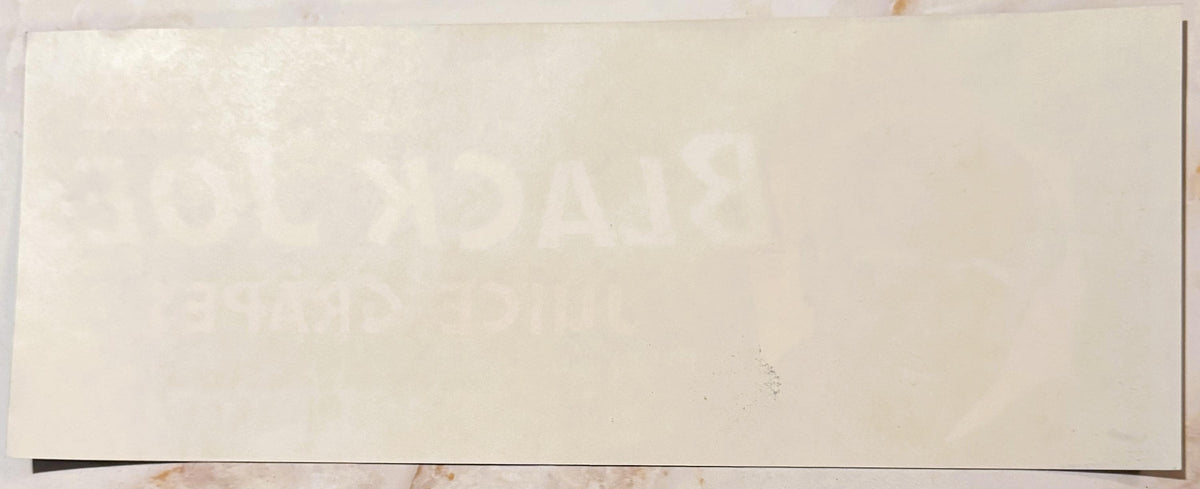
This is a Black Joe Brand Juice Grapes crate label, produced for the Elkhorn Fruit Co. of Lodi, California — an outfit that described itself right on the label as "Growers, Packers & Shippers." The label measures approximately 13 x 4 inches (about 33 x 10 cm), the classic long, narrow shape built to run the length of a wooden lug box, and it survives as New Old Stock (NOS) — never applied to a crate, never shipped, never used for its intended purpose.

The artwork itself is a small riot of color lithography: a bright orange-and-yellow shield shape, outlined in green and black, frames a large portrait of a smiling, white-haired man wrapped in a patterned red bandana, set against a deep navy-blue field. "BLACK JOE" runs across the top in bold cream-and-blue block lettering, with "JUICE GRAPES" beneath it in a punchy yellow script.

Down in the corner sits the company's own orange triangular "EFC" trademark — Elkhorn Fruit Co., Lodi — and the text runs bilingual throughout, English paired with French: "Produce of U.S.A." beside "Produit des États-Unis," "Net Weight 36 lbs." beside "Poids Net 16.3 KG," and "Juice Grapes" beside "Raisins Pour Jus." A small blue box calls out the grape variety inside: Zinfandel.

Below the artwork, in smaller lettering, the label also carries the name "Leonardini & Son" alongside Elkhorn Fruit Co.'s main office address in Lodi.

No printer's manufacture code survives legibly on this label, so an exact production year can't be pinned down with certainty — and I'd rather tell you that plainly than hand you a date I can't stand behind. What the label itself can tell us, though, is genuinely interesting: it carries a five-digit ZIP code (95240) in its printed address, and ZIP codes didn't exist anywhere in the United States before 1963. That single detail rules out an early date and points us instead toward the 1960s into the 1970s — a period when Lodi's shippers were still leaning on traditional paper crate labels even as the packing industry nationwide was sliding toward printed cardboard cartons. It's a small forensic clue, but it's the kind of thing that makes a piece of advertising ephemera worth studying closely rather than just admiring.


🍷 Lodi, California — Zinfandel Country

Lodi sits in California's Central Valley, in San Joaquin County, on flat, sandy-loam ground fed by the Mokelumne River — soil and climate that turned out, almost by accident, to be some of the finest Zinfandel-growing land on the continent. Old-timers around Lodi will tell you the town's vineyards were planted by generations of immigrant families — Italian, German, Portuguese — who came to farm and stayed to grow grapes, many of them still tending vines that trace back to plantings from the early 1900s. Lodi has long carried the informal title of the "Zinfandel Capital of the World," and some of its old head-trained vines are among the oldest continuously producing Zinfandel vineyards in America. It's exactly the kind of place where a shipper naming a brand "Zinfandel" on a grape label wasn't marketing flourish — it was simply telling you, honestly, what variety was inside the box.

📦 The Golden Age of the Fruit Crate Label

For roughly the first two-thirds of the twentieth century, California's produce industry ran on an advertising medium almost nobody thinks about anymore: the crate label. Growers' cooperatives and independent packing houses alike commissioned full-color lithographed labels — printed by specialty lithography houses that turned out these designs by the tens of thousands — to paste onto the ends of wooden shipping crates. A buyer standing in a wholesale produce terminal in Chicago or New York had no internet, no photograph of the orchard, no brand website. All he had was the crate label, and it had to do every job modern packaging does today: identify the grower, state the contents, communicate quality, and — most importantly — be memorable enough that the same buyer would ask for that brand by name next season.

That pressure produced an entire visual language built around invented characters — friendly, memorable faces meant to stick in a buyer's mind faster than any typeface could. Warehouses shipped grapes and oranges and peaches under brands named for admirals, chiefs, aunts, uncles, sunbursts, and folksy old-timers, each one designed to be instantly recognizable across a crowded shipping dock. It's the same instinct that, in the broader American advertising world of that era, gave rise to enduring commercial characters like Aunt Jemima on pancake boxes, Uncle Ben on rice bags, and the maiden who eventually became known as Mia on Land O'Lakes butter — figures created to build fast familiarity and trust with a buyer who had seconds, not minutes, to decide. Many of those household-name characters have since been retired or reimagined as American culture has evolved, and the character on this label sits within that same broad tradition of illustrated, personified branding — a visual habit of American commerce that shaped how nearly every product on a grocer's shelf or warehouse floor introduced itself to the public for the better part of a century.

🏷️ What This Label Is, and Why It Still Matters

Let's name it plainly, because the naming is the point. The brand name and the figure on this label place it squarely in what collectors and historians call Black Americana — commercial art that used caricatures of Black Americans to sell everyday goods. It ran through American advertising decade after decade, on pancake boxes and rice bags and fruit crates like this one, and it was ordinary. That is the uncomfortable part, and it is also the historically important part: this was not fringe material. It came out of the same lithography houses that printed every other label in the shed, ordered by companies that thought nothing of it, and it moved through produce markets in every city in the country. It was the mainstream commercial vocabulary of its time.

Most of it is gone now. Not preserved, not catalogued — thrown out. The paper crate label trade ended when packing houses switched over to pre-printed cardboard cartons, and an obsolete supply goes the way every obsolete supply goes: pulped, burned, or hauled out of the shed with everything else. Those household-name characters were retired one by one as the country's patience for them ran out — Quaker announced the end of Aunt Jemima in June 2020 and the brand became Pearl Milling Company; Mars announced that September that Uncle Ben's would become Ben's Original — and a company retiring a trademark is not in the business of preserving it. What survives, survives by accident. The crate labels in collectors' hands today are overwhelmingly labels that were printed but never used, bundles that sat in a packing house label room for decades until somebody finally opened the door. That is exactly what this one is, and unused warehouse stock like it is the main reason any of this material is still here to be looked at.

We don't sell this as decoration and we don't sell it as a joke. It is a primary document of how American business once talked about race, and that is a category of object serious institutions collect on purpose. The Jim Crow Museum at Ferris State University has built the nation's largest publicly accessible collection of artifacts of intolerance — tens of thousands of pieces of exactly this kind of material — on the principle that objects of intolerance can be used to teach tolerance. University special collections from Johns Hopkins to San Jose State keep advertising ephemera like this on the same stated grounds: not to celebrate it, but to keep the evidence within reach of people examining the legacy of racist depiction in American commerce. This label belongs with people who study that history, teach it, or simply want the record kept rather than erased. Understanding how ordinary this once was is the whole reason it needs keeping.

🚂 Juice Grapes, Home Winemakers, and a Trade That Crossed Borders

The words "Juice Grapes" on this label point to a specific and genuinely fascinating chapter of American food history. For much of the twentieth century, California's Central Valley didn't just ship Zinfandel and other wine varietals to commercial wineries — it shipped boxcar after boxcar of fresh grapes directly to ordinary households, especially in the immigrant neighborhoods of the East Coast and Midwest, where families with roots in Italy, Portugal, and elsewhere kept up the old-world tradition of making their own wine at home each fall. Even after Prohibition ended in 1933, this trade never really stopped — "juice grapes" and grape concentrate were sold for generations to home winemakers who bought crates by the dozen when the fall harvest trains rolled east. Old-timers in wine country still talk about the seasonal rush when Zinfandel crates left Lodi loaded onto refrigerated rail cars, bound for cities where a family's autumn ritual meant a cellar full of crushed grapes and a demijohn fermenting quietly through the winter.

The bilingual English-French wording on this particular label — "Raisins Pour Jus," "Produit des États-Unis" — is a strong clue that Elkhorn Fruit Co.'s juice grapes traveled well beyond U.S. borders, most likely north into Canada, where French-language labeling became increasingly expected on goods sold in Quebec and other French-speaking markets through the 1960s. It's a small detail, but it turns this label into a little piece of cross-border commercial history: a Lodi grower dressing its Zinfandel crates in two languages so they'd be just as welcome on a loading dock in Montreal as one in Sacramento.

🏢 Elkhorn Fruit Co. and the Leonardini Name

Elkhorn Fruit Co. identified itself on its labels plainly as growers, packers, and shippers, headquartered in Lodi, and marked its crates with a distinctive orange triangular "EFC" trademark — a clean, confident logo built for quick recognition on a busy dock. Alongside the company name, this label also carries the name "Leonardini & Son," a detail that's sparked more than a little curiosity among collectors over the years. The Leonardini name carries real weight in California wine country, tied to winegrowing families with deep roots in the Lodi and Napa areas whose name is still known in wine circles today. Whether this particular "Leonardini & Son" is a branch of those families or a separate Lodi grower who happened to share the name, I have not been able to document — and, same as with the date, I would rather leave the question open than hand you a family tree I can't stand behind.

Shipping

🚚 Shipping & Handling

  • Shipping costs and timing are calculated at checkout.
  • Items curated and shipped directly by me include U.S. shipping at no additional cost, professionally packed to ensure safe arrival of your artifact.

Items from Vetted Pro Collectors
Shipping for items offered by vetted Pro Collectors is determined at checkout. All Pro Collector listings are reviewed to ensure fair, reasonable shipping practices.

For full details, please refer to our Shipping Policy.

Returns & Exchange

Take your time — you've got a full six months. If a piece isn't right for you, send it back the way it reached you and we're good.

In the first 30 days your money goes straight back the way you paid. After that it's store credit, so you can put it toward something you'd rather have.

Return shipping we sort out between us, case by case. I don't make this difficult.

If something arrives damaged, or it isn't what I said it was, send me a photo within 48 hours and I'll make it right.

Email info@vintageantiquesgifts.com or call 802-356-9872 — that's me answering, not a call center.

The only things I can't take back are custom or special-order pieces and gift cards.

View full details
  • 5 stars: 3 (100%)
  • 4 stars: 0 (0%)
  • 3 stars: 0 (0%)
  • 2 stars: 0 (0%)
  • 1 star: 0 (0%)
e
e***n (9)

This was an A++++++++transaction!!!! Very nice!!

l
l***h (1158)

Epherma was in incredible condition! Looks brand new despite it's age. High quality image that looked exactly like the listing displayed. The seller even took the time to include a note. This seller is a rare hidden gem on here and I can't recommend them enough!

8
8***j (516)

pleasure to deal with A#1 seller