Skip to product information
1 of 3

Vintage and Antique Gifts

Vintage B&O Railroad Stock Certificate 🚂 1930s 1950s Baltimore & Ohio 5 Shares Green Steel-Engraved

Vintage B&O Railroad Stock Certificate 🚂 1930s 1950s Baltimore & Ohio 5 Shares Green Steel-Engraved

Regular price 6.00 USD
Regular price Sale price 6.00 USD
Sale Sold out
Shipping calculated at checkout.
Quantity

What did it feel like to own a piece of the oldest railroad in America? 🚂

There's a particular kind of magic in holding a stock certificate from a company that helped build a country. Long before "railroad" was a nostalgic word, it was the single most electrifying idea in American commerce — the thing that turned muddy wagon trails into steel rails, and turned a struggling Atlantic port into the gateway to the West. This certificate carries that whole story on a single sheet of steel-engraved paper: a green-bordered share of The Baltimore and Ohio Railroad Company, the line that started it all.

This is a genuine common stock certificate issued by The Baltimore and Ohio Railroad Company, a green "Certificate for Less Than 100 Shares" issue on which the exact number of shares varies from certificate to certificate — the example shown being five shares at $100 par each, engraved and printed by International Bank Note Co., New York.

Measuring 11.5 x 7.25 inches (29.2 x 18.4 cm), it belongs to the railroad's later "green border" common stock series — the "Certificate for Less Than 100 Shares" style — issued across the mid-20th century. The design is a small work of art in its own right: a bold green guilloché border frames the document on all sides, with ornate rosette medallions anchoring each corner, cream security paper as the field, and crisp black engraving carrying the text and the central vignette.

Small bursts of red ink appear where transfer offices historically stamped and processed the certificate as it changed hands over the decades. Across the top, "COMMON STOCK" reads in a bold banner, and beneath it, in flowing engraved script, "The Baltimore and Ohio Railroad Company" — with the proud, matter-of-fact line every share carried: "Incorporated by the State of Maryland, February 28, 1827." These certificates were genuinely issued and passed through real transfer offices and registrars over the years — not blank stock, but working financial paper that once represented real ownership in one of the great American railroads.

At the top center sits the certificate's centerpiece: a beautifully engraved vignette of an early B&O train, rendered in fine steel-engraved detail. A small steam locomotive leads the way, its operator standing at the open controls, hauling behind it a flatcar heaped with wooden barrels, then a large double-deck excursion carriage crowded with passengers — some seated inside, others perched along the open upper deck — and a smaller carriage trailing at the rear. The whole train rolls along the rails beside a river dotted with sailboats, a distant bridge and rolling hills filling the horizon, and a leafy tree framing the scene at the edge. It's a snapshot of the railroad in its infancy, when a train car still looked more like a stagecoach than a locomotive, and a ride along the tracks was as much a spectacle as a mode of transportation.

Stock and bond paper from this era earns its markings rather than merely wearing them: things like signatures and endorsements on the back, stamps from a transfer agent or registrar, tax or revenue stamps, cut or punch cancellations, staple holes, and pencil ledger marks. That is the paper trail of a working financial instrument, part of what makes it interesting, not a flaw in it.


🚂 The Railroad That Started an Industry

The date engraved on this certificate — February 28, 1827 — is not a decorative flourish. It's the actual charter date of the Baltimore and Ohio Railroad, granted by the Maryland legislature (with Virginia following on March 8 of that same year), making the B&O the oldest railroad chartered in the United States and the nation's first common carrier — meaning it was built from the start to haul both freight and paying passengers, not just serve a single mine or mill. The charter was the brainchild of a small circle of Baltimore merchants and bankers who watched their city's port fortunes slipping as the Erie Canal and the proposed Chesapeake and Ohio Canal threatened to route the growing trade of the American interior away from Baltimore entirely. Their answer was audacious for 1827: instead of digging a canal, they would lay iron rails straight over the mountains toward the Ohio River.

Ground was broken on July 4, 1828, and by 1830 the first stretch of track was open between Baltimore and Ellicott's Mills, a little over thirteen miles — a modest beginning for a railroad that would eventually stretch across thirteen states, tying Atlantic ports to the Ohio Valley and beyond. In those first years, the cars were pulled by horses along the rails, not engines; the idea of steam power on American rails was still an experiment, and a costly, unproven one at that. That's where one of the most beloved stories in American railroad history comes in — the tale of Tom Thumb, the small experimental steam locomotive built to prove that steam could out-pull a horse. Old-timers and railroad buffs still tell the story of Tom Thumb's legendary race against a horse-drawn car on the B&O's own tracks — a contest the little engine ultimately lost when a belt slipped, but one that nonetheless convinced the railroad's directors that steam was the future. It's a small irony of history that a "losing" race is what won the argument for steam power in America.

The B&O's growth over the following decades was staggering by any measure. From a modest capital base in its founding year, the railroad had grown by the 1850s into a major carrier generating millions in annual profit across hundreds of miles of track and tens of millions of passenger miles a year. Its granite bridges, tunnels, and depots — engineering marvels for their time — pushed steadily westward, and the railroad found itself locked in a decades-long rivalry with the Pennsylvania Railroad for traffic and territory that helped draw the map of the entire eastern American rail network. During the Civil War, the B&O's tracks became a strategic lifeline, carrying Union troops and supplies through contested Maryland and Virginia territory — a role significant enough that control of the B&O's lines was fought over almost as fiercely as any battlefield.


🏛️ Baltimore, and the Man Who Signed the Declaration

Every share of B&O stock, including this one, traces back to the city stamped right into its name: Baltimore, Maryland. In the 1820s, Baltimore was a booming Atlantic port anxious not to be left behind by New York's Erie Canal or Philadelphia's turnpikes, and it was Baltimore's own merchant and banking class — men like Philip E. Thomas and George Brown — who conceived of and financed the railroad. Thomas, inspired by accounts of England's early mining railways, became the B&O's first president in 1827 and is remembered by railroad historians as "the Father of American Railways." George Brown served as treasurer, and the Brown family — prominent Baltimore bankers — were among the railroad's earliest and most committed investors.

Local legend holds a particularly stirring detail from the railroad's earliest days: the ceremonial first stone of the B&O line is said to have been laid in 1828 by none other than Charles Carroll of Carrollton — the last surviving signer of the Declaration of Independence. As the story is passed down, the elderly Carroll, then in his nineties, took part in the groundbreaking ceremony as a living link between the founding of the nation and the founding of its first railroad — a symbolic passing of the torch from the Revolution to the age of steam. Whether or not every detail of that ceremony survives in the record exactly as told, it's a piece of B&O lore that Baltimoreans and railroad historians have carried forward for generations, and it captures something true: the B&O really did see itself, from day one, as a continuation of the American project.


🎲 The Railroad on Every Monopoly Board

Ask a hundred people if they've heard of the Baltimore and Ohio Railroad, and a good number will place it instantly — not from a history book, but from a game board. The B&O is one of the four railroads printed on the original Monopoly board, alongside the Pennsylvania, Reading, and Short Line. Collectors and game-room decorators love pointing out the quirky trivia behind it: although every other property on the Monopoly board takes its name from an actual Atlantic City street, the B&O never actually ran a line into Atlantic City at all — it simply lent its famous name to the game as shorthand for "railroad" in the American imagination. That contradiction has become part of the railroad's pop-culture folklore, and it's exactly why a genuine B&O stock certificate has become such a favorite for board-game rooms and railroad collections alike — a real piece of the company that generations of families have "owned" four little green houses at a time.


🏦 A Swiss Banking House, a Wall Street Broker, and the Paper Trail Between Them

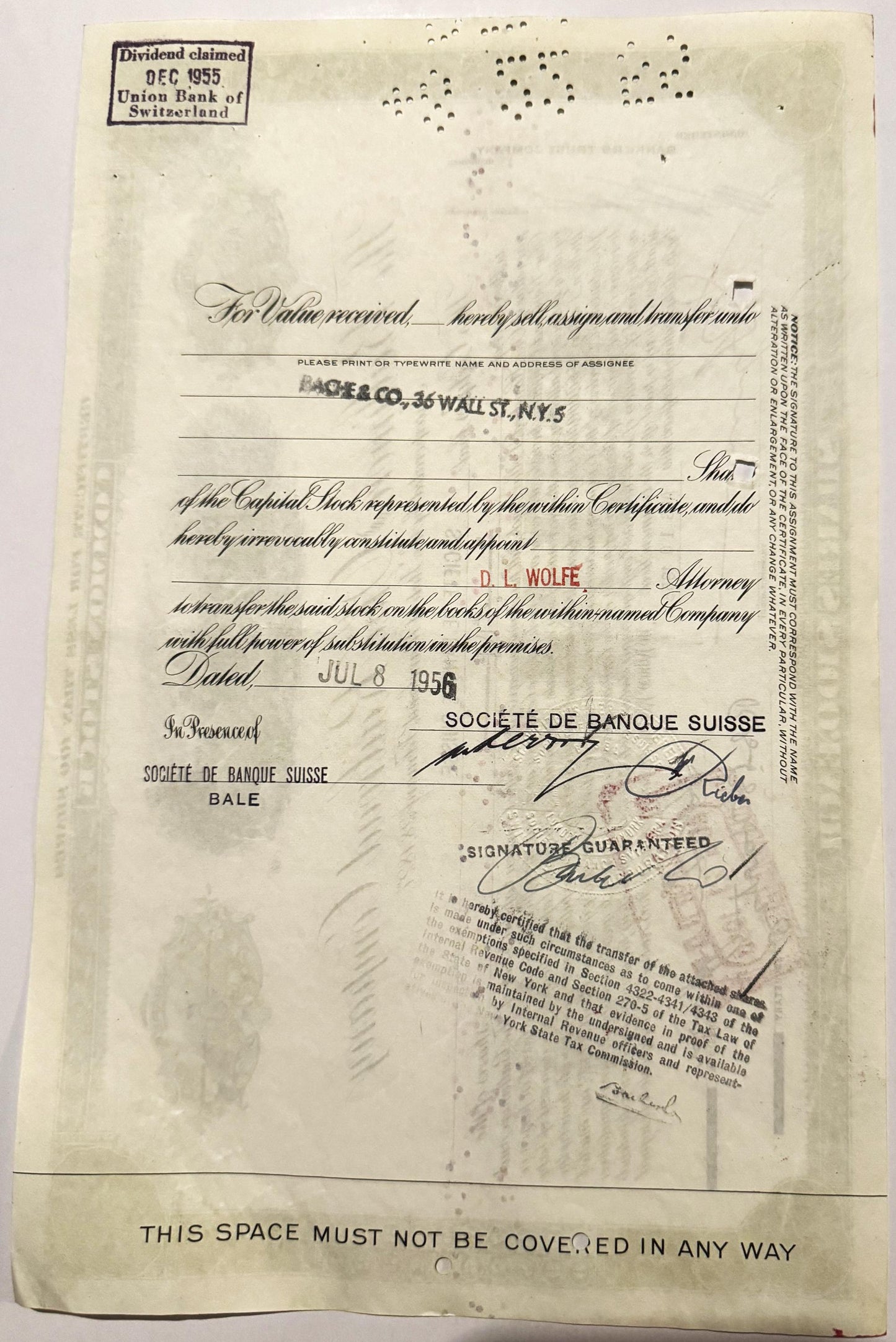
Part of what makes certificates from this find so compelling is the financial paper trail stamped and signed across them. Certificates from this offering carry the fingerprints of an international institutional holder — Société de Banque Suisse, the French name of the Swiss Bank Corporation, a major Swiss investment bank that would go on, decades later, to merge with the Union Bank of Switzerland and become UBS. In the mid-1950s, it was common practice for large European banking houses to hold blocks of blue-chip American railroad stock as part of their investment portfolios, and the B&O — as one of the oldest and most storied names on the American rails — was exactly the kind of "safe" American holding a Swiss bank of that era would want on its books.

Certificates in this series carry the printed designation of Bankers Trust Company as registrar and transfer agent — one of the great New York money-center banks of the 20th century, whose job was to keep the official books of who owned what on Wall Street. Many pieces from this same group also bear the assignment stamp of Bache & Co., a well-known Wall Street brokerage headquartered at 36 Wall Street, along with a dividend-claimed stamp from the Union Bank of Switzerland — small paper footprints of the real financial machinery that moved this stock from a European vault back into American hands. It's a genuinely satisfying detail for anyone who loves the paper trail of finance: this isn't just a decorative certificate, it's a document that shows its own working life, crossing an ocean and passing through two of the biggest financial institutions of its day before ending up as a collectible.


🖨️ The Engraver's Craft Behind the Certificate

The imprint along the border reads International Bank Note Co., New York — the security printing firm responsible for engraving this certificate. In the era of physical stock certificates, engraving wasn't a luxury; it was a requirement. The New York Stock Exchange required that certificates for exchange-listed companies be engraved by a recognized security printer specifically to guard against forgery, which is why certificates like this one carry the fine, intricate line-work, guilloché borders, and vignette artistry more commonly associated with currency than with paperwork. That steel-engraving tradition — the same craft used to print banknotes and bonds — is exactly what gives these old railroad certificates their enduring visual appeal today: they were never meant to be merely functional, they were built to look unforgeable and important, and they still do.


📜 Paper That Once Was Money

Stock certificates like this one belong to a much older tradition than most people realize. The idea of a paper share representing ownership in a company dates back to the earliest joint-stock corporations of the 1600s, and for the three centuries that followed, an engraved certificate like this was the actual, physical proof of ownership — the only thing standing between an investor and their stake in a company. There was no database, no digital ledger; there was only the paper, the signatures, and the registrar's stamp. In recent decades, the entire system has shifted to electronic record-keeping, and corporations have largely stopped issuing paper certificates altogether — which is precisely why surviving certificates like this one, especially from a company as historically significant as the B&O, have become treasured objects of scripophily (the collecting of stock and bond certificates) rather than ordinary paperwork. They're tangible, beautifully engraved artifacts of a financial world that no longer exists on paper.


📉 From the Rails of the Nation to the History Books

The B&O's own corporate story eventually came full circle. After more than a century as an independent giant of American railroading, the Chesapeake and Ohio Railway took financial control of the B&O in the early 1960s. The two railroads, along with the Western Maryland, were brought together under the Chessie System banner in the 1970s while still technically operating separately, before the whole group merged into CSX Corporation in 1980. The Baltimore and Ohio Railroad's own corporate existence finally came to an end in 1987, when it was formally absorbed into the Chesapeake and Ohio Railway on its way into CSX Transportation. Today, the B&O's legacy is preserved not on the balance sheets of Wall Street but in places like the B&O Railroad Museum in Baltimore and the beautifully restored Ellicott City station — the oldest surviving railroad depot in the country — both living reminders of just how far that first thirteen-mile stretch of track eventually carried the nation.


🖼️ Display Ideas

  • 🚂 Framed on its own as a centerpiece for a train room, model railroad layout, or railroad memorabilia wall
  • 🎲 Hung alongside a vintage Monopoly board for a game room that celebrates the real history behind the little green houses
  • 🏦 Paired with vintage stock ticker tape, brokerage ephemera, or Wall Street photography for a finance-themed office or den
  • 📚 Displayed in a home library or study alongside American history and industrial-era books
  • 🎁 Given as a milestone gift to a stockbroker, financial professional, railroad enthusiast, or history-loving graduate
  • 🖋️ Matted with a period map of the B&O rail lines or a photograph of the Ellicott City depot for added context

🎁 Who Collects These

Scripophily collectors seek out B&O certificates as one of the true blue-chip names in American railroad stock history — a company whose founding predates nearly every other railroad in the country. Railroad history buffs and model train enthusiasts love them as tabletop and wall pieces that connect directly to the equipment and lines they study. Monopoly fans and game-room collectors are drawn to the B&O for its surprising board-game fame. Baltimore and Maryland history lovers value it as a genuine piece of their state's industrial heritage, and collectors of Wall Street and financial history appreciate the engraved craftsmanship and the real paper trail of registrars, banks, and brokers stamped across it.


❓ FAQ

Is this a genuine, issued stock certificate?
Yes. This is an authentic common stock certificate of The Baltimore and Ohio Railroad Company, engraved by International Bank Note Co., New York, and issued and processed through real transfer offices and registrars during its working life.

Is 1827 the date this certificate was printed?
No — 1827 is the year the B&O Railroad was chartered by the State of Maryland, and it's proudly printed on every certificate as part of the company's identity. The certificates themselves, in this green "Certificate for Less Than 100 Shares" style, were issued in the mid-20th century, decades after that founding charter.

Can this certificate still be traded or redeemed as stock?
No. The B&O's own corporate existence ended in 1987 when it was absorbed into what eventually became CSX Transportation, so these certificates are no longer active securities — they're historical collectibles and scripophily pieces.

What does "Certificate for Less Than 100 Shares" mean?
Railroads and other corporations often printed a distinct certificate design for smaller share blocks (under 100 shares) versus larger institutional bl

Shipping

🚚 Shipping & Handling

  • Shipping costs and timing are calculated at checkout.
  • Items curated and shipped directly by me include U.S. shipping at no additional cost, professionally packed to ensure safe arrival of your artifact.

Items from Vetted Pro Collectors
Shipping for items offered by vetted Pro Collectors is determined at checkout. All Pro Collector listings are reviewed to ensure fair, reasonable shipping practices.

For full details, please refer to our Shipping Policy.

Returns & Exchange

Take your time — you've got a full six months. If a piece isn't right for you, send it back the way it reached you and we're good.

In the first 30 days your money goes straight back the way you paid. After that it's store credit, so you can put it toward something you'd rather have.

Return shipping we sort out between us, case by case. I don't make this difficult.

If something arrives damaged, or it isn't what I said it was, send me a photo within 48 hours and I'll make it right.

Email info@vintageantiquesgifts.com or call 802-356-9872 — that's me answering, not a call center.

The only things I can't take back are custom or special-order pieces and gift cards.

View full details
  • 5 stars: 1 (100%)
  • 4 stars: 0 (0%)
  • 3 stars: 0 (0%)
  • 2 stars: 0 (0%)
  • 1 star: 0 (0%)
T
Travis Bolinger (San Francisco, US)
Awesome family owned company

I have ordered multiple stocks and bonds from Travis, his customer service is top notch, the product was beautiful, and his thoughtful input into each and every order is very much appreciated. Will ONLY be buying from this company from now on 🙂