Skip to product information
1 of 3

Vintage and Antique Gifts

Vintage B&O Railroad Stock Certificate 🚂 100 Shares 1930s 1950s Baltimore & Ohio Engraved Banknote Vignette

Vintage B&O Railroad Stock Certificate 🚂 100 Shares 1930s 1950s Baltimore & Ohio Engraved Banknote Vignette

Regular price 6.00 USD
Regular price Sale price 6.00 USD
Sale Sold out
Shipping calculated at checkout.
Quantity

Size: 11.5 x 7.25 inches

🚂 A Hundred-Share Round Lot in the Railroad Everyone Knows From the Board Game

This is an original common stock certificate of the Baltimore & Ohio Railroad Company — and it is a big one: one hundred shares, a full round lot rather than the small share lots most surviving certificates represent, printed in a warm, displayable brown with the classic Tom Thumb-era train vignette. It is genuine antique scripophily: a real, issued-and-cancelled railroad share, not a reproduction or a modern novelty print. Everything described here is read directly from certificates of this type in the photographs; nothing is invented.


📌 About This Listing — Please Read

These brown hundred-share B&O certificates come from a single original group, printed across roughly two decades spanning the 1930s into the 1950s, and the exact typed date, serial number, registered holder and signatures vary from one certificate to the next. The photographs document representative examples from that group — so the year and the holder name shown in the pictures may differ on the certificate you actually receive. What is consistent, and what you are buying, is the certificate type itself: an original engraved Baltimore & Ohio Railroad brown common stock certificate for one hundred (100) shares, printed by the International Bank Note Company, with the same big "100" medallions, the same Tom Thumb-era vignette, the same brown border and color, in comparable honest antique condition. The color below describes the examples in the photos and this certificate type, and is accurate to both.


🎩 "B. & O." — the Railroad on the Monopoly Board

Almost everyone has held a little piece of the B&O without ever holding a share of it — because the Baltimore & Ohio is one of the four railroads on the classic Monopoly board, the "B. & O. Railroad" that generations of players have bought, mortgaged and traded across the kitchen table. That fame is not an accident; the game reached for the B&O precisely because it was one of the great, familiar names of American railroading. Here is the real thing behind the game token: an actual, issued share certificate of that very railroad, engraved, signed and cancelled, the genuine article the board-game square only stands in for. For anyone who grew up landing on B. & O., this is a quietly delightful object to own.


💯 A Round Lot — Read the Big Numbers

Where a small certificate whispers, this one announces itself. Because it represents a full hundred shares, the engravers gave it two large ornamental medallions — a bold "100" set into each of the panels that flank the central vignette — and spelled the amount out in engraved capitals, "ONE HUNDRED," across the body. These certificates were printed across roughly two decades, spanning the 1930s into the 1950s — the twilight of the great steam railroads, just before the diesels and then the airlines and interstates remade travel entirely. A hundred-share block of the B&O was a real position in a real railroad, taken through the high-water years of the passenger train. On the brown example photographed, that block was issued in the early 1950s; another certificate from the group will carry its own date and holder.


🎨 The Engraved Vignette — Watch the Double-Deck Coach

Across the top sits the beautifully engraved tableau of early American steam that these certificates are loved for. A pioneer locomotive of the 1830s leads the way, an engineer standing on its little open platform. But the detail to watch on this certificate is the carriage riding behind: an ornate, open double-deck passenger coach, its riders seated below and more passengers perched along the roof under a canopy, the whole thing looking more like a fine stagecoach set on rails than any modern train car. That is exactly what the earliest passenger railroading looked like — road-carriage bodies mounted on flanged wheels — and the engraver caught it in crisp intaglio line, complete with a sailboat-dotted bay and soft mountains behind. The security printer's imprint sits at the foot of the sheet.

The whole certificate is printed in a warm, rich brown — the border, the twin "100" medallions, the "COMMON STOCK" banner across the top and the "SHARES $100 EACH" ribbon below. Two company officers signed it by hand. It is a handsome, substantial-looking document, designed to convey exactly the permanence and weight that a hundred-share holding was meant to represent.


📜 The Back — a Documented Transfer

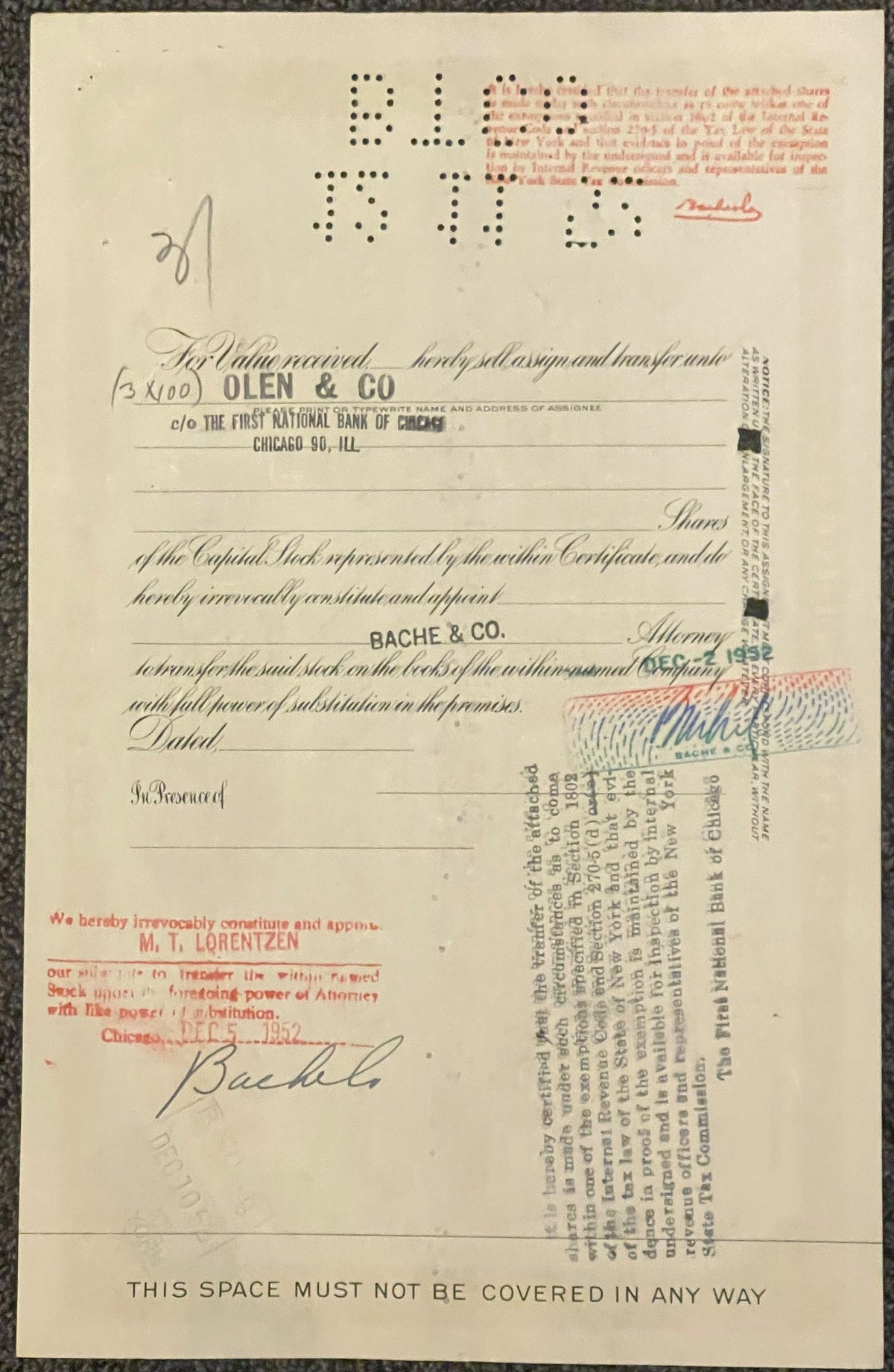
The reverse records the certificate's transfer in ink and rubber stamp — though, as with the dates, the exact assignment differs certificate to certificate. On the brown example photographed, the hundred shares were assigned unto Olen & Co., care of The First National Bank of Chicago — one of three hundred-share blocks moving together, marked "(3 x 100)" — with Bache & Co. named as the transferring attorney. And here is a small connective pleasure for collectors: the same red attorney stamp of M. T. Lorentzen appears on the back of that brown example as on the blue ten-share B&O example that a Swiss bank once owned — the same hand at the transfer desk, a very different holder apart. A New York State Tax Commission notice, clerk stamps and a perforated cancellation complete the record.


🔎 What Collectors Look For, and Why This Delivers

Scripophily — the collecting of antique stocks and bonds — rewards a few particular qualities, and this certificate type carries them. It is a blue-chip issuer with instant name recognition, thanks to that Monopoly-board fame. It is a large-denomination hundred-share round lot, more visually impressive than the common single-digit certificates, with those big "100" medallions doing real display work. It has a beautifully engraved period vignette from a respected security printer, and a documented transfer on the back tying the paper to real holders. And it is decorative and historical at once — a warm brown that frames beautifully and a story anyone can follow.


📈 What a Hundred-Share Certificate Actually Is

A stock certificate was, for most of two centuries, the physical proof that you owned a piece of a company — and this one is a substantial piece. It certifies one hundred shares of the common stock of the Baltimore & Ohio Railroad, at a par value of one hundred dollars each, which is why it is called a "round lot": a full, even hundred-share block, the standard unit in which stock was traded, rather than the odd handful most surviving certificates represent. That scale is written all over the design, from the twin "100" medallions to the "ONE HUNDRED" spelled across the body. When the block changed hands, the owner signed the assignment on the back, an attorney was named to record the transfer on the company's books, a bank processed it, and the certificate was cancelled with the punch and perforation you can see on the sheet. That cancellation is the honest mark of a document that finished its working life — and the reason it survived to be collected, filed away rather than redeemed, to surface decades later as a genuine artifact of who owned the railroads.


🎲 The Four Railroads of the Monopoly Board

The Monopoly connection is worth telling in full, because it is entirely true and it is why these certificates delight people who have never collected anything. The classic American Monopoly board carries four railroads — Reading, Pennsylvania, B. & O., and Short Line — set at the four midpoints of the board, the properties a shrewd player collects to squeeze rent out of every lap. The board is modeled on the streets of Atlantic City, New Jersey, and three of its four railroads were real companies that actually served the region; the Baltimore & Ohio is the "B. & O." among them. Owning a genuine B&O share certificate is about as close as anyone can come to holding a piece of the Monopoly board in real life — not a reproduction, not a game token, but an original document of the actual railroad the square was named for, engraved and signed and cancelled. Hand it to someone beside a Monopoly set and the delight is instant.


🇺🇸 The First American Railroad — and Its Famous First Stone

The Baltimore & Ohio was chartered in 1827 as the first common-carrier railroad in the United States, and its construction began with a ceremony that tied it straight to the nation’s founding: on the Fourth of July, 1828, the first stone was laid by Charles Carroll of Carrollton — the last surviving signer of the Declaration of Independence — who reportedly counted it among the most important acts of his life, second only to signing the Declaration itself. The company Carroll helped inaugurate became an enduring American institution, and this certificate is a genuine share in it.

🖼️ How to Live With It

  • 🖼️ Frame it to feature the brown border and the twin "100" medallions; the big numbers make it read across a room.
  • 🎩 Hang it with a vintage Monopoly board or set for a witty, real-and-game pairing that always draws a smile.
  • 🏙️ Give it a place in a study or office as an authentic artifact of Wall Street and the American railroad age.
  • 📚 Pair it with histories of the B&O or of the great American passenger trains in their final decades.
  • 🎁 Give it to a train lover, a Monopoly devotee, or a collector of antique financial paper — a hundred shares of history, framable and affordable.

Condition is graded honestly: these are genuine period documents, and they show honest edge wear, light handling and even toning consistent with their age. The certificate you receive will be the same brown hundred-share B&O type shown, in comparable condition, offered exactly as photographed.

Shipping

🚚 Shipping & Handling

  • Shipping costs and timing are calculated at checkout.
  • Items curated and shipped directly by me include U.S. shipping at no additional cost, professionally packed to ensure safe arrival of your artifact.

Items from Vetted Pro Collectors
Shipping for items offered by vetted Pro Collectors is determined at checkout. All Pro Collector listings are reviewed to ensure fair, reasonable shipping practices.

For full details, please refer to our Shipping Policy.

Returns & Exchange

Take your time — you've got a full six months. If a piece isn't right for you, send it back the way it reached you and we're good.

In the first 30 days your money goes straight back the way you paid. After that it's store credit, so you can put it toward something you'd rather have.

Return shipping we sort out between us, case by case. I don't make this difficult.

If something arrives damaged, or it isn't what I said it was, send me a photo within 48 hours and I'll make it right.

Email info@vintageantiquesgifts.com or call 802-356-9872 — that's me answering, not a call center.

The only things I can't take back are custom or special-order pieces and gift cards.

View full details
  • 5 stars: 1 (100%)
  • 4 stars: 0 (0%)
  • 3 stars: 0 (0%)
  • 2 stars: 0 (0%)
  • 1 star: 0 (0%)
T
The

This was a gift from my brother-in-law, and he loved it.