Skip to product information
1 of 5

Vintage and Antique Gifts

Vintage 1950s Gainesville Police 🚔 Special Tin Lithography Badge NOS Original Card Japan Novelty Pin American Made

Vintage 1950s Gainesville Police 🚔 Special Tin Lithography Badge NOS Original Card Japan Novelty Pin American Made

Regular price 20.00 USD
Regular price Sale price 20.00 USD
Sale Sold out
Shipping calculated at checkout.

Description

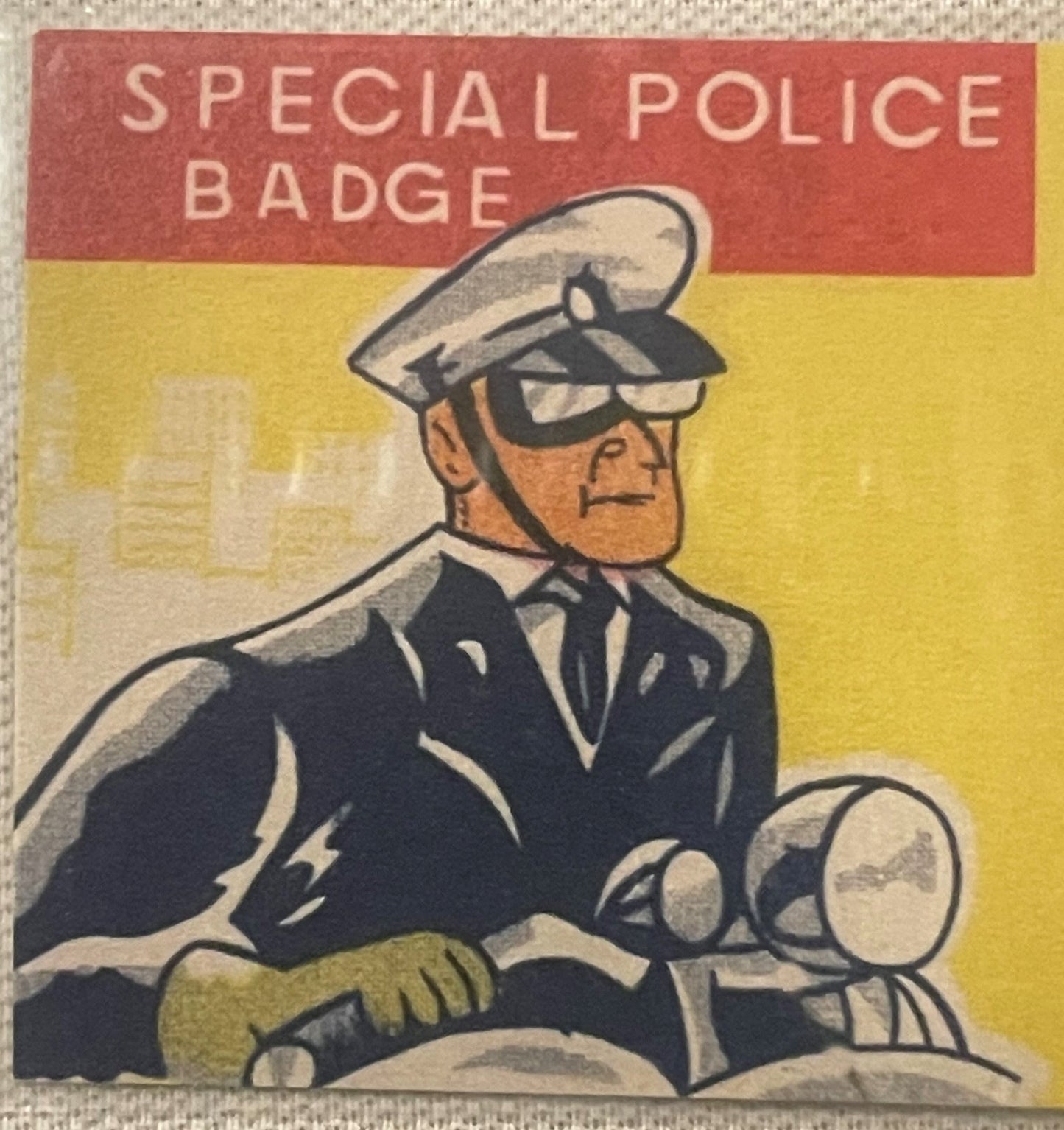
# What Does a 1950s Florida Badge Look Like After Seventy Years? ✨ — Like the Day It Left the Counter. There is a moment every serious collector knows. You are sorting through a flat of old cards at an estate sale, or digging through a wooden crate at an antique mall somewhere off the highway, and your fingers land on something that simply feels *different.* The surface has a depth to it. The colors hold. The card hasn't yellowed into oblivion. You turn it over and the back is clean, the pin mechanism intact, and for one suspended second you are not standing in a dusty booth in the present — you are standing at a Woolworth's counter in 1953, and a kid in a crew cut is dropping nickels into a clerk's palm and reaching for exactly this. That is what this badge does. Every single time. What you are looking at here is a genuine New Old Stock tin lithography **Gainesville Police Special Badge**, riding its original bright yellow display card, produced in the early 1950s and never once worn, never mounted on a wall, never stripped of its packaging. It came out of old retail stock exactly as it sat under that glass counter decades ago, and the fact that it survived that long — colors vivid, dome intact, card firm — is its own quiet miracle. --- ## 🏅 What This Is, Exactly — The Object, the Era, the Process This is a **round, slightly domed tin lithography novelty badge**, measuring **2 inches across**, presented on its **original yellow display card** which measures **4 inches by 2.4 inches**. The badge reads *Gainesville Police* in gold lettering across a deep navy shield. At its center, the Gainesville Police Department's own emblem is rendered in full: the outline of the state of Florida filled in solid red, a white star pinpointing Gainesville on the map, and a green palm tree rising from a curving shoreline in the foreground. Two gold stars flank the lower register of the design. The whole surface is finished in a high-gloss lithography process — not a flat print, not a sticker — a *lithographed tin* surface that gives the colors a dimensional richness, almost like looking into enamel. The card is that vivid, graphic mid-century yellow that you remember from five-and-dime store displays: bold, unapologetic, designed to catch a child's eye from across a crowded glass case. The badge is categorized as **New Old Stock** — NOS in collector shorthand — meaning it was manufactured, carded, and placed in distribution but was never sold at retail. It went into storage instead, and it has emerged now in the same condition it carried out of the factory. That designation matters enormously in the novelty badge world, because these pieces were *made to be worn and played with*, and most of them were. Finding one still on card, still bright, still complete, is the exception rather than the rule. The piece was **made in Japan**, as were the overwhelming majority of high-quality tin lithography novelty items sold throughout the United States during the 1950s. That provenance is not incidental — it is part of this badge's story, and we will get into that history in detail below. --- ## 🏭 The Industry Behind the Badge — Tin Lithography, Novelty Trade, and the Five-and-Dime Counter To understand what you are holding, you have to understand the world that made it possible. Tin lithography as a commercial process dates to the mid-nineteenth century, but it reached its golden age in the post-war decades — roughly 1946 through the early 1960s — when a combination of cheap raw material costs, sophisticated color printing presses, and an enormous American consumer appetite for inexpensive, visually bold toys and novelties created an industry unlike anything before or since. The process itself involves printing directly onto thin sheet tin using offset lithography, then cutting and shaping the printed sheet into three-dimensional forms. The result is a surface that is simultaneously *printed* and *structural* — the image is baked into the metal, not applied on top of it. That is why these badges hold their color across decades in ways that paper-label or sticker-over-metal pieces simply cannot. The lithography *is* the badge. There is no layer to peel, no surface to chip. When you see color on a tin lithography badge from the 1950s, you are seeing color that was fused to metal when Eisenhower was in the White House. The novelty badge market in this era was enormous and largely invisible to historians for many years. Wholesale jobbers — middlemen who sat between manufacturers and the nation's army of five-and-dime stores, drugstore toy counters, and souvenir shops — would place orders for localized novelty items by the gross. A jobber covering the Southeast might order sheriff badges for a dozen different Florida counties, police badges for major and minor cities alike, and fire chief sets for towns that most people outside those towns had never heard of. The badges were inexpensive to produce, profitable per unit, and moved quickly from the display cards into the hands of children. **The fact that a badge was made for Gainesville specifically** — not just a generic "Police" badge, but one bearing the actual Gainesville Police Department shield design — tells you that someone in that supply chain thought Gainesville was worth a dedicated run. That is a small but meaningful piece of civic history in pressed tin. Lore passed down among collectors holds that the most detailed and colorful local-issue novelty badges of the 1950s often came from a relatively small cluster of Japanese manufacturers who had converted their facilities from wartime light-metal production to consumer goods after 1945. These factories, operating under American import contracts, competed fiercely on quality as a differentiator, and the result was a generation of lithographed tin toys and novelties that *exceeded* the visual quality of much of the domestic novelty output of the same period. Collectors who have spent decades working this category will tell you flatly: the best-looking 1950s tin novelty badges are almost invariably the Japan-made pieces. This badge — with its clean gold lettering, its domed form, its vivid color field — is a prime example of that quality. --- ## 🌴 Gainesville, Florida in the Early 1950s — The Town Behind the Badge Gainesville in the early 1950s was a city in the middle of its own transformation. The University of Florida had been accepting women since 1947, and the post-war GI Bill was flooding the campus with veterans on their way to degrees and futures. The city's population was climbing steadily, the downtown corridor along University Avenue was active and commercial, and the Gainesville Police Department was a real and visible civic institution in a community that took pride in its institutions. The Alachua County seat sits in north-central Florida, far enough from the coasts to feel like a different Florida than the one most outsiders picture — less beach, more live oak, more Spanish moss, more of the Florida that existed before the tourism explosion fully remade the peninsula. In 1950 Gainesville, a child could walk to a five-and-dime on a Saturday afternoon with change from a week's worth of small chores and come home with something to show for it. A badge that said *Gainesville Police* on a gold-lettered shield was not just a toy — it was a piece of *their* city, small and shiny and theirs. Local legend has it that the Gainesville area five-and-dimes and variety stores of the early 1950s kept rotating displays of local-themed novelties near the front entrance as a deliberate strategy to catch foot traffic from the university crowd as well as neighborhood children — that pairing of the collegiate market and the kid market was, the story goes, a particular feature of Gainesville retail that set it apart from comparable small southern cities. Whether or not the specific display arrangement survives in any documented record, what is certain is that Gainesville-specific novelty items from this period are genuinely uncommon on the collector market today, which gives this badge a scarcity weight beyond its age alone. The Gainesville Police Department shield design captured on this badge — the state outline in red, the white star, the palm and shoreline — reflects the civic graphic language of mid-century Florida law enforcement, a visual vocabulary built around the state's distinctive geography and its pride in place. That a novelty manufacturer took the care to reproduce this specific emblem accurately, at this scale, in this process, is a small act of documentary faithfulness that collectors of Florida history and law enforcement memorabilia both recognize and value. --- ## 🖼️ Display Ideas - 🪵 **Frame it on original card.** A simple shadow box with a dark navy or cream mat lets the yellow card pop without competing with it — the mid-century color palette does all the work. - 🚓 **Law enforcement tribute wall.** Pair it with other vintage Florida police memorabilia — department photos, vintage patches, old press credentials — for a dedicated wall grouping that tells a regional story. - 📚 **Florida history bookshelf anchor.** Propped against a row of Florida history volumes or local Gainesville/Alachua County reference books, the badge becomes an instant three-dimensional accent piece. - 🎓 **University of Florida collector's display.** For Gator alumni with a passion for Gainesville history, this badge sits naturally alongside vintage UF pennants, game programs, and campus photographs from the same era. - 🏛️ **Mid-century Americana vignette.** Grouped with other NOS novelty items — tin toys, character pins, carded dime-store finds from the same decade — it anchors a curated 1950s counter display that captures the whole era. - 🎁 **Gift-ready as found.** The original card is its own presentation. No frame required for gifting — the yellow card, the badge, and the period typography arrive as a self-contained artifact of American mid-century life. --- ## 🎁 Who Collects These The universe of collectors who converge on a piece like this is wider than you might expect, and each of them brings a different reason to want it. **Florida history collectors** — and this is a devoted and growing community — are always looking for items that connect to specific cities and counties rather than generic state imagery. A badge that names *Gainesville* specifically, that carries the actual GPD shield, is a primary-source artifact of Alachua County civic life in a way that a generic Florida souvenir simply is not. **Tin lithography and tin toy collectors** know exactly what NOS on original card means in this category. These collectors track condition obsessively because they understand how rarely these pieces survived intact. A domed tin badge still wearing its full color, still carded, still with its original display presentation — that is a condition grade that commands attention in any serious collection. **Law enforcement memorabilia collectors** pursue vintage badges across all categories — real service badges, presentation pieces, novelty issues — and the Gainesville Police shield design gives this piece specific departmental identity that generic "Police" badges lack. It sits comfortably in a collection organized around Florida law enforcement history. **Childhood nostalgia collectors** — adults who grew up in Gainesville or in Florida in the 1950s, or who grew up *anywhere* in mid-century America with access to a five-and-dime counter — respond to this piece on a purely emotional register. It is the *feeling* of that counter, that yellow card, that shiny dome catching the fluorescent light, that they are buying as much as the object itself. **Serious gift-givers** who have someone in their life with a connection to Gainesville, to Florida law enforcement history, or to mid-century Americana know that a piece like this — original, intact, NOS, genuinely old — is in a completely different category from reproduction or decorative items. It is a real thing from a real time, and the people who receive gifts like this *know the difference.* --- ## ❓ Frequently Asked Questions ### Is this badge actually from the 1950s, or is it a reproduction? This is a genuine 1950s period piece — not a reproduction, not a later re-issue, not a modern commemorative. The tin lithography process, the card stock, the yellow ground color, the typography, and the manufacturing construction are all consistent with early 1950s novelty badge production. The "Made in Japan" designation on pieces of this type is itself a dating marker, as the specific trade patterns and import labeling conventions that produced this style of novelty badge for the American market are well-documented to the postwar decade. When collectors describe a piece as NOS — New Old Stock — they mean exactly what this badge is: manufactured in its era, never sold at retail, preserved in its original state. ### What does NOS mean and why does it matter so much for condition? NOS stands for New Old Stock, a term borrowed originally from the automotive and hardware trades that has become standard across all antique and vintage collecting categories. It means the item was produced, packaged, and entered into a distribution or storage pipeline but was never purchased and used by a consumer. In the novelty badge world, NOS status is significant because these items were *designed and priced* for active use by children — they were meant to be worn, played with, scratched, bent, and eventually discarded. The survival rate for used examples in fine condition is low. An NOS example, still on its original card, represents the piece exactly as it left the factory and exactly as it would have appeared in the store display. For collectors, that is the highest possible standard. ### How sturdy is the card after seventy years? Is it fragile? This is characteristic of quality carded novelty items that were stored flat and away from moisture — the card stock used by novelty manufacturers of this era was reasonably substantial by the standards of its day, and when pieces were kept in stock rather than displayed in humid retail environments, the cards often survived in very presentable condition. The card on this piece retains its color and structural integrity. Appropriate care going forward — framing under UV-protective glass, storage in an acid-free environment — will preserve it for another generation without difficulty. ### The badge says "Made in Japan" — what does that mean for its connection to Gainesville? The Japan origin is entirely consistent with the history of this category and does not diminish the piece's Gainesville identity in the slightest. The localization of these badges — the specific city name, the specific department shield design, the geographic details of the Florida state outline — was specified by American wholesale buyers or jobbers who ordered customized runs for regional distribution. The manufacturer produced the design to spec. The Gainesville Police emblem on this badge, the accurate state outline, the white star marking Gainesville's location — those details came from American sources who knew the market they were serving. The badge is a Gainesville artifact that happens to have been manufactured in Japan, in exactly the same way that a great deal of beloved mid-century American popular culture was produced. ### Is the pin mechanism on the back functional? Yes. The pin mechanism is intact and functional, as is standard for NOS pieces of this type that have been properly stored. The back clasp on 1950s tin novelty badges of this construction is a simple C-catch or roll-over pin, standard to the category, and on an unplayed-with NOS example it operates exactly as it did when the badge was new. Whether you choose to wear it, display it on card, or frame it, the hardware is there and working. ### Is this the kind of thing that appreciates in value over time? Localized NOS novelty badges with verifiable city-specific designs — particularly from smaller or mid-sized cities where production runs were limited — have performed consistently well in the collector market over the past two decades. The combination of geographic specificity, NOS condition, original card presentation, and the aging out of the population that has direct personal memory of these items all contribute to a collector market that tends to treat quality examples of this type with increasing seriousness. That said, the honest answer is that no one can predict any individual item's future value. What collectors and dealers in this category agree on is that *condition* is the overriding variable, and a fully intact NOS example on original card is in the tier where value tends to hold and build. ### Can this work as a gift for someone who isn't a collector? Absolutely — and this is actually one of the ways pieces like this find their best homes. A Gainesville connection, a Florida law enforcement background, a childhood spent in the South in the 1950s, a passion for mid-century Americana — any one of those threads is enough to make this badge land as a genuinely meaningful gift rather than a generic decorative object. The original yellow card does a lot of the work on its own: it arrives looking exactly like what it is, a real piece of the past in original condition, and most people respond to that instinctively even without a collecting background. It is, in the best possible sense, something they have never seen before — and once they hold it, they understand it immediately.

Shipping

🚚 Shipping & Handling

  • Shipping costs and timing are calculated at checkout.
  • Items curated and shipped directly by me include U.S. shipping at no additional cost, professionally packed to ensure safe arrival of your artifact.

Items from Vetted Pro Collectors
Shipping for items offered by vetted Pro Collectors is determined at checkout. All Pro Collector listings are reviewed to ensure fair, reasonable shipping practices.

For full details, please refer to our Shipping Policy.

Returns & Exchange

Product Page Return Policy

  • 60-Day Returns – Items must be in original condition.
  • Refunds – Issued after inspection (excluding shipping costs).
  • Return Shipping – Customer is responsible unless item is damaged or incorrect.
  • Damaged/Incorrect Items – Contact us within 48 hours for a replacement or refund.
  • Easy Returns – Email info@vintageantiquesgifts.com or call 802-356-9872 to initiate a return.

For full details, visit our Refund Policy.

View full details