Skip to product information
1 of 4

Vintage and Antique Gifts

Vintage 1960s Monmouth Park Jockey Club Stock Certificate 🐎 Jersey Shore Horse Racing, Oceanport NJ

Vintage 1960s Monmouth Park Jockey Club Stock Certificate 🐎 Jersey Shore Horse Racing, Oceanport NJ

Regular price 16.45 USD
Regular price Sale price 16.45 USD
Sale Sold out
Shipping calculated at checkout.
Quantity

🏇 What Do You Do With a Piece of Paper That Once Controlled a Racetrack?

There's a particular kind of magic in holding a stock certificate from a place you can still drive to. Monmouth Park is real. The dirt is still turned every spring in Oceanport, New Jersey, horses still thunder down that mile oval, and somewhere in the archive of American finance, certificates just like this one once represented real ownership in the club that built it back from nothing. This isn't a reproduction of racing history — it's a genuine artifact of it, the kind of paper that used to sit in a lawyer's safe deposit box or a horseman's desk drawer, waiting quietly for a day that, in most cases, never came for it to be redeemed.

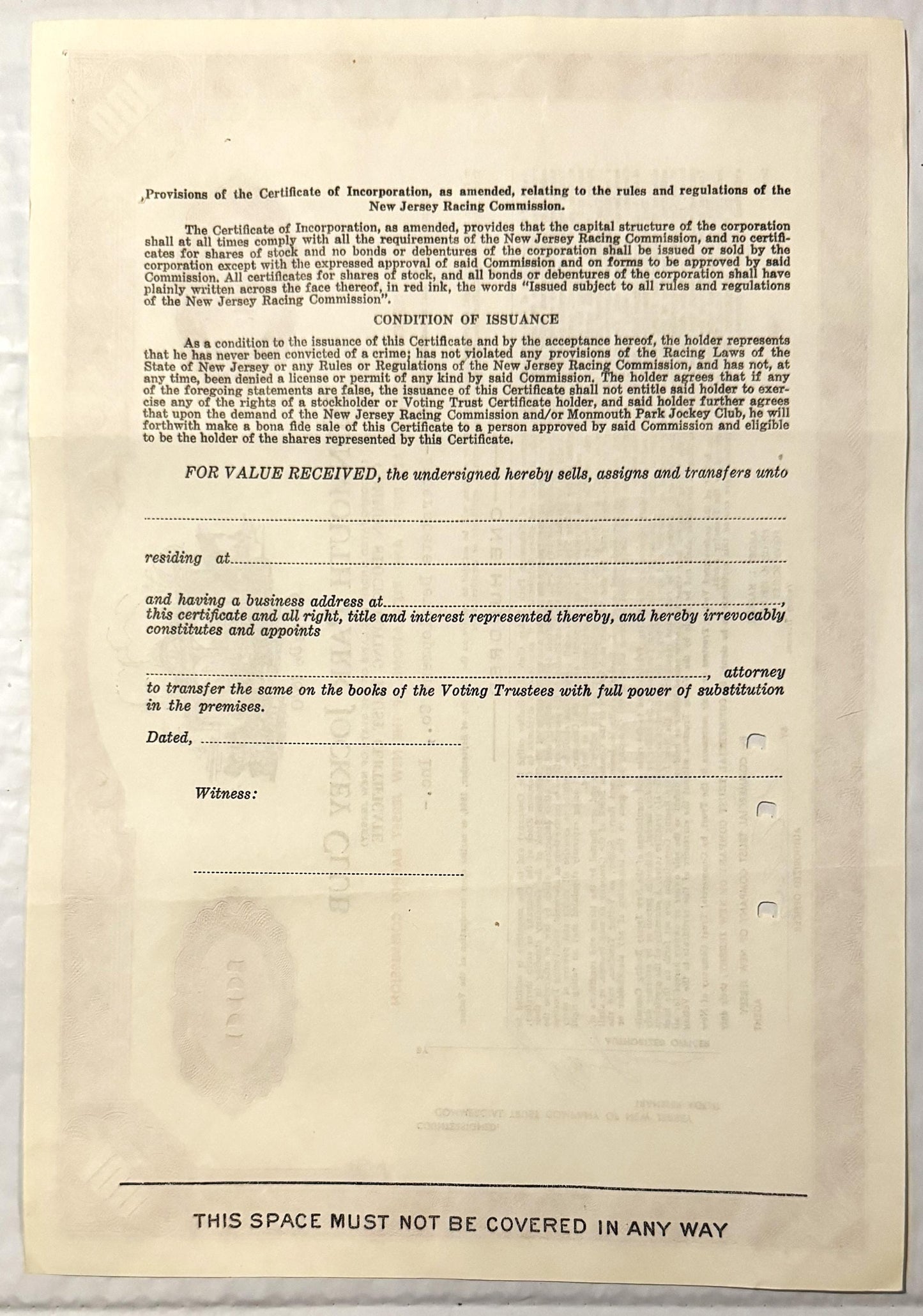
This is a genuine Monmouth Park Jockey Club Common Stock Voting Trust Certificate, issued by the Club — incorporated under the laws of the State of New Jersey and headquartered at the track itself in Oceanport — during the club's mid-20th-century racing era, when Monmouth Park operated under a formal Voting Trust Agreement among its trustees.

The certificate measures a substantial 12" x 8" (about 30.5cm x 20cm), printed on heavy engraved stock in the deep red and cream palette so recognizable from the golden age of American securities. Across the top, a broad Victorian-scrollwork border frames the piece like a proscenium arch, and at its center sits a beautifully engraved vignette of the original Monmouth Park grandstand entrance, horse-drawn carriages queued beneath its arches, smoke curling into the sky above, captioned simply: "Opening Day 1870." Bold serif lettering spells out MONMOUTH PARK JOCKEY CLUB beneath it, followed by dense, formal legal language describing the rights of the shares, the par value, and the names of the Voting Trustees — Amory L.

Haskell, Philip H. Iselin, and Reeve Schley — with countersignature from Commercial Trust Company of New Jersey as transfer agent. This is an original issued voting trust certificate — made out to a holder, date-stamped, and signed in ink by the trustees' agent and the transfer agent — an excellent surviving example of mid-century American security engraving and New Jersey racing history alike.


🏛️ The Jockey Club Behind the Certificate

The words printed across the top of this certificate — "Issued Subject to All Rules and Regulations of the New Jersey Racing Commission" — tell you everything about the era this piece comes from. Horse racing with betting attached has always lived at the mercy of state law, and Monmouth Park's own story is really the story of that relationship swinging from boom to prohibition and back again.

The certificate you're holding is a Voting Trust Certificate, not an ordinary share of stock — a distinction worth savoring. Under a Voting Trust Agreement dated in the mid-1950s, the Club's actual shares of common stock were held by a small group of trustees, who then issued certificates like this one to the real owners. The trustees kept the voting power consolidated in their own hands — a common and perfectly legal structure at the time for closely held companies, especially one operating under the watchful eye of a state racing commission — while the certificate holder retained every economic right: dividends, distributions, and eventual delivery of the underlying stock once the trust expired. It's a small piece of corporate law history hiding inside a beautiful piece of paper, evidence of just how carefully regulated and structured a racetrack's ownership had to be in that era.

The par value printed on the certificate — one cent per share — is itself a quiet giveaway of how this stock was structured: a nominal, symbolic value typical of closely held sporting and club enterprises of the period, where the real worth lived in the land, the grandstand, and the racing calendar, not in a Wall Street ticker price.


🌊 Oceanport and the Track They Called the "Newmarket of America"

Long before this certificate was printed, Monmouth Park was already a legend along the Jersey Shore. The original track opened its gates in 1870 — the very date engraved into the vignette at the top of this certificate — built to lure summer visitors from New York and Philadelphia into the coastal resort towns of Monmouth County. It worked spectacularly. Within a few short seasons, Monmouth Park had built a reputation rich enough to earn itself the nickname "the Newmarket of America," a nod to England's own storied racing headquarters. Old-timers along the Shore still repeat that title with real pride — it was never an official designation, just a compliment that stuck because it was earned.

That first golden era didn't last. New Jersey outlawed betting in the early 20th century, and Monmouth Park's gates closed along with it — the grandstands sat silent for decades, a ghost of a track that regulars along the shore never quite stopped talking about. Local legend has it that families who'd once made a summer ritual of a day at the races kept the memory alive at kitchen tables and porch conversations for a generation, waiting for the day the horses might come back.

They did. When New Jersey legalized parimutuel wagering in the 1940s, a group of New Jersey businessmen — led by Amory L. Haskell and Philip H. Iselin, the very names on this certificate as Voting Trustees — organized the Monmouth Park Jockey Club and built an entirely new track a few miles from the original site, in Oceanport. On June 19, 1946, Monmouth Park reopened its gates to nearly 19,000 people — a homecoming crowd if there ever was one — reviving classic stakes races and installing a full modern racing calendar. It was this reborn Club, the one built by Haskell and Iselin's generation, that issued certificates exactly like this one through the 1950s and 1960s as the track became one of the most important summer racing destinations on the East Coast.


🐎 The Track Itself — A Character All Its Own

Anyone who's spent a summer afternoon at Monmouth Park knows the track has a personality as vivid as any horse that's ever run there. The main dirt course is a full mile oval, 100 feet wide, built up in careful layers of stone and sand beneath a soft cushioned top — engineered for speed but forgiving underfoot. Distance poles run the rail in a color code regulars learn by heart: green-and-white marking every eighth of a mile, red-and-white at the quarters, black-and-white at the sixteenths, so a sharp-eyed horseplayer can read a race's pace at a glance without ever checking a program. A separate turf course — seven-eighths of a mile of bluegrass and rye — hosts the longer grass races that give Monmouth its reputation among serious handicappers.

Behind the clubhouse sits a paddock built from oak, sixteen stalls wide, opening onto a leafy, English-style walking ring where horses are paraded before post time — old racegoers will tell you it's the quietest, most contemplative corner of the whole property, a world away from the roar of the grandstand. Out past the backstretch, barns shelter well over a thousand horses along with the grooms, trainers, and hot-walkers who care for them — enough of a working population that the backstretch has its own chapel, recreation hall, and post office, practically a small village unto itself. At the center of it all sits the Quadrangle, once home to the Frenchman's Kitchen, a concession stand collectors and old regulars still fondly recall for its wry house motto, passed down in racetrack lore ever since: "Eat your betting money, but never bet your eating money."


✒️ The People Whose Signatures Made It Official

Certificates like this one carry real names, not just decoration. Amory L. Haskell and Philip H. Iselin, listed here as Voting Trustees, were the driving forces behind Monmouth Park's 1946 revival — men whose reputations in New Jersey business and horse racing circles were substantial enough that the track's own showcase stakes race, the Haskell Invitational, still carries Amory Haskell's name today, run every summer as one of the marquee events on the American racing calendar. Reeve Schley, the third trustee named on the certificate, rounds out a board of men who quite literally put their names on the line — and their signatures on paper like this — to see the track rebuilt and running again after decades of silence.

The certificate was countersigned by Commercial Trust Company of New Jersey, acting as the Voting Trustees' registered transfer agent — the institution charged with keeping the official books of who owned what, a small but essential piece of the machinery that kept a mid-century racetrack corporation running on the up-and-up under state oversight.


🏁 Why It Still Resonates Today

Monmouth Park is still racing. That's the part that makes a certificate like this feel less like a relic and more like a living connection — you can visit the grandstand pictured in miniature on this very certificate's ancestor site, watch a summer card, and stand where Haskell and Iselin's rebuilt club once staged its comeback. For collectors along the Jersey Shore, in Monmouth County, and among American racing history and scripophily circles alike, that continuity is exactly the draw: a tangible link between the paperwork of ownership and the living, breathing sport that paperwork once financed.


🖼️ Display Ideas

  • 🖼️ Framed alone in a simple black or gilt frame, matted to let that red engraved border and the "Opening Day 1870" vignette breathe
  • 🏇 Paired with a vintage racing program or winner's photo for a Monmouth County horse-racing gallery wall
  • 🛋️ Displayed in a den or home office alongside other mid-century American stock and bond certificates as a small "scripophily" grouping
  • 🎁 Given as a milestone gift to a Jersey Shore native, a racing fan, or someone with family ties to Oceanport or Monmouth County
  • 🏆 Set near a shelf of racing memorabilia — a jockey's silks, a trophy, a set of binoculars — to anchor the collection in real documented history
  • 📚 Kept in an archival sleeve as part of a broader collection of American racetrack and turf-club ephemera

🎁 Who Collects These

Scripophily collectors — those who gather historic stock and bond certificates for their artistry and history rather than any lingering financial value — seek these out as fine examples of mid-century American security engraving. Horse racing enthusiasts and Monmouth Park regulars prize them as tangible pieces of the track's story. New Jersey history buffs and Monmouth County natives connect with the local color; and anyone drawn to unusual, conversation-starting vintage paper — the kind that looks equally at home in a den, an office, or a racing-themed gallery wall — finds real charm in a piece this ornate.


❓ FAQ

Is this an original certificate, or a reprint?

This is a genuine issued certificate from the Monmouth Park Jockey Club's voting trust issue, and an excellent surviving example of the club's mid-century engraved certificates.

What exactly is a "Voting Trust Certificate"?

It represents beneficial ownership of common stock while the actual voting shares were held by a small group of designated trustees — a structure many closely held companies, including racetrack corporations under state regulatory oversight, used at the time to keep control consolidated while still distributing economic ownership.

Why does it reference the New Jersey Racing Commission?

Because Monmouth Park operated as a licensed racetrack, its corporate stock issuance was subject to state racing regulation — a detail printed right on the certificate that reflects just how closely regulated the racing business was in New Jersey.

Who were Haskell, Iselin, and Schley?

The Voting Trustees named on the certificate — the businessmen behind Monmouth Park's 1946 revival after decades of the track sitting closed under New Jersey's earlier betting laws.

What does "Opening Day 1870" refer to?

It's the engraved vignette commemorating the original Monmouth Park's founding along the Jersey Shore — the track that later became the "Newmarket of America" before its long mid-century closure and eventual rebirth in Oceanport.

What size is the certificate?

It measures 12" x 8" (about 30.5cm x 20cm), a substantial size that displays beautifully framed.

Does Monmouth Park still race today?

Yes — Monmouth Park in Oceanport, New Jersey remains an active racetrack, making this certificate a rare direct link between a real, ongoing piece of American horse racing and its documented mid-century ownership history.

These are issued instruments rather than blanks. Certificates of this type were filled in for a holder in ink, countersigned by the transfer agent and registered by the registrar, then punch- or cut-cancelled when they were redeemed and retired. Expect financial writings, markings, stamps, hole punches and staple holes as part of the life of the instrument: endorsements and signatures, transfer-agent and registrar stamps, revenue or documentary tax stamps, cancellation punches, staple holes from being bound into a transfer book, pencil ledger notations. That is the paper trail of a security that actually did its job, and it is what separates a document that lived from a blank that never did. No two are alike: holder details, serial numbers, dates, signatures, stamps and punch patterns vary from example to example, so the photographs show the type rather than the exact sheet that ships.

Shipping

🚚 Shipping & Handling

  • Shipping costs and timing are calculated at checkout.
  • Items curated and shipped directly by me include U.S. shipping at no additional cost, professionally packed to ensure safe arrival of your artifact.

Items from Vetted Pro Collectors
Shipping for items offered by vetted Pro Collectors is determined at checkout. All Pro Collector listings are reviewed to ensure fair, reasonable shipping practices.

For full details, please refer to our Shipping Policy.

Returns & Exchange

Take your time — you've got a full six months. If a piece isn't right for you, send it back the way it reached you and we're good.

In the first 30 days your money goes straight back the way you paid. After that it's store credit, so you can put it toward something you'd rather have.

Return shipping we sort out between us, case by case. I don't make this difficult.

If something arrives damaged, or it isn't what I said it was, send me a photo within 48 hours and I'll make it right.

Email info@vintageantiquesgifts.com or call 802-356-9872 — that's me answering, not a call center.

The only things I can't take back are custom or special-order pieces and gift cards.

View full details
  • 5 stars: 4 (100%)
  • 4 stars: 0 (0%)
  • 3 stars: 0 (0%)
  • 2 stars: 0 (0%)
  • 1 star: 0 (0%)
a
a***d (817)

Nice little piece of history for this racing fan and Monmouth County boy.

2
2***h (193)

WOW! Thanks a Million - Fantastic Vintage Stock Certificate, Great Price, Super-Fast Delivery

j
j***_ (64)

Excellent. Thank you

G
Grant

Great seller, fast shipping, item arrived as described.