Skip to product information
1 of 10

Vintage and Antique Gifts

Vintage New York Central Railroad Gold Bond Certificate 🚂 $1,000 Consolidation Mortgage Series A

Regular price 16.00 USD
Regular price Sale price 16.00 USD
Sale Sold out
Shipping calculated at checkout.

Description

What Did It Feel Like to Hold a Piece of the Railroad's Own Promise? 🚂

There was a time when the biggest, most trusted names in American industry didn't just sell you a product — they sold you their word, engraved in steel, dressed in fine scrollwork, and backed by a mortgage on their own rails and real estate. That's exactly what you're holding when you hold one of these. Long before anyone thought to keep a ledger on a screen, a corporation as vast as the New York Central Railroad put its promises on paper this beautiful, this dense with legal language, this determined to look permanent — because in every sense that mattered to the people who bought them, it was.

This is an original New York Central Railroad Company Four Per Cent Consolidation Mortgage Gold Bond, Series A, a $1,000 par-value certificate issued under the railroad's 1913 consolidation mortgage and tied to a corporation headquartered in the Borough of Manhattan, New York City. It measures a substantial 13.5 x 9.5 inches (approximately 34.3 x 24.1 cm) — a broad, document-sized sheet meant to be read, filed, and eventually framed, not tucked away. The design is unmistakably early-20th-century American banknote artistry: a deep blue guilloche border of tightly woven wave-and-scroll engraving runs across the top and bottom, framing a central oval medallion portrait of a classical, laurel-crowned figure rendered in fine steel-engraved detail — the kind of allegorical imagery banknote houses reached for again and again to suggest permanence, authority, and worth. Flanking that medallion, two ornate cartouche panels each display the bond's $1,000 denomination in bold lettering, set inside dense oval scrollwork. Below the portrait sits a "NUMBER" plate, and beneath that, two full columns of small, formally worded legal print lay out — in the elaborate, unhurried prose of the era — exactly what the railroad promised its bondholders. It is offered here as exactly what it is: a genuine issued bond from the era's corporate world, registered to a holder in typed ink, signed by the railroad's officers under an embossed seal, and punch-cancelled when it was retired — an excellent surviving example of early American finance and railroad history.


🚂 The Railroad Behind the Bond

The New York Central Railroad Company that stands behind this certificate was, by the time this bond's terms were written, one of the largest and most consequential transportation empires in the country. Its lineage runs back to the mid-1800s, when a patchwork of small New York State railroads was gradually stitched together — famously under the ambition of Cornelius Vanderbilt, the "Commodore," who built and consolidated line after line until a single system linked New York City to Chicago along what the railroad proudly branded its "water-level route," a low-grade path that hugged the Hudson River, the Mohawk Valley, the Erie Canal corridor, and the Great Lakes shoreline rather than climbing mountain grades the way its great rival, the Pennsylvania Railroad, was forced to do. That water-level route became a point of civic and corporate pride for generations of New York Central men — old-timers along the line used to say you could set your watch by the Central's expresses precisely because the rails ran so smooth and so level.

The certificate in hand states plainly that the New York Central Railroad Company was "a corporation formed by the consolidation of The New York Central and Hudson River Railroad Company, The Lake Shore and Michigan Southern Railway Company and other companies," under an agreement for consolidation dated April 29, 1914. That single sentence packs in decades of railroad history: it tells you that what riders and shippers had long called simply "the Central" was, at the corporate level, actually a federation of once-independent lines — the Hudson River road, the Lake Shore and Michigan Southern reaching west along the lake, and a constellation of smaller subsidiaries — finally merged into one legal entity to simplify financing, operations, and management under a single corporate roof. It's the kind of consolidation that swept through American railroading in the early 1900s, as regional lines gave way to continent-scale systems.

The bond's own text also carries a footprint of just how far that system reached: printed right on the certificate is a notation that its issue was authorized by the State Public Utilities Commission of Illinois. That's a small but telling detail — a New York-chartered railroad needed sign-off from an Illinois regulator because its rails ran deep into that state, all the way to Chicago and beyond, and its bonds had to satisfy the securities laws of every jurisdiction its steel touched.


💰 Reading a Gold Bond: What This Certificate Actually Promised

Before the world of computerized ledgers and electronic transfers, a corporate bond was a physical contract, and this one reads like it. The New York Central promised, in gold coin of the standard of weight and fineness that existed as of August 1, 1913, to pay the bearer the face sum along with four per cent annual interest, paid out twice yearly. That "gold clause" language was standard for the era — an assurance, in the years before the country moved away from a strict gold standard, that a bondholder's payment would hold real, tangible value rather than be eroded by currency fluctuation.

This wasn't a standalone note, either — it was one piece of an enormous, carefully engineered financing structure. The certificate explains that the whole authorized issue of these Consolidation Mortgage Gold Bonds was capped at $167,102,400, split across four series: Series A, authorized up to roughly $90.5 million, was issued in exchange for the old New York Central and Hudson River Railroad's 3½% gold bonds secured by Lake Shore collateral. Series B, capped near $19.3 million, retired a similar class of bonds secured by Michigan Central collateral. Series C, up to $48 million, retired the railroad's thirty-year 4% gold debentures dated 1904, and Series D, up to roughly $9.2 million, retired a matching thirty-year debenture series from 1912. In plain terms: the New York Central was doing what any well-run enterprise eventually does — rolling a tangle of older debts, issued by predecessor companies over a decade or more, into one unified, mortgage-secured obligation, all governed by a single indenture dated June 20, 1913, with Bankers Trust Company of New York standing as trustee for the bondholders.

Series A bonds carried an additional layer of security besides: a second indenture, dated January 15, 1915, pledged to Bankers Trust Company and a named individual trustee, William H. Elmendorf, the actual rail lines and property that had belonged to the Lake Shore and Michigan Southern Railway at the moment of consolidation. In other words, this wasn't a promise resting on faith alone — it was backed, quite literally, by mortgaged track, yards, and terminal property. Certificates in this series carry a printed maturity date of February 1, 1998 — an almost startlingly long horizon to have set down in the 1910s, a bet on the railroad's endurance stretching most of a century into the future.


🗽 Grand Central, the Vanderbilts, and the Golden Age of the Rails

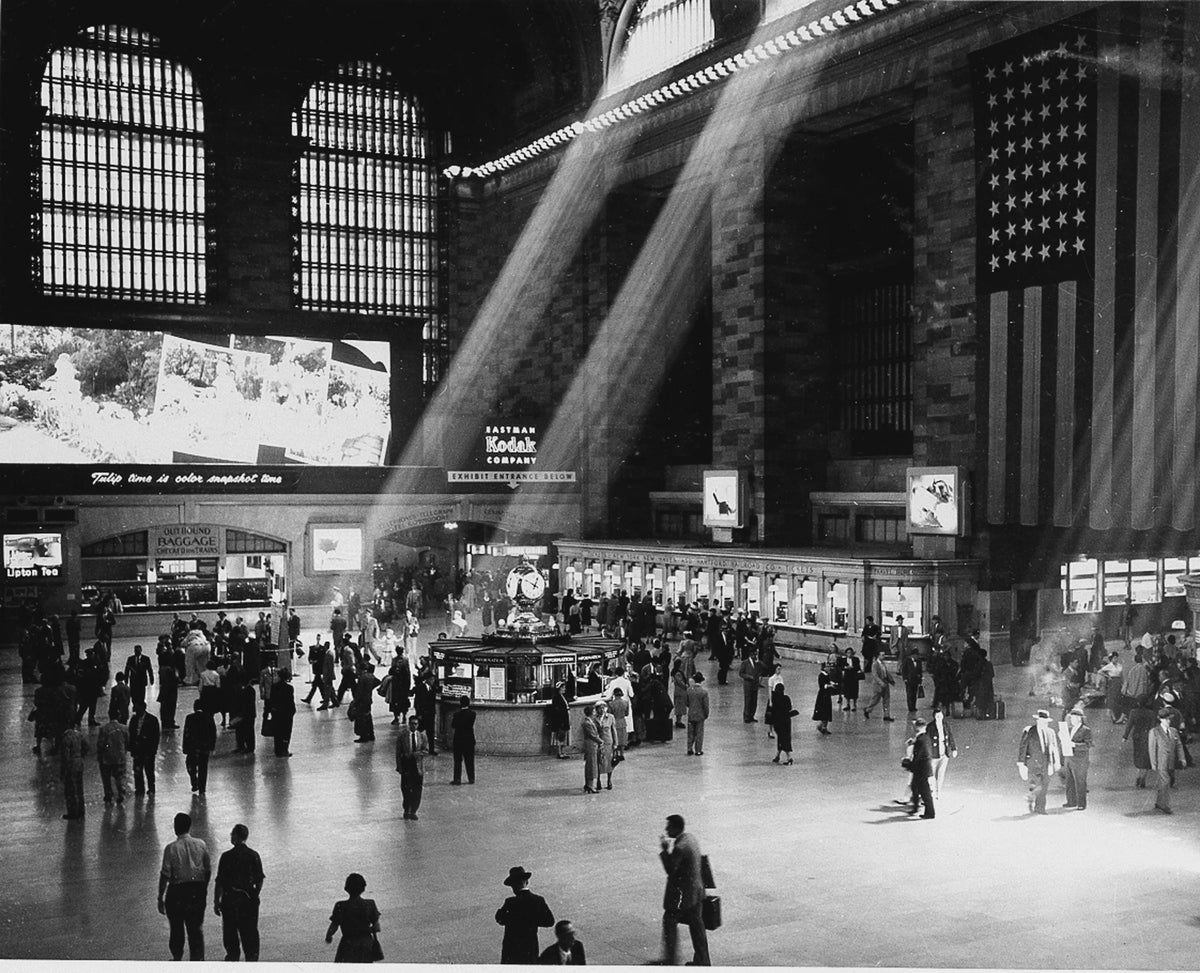
It's worth sitting with the moment this bond's underlying indenture was struck, because it lands right in the middle of one of the great showpiece projects of American railroading: the completion of Grand Central Terminal in Manhattan in 1913. The Central had spent the better part of a decade tearing out its old depot and building, in its place, a cathedral to rail travel — vaulted ceilings, a painted celestial sky, miles of new electrified tunnel running beneath Park Avenue. Old-timers who worked the terminal in its early decades loved to tell newcomers that the famous ceiling mural was painted backward, the constellations mirrored rather than true to the sky — legend has it an embarrassed astronomer pointed it out to the railroad's engineers only after the paint had dried, and the story stuck as one of Grand Central's favorite pieces of lore, whether embellished in the retelling or not.

This certificate's payment terms specify that principal and interest were payable at the railroad's office or agency in the Borough of Manhattan — placing the financial heart of this whole enterprise squarely in the same city where the Vanderbilt family had built its railroad fortune and its terminal legacy. Collectors of scripophily — the hobby of collecting stock and bond certificates — often say that a New York Central bond or share is really a Vanderbilt artifact by extension, a paper thread back to the Commodore's 19th-century empire-building and to his descendants, who continued shaping the railroad's fortunes well into the 20th century.


🛤️ From New York Central to Penn Central: A Corporate Succession Written Right on the Bond

One of the most fascinating things about this certificate is that its own signature block quietly tells the second half of the New York Central's story. The bond is executed not simply "The New York Central Railroad Company," but by the Penn Central Transportation Company, Successor to The New York Central Railroad Company, over the signatures of a Vice-President and an Assistant Secretary, alongside a raised corporate seal. That single line captures one of the most dramatic turns in American railroad history: in 1968, the New York Central and its longtime rival, the Pennsylvania Railroad, merged into the Penn Central Transportation Company, uniting two systems that had spent a century racing each other between New York and Chicago. The merger, meant to save both giants from the mounting pressure of highway trucking and jet travel, instead collapsed into what was then the largest corporate bankruptcy in the nation's history, filed in 1970. Penn Central's rail operations were eventually folded into Conrail in the mid-1970s, and its passenger trains passed to the newly formed Amtrak.

So while the terms printed on this certificate — the 4% interest, the gold clause, the 1913 indenture, the 1915 supplemental mortgage — all trace back to the railroad's consolidation-era financing, the certificate itself was executed later, under Penn Central's hand, standing in as legal successor to honor the New York Central's original obligations to its bondholders. It's a single sheet of paper that spans, in its own text, from the Gilded Age railroad consolidations of the early 1900s clear through to the turbulent corporate reorganizations of the mid-to-late 20th century — a genuinely rare thing for one certificate to carry.


📜 Why Pieces Like This Still Matter Today

Collectors of railroad scripophily prize certificates like this one precisely because they braid together so many different American stories at once: the era of steam and steel that physically stitched the country together; the era of formal, engraved paper finance, when a corporation's word to its investors was rendered in as much artistry as a banknote; and the slow, dramatic decline and reorganization of the great railroad titans in the face of highways and airlines. Engraved by the American Bank Note Company — the same storied security-printing house responsible for a vast share of America's historic banknotes, stock certificates, and bonds — this piece carries the unmistakable hand of the finest commercial engravers of its day, from the fine-line guilloette borders to the classical portrait medallion at its center. It stands today as a genuinely excellent example of early American financial engraving and railroad history, the sort of piece that collectors of Americana, transportation memorabilia, and antique finance all reach for at once.


🖼️ Display Ideas

  • 🖼️ Framed on its own as a striking, text-rich focal point in a study, office, or den
  • 🚂 Paired with vintage railroad photographs or route maps of the New York Central system
  • 🗽 Grouped with other Grand Central Terminal or New York City transit ephemera
  • 📚 Displayed alongside other early-1900s stock and bond certificates for a scripophily collection wall
  • 🏛️ Set into a home library or finance-themed office as a conversation piece on paper money history
  • 🎓 Used as a teaching artifact for economics, business, or American history discussions

🎁 Who Collects These

This certificate speaks to several overlapping collecting worlds at once. Scripophily collectors — those who specialize in historic stock and bond certificates — seek out New York Central material specifically because it touches so many major corporate reorganizations in one company's history. Railroad enthusiasts and railroadiana collectors value it as a paper counterpart to timetables, builder's plates, and dining-car china from the same era. Americana and antique finance collectors are drawn to the engraving itself — the classical imagery, the ornate borders, the sheer craft of American Bank Note Company's work. And it makes a genuinely thoughtful gift for anyone with ties to New York City, Chicago, or the old rail corridor in between — a framable piece of history for the person who already has the trains and the timetables and is looking for the paper that financed them.


❓ FAQ

Is this a real, issued financial instrument, or a reproduction?

This is an authentic period bond certificate from the New York Central Railroad Company's consolidation mortgage bond program, engraved by the American Bank Note Company. It is offered as a genuine issued bond that spent its life in an actual bondholder's portfolio.

Can this bond still be redeemed for money?

No. These are collected today strictly as historical and decorative pieces of Americana and railroad history, not as active financial instruments.

Why does it say "Series A," and what does that mean?

The New York Central's 1913 consolidation mortgage authorized four series of gold bonds — A, B, C, and D — each tied to retiring or exchanging different predecessor companies' older debt. Series A bonds were issued in exchange for the New York Central and Hudson River Railroad's earlier gold bonds secured by Lake Shore collateral.

Why is it signed by the "Penn Central Transportation Company" instead of the New York Central?

The New York Central merged with the Pennsylvania Railroad in 1968 to form the Penn Central Transportation Company. Certificates in this series were executed later by Penn Central as the legal successor honoring the New York Central's original bond obligations, which is why that

These are issued instruments rather than blanks. Bonds and debentures of this type were registered to a holder, authenticated by the trustee, and punch- or cut-cancelled when they were finally redeemed. Expect financial writings, markings, stamps, hole punches and staple holes as part of the life of the instrument: endorsements and signatures, trustee and registrar stamps, revenue or documentary tax stamps, cancellation punches, staple holes from being bound into a transfer book, pencil ledger notations. That is the paper trail of a security that actually did its job, and it is what separates a document that lived from a blank that never did. No two are alike: holder details, serial numbers, dates, signatures, stamps and punch patterns vary from example to example, so the photographs show the type rather than the exact sheet that ships.

Shipping

🚚 Shipping & Handling

  • Shipping costs and timing are calculated at checkout.
  • Items curated and shipped directly by me include U.S. shipping at no additional cost, professionally packed to ensure safe arrival of your artifact.

Items from Vetted Pro Collectors
Shipping for items offered by vetted Pro Collectors is determined at checkout. All Pro Collector listings are reviewed to ensure fair, reasonable shipping practices.

For full details, please refer to our Shipping Policy.

Returns & Exchange

Product Page Return Policy

  • 60-Day Returns – Items must be in original condition.
  • Refunds – Issued after inspection (excluding shipping costs).
  • Return Shipping – Customer is responsible unless item is damaged or incorrect.
  • Damaged/Incorrect Items – Contact us within 48 hours for a replacement or refund.
  • Easy Returns – Email [email protected] or call 802-356-9872 to initiate a return.

For full details, visit our Refund Policy.

View full details