Skip to product information
1 of 2

Vintage and Antique Gifts

Antique Big John Plug Cut Tobacco Label and Tag Set John Weisert Tobacco Co St Louis Missouri USA Ephemera Collectible 🚬

Antique Big John Plug Cut Tobacco Label and Tag Set John Weisert Tobacco Co St Louis Missouri USA Ephemera Collectible 🚬

Regular price 9.00 USD
Regular price Sale price 9.00 USD
Sale Sold out
Shipping calculated at checkout.
Quantity

Who Was Big John — and Why Did He Never Let Go of His Pipe? 🚬

There is a particular kind of quiet power in a working man who folds his arms, holds his pipe, and simply looks at you. He doesn't need to say a word. He already knows the quality of what's in his pocket, and he's letting you figure the rest out for yourself. That's Big John. He stood on tobacco labels in St. Louis shops, on counter displays in Missouri river towns, and on the shelves of general stores from the Ozarks to the Illinois bluffs — and then, sometime in the last century, a stack of his labels and companion tags got tucked away and forgotten. Left alone. Stored in the dark the way only the very best things are. And now he's looking out at you again, arms folded, with that same unshakeable calm, colors still bright as the day the lithographer pulled them off the press.

That survival is the whole story. Not every piece of American commercial art gets to make it. Most was used, damaged, discarded, or simply dissolved under a century of humidity and handling. What you're holding here — or what you're considering holding — is a rare double survivor: a matched label and companion tag from the Big John Plug Cut Tobacco line, both in New Old Stock condition, both still wearing the full vivid palette that John Weisert's printers put on them decades ago. That doesn't happen by accident. That happens by grace.


🪄 What It Is — The Object, Described Plainly and Completely

This is a two-piece set: a primary label and a companion tag, produced together for the Big John Plug Cut Tobacco brand, manufactured and sold by the John Weisert Tobacco Company of St. Louis, Missouri. They were designed to work as a system — the label identifying the product on the plug itself, the tag serving as the hanging or banding accent that completed the retail presentation. Together, they tell one complete story about a brand, a company, a city, and an era in American tobacco commerce that shaped everyday life across the Midwest and beyond.

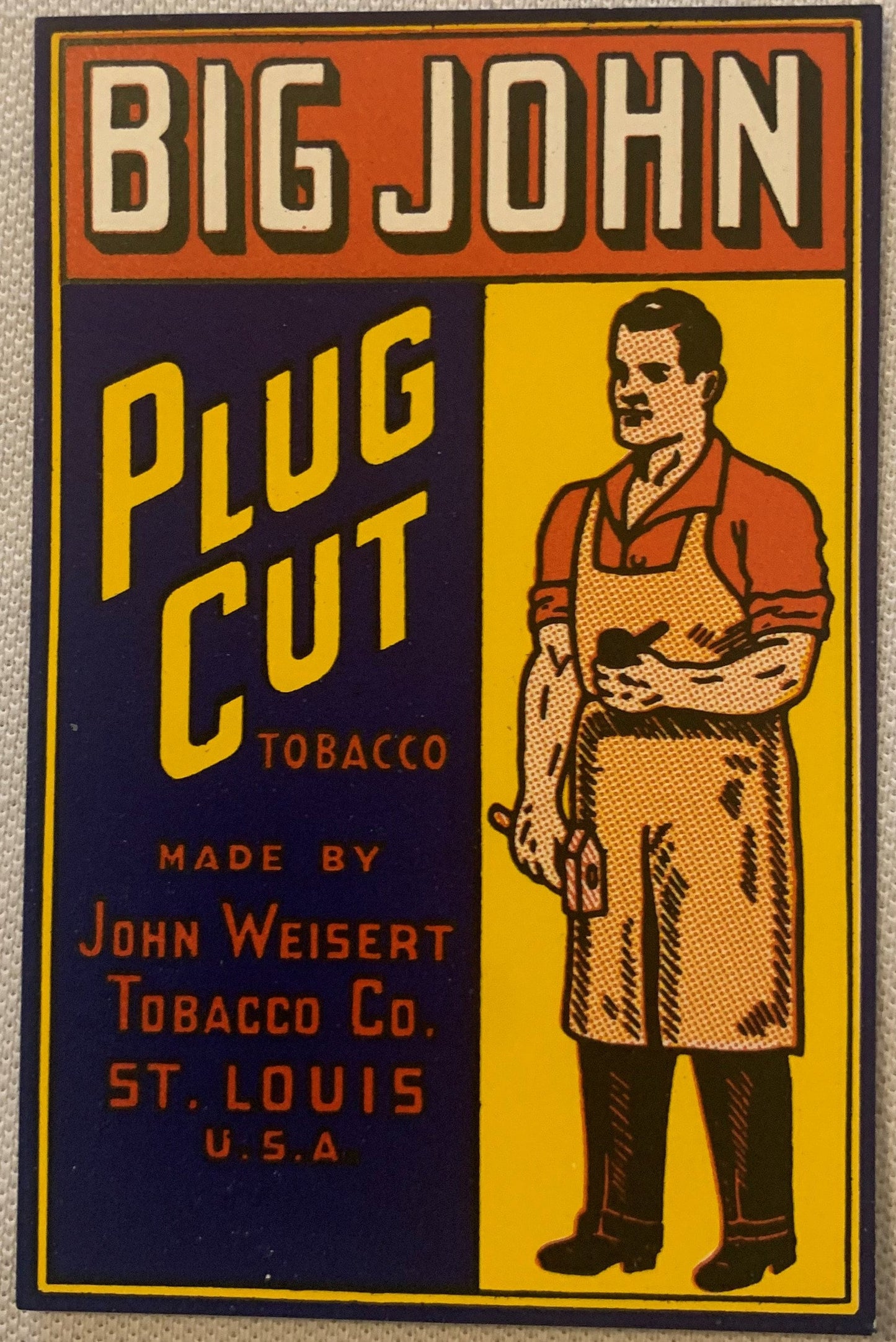
The main label measures 2¾ × 1¾ inches — small in the hand, enormous in visual presence. The top band announces BIG JOHN in bold white block lettering on a deep burnt orange ground that commands attention immediately. Below, the composition divides into two carefully considered fields. The left panel runs in dark navy blue, where PLUG CUT appears in large yellow lettering directly above the word TOBACCO, with MADE BY / JOHN WEISERT / TOBACCO CO. / ST. LOUIS / U.S.A. set below in warm brick red — a color choice that feels deliberate, grounded, and confident. The right panel shifts to golden yellow, and it is here that Big John himself lives: a stocky, full-length illustration of a working man in a red shirt and a long apron, arms folded, holding a pipe, looking directly out at the viewer with the unhurried authority of someone who has nothing left to prove.

The companion tag is long and narrow, executed entirely in dark navy blue, with BIG JOHN / TOBACCO lettered cleanly in white across its face. The pointed chevron ends give it the quality of a banner or ribbon — something ceremonial, something meant to be noticed from across a counter or case. Both pieces are New Old Stock (NOS): original lithographed paper, never used in commerce, colors still vivid and immediate, edges holding their integrity. The lithography process — the flat-stone or metal-plate printing technique that commercial printers used throughout the late nineteenth and early twentieth centuries — is what gave these labels their saturated, layered color depth. It is a process that cannot be easily replicated today, and the results speak for themselves every time you encounter a surviving example in this kind of condition.


🏭 The Company Behind the Name — John Weisert and the St. Louis Tobacco Trade

John Weisert arrived in America from Germany and was already inside the tobacco business by 1855 — which places his origins in an era when St. Louis was one of the most consequential commercial cities in North America, a gateway city sitting at the confluence of the Missouri and Mississippi rivers where goods moved in every direction and fortunes were built fast. Tobacco, along with furs, lead, and dry goods, was among the primary commodities flowing through that city's warehouses, and the men who understood how to process, brand, and sell it well were building legacies that would outlast them by generations.

The John Weisert Tobacco Company did exactly that. In a trade notorious for volatility — for brands that flared and vanished, for companies absorbed by consolidators, for product lines discontinued without ceremony — Weisert's firm became something rare: a survivor. It outlasted competitors that seemed far larger and better capitalized. It navigated the trust era, the regulatory shifts, the market disruptions of two world wars, and the changing taste preferences of successive generations of American smokers and chewers. The company became one of the most storied names in Missouri tobacco history, and its products — including the plug cut varieties like Big John — were household names across a wide swath of the American Midwest.

Plug cut tobacco, for those newer to the category, was a specific preparation: tobacco leaves pressed into a firm cake or plug and then cut into slices or chunks for chewing or pipe use. It was the working man's tobacco — practical, economical, satisfying, and durable enough to be carried in a shirt pocket all day. The market for it was enormous through the late nineteenth and early twentieth centuries, and the competition among brands was fierce enough to generate some of the most visually compelling commercial art of the period. Lithographed labels and tags were the advertising medium of the moment — bright, bold, immediately readable from across a counter — and companies like Weisert invested in them seriously.

St. Louis, as a production center for tobacco goods, occupies a genuinely significant place in American commercial history that often gets overshadowed by Virginia and North Carolina in the popular imagination. But Missouri had its own deep tobacco culture, rooted in the river counties where burley and dark-fired leaf were grown, and St. Louis had the infrastructure — the warehouses, the railroads, the river freight connections, the printing houses — to turn raw leaf into finished branded product and move it efficiently to market. The city's German immigrant community, of which John Weisert was a part, brought with them a tradition of precision manufacturing and meticulous commercial practice that shaped the quality standards of everything the company produced.

Local legend has it that the Weisert operation was one of the few St. Louis tobacco firms where the founder's original standards were enforced so rigorously that even after his death, longtime employees would invoke his name on the production floor when they were correcting a colleague's work — a cultural continuity that collectors who've spoken with former employees have described as almost ceremonial. Whether or not that particular story is precisely documented, it reflects something real about how the company was perceived from the inside: as a place where the founder's reputation was a living presence, not a historical footnote.

Lore passed down among Midwestern tobacco ephemera collectors holds that certain Weisert brand labels — particularly those from the plug cut lines — were designed specifically to appeal to the German-American working-class communities in St. Louis's south side neighborhoods, where brand loyalty to local manufacturers ran deep and where a familiar face on a label carried genuine commercial weight. Big John, with his apron and folded arms, fits that profile exactly. He looks like someone from the neighborhood. He looks like someone your grandfather might have recognized.


🏙️ St. Louis, Missouri — The City That Made These Labels Possible

It would be a mistake to treat the St. Louis, U.S.A. text on this label as mere boilerplate. Those words are a geographic argument. They are the company telling you, explicitly, that this product comes from a specific place with a specific reputation — a city that in the mid-to-late nineteenth century was among the most dynamic commercial and industrial centers in the entire country, and that by the early twentieth century had developed a manufacturing culture of genuine depth and pride.

St. Louis in the tobacco era was a city of breweries and manufacturing firms and river commerce, of German and Irish and Eastern European immigrant communities building working-class neighborhoods with corner stores and tobacco shops and saloons where plug cut was sold behind the counter in paper-wrapped blocks. The printing houses that produced these labels — the chromolithography firms that translated a tobacco company's brand vision into vivid, durable commercial art — were themselves significant businesses, employing skilled craftsmen who took enormous professional pride in their color work. The saturation and precision you see in a surviving NOS label like this one reflects not just the original printing but the craft culture that produced it.

For collectors with a specific geographic connection to St. Louis and the surrounding Missouri river towns, pieces like this carry a local resonance that transcends their status as tobacco ephemera. They are artifacts of a particular civic and commercial moment — the era when St. Louis was still competing to be the dominant city of the American interior, when its manufacturers were producing goods that moved by rail and river freight to every corner of the country, and when a company like John Weisert's could put its city's name on a label and mean it as a mark of quality.


🖼️ Display Ideas — Giving Big John a Home He Deserves

  • 🪵 Primitive farmhouse or country store vignette: Frame the label and tag together in a small shadowbox with a scrap of burlap or aged kraft paper backing — pair with other general-store-era ephemera for a curated counter display that tells the whole story of rural American commerce.
  • 🍺 Man cave or tavern corner: Mounted under glass with other Missouri-produced trade labels, these pieces anchor a wall display that celebrates the working-class commercial culture of the St. Louis region — tobacco, beer, and river trade in one visual conversation.
  • 📚 Collector's archival display: Housed in acid-free sleeves or mounted in a conservation-quality frame as part of a larger NOS tobacco ephemera collection, where the vivid lithography can be appreciated against other surviving examples of the form.
  • 🎨 Graphic design inspiration display: Pinned or floated-mounted in a design studio or creative workspace — the color blocking, typography, and figure illustration on these labels are textbook examples of late nineteenth and early twentieth century American commercial art at its most confident.
  • 🏪 Antique shop or vintage market booth décor: Used as authentic period atmosphere in a retail setting focused on Americana, Midwestern antiques, or tobacciana — the label and tag together create an immediate visual anchor that signals both expertise and genuine curation.
  • 🎁 Framed gift for the Missouri or St. Louis history enthusiast: Matted and framed with a small printed card describing the Weisert company's history, this becomes a deeply personal gift for anyone with family roots in the St. Louis area or a professional interest in Missouri commercial history.

🎁 Who Collects These — and Why They Search for Exactly This Kind of Piece

The world of tobacciana collecting is one of the oldest and most established niches in American antiques and ephemera, and it encompasses a remarkably wide range of serious collectors. There are those who focus specifically on plug cut and chewing tobacco labels — a sub-category defined by its vivid lithography, its working-class subject matter, and its relative scarcity in NOS condition. These collectors know their printing houses, their regional brands, and their chromolithography periods the way a coin collector knows their mints and mintmarks.

St. Louis and Missouri history collectors represent another significant audience — people who are building archives of commercial and cultural ephemera from the region's industrial and mercantile peak. For them, a Weisert label isn't just a pretty piece of paper; it's a primary source document about a specific company, a specific neighborhood economy, and a specific moment in Missouri's commercial development.

American commercial art and graphic design historians collect these labels for the lithography itself — for the color theory, the typography, the figure illustration, and the compositional decision-making that went into every element of what was, functionally, a very small canvas with very high stakes. Big John's label is a masterclass in hierarchy: you read the brand name first, the product descriptor second, the manufacturer third, and the figure last — but the figure is what you remember.

General Americana and vintage advertising collectors are drawn to the warmth and specificity of pieces like this one — objects that feel genuinely rooted in a particular place and time, that carry the texture of everyday American commercial life, and that survived in NOS condition through what can only be described as a combination of obscurity and luck. These collectors understand that New Old Stock isn't just a condition grade — it's a story about survival, about the gap between what was made and what was used, and about the extraordinary good fortune of finding something that came through a century intact.


❓ Frequently Asked Questions — What Serious Collectors Want to Know

What exactly does "New Old Stock" (NOS) mean for a piece like this?

New Old Stock — NOS — means that these label and tag pieces were produced for commercial use but were never actually used. They were printed, stored, and somehow never made it into the production or retail process. For tobacco labels, this most commonly happened when a brand was discontinued, when a company reorganized its product line, or when overstock was simply packed away and forgotten in a warehouse, stockroom, or private storage. The result is a label that has never been gummed, never been applied to a product, never been handled in a retail environment. It has aged in whatever storage condition it found itself in, but it has not experienced the mechanical damage of actual use. For collectors, NOS condition in commercial lithography represents the absolute ceiling of survivorship — these pieces look the way they looked when they left the printing house, and that is extraordinarily rare for paper ephemera of this age.

How old are these pieces, and how do we know?

John Weisert was in the tobacco business by 1855, and the company remained active well into the twentieth century. The design language, typography, and lithography style of these Big John pieces — the block lettering, the color palette, the figure illustration style, the layout conventions — are consistent with American commercial label printing from the late nineteenth through the early twentieth century. Plug cut tobacco as a major commercial category was at its peak during this same era, before changing consumer habits shifted the market significantly. While precise dating of individual NOS label stock requires specific production records that rarely survive, the visual and material evidence places these pieces firmly within the company's active production period, representing decades of American commercial history compressed into a very small, very vivid object.

Is the lithography original, and what printing process was used?

Yes, the lithography is original. Lithographic printing — the process of transferring an image from a flat stone or metal plate using the chemistry of oil and water — was the dominant commercial printing method for labels, posters, and advertising materials throughout the late nineteenth and early twentieth centuries. Color lithography required separate passes through the press for each color, with skilled craftsmen aligning each layer precisely to build up the final image. The result was a depth and saturation of color that photographic reproduction methods could not match. What you're seeing in these labels — the rich navy blue, the burnt orange, the golden yellow, the warm brick red — is the accumulated result of multiple precise press runs. That is why NOS lithographed labels look so different from later reproduction: the original ink chemistry, the original paper, and the original layering are all still present and intact.

Who was the figure on the label — was "Big John" a real person?

The short and honest answer is: we don't know with documented certainty, and that mystery is part of what makes the label compelling. The figure — stocky, aproned, red-shirted, pipe in hand, arms folded — is clearly a type rather than a portrait, a working-man archetype designed to communicate reliability, strength, and unpretentious quality to a specific consumer audience. Whether there was a specific individual who inspired the illustration, whether "Big John" was a composite, or whether the figure was entirely the invention of a commercial artist at the printing house is not recorded in any source that has come to light among collectors. Local legend in St. Louis tobacco collecting circles has it that the figure was loosely inspired by a well-known figure in the Weisert operation itself, but this has never been confirmed by primary documentation, and it should be held as folklore — which is precisely what makes it worth recording.

How should these pieces be stored or displayed to preserve their condition?

For storage, acid-free sleeves or envelopes are the gold standard for paper ephemera of this age and significance — they prevent the acids naturally present in wood-pulp paper from migrating to the label surfaces and accelerating deterioration. Keep stored pieces away from direct light, humidity fluctuations, and heat sources. For display, UV-filtering glazing in a conservation-quality frame will protect the colors from fading over time; the vivid lithography that makes these pieces so striking is also vulnerable to prolonged light exposure. Many collectors choose to display their finest NOS pieces in rotation, returning them to archival storage periodically, so the colors are protected over the long term. Whatever approach you take, the goal is to maintain the same conditions that allowed these labels to survive in this condition for the better part of a century — cool, dark, stable, and undisturbed.

Are the label and tag meant to be kept together or can they be displayed separately?

They were designed and produced as a companion set, and the strongest curatorial argument is to keep them together — the label and tag complete each other visually and historically, telling the full story of how the Big John brand presented itself in the retail environment. The label carried the full brand identity and manufacturer information; the tag served the banding or hanging function that completed the physical product presentation. Together, they represent a complete system of commercial communication. That said, each piece stands on its own as a significant collectible, and collectors who want to incorporate one element into a larger display while keeping the other in archival storage are making a perfectly reasonable choice. The important thing is that the set is documented and understood as a matched pair, which affects both its historical meaning and its long-term collector value.

Why is St. Louis specifically significant for tobacco ephemera collectors?

St. Louis occupies a genuinely distinct position in the geography of American tobacco commerce that is underappreciated outside the collector community. The city's location at the junction of the Missouri and Mississippi rivers made it a natural distribution hub for tobacco goods moving to markets throughout the Midwest, the Plains states, and beyond. Its large German immigrant manufacturing community — of which John Weisert was a representative figure — brought production standards and brand identity practices that distinguished St. Louis-made goods in the marketplace. And the city's commercial printing industry, which produced the lithographed labels and advertising materials for these tobacco brands, was sophisticated enough to execute the kind of complex color work you see in pieces like this Big John set. For collectors focused on Midwestern Americana, Missouri commercial history, or the geography of American manufacturing, St. Louis tobacco ephemera represents a specific and well-defined collecting category with its own internal logic, its own key brands and companies, and its own hierarchy of rarity and desirability — and Weisert pieces sit comfortably near the top of that hierarchy.

Shipping

🚚 Shipping & Handling

  • Shipping costs and timing are calculated at checkout.
  • Items curated and shipped directly by me include U.S. shipping at no additional cost, professionally packed to ensure safe arrival of your artifact.

Items from Vetted Pro Collectors
Shipping for items offered by vetted Pro Collectors is determined at checkout. All Pro Collector listings are reviewed to ensure fair, reasonable shipping practices.

For full details, please refer to our Shipping Policy.

Returns & Exchange

Take your time — you've got a full six months. If a piece isn't right for you, send it back the way it reached you and we're good.

In the first 30 days your money goes straight back the way you paid. After that it's store credit, so you can put it toward something you'd rather have.

Return shipping we sort out between us, case by case. I don't make this difficult.

If something arrives damaged, or it isn't what I said it was, send me a photo within 48 hours and I'll make it right.

Email info@vintageantiquesgifts.com or call 802-356-9872 — that's me answering, not a call center.

The only things I can't take back are custom or special-order pieces and gift cards.

View full details
  • 5 stars: 2 (100%)
  • 4 stars: 0 (0%)
  • 3 stars: 0 (0%)
  • 2 stars: 0 (0%)
  • 1 star: 0 (0%)
4
4***_ (49)

Item arrived quickly and in perfect condition packaged very well exact to sellers pictures at a good price very good quality will look great framed. Very appreciative seller and it is awesome that his children are involved in his business A+

p
pinyanj

Great shipping, great tobacciana, one of my favorites

Thank you so much! We appreciate it. Keep your eye out as I have 100's more tobacciana to list that I haven't gotten to yet.