Skip to product information
1 of 7

Vintage and Antique Gifts

Antique 1911 Cleveland Short Line Railway First Mortgage Gold Bond 1000 Steam Locomotive Vignette 📜

Antique 1911 Cleveland Short Line Railway First Mortgage Gold Bond 1000 Steam Locomotive Vignette 📜

Regular price 17.00 USD
Regular price Sale price 17.00 USD
Sale Sold out
Shipping calculated at checkout.
Quantity

What Do You Do When Your Own Railroad Can't Get Through Your Own City? 🚂

There's a particular kind of magic in old railroad paper — not the stock certificates with their soaring eagles and allegorical maidens, but the bonds. Denser. Wordier. More serious. A bond wasn't selling you a piece of a dream; it was a promise, backed by steel rails and rolling stock and the full faith of a company that intended to still be paying interest checks fifty years down the line. Hold one of these and you're holding more than a century of American industrial ambition — the sound of a steam whistle echoing off a rock cut, the smell of coal smoke drifting over a city that had simply outgrown its own tracks. This piece tells that story better than almost anything I've come across: a railroad built for one reason and one reason only — to get freight around a city instead of fighting through the middle of it.

What you're looking at is a genuine, physically issued First Mortgage Gold Bond — not a stock certificate — from The Cleveland Short Line Railway Company of Cleveland, Ohio, a $1,000 denomination "Fifty Year First Mortgage Gold Bond of 1911," engraved and printed by the American Bank Note Company of New York.

The certificate measures a substantial 15 x 10 inches, rendered in the deep brown and black intaglio linework of period high-security printing, with red engraved serial numbering and cream-toned certificate stock. The centerpiece is a striking vignette of a steam locomotive hauling a long passenger train past telegraph poles and open country, framed beneath an arched "United States of America" banner and set into dense geometric guilloché border-lace — the kind of obsessively fine engraving that period bank-note printers used specifically because it was nearly impossible for a forger to reproduce by hand.

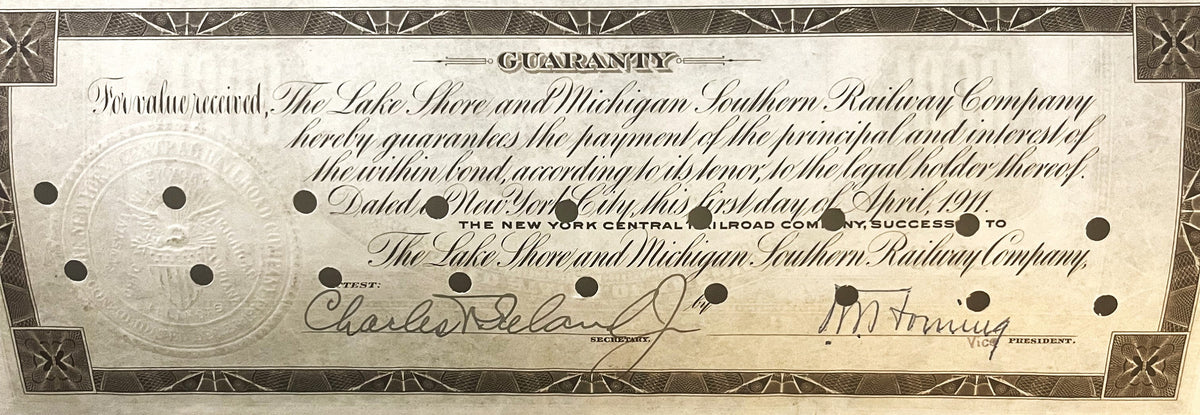
Below the vignette, bold Victorian-into-Edwardian lettering announces the company name, the "State of Ohio," and the bond's terms; an embossed corporate seal and punch-cancellation holes appear on the document as well, along with a separate "Guaranty" panel and a Trustee's Certificate — additional engraved sections that carried real legal weight when this bond was part of a company's outstanding financial obligations.

This is a genuine early-20th-century railroad financing instrument, not a reproduction, and it belongs in that particular category of American paper — scripophily, the collecting of historic stock and bond certificates — where a piece of finance becomes, over a hundred years later, a piece of art.


🚂 A Railroad Built to Solve One Very Specific Headache

The Cleveland Short Line Railway was chartered on November 24, 1902, and the men behind it weren't outside speculators — they were insiders, already major shareholders of the powerful Lake Shore and Michigan Southern Railway (LS&MS), one of the great trunk lines feeding freight and passengers into Cleveland's increasingly overwhelmed downtown lakefront rail district. Their solution was almost architectural in its simplicity: build a beltline, a circumferential railroad, that would let freight swing around the south side of the city entirely rather than fight its way through the crowded heart of it.

Construction began in May 1906. By February 24, 1910, the first stretch — a bit over ten miles, connecting the Rockport area southwest of Cleveland to the Lake Erie and Pittsburgh Railway (itself jointly owned by the New York Central and the Pennsylvania Railroad) — was open and carrying trains. The company kept building through 1912, eventually stitching together roughly twenty miles of beltline that let freight bypass Cleveland's center entirely. Locally, almost nobody called it "The Cleveland Short Line Railway Company" in conversation — it was known, plainly and affectionately, as the Belt Line, the railroad that went around instead of through.

This bond, dated the first day of April, 1911, sits squarely in the middle of that construction window — a $1,000, 4½% gold bond, part of a larger authorized issue meant to run no more than one hundred million dollars outstanding at any one time, structured to mature fifty years later. It is, in the truest sense, financing paper for a railroad that was still being built when investors bought it: money raised on the promise of a beltline that would, within a couple of years, be fully operational and moving freight around a booming Midwestern industrial city.


🏦 Gold Coin, London Exchange, and a Guaranty Worth Reading

Read the fine print on one of these bonds and you get a small education in how serious American infrastructure finance actually worked in the early 1900s. The bond promises payment "in gold coin of the United States of America, of the present standard of weight and fineness" — not paper currency, not a promissory note, but gold itself, the bedrock of monetary confidence in that era. Interest was payable twice yearly, April 1st and October 1st, at the fixed rate of 4½ percent per annum. And in a detail that speaks to just how international American railroad capital had become by 1911, the bond gave holders the option to collect their interest and principal not just in Manhattan, but in London, England, at the office of Morgan, Grenfell & Co. — the London arm of the House of Morgan — at a fixed exchange rate of $4.86½ to the pound sterling. American railroads weren't just raising money from Wall Street anymore; they were courting British capital directly, and this bond was built to be just as spendable in the City of London as it was in the Borough of Manhattan.

The certificate also carries a formal Guaranty section — a separate engraved panel in which the Lake Shore and Michigan Southern Railway Company, and later its successor the New York Central Railroad Company, formally guaranteed the payment of principal and interest to the legal holder of the bond, "according to its tenor." This is the corporate paper trail made visible: the Cleveland Short Line wasn't standing alone on its own credit — it was backed by the much larger and more established Lake Shore and Michigan Southern, which was itself absorbed into the New York Central system. The bond's mortgage and deed of trust were held by the Guaranty Trust Company of New York, acting as Trustee over "all the property and franchises" of the Railway Company — the legal machinery that protected bondholders if the railroad ever defaulted. It's easy to skim past this kind of language as legal boilerplate, but it's really the skeleton of how enormous, capital-hungry railroad projects got built in this era: layers of guarantee, trust, and mortgage, all stacked on top of steel and gravel and crossties.


🖋️ The American Bank Note Company: Engravers of Record

The imprint at the base of the certificate — "American Bank Note Company, New York" — belongs to one of the most important security-printing firms in American history. Its roots trace back to 1795, when a firm called Murray, Draper, Fairman & Company began engraving currency and financial documents, eventually growing into the young nation's foremost engraver of paper money, postage stamps, and stock and bond certificates in the decades before the Civil War. For much of the 19th century, if a piece of American paper needed to be trusted — a banknote, a government security, a corporate bond — there was a good chance American Bank Note Company's engravers had cut the plates.

In 1875, the newly created federal Bureau of Engraving and Printing took over the job of printing the nation's official currency, closing that chapter of the company's history overnight. But American Bank Note Company didn't fade — it pivoted hard into exactly the kind of work this certificate represents: engraving stock and bond certificates for the flood of American railroads, industrial corporations, and financial institutions that defined the Gilded Age and the decades that followed. The firm was known for using premium stock — paper sourced largely from Crane & Co., the same paper house long associated with American currency — and for a house style of engraving so dense and confident that, even now, more than a century later, it reads less like paperwork and more like fine art. That's exactly what's on display here: the fine cross-hatched guilloché lattice bordering the certificate, the shaded, dimensional lettering of the denomination, the finely rendered locomotive vignette — all hallmarks of a printer whose entire business model depended on making forgery a practical impossibility.


🚉 From New York Central, to Penn Central, to Conrail

The Cleveland Short Line's independent corporate life was always somewhat theoretical — from its earliest days it operated as part of the larger New York Central system, financing and building a beltline that the Central needed far more than it needed a standalone Short Line company. Over the following decades, that pattern repeated itself at a much larger scale: the New York Central Railroad itself was eventually merged into the Penn Central Transportation Company, a merger that became one of the most spectacular corporate collapses in American business history when Penn Central declared bankruptcy on June 21, 1970. Penn Central limped along under bankruptcy protection for several more years until President Richard Nixon signed the Regional Rail Reorganization Act on January 2, 1974, paving the way for most of its tracks — including, by extension, the old Cleveland Short Line beltline — to be folded into a new federally backed successor: Conrail.

What's remarkable is how long the physical railroad itself kept working. Railroad-history records show that Conrail crews were still actively maintaining and upgrading the interchange and diamond crossing between the "Big Four" line and the old Cleveland Short Line as late as the 1990s, in preparation for Conrail's eventual split between Norfolk Southern and CSX. In other words: a beltline financed in part by bonds like this one, built to solve a congestion problem in the first decade of the 1900s, was still hauling freight around Cleveland nearly a hundred years later. Few pieces of paper can claim their subject outlived them by that long.


🏙️ Cleveland in the Age of Steam and Ambition

To understand why a beltline like this mattered, it helps to picture Cleveland in the years this bond was issued: a booming Great Lakes industrial city, its downtown lakefront rail district choked with the freight traffic of a half-dozen competing trunk lines, all trying to funnel ore, coal, steel, and manufactured goods through the same narrow corridor along the water. Old-timers along the route are said to have called the beltline exactly what it was built to be — a "way around" — and the nickname "Belt Line" stuck hard enough that it outlived the formal corporate name in everyday speech for generations of Clevelanders who lived, worked, or grew up along its right-of-way. Collectors of Cleveland railroad history still trade that nickname today, a small piece of oral tradition that never quite made it into a corporate charter but has never fully disappeared either.

It's worth sitting with the ambition embedded in a project like this one: a group of railroad shareholders looking at a city literally strangling on its own success, and deciding the answer wasn't to fight through the congestion but to build an entirely new twenty-mile railroad around it. That's the story a document like this one preserves — not just a financial instrument, but a snapshot of an industrial city solving a very physical, very real problem with steel, gravel, and gold-backed capital.


🖼️ Display Ideas

  • 🖼️ Framed under glass in a home office or library as a striking piece of early American financial engraving and railroad Americana
  • 🚂 Paired with other railroad ephemera — timetables, tickets, postcards — in a themed Cleveland or Ohio railroad history display
  • 📚 Displayed alongside American Bank Note Company items as an example of turn-of-the-century security-printing craftsmanship
  • 🏛️ Featured in a collection of Gilded Age / Progressive Era financial documents, next to other gold bonds or mortgage certificates
  • 🎓 Used as a teaching piece for anyone interested in railroad history, industrial finance, or the gold standard era
  • 🖋️ Hung as a standalone conversation piece for its sheer engraving detail — the locomotive vignette and guilloché border reward a close look

🎁 Who Collects These

Scripophily — the collecting of antique stock and bond certificates — draws a particular kind of collector: railroad history buffs tracing the New York Central and its many subsidiary lines; Cleveland and Ohio local-history collectors building out a picture of the city's industrial peak; American Bank Note Company enthusiasts who collect specifically for the engraving craft rather than the company behind it; gold-standard and financial-history collectors drawn to the era when bonds literally promised payment in gold coin; and gift-givers looking for a genuinely unusual, conversation-starting piece of American history for someone with roots in Cleveland, an interest in trains, or a love of old paper with real substance behind it.


❓ FAQ

Is this an original 1911 bond, or a reproduction?

This is a genuine period bond certificate from The Cleveland Short Line Railway Company's Fifty Year First Mortgage Gold Bond of 1911 series, engraved and printed by the American Bank Note Company of New York.

What does "First Mortgage Gold Bond" actually mean?

It means the bond was secured by a mortgage on the railway company's own property and franchises, and that principal and interest were, by its own terms, payable in gold coin — a common and reassuring structure for railroad financing in the early 1900s.

Was the Cleveland Short Line a real, operating railroad?

Yes. Chartered in 1902 and built between 1906 and 1912, it was a roughly twenty-mile beltline that let freight bypass Cleveland's congested downtown lakefront rail district, eventually operating as part of the New York Central system.

What happened to the railroad this bond financed?

The line was absorbed into the New York Central system, which later merged into Penn Central before that company's 1970 bankruptcy led to its tracks being reorganized into Conrail in 1974 — with the old beltline still in active freight use decades later.

Who printed and engraved this certificate?

The American Bank Note Company of New York, a security-printing firm tracing back to 1795 and long regarded as one of the premier engravers of American currency, stamps, and stock and bond certificates.

What size is the certificate?

It measures 15 x 10 inches, a large-format engraved document typical of the era's most formal financial instruments.

What condition is the certificate in?

This is a genuine early-20th-century engraved bond certificate, offered as an excellent example of period American financial engraving and railroad Americana — the artwork, lettering, and craftsmanship are the focus, and the piece is exactly the kind of substantial, historically rich item that collectors of scripophily and railroad history seek out.

An issued certificate picks up the marks of its working life: endorsements and signatures on the reverse, transfer-agent and registrar stamps, revenue or documentary tax stamps, punch or cut cancellations at redemption, staple holes from being bound into a transfer book, and pencil ledger notations. Those marks are the paper trail of a financial instrument that actually did its job.

Shipping

🚚 Shipping & Handling

  • Shipping costs and timing are calculated at checkout.
  • Items curated and shipped directly by me include U.S. shipping at no additional cost, professionally packed to ensure safe arrival of your artifact.

Items from Vetted Pro Collectors
Shipping for items offered by vetted Pro Collectors is determined at checkout. All Pro Collector listings are reviewed to ensure fair, reasonable shipping practices.

For full details, please refer to our Shipping Policy.

Returns & Exchange

Take your time — you've got a full six months. If a piece isn't right for you, send it back the way it reached you and we're good.

In the first 30 days your money goes straight back the way you paid. After that it's store credit, so you can put it toward something you'd rather have.

Return shipping we sort out between us, case by case. I don't make this difficult.

If something arrives damaged, or it isn't what I said it was, send me a photo within 48 hours and I'll make it right.

Email info@vintageantiquesgifts.com or call 802-356-9872 — that's me answering, not a call center.

The only things I can't take back are custom or special-order pieces and gift cards.

View full details
  • 5 stars: 4 (100%)
  • 4 stars: 0 (0%)
  • 3 stars: 0 (0%)
  • 2 stars: 0 (0%)
  • 1 star: 0 (0%)
9
9***b (254)

Railroad certificate received in great shape. It looks fantastic. It was packaged well and delivered promptly and the price was fair. I will definitely purchase from seller again.

e
e***e (2111)

Great certificates. Great packaging. Fast shipping. Great eBayer.

R
Robert Hann (Romeo, US)
Positive experience . . .

As described. Nice example, carefully packaged and shipped.

Hi there! Thank you so much for your positive review! We're glad to hear that you had a great experience with your purchase and that it arrived safely. We take great care in packaging and shipping our items. We hope you enjoy your antique gold bond certificate! Thank you for your support. It means the world to us! Have a wonderful day!

9
9***b (124)

Stock certificates received in great condition. High quality and looked fantastic. It was packaged well and delivered promptly. The price was fair. I will definitely purchase with seller again.