Skip to product information
1 of 5

Vintage and Antique Gifts

Antique 1930s Fido Brand Citrus Crate Label 🍎 Orosi Tulare County California

Regular price 17.00 USD
Regular price Sale price 17.00 USD
Sale Sold out
Shipping calculated at checkout.

Description

🐕 A Worried-Eyed Puppy Who Has Waited a Century to Be Pasted to a Box

Every so often a sheet of warehouse paper turns out to be a small piece of design history that never got to do its job. This is a genuine, unused FIDO Brand lemon crate label, printed for the Orosi Foothill Citrus Association of Orosi, Tulare County, California, and it has spent the better part of a century in a printer's stack rather than on a wooden lemon box. Everything physical claimed here is read directly off the sheet itself, at full resolution, and everything historical is drawn from documented citrus-industry and printing-trade sources. Nothing is invented, nothing is upgraded past what the paper and the record actually support -- including, deliberately, the word "rare," which a specialist dealer's own stock records do not back up for this particular label and which this listing does not use.


🍋 Reading the Label -- Lemon, Not Orange

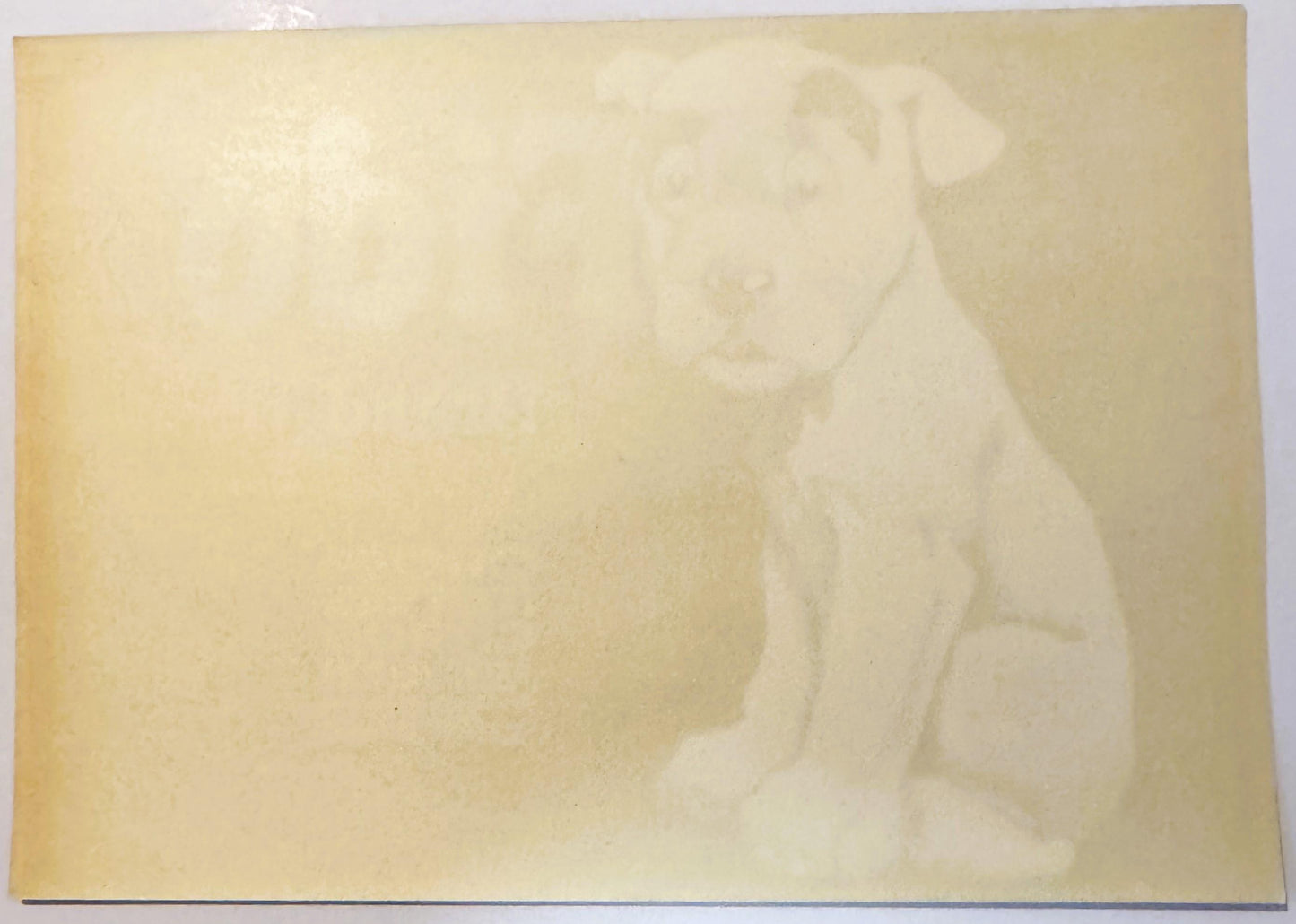
Start with the fruit, because it matters: this is a lemon label, not an orange label. Both the trade record for this exact brand and the elongated, landscape-format layout common to California lemon-box labels confirm it, and it is stated here plainly so there is no ambiguity. The sheet is a chromolithograph printed on a black ground, set inside a deep-blue border with a fine red-orange inner rule -- a striking, high-contrast palette built to catch a wholesale buyer's eye from across a packing-house floor. The left two-thirds of the label is given over entirely to a seated puppy, painted with real tenderness: a white bull-terrier-type dog with one dark patch over an eye and ear, oversized front paws it hasn't quite grown into yet, a soft pink muzzle, and a pair of genuinely worried-looking eyes. It is disarming artwork, the kind that was clearly meant to make a grocer smile before he even read the brand name.

The right side of the sheet carries the brand block, and every word of it is transcribed here exactly as printed: Fido in bold outlined lettering, Brand beneath it in a smaller script, then OROSI / FOOTHILL / CITRUS / ASSOCIATION stacked in solid capitals, followed by OROSI, TULARE CO. CALIFORNIA. Below that, in smaller type, the sheet reads SHIPPED THRU / LINDSAY-MERRYMAN CITRUS EXC. A tiny printer's imprint sits in the lower-left margin: SCHMIDT LITHO. CO. S.F. -- easy to miss, but it is the signature of one of the two or three great West Coast lithography houses of the period, and its San Francisco plant designation is worth noting on its own, since sister labels from this same catalogue carry Schmidt's separate Los Angeles branch imprint instead. This label was printed at the San Francisco plant specifically.


🏛️ The Two-Tier System This Label Records

The most historically interesting line on the whole sheet is the smallest: "SHIPPED THRU LINDSAY-MERRYMAN CITRUS EXC." Orosi sits in the Tulare County citrus foothills on the eastern edge of the San Joaquin Valley, below the Sierra Nevada, and growers there did not each ship their own fruit to market individually. They organized into local packing associations -- like the Orosi Foothill Citrus Association named at the top of this label -- which pooled the harvest from many small groves, packed and labeled it under a shared brand, and then shipped it onward through a larger regional marketing exchange, in this case the Lindsay-Merryman Citrus Exchange one valley town over at Lindsay. This label is, in effect, a printed diagram of that two-tier cooperative system: a local packing house's brand riding on top of a larger exchange's distribution network, both named on the same six square inches of paper. It is a genuinely useful primary document for anyone interested in how early-20th-century California citrus actually reached a grocer's shelf a continent away.

The design itself belongs to a specific moment in American commercial art: the 1920s vogue for cartoon-dog advertising mascots, when illustrators across the country reached for an appealing animal face to carry a brand name into a buyer's memory. It is worth being precise about what this puppy is and is not. Trade listings sometimes describe labels of this type using the shorthand "Bonzo dog," after a popular British cartoon character of the era -- but that is a dealer's descriptor, not anything printed on this sheet, and there is no license mark, no signature, and nothing else here connecting this artwork to that specific character. This is an original, unattributed piece of citrus-label illustration, and it is described here as exactly that.


🔍 Condition -- New Old Stock, Never Applied

This label is unused lithographic warehouse stock. The verso is a clean, blank cream sheet, showing only the faint ghost of the front-side ink bleeding through the paper -- there is no paste, no glue residue, no crate wear, no soiling, and no tears at the edges. It was printed to be pasted onto the end of a wooden lemon crate and, for whatever reason lost to time, it never was. That is precisely why it survives today in such crisp, unfaded condition: it spent a century flat in a stack rather than nailed to a box that eventually got broken down for kindling, which is the fate that met the overwhelming majority of its printed siblings.


📏 A Word on Size and Dating

This sheet has not been measured on our end with a ruler, so no exact dimension is stated here as settled fact. A specialist paper-ephemera dealer lists the Fido Brand Tulare County lemon label at 8 3/4 x 12 1/4 inches, the standard format for a California lemon-box label of this period, and this example's own photographed proportions are consistent with that figure -- so "approximately 8 3/4 x 12 1/4 in." is a reasonable working description, offered honestly as an estimate rather than a verified measurement.

No date is printed anywhere on the label, so any year given here is an informed attribution, not a transcription. Two independent trade sources exist and they differ slightly, so both are given rather than inventing a false precision: a university special-collections citrus-label archive catalogues the Orosi Foothill Citrus Association Fido Brand label as 1920-1930, printer Schmidt Litho. Co. S.F.; a specialist ephemera dealer separately dates its own Fido stock to the 1930s. The defensible range spanning both sources is c.1920s-1930s, and this listing's "1930s" attribution sits comfortably inside that supported band.


📦 On the Word "Rare"

It would be easy, and tempting, to reach for the word "rare" on a label this charming -- but the honest record does not support it, and this listing does not use it. The same specialist dealer who catalogues this exact brand notes that a few thousand Fido labels were recovered from the packing house where they were printed and stored. A few thousand surviving sheets is a real and specific number, and it means this label, while genuinely scarce in the sense that any unused 90-plus-year-old warehouse label is scarce, is not a one-of-a-kind survivor. It is offered here for exactly what it is: an original, unused, beautifully drawn piece of California citrus advertising art, honestly described rather than oversold.


🖼️ Display Ideas

  • 🗼️ Frame it as a single statement piece in a kitchen or breakfast nook, where the puppy's oversized eyes read as pure charm from across the room.
  • 🐶 Pair it with other early-20th-century animal-mascot advertising art for a themed vintage-dog collection.
  • 🍋 Group it with other California citrus crate labels -- lemon, orange, and grapefruit brands together -- for a wall built entirely around the golden age of West Coast fruit packing.
  • 🏡 Give it to anyone with Tulare County or San Joaquin Valley roots, as a real piece of regional agricultural history.
  • 🖋️ Slip it into an archival sleeve and store it flat if you would rather preserve than frame -- it has survived unused for nearly a century already.

🎁 Who Collects Labels Like This

  • 🐶 Vintage dog-art and advertising-mascot collectors, who specifically hunt for early cartoon-animal branding.
  • 🍋 Citrus-label and California agricultural-history collectors building a regional set.
  • 🎨 Collectors of early-20th-century chromolithography and commercial printing craft.
  • 🏠 Kitchen and farmhouse decorators looking for a genuinely old, colorful, single-subject piece of paper art.
  • 🎁 Gift-givers shopping for a dog lover with a taste for real antique ephemera over reproduction prints.

❓ Honest Answers

Is this a lemon label or an orange label?

It is a lemon label. This is stated plainly here because crate labels are sometimes miscategorized by fruit, and getting it right matters to anyone building a citrus-specific collection.

Was this ever used on an actual crate?

No. The clean, blank, unmarked verso and the absence of any paste, glue, or box wear show this sheet was printed and then never applied. It is genuine unused warehouse stock.

Is this label truly rare?

Not in the strict sense of the word, and this listing says so honestly. A specialist source records a few thousand surviving examples recovered from the original packing house. It is old, original, and in excellent unused condition -- but "a few thousand exist" and "rare" are different claims, and only the first is supported here.

Is the puppy a licensed cartoon character?

No license or character name is printed on the sheet. It is original, unattributed illustration art created for this specific brand, in the popular cartoon-animal advertising style of its era.

What does "SHIPPED THRU LINDSAY-MERRYMAN CITRUS EXC." mean?

It documents the two-tier system common to California citrus packing at the time: the Orosi Foothill Citrus Association packed and branded the fruit locally, then shipped it onward to market through the larger Lindsay-Merryman Citrus Exchange. Both organizations are named, in print, on this one label.

An honestly described, genuinely old piece of California citrus advertising art -- a worried little puppy that has spent a century waiting for a box it will now never have to ride on.

Shipping

🚚 Shipping & Handling

  • Shipping costs and timing are calculated at checkout.
  • Items curated and shipped directly by me include U.S. shipping at no additional cost, professionally packed to ensure safe arrival of your artifact.

Items from Vetted Pro Collectors
Shipping for items offered by vetted Pro Collectors is determined at checkout. All Pro Collector listings are reviewed to ensure fair, reasonable shipping practices.

For full details, please refer to our Shipping Policy.

Returns & Exchange

Product Page Return Policy

  • 60-Day Returns – Items must be in original condition.
  • Refunds – Issued after inspection (excluding shipping costs).
  • Return Shipping – Customer is responsible unless item is damaged or incorrect.
  • Damaged/Incorrect Items – Contact us within 48 hours for a replacement or refund.
  • Easy Returns – Email [email protected] or call 802-356-9872 to initiate a return.

For full details, visit our Refund Policy.

View full details