Skip to product information
1 of 4

Vintage and Antique Gifts

Vintage Cook's Bock Beer Label 🍺 Steamboat & Goat Design | F.W. Cook Co., Evansville, Indiana American Made

Regular price 4.50 USD
Regular price Sale price 4.50 USD
Sale Sold out
Shipping calculated at checkout.

Description

What Does It Feel Like to Hold a Piece of Paper That Outlasted an Entire American Century? 🍺

There is a particular stillness that comes over you when you pick up something old and realize — really realize — that it has been waiting. Not displayed, not used, not passed hand to hand through decades of admiring owners. Just waiting. Tucked away in old stock, wrapped in the quiet dark of a warehouse or a storeroom, while the world outside it changed beyond recognition. The brewery that printed it closed. The river traffic that inspired its design thinned out and transformed. The commercial artists who lettered its curves and drew its steamboat by hand moved on to other work, or retired, or passed away. And still this small rectangle of paper held its color, kept its crispness, and survived intact into a world that is now hungry for exactly what it represents.

That is the experience waiting for you with this Cook's Bock Beer label. It is not a reproduction. It is not a facsimile. It is the original printed object — vivid, warm-toned, and completely undiminished by the decades that should have consumed it.


🏷️ What This Is — The Object Itself

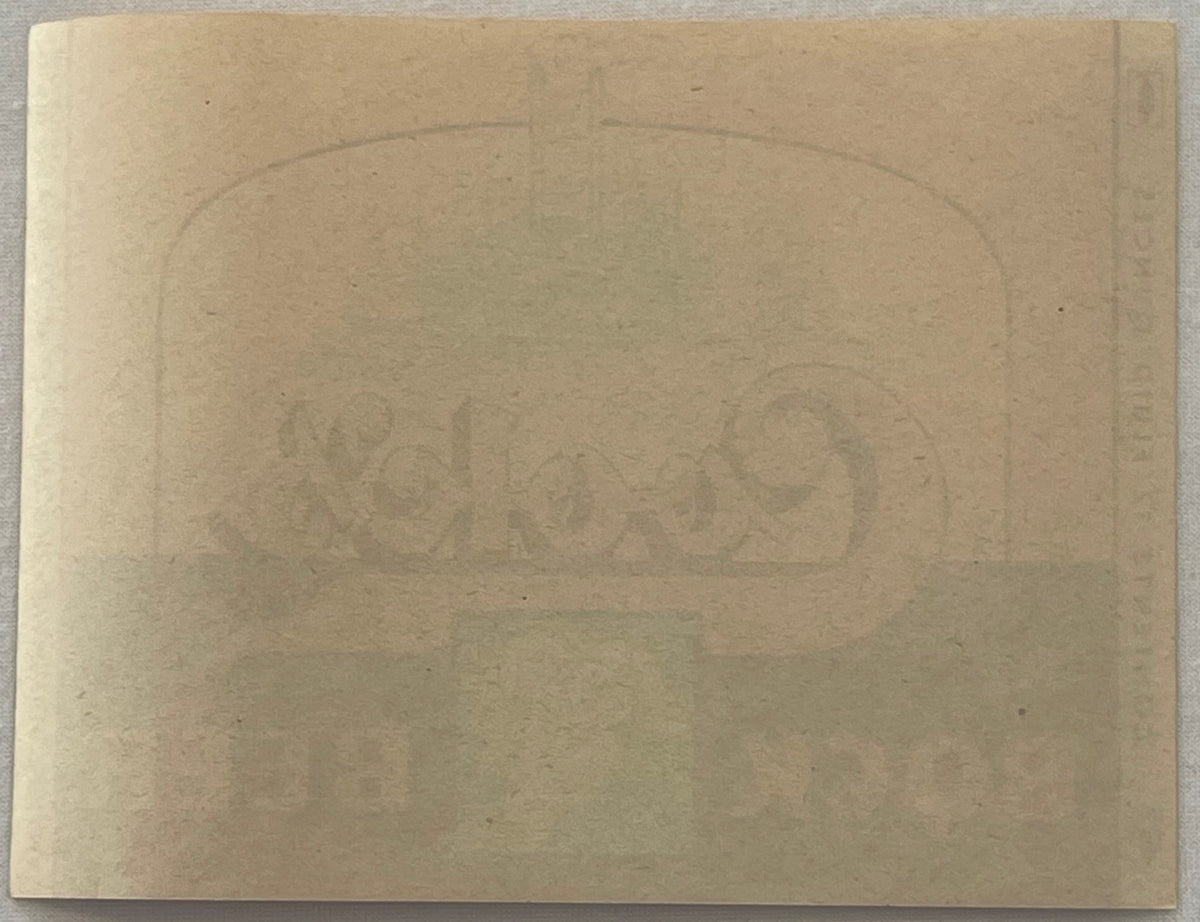
This is a New Old Stock (NOS) bottle label produced for Cook's Bock Beer by the F.W. Cook Company, Inc. of Evansville, Indiana. It was printed somewhere in the window between 1942 and 1955 — the confident heart of mid-century American commercial printing — and it was never applied to a bottle. Never soaked in water, never scraped away with a thumbnail, never exposed to the slow damage of humidity and handling that strips lesser survivors of their vibrancy. It came out of old stock clean, bright, and fully intact, and it measures approximately 4.5 by 3.5 inches: a compact, palm-sized document of an era when American brewery graphics were produced with real craft and genuine artistic ambition.

The label is letterpress and lithography work at its mid-century peak. The background field glows with warm golden amber — the color of the beer it was meant to announce — and five white five-pointed stars march across the top edge in a row, the kind of quietly patriotic detail that 1940s commercial art absorbed naturally, without self-consciousness. Inside a graceful arched cartouche, a green-line illustration depicts a paddle-wheel steamboat pushing through a river, twin smoke stacks rising, deck railings finely articulated, the whole silhouette unmistakably that of a working Ohio River vessel. Below the arch, the name Cook's sweeps across in looping hand-lettered script — gold-toned, outlined in deep brown — the work of a commercial lettering artist at the height of a tradition that the digital age would eventually make obsolete. And below that, the word Bock appears above the Cook Company credit line, completing the label's graphic hierarchy with the confidence of a brand that knew exactly who it was.

And then there is the goat — but we'll come back to him.


🏭 The F.W. Cook Company — A Brewery That Shaped a City

The F.W. Cook Brewing Company was one of the great institutional breweries of the American Midwest, and Evansville, Indiana was its home, its context, and in many ways its reason for being. Frederick William Cook founded the operation in the 1850s, planting it on the banks of the Ohio River at a moment when the American brewing industry was just beginning its long transformation from small local craft to industrial-scale production. The timing was extraordinary. German immigrant brewers were arriving across the Midwest in waves, bringing lager traditions, cold-fermentation techniques, and an unshakable commitment to quality malt beverage. Cook was part of that world — Evansville was part of that world — and the brewery grew accordingly.

By the late nineteenth century, the F.W. Cook Company had become one of the most significant brewing operations in southern Indiana, with a physical plant that dominated its section of the Evansville riverfront. The brewery survived the brutal consolidation years that destroyed hundreds of smaller American breweries, adapted through technological change, and — critically — survived Prohibition, re-emerging in 1933 with the energy of a company that had spent thirteen years planning its return. The postwar years, the exact era that produced this label, were in many respects the Cook Company's finest hour: production was strong, regional loyalty was deep, and the graphics the company put on its bottles reflected a house confident in its identity and its place in the community.

Cook's Goldblume was the flagship, but Bock season — the rich, malty dark lager traditionally brewed in late winter and released in spring — was a genuine event in the brewery's calendar and in the social calendar of Evansville's beer-drinking community. Bock beer carried its own visual language: the goat was its ancient emblem, tracing back to German brewing traditions that American brewers inherited and honored. When Cook's dressed its Bock label with a steamboat and a goat, it was doing something specific — it was planting one foot in the regional identity of the Ohio River valley and one foot in the centuries-old iconography of the bock tradition. That combination, on a single 4.5 by 3.5 inch label, is exactly what makes it remarkable.


🌊 Evansville, Indiana — River Town, Brewing Town, Collector Country

You cannot fully appreciate this label without understanding Evansville. Situated on a dramatic horseshoe bend of the Ohio River in southwestern Indiana, Evansville was never a quiet backwater — it was a genuine industrial and commercial center, one of the largest cities in Indiana for much of the nineteenth and twentieth centuries, and the river was the engine of everything. Flatboats, keelboats, and eventually the great paddle-wheel steamers that define our romantic image of the antebellum Midwest all moved through Evansville's reach of the Ohio. The city grew up watching river traffic, depending on river commerce, and identifying itself with the life of the water.

That steamboat on the Cook's Bock label is not decorative in any generic sense. It is a specific cultural reference, instantly legible to anyone who grew up in Evansville or anywhere along the Ohio's southern Indiana shore. The paddle-wheel steamboat was the symbol of commerce, connection, and regional identity for generations of river valley residents. Putting it on the Bock label was the brewery saying, plainly: this beer is from here, made by us, for you, in the place we all share. It is a statement of regional pride in graphic form, and it has aged into something considerably more resonant than it was when it was printed.

Evansville also had a robust German-American community — the same community that supported and worked in and drank the beer of breweries like Cook's. The bock tradition, with its springtime release and its goat mascot, was cultural as much as it was commercial. Local legend has it that Cook's Bock release was something of an informal community event in the German-American neighborhoods near the brewery, with tavern owners putting out the word when the new Bock arrived and regulars making a point to be first through the door. Whether that tradition was as formal as some old-timers recall or whether it softened in the retelling over the years is hard to say, but the lore is consistent enough that it carries the ring of genuine cultural memory.


🐐 The Goat — And Why He Matters More Than You Think

Bock beer and the goat are inseparable, and the story of how they came to be joined is one of brewing history's most satisfying little mysteries. The most widely accepted explanation traces the word bock to Einbeck, a German city famous for its strong lager — Bavarian brewers adopted and mispronounced Einbeck as ein Bock, meaning "a billy goat" in German, and the goat stuck as the beer's emblem. By the time American brewers inherited the tradition, the goat was simply part of the visual contract of Bock beer — you put a goat on the label, and every beer drinker in the country knew what they were getting.

But the goat on a Cook's label is also an Evansville goat, if you follow the lore. Collectors who have spent time with Cook's ephemera over the years tend to note that the goat imagery on Cook's Bock materials has a particular character — not the aggressive, head-lowered rams that some breweries favored, but a goat rendered with a certain amiable dignity. Lore passed down among breweriana collectors holds that Cook's graphic department had a standing instruction to make the bock goat look like a gentleman rather than a threat, on the theory that a friendly label sold better to the household buyer — the wife who was sending her husband to the tavern with a specific request. Whether that instruction was ever written down, or whether it was simply house style absorbed and repeated across print runs, no one can say for certain. But look at the label, and you will see exactly what the collectors mean.


🖨️ The Art of the Mid-Century Beer Label

It is worth pausing on what it actually took to produce a label like this in the 1940s, because the process is as much a part of the artifact's value as the design itself. Commercial lithography and letterpress printing at mid-century was skilled, labor-intensive work. The color separations were drawn by hand. The lettering — that gorgeous looping Cook's script — was executed by a commercial lettering artist who may have spent days on a single alphabet for a single client. The registration of multiple colors required precision machinery operated by experienced pressmen. Every element of this label represents human skill deployed at a high level, in service of a product that was expected to last only as long as a bottle of beer sat on a shelf before being opened.

The fact that NOS examples survived at all is something of an accident of commercial history. Overruns were common in the printing trade — you ordered more labels than you needed, because running the press short was more expensive than running it long, and the extras went into storage. When a brewery reformulated, rebranded, or closed, those storage rooms yielded their contents to whoever was paying attention. The labels that came out of those rooms intact are now, decades later, among the most charming and historically specific artifacts of mid-century American commercial art. This label is one of them.


🖼️ Display Ideas

  • 🪟 Frame it as standalone wall art — a simple black or walnut frame with a cream mat lets the golden amber background and the steamboat illustration do exactly what they were designed to do: stop a viewer in their tracks.
  • 🍺 Build a breweriana gallery wall — pair this Cook's Bock label with other Indiana or Ohio River valley brewery ephemera for a regional brewing history display that tells a coherent geographic and cultural story.
  • 🗺️ Mount it in a vintage map context — displayed alongside an antique Ohio River navigation chart or a period map of Evansville, the steamboat design takes on immediate historical depth and becomes a conversation piece about river commerce and regional identity.
  • 🍽️ Feature it in a bar or kitchen vignette — tucked into a display with vintage barware, a period bottle opener, and other mid-century tavern objects, this label anchors a curated vignette with genuine historical credibility.
  • 📚 Include it in a historical ephemera collection or archive — for collectors who maintain flat files or archival sleeves of paper Americana, this label is a first-tier addition to a Midwest brewing or Indiana commercial art subcollection.
  • 🎨 Use it as a design reference or inspiration piece — graphic designers, illustrators, and typographers who collect mid-century commercial art for reference will find the hand-lettered script, the cartouche structure, and the color palette genuinely instructive and endlessly reference-able.

🎁 Who Collects These

Breweriana collecting is one of the most active and passionate corners of American antiques and vintage, and beer label collecting sits at its accessible, high-reward heart. The people who seek out labels like this Cook's Bock example come from several overlapping worlds, and understanding those communities helps explain why a piece of paper this small can carry this much meaning.

There are the brewery historians and regional collectors — people who focus specifically on Indiana brewing, Ohio River valley commercial history, or the pre-consolidation era of American regional beer. For this community, a Cook's label in NOS condition is a primary source document, the kind of artifact that illustrates a brewery's graphic identity at a specific moment in time far more vividly than any written record.

There are the paper Americana and ephemera collectors who approach these labels as examples of mid-century commercial printing and graphic design — people who collect trade cards, advertising art, and printed packaging as a category, and who recognize the hand-lettering and lithographic quality here as representative of a tradition worth preserving.

There are Evansville and Indiana locals — residents and former residents with personal or family connections to Cook's, to the brewery neighborhood, to the Ohio River waterfront, or simply to the cultural memory of a time when this label meant something specific about where they lived. For this buyer, the label is not just art or history; it is identity.

And there are the bock beer and brewing tradition enthusiasts — craft brewing's revival has brought intense new interest in the history of American lager styles, and bock beer's ancient iconography, including that noble goat, resonates strongly with a new generation of drinkers who want to understand where their favorite styles came from and what they looked like when they were at their commercial and cultural peak.


❓ Frequently Asked Questions

What exactly does "New Old Stock" mean for a paper label like this?

New Old Stock — NOS — means the item was produced for commercial use, was never used, and survived in storage in essentially the same condition it left the printer. For a paper label, this is significant: it means the label was never soaked in water for application, never exposed to the humidity and condensation of a bottle, never scraped or peeled. Paper that was applied to bottles and then removed — even carefully — carries the evidence of that process in its fibers. An NOS label, by contrast, retains its original surface, its full ink saturation, and its structural integrity exactly as it came off the press. This Cook's Bock label is NOS, which is precisely why the color is as vivid and the paper as crisp as it is after seven or more decades.

How do I know when this label was printed?

The dating window of 1942 to 1955 is established through a combination of F.W. Cook Company corporate history, label design conventions, and printing style. The patriotic star row at the top of the label is consistent with wartime and immediate postwar graphics vocabulary. The hand-lettering style, the color palette, and the lithographic technique are all consistent with commercial printing practice in that period. Collectors and breweriana researchers who have catalogued Cook's label series over the years have established this window with reasonable confidence, though pinning it to a single year is not currently possible without additional documentation. What is certain is that it is a genuine mid-century artifact from the Cook Company's active production years.

Is this label suitable for framing, and what should I use?

Absolutely — and this is one of the genuine pleasures of collecting NOS paper ephemera in this condition. Because the label was never applied or soaked, it lays perfectly flat and requires no restoration or mounting preparation. For display, UV-protective glass or acrylic is worth considering if the piece will hang in a room with significant natural light, simply because all paper is light-sensitive over long periods. A standard archival mat — cream or warm white tends to complement the golden amber of the label beautifully — and a simple frame in black, walnut, or aged gold all work well with the label's color palette and period character.

What is the condition of this specific label?

The label is described as clean, bright, and full of color — the direct result of its NOS provenance. As with all vintage paper, minor age characteristics consistent with the piece's decades of existence may be present under close examination, but the overall presentation is vivid and strong. This is the condition that makes NOS breweriana paper so prized among serious collectors.

Why is the steamboat image significant on this particular label?

The paddle-wheel steamboat is not generic decoration — it is a direct reference to Evansville's identity as an Ohio River city. The Ohio River was the commercial spine of the entire region, and the steamboat era defined the economic and cultural life of river towns like Evansville for generations. Placing a finely detailed steamboat at the center of the label's graphic architecture was the F.W. Cook Company staking a claim to regional identity — saying explicitly that this beer belonged to the river valley, to its history, and to its people. For collectors interested in the intersection of brewing history and regional American history, that design choice makes this label considerably more layered and interesting than a label that simply names the product.

Is Cook's Bock Beer still produced, and what happened to the F.W. Cook Company?

The F.W. Cook Company, like the vast majority of America's independent regional breweries, did not survive the great consolidation wave of the mid-to-late twentieth century. The forces that shuttered hundreds of beloved regional breweries — national brand dominance, rising production costs, changing distribution economics — eventually reached Evansville as well. The Cook brand and its associated recipes and imagery passed through several hands after the original company's closure, and Evansville's brewing heritage, while no longer anchored by the Cook plant, is well remembered and actively celebrated by local historians and breweriana collectors. The labels, cans, trays, and advertising materials from the Cook Company's active years are now the primary physical record of that history, which is precisely what gives them their weight as collectibles.

How rare are Cook's Bock Beer labels in this condition?

NOS beer labels from mid-century regional breweries are genuinely uncommon in strong condition, and Cook's material specifically — given the brewery's regional rather than national footprint — does not surface with the frequency of labels from larger national brands. The Bock label variant is further specialized within the Cook's label family, since Bock was a seasonal product with its own dedicated label series rather than the brewery's year-round flagship. Collectors who focus on Indiana breweriana, Ohio River valley material, or mid-century seasonal beer labels will recognize immediately that a clean, bright NOS example of this label is not something that appears in every search. When NOS breweriana paper in this condition does surface, the collector community moves on it with appropriate urgency.

Shipping

🚚 Shipping & Handling

  • Shipping costs and timing are calculated at checkout.
  • Items curated and shipped directly by me include U.S. shipping at no additional cost, professionally packed to ensure safe arrival of your artifact.

Items from Vetted Pro Collectors
Shipping for items offered by vetted Pro Collectors is determined at checkout. All Pro Collector listings are reviewed to ensure fair, reasonable shipping practices.

For full details, please refer to our Shipping Policy.

Returns & Exchange

Product Page Return Policy

  • 60-Day Returns – Items must be in original condition.
  • Refunds – Issued after inspection (excluding shipping costs).
  • Return Shipping – Customer is responsible unless item is damaged or incorrect.
  • Damaged/Incorrect Items – Contact us within 48 hours for a replacement or refund.
  • Easy Returns – Email [email protected] or call 802-356-9872 to initiate a return.

For full details, visit our Refund Policy.

View full details