Skip to product information
1 of 5

Vintage and Antique Gifts

Vintage 1940s Old Tavern Premium Lager Beer Label 🍺 Warsaw Brewing Corp, Warsaw, Illinois NOS Fox Hunt American Made

Regular price 4.50 USD
Regular price Sale price 4.50 USD
Sale Sold out
Shipping calculated at checkout.

Description

Does a Four-Inch Piece of Paper Really Hold Eighty Years of American Brewing History? 🍺

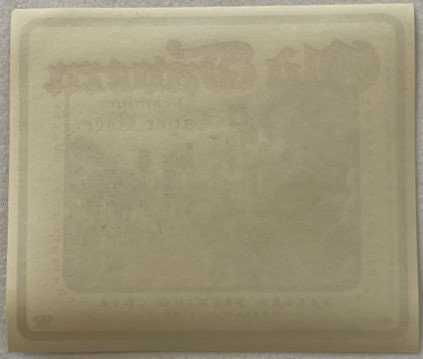
It does — and this one proves it. Hold this label at the right angle under a warm lamp and something remarkable happens: the ink still jumps, the colors still sing, and the fox hunt scene at its center carries you somewhere specific and unhurried, somewhere that smells faintly of hops and river air and a Saturday afternoon in a small Illinois town when the beer was cold and the company was good. This is not a reproduction, not a facsimile, not a later printing issued to satisfy nostalgia. This is the genuine article — a survivor — and that quiet fact is the whole story in a single sentence.

What you are looking at is a piece of paper that was printed sometime in the 1940s, stored carefully, and never once touched a bottle. It arrived here as New Old Stock: crisp, vivid, structurally intact, carrying every bit of its original detail. The fox hunt scene — rendered in that confident, illustrative style that mid-century label artists perfected — is as sharp today as it was the morning it rolled off the press. Some things improve with age. Some things simply endure. This label belongs to the second, rarer category, and collectors who understand what NOS means in the breweriana world know exactly why that matters.


🏷️ What It Is — Brand, Brewery, Era, and the Significance of "New Old Stock"

This is an original Old Tavern Premium Lager Beer label, produced by the Warsaw Brewing Corporation of Warsaw, Illinois, dating to the 1940s. It measures 4 x 3.2 inches — a compact, satisfying format that was standard issue for American beer bottles of the era, sized to wrap cleanly around the shoulder of a long-neck or fit flush against the body of a stubby. The printing quality is characteristic of mid-century commercial label work at its best: bold outlines, confident color fills, and a central vignette — the fox hunt tavern scene — that tells you everything you need to know about how this brewery wanted its beer perceived. This was a premium lager. The imagery said so before a single word was read.

The term New Old Stock deserves its own moment here, because it is the single most important phrase in this listing. NOS means this label was produced for commercial use, stored in a warehouse, a back office, a printer's flat file, or some combination of the three, and it was never applied to a bottle. It entered the world as a working commercial object, and it survived that world intact by simply never being used. In the breweriana collecting community, NOS labels are the gold standard. They have not been soaked off bottles (no water damage, no glue residue, no tearing from removal). They have not been flattened under books and left with pressure creases. They exist in the condition their makers left them in, which — when the storage was kind, as it was here — means they arrive looking startlingly, almost impossibly, fresh. This one is exactly that.


🏭 The Warsaw Brewing Corporation — Small-Town Pride, Midwestern Craft, and a Name Worth Remembering

The Warsaw Brewing Corporation operated during one of the most turbulent and transformative periods in American brewing history. The 1940s found the industry navigating the long hangover of Prohibition — which had ended in 1933 but left scars on the brewery landscape that took decades to fully heal — while simultaneously contending with the material shortages and economic pressures of World War II. Grain rationing, tin shortages, and a workforce drawn down by military service made running a regional brewery in the 1940s an act of genuine determination. The breweries that kept their doors open during these years, that kept their labels on the press and their lager in the tank, were operated by people who believed in what they were doing at a level that went beyond the purely commercial.

Warsaw Brewing Corporation was one of those operations — small enough to be local, ambitious enough to produce a premium lager under a brand name that reached for something aspirational. The "Old Tavern" name is deliberate and evocative. Tavern culture in mid-century America carried connotations of warmth, community, and a certain old-world respectability — particularly in river towns with deep European immigrant brewing traditions. A tavern was where the town took its temperature, where news traveled, where deals were made and feuds were settled over shared tables. Naming a premium lager after that institution was not accidental. It was a positioning statement, and a confident one.

The fox hunt imagery reinforces the premium tier even further. In the 1940s, English fox hunt scenes were widely understood as visual shorthand for quality, tradition, and a kind of aspirational leisure. You saw them on gentlemen's clubs, on imported goods, on the labels of products that wanted to communicate that they had standards. For a small Illinois brewery to reach for that imagery on its flagship premium label tells you something about the ambitions of the people running Warsaw Brewing. They were not making an everyday workingman's lager, or at least, they were making it clear that even an everyday lager could carry itself with a certain dignity.

Local legend has it that Warsaw Brewing was deeply woven into the social fabric of Hancock County in ways that went well beyond beer — that the brewery's principals were involved in local civic organizations, that the delivery routes doubled as community check-ins, and that the brewery's survival through the lean war years was a source of genuine local pride. Whether every detail of that lore can be documented is another matter; what is certain is that small regional breweries of this era functioned as community anchors in ways that are difficult to fully appreciate today, and Warsaw Brewing fits that pattern entirely.


🌊 Warsaw, Illinois — The River Town the Mississippi Shaped

Warsaw sits on the eastern bank of the Mississippi River in Hancock County, Illinois, in a dramatic bend of the river where the borders of Illinois, Iowa, and Missouri draw close together. It is one of those American places that carries more history per acre than almost anywhere else in the country — a fact that most people outside the region have simply never had occasion to learn, which makes stumbling across an artifact like this label all the more pleasurable.

The town was platted in the 1830s and grew quickly on the strength of river commerce. Flatboats, keelboats, and eventually steamers made Warsaw a legitimate port of call on one of the continent's busiest trade corridors. Goods moved through Warsaw on their way to St. Louis and New Orleans; settlers moving west stopped at Warsaw to resupply. The Mississippi was the highway, and Warsaw was a town that understood this — that built its economy around the current and the traffic it carried.

By the time the Warsaw Brewing Corporation was pressing labels in the 1940s, Warsaw had already witnessed the full sweep of American frontier history. The town had seen the early Mormon settlement period — Nauvoo, the major Mormon city, was just a few miles up the river — and had been present for some of the most dramatic episodes of that community's history. Warsaw was a Civil War town. It was a river commerce town. It was a town with German and Irish immigrant communities who brought brewing traditions with them from across the Atlantic and planted them firmly in the Mississippi Valley soil.

That immigrant brewing tradition is not incidental to this label. The lager style that Warsaw Brewing chose for its Old Tavern brand is itself a product of that heritage. Lager — cold-fermented, clean, crisp — was the dominant style brought to America by German immigrant brewers in the nineteenth century, and it became the defining American beer style by the early twentieth. When Warsaw Brewing called its product a "Premium Lager," it was invoking that tradition directly, connecting its product to a lineage of craft that ran from the brewery cellars of Bavaria and Bohemia straight through to the river towns of the American Midwest.

Lore passed down among collectors and regional historians holds that the Warsaw area once supported more brewing activity than its modest population might suggest — that the combination of river access for ingredient transport, German immigrant know-how, and a local culture that valued communal drinking and good fellowship made Hancock County a more significant brewing region than it is now generally remembered to be. This label is a small, beautiful piece of evidence for that claim.


🎨 The Label as Art — Fox Hunt Scene, Printing, and the Visual Language of Mid-Century Breweriana

Beer label art from the 1940s occupies a fascinating and underappreciated niche in American commercial art history. The constraints were real — small format, limited color separations, paper stock that had to survive refrigeration and humidity — but within those constraints, label artists of the era produced work of remarkable vitality and precision. The Old Tavern label is a fine example of this tradition.

The fox hunt tavern scene at the label's center is the kind of image that commercial illustrators of the 1940s executed with practiced confidence. Hunt scenes required a mastery of equestrian proportion, landscape composition, and period costuming, all compressed into a space measured in inches. The fact that this scene reads clearly and with genuine atmosphere at 4 x 3.2 inches is a testament to the skill of whoever sat down at a drafting table and worked it out, color separation by color separation, in the years before digital tools made such things trivially easy.

The word "premium" on a beer label in this era was not used lightly. Regional breweries competed fiercely for shelf space and tap lines, and a premium designation carried with it expectations about ingredient quality, brewing process, and yes, label presentation. The Old Tavern label communicates premium through its imagery, its typography, and the overall confidence of its design. This is a label that knew what it was doing.

NOS labels like this one also offer something that applied labels almost never can: the chance to study the printing craft itself without the interference of glue, moisture, or the distortions introduced by the bottling process. You can examine the registration, the color application, the paper stock, the ink saturation — all of it exactly as the printer delivered it. For collectors interested in the history of commercial printing as much as in the history of brewing, that is a genuinely meaningful distinction.


🖼️ Display Ideas

  • 🪵 Frame it in a simple dark wood or gilded frame — the fox hunt scene and warm label colors read beautifully against a deep walnut or aged gold surround, and the small format makes it ideal for a gallery wall grouping with other breweriana or vintage Illinois ephemera.
  • 🍺 Anchor a home bar display — mounted above a tap, tucked into a shadow box with a period bottle or church-key opener, or simply propped in a small easel on a back bar shelf, this label transforms a casual drinking space into something that has a story to tell.
  • 🗺️ Pair it with a vintage Illinois or Mississippi River map — Warsaw's river location makes the geographic pairing immediately evocative, and a framed label-and-map combination becomes a conversation piece that connects place to craft in a genuinely compelling way.
  • 🎁 Gift it as a framed piece — matted and framed, this label becomes a ready-to-hang gift for the Illinois history enthusiast, the breweriana collector, the home bar decorator, or anyone who appreciates the kind of thing that simply cannot be replicated or manufactured new.
  • 📚 Integrate it into a research or ephemera collection — stored flat in an archival sleeve, this label is a primary source document for anyone researching Illinois brewing history, Hancock County commerce, or mid-century American label printing, and it belongs in serious collections alongside postcards, trade cards, and regional advertising material.
  • 🏡 Use it as a kitchen or den accent — small-format vintage labels have a warmth and specificity that mass-produced "vintage-style" prints simply cannot replicate; this one, with its rich scene and clear provenance, works beautifully in lived-in spaces that value character over uniformity.

🎁 Who Collects These — and Why This One Matters to Them

Breweriana collecting is one of the most enthusiastic and well-organized corners of the Americana collecting world, and beer label collecting sits at an accessible, rewarding entry point within that world. Labels are affordable relative to larger three-dimensional breweriana (trays, signs, steins), they are easy to store and display, and they carry an enormous density of historical information in a very small package. A serious label collector understands that what they are building is, in effect, a visual archive of American regional brewing culture — a record of companies, towns, brand identities, and printing traditions that would otherwise survive only in institutional archives, if at all.

This particular label appeals to several distinct collector communities simultaneously. Illinois collectors and Hancock County local historians will recognize immediately how rare Warsaw Brewing material is — this is not a Chicago or St. Louis brewery with a robust collector market; this is a small-town operation whose surviving material is genuinely scarce, which makes each piece that surfaces meaningful beyond its individual visual appeal. Mississippi River Valley enthusiasts will connect the label to the broader story of river commerce and immigrant industry that shaped the region. Fox hunt and equestrian art collectors will appreciate the label's central scene as a miniature example of a decorative tradition that runs through English and American decorative arts for centuries. And NOS purists — collectors who specifically seek out unused, pristine-condition vintage material — will value the label's uncompromised condition as the single most important fact about it.

It also makes a genuinely thoughtful gift. There is a whole category of gift-giving that this label inhabits: the gift for the person who has everything, the gift for the history enthusiast who would never find this on their own, the gift that says I know what you actually care about in a way that a generic present simply cannot. Framed, this is a piece of wall art with a story attached. Presented in an archival sleeve with a note about Warsaw Brewing's history, it is an artifact with context. Either way, it is the kind of thing that gets kept.


❓ Frequently Asked Questions — Old Tavern Premium Lager Beer Label, Warsaw Brewing Corp.

What makes a label from a brewery this small worth serious collector attention?

Precisely its scarcity and specificity. Warsaw Brewing never had a large market footprint, so surviving material is genuinely uncommon, and a NOS example in this condition documents a slice of Mississippi River Valley brewing history that larger regional brands simply can't offer.

Is this label actually from the 1940s, or is it a later reproduction?

This is an original 1940s label, not a reproduction, reprint, or facsimile. New Old Stock (NOS) means it was produced during the brewery's active operation in the 1940s and has been in storage since that time, never applied to a bottle. Collectors with experience handling mid-century breweriana will recognize immediately that this is the real thing.

What does "New Old Stock" (NOS) mean, and why does it matter for condition?

New Old Stock is a term used across multiple collecting categories — automotive parts, electronics, clothing, and yes, paper ephemera and breweriana — to describe items that were manufactured for commercial use but were never sold or used, and have been in storage since their production. For beer labels specifically, NOS status is significant because it means the label was never subjected to the bottle application process (which involves moisture, glue, and the mechanical pressures of a bottling line) and was never subsequently soaked off a bottle for collection (which introduces additional moisture and the risk of tearing). An NOS label arrives in the condition its printer intended.

What were the Warsaw Brewing Corporation's years of operation, and why is their material so scarce?

Precise founding and closing dates for small regional breweries of this era can be difficult to pin down definitively, and Warsaw Brewing Corporation is no exception — the documentary record for small-town Illinois breweries is often fragmentary, distributed across local newspaper archives, state licensing records, and the memories of families connected to the operations. What is clear is that Warsaw Brewing was producing the Old Tavern Premium Lager brand during the 1940s, and like the vast majority of small regional American breweries, it did not survive the postwar consolidation of the industry that saw hundreds of local operations close as national brands expanded their distribution networks.

How should I store or display this label to preserve it long-term?

For archival storage, the gold standard is an acid-free, archival-quality sleeve or envelope stored flat, away from direct light, in a stable-humidity environment. Heat and humidity are the primary enemies of vintage paper; a climate-controlled interior space is ideal. For display, UV-filtering glass or acrylic in a frame will significantly slow any light-related fading.

What is the fox hunt scene on the label, and what does it tell us about the brand's positioning?

The fox hunt tavern scene is a piece of commercial illustration that places the Old Tavern brand within a visual tradition associated with English country life, sporting leisure, and a certain aspirational quality. For Warsaw Brewing to use this imagery on its premium lager label was a deliberate brand statement: this is a beer for people with standards, served in the kind of warm, convivial establishment the "Old Tavern" name evokes.

What's the broader takeaway for someone weighing whether this piece fits their collection?

If your collection leans toward Midwestern river-town history, pre-consolidation regional brewing, or mid-century commercial illustration, this label checks all three boxes at once in a single, affordable, easy-to-display object, which is exactly why pieces like it tend to become anchors rather than afterthoughts in a serious collection.


Shipping

🚚 Shipping & Handling

  • Shipping costs and timing are calculated at checkout.
  • Items curated and shipped directly by me include U.S. shipping at no additional cost, professionally packed to ensure safe arrival of your artifact.

Items from Vetted Pro Collectors
Shipping for items offered by vetted Pro Collectors is determined at checkout. All Pro Collector listings are reviewed to ensure fair, reasonable shipping practices.

For full details, please refer to our Shipping Policy.

Returns & Exchange

Product Page Return Policy

  • 60-Day Returns – Items must be in original condition.
  • Refunds – Issued after inspection (excluding shipping costs).
  • Return Shipping – Customer is responsible unless item is damaged or incorrect.
  • Damaged/Incorrect Items – Contact us within 48 hours for a replacement or refund.
  • Easy Returns – Email [email protected] or call 802-356-9872 to initiate a return.

For full details, visit our Refund Policy.

View full details