Skip to product information
1 of 3

Vintage and Antique Gifts

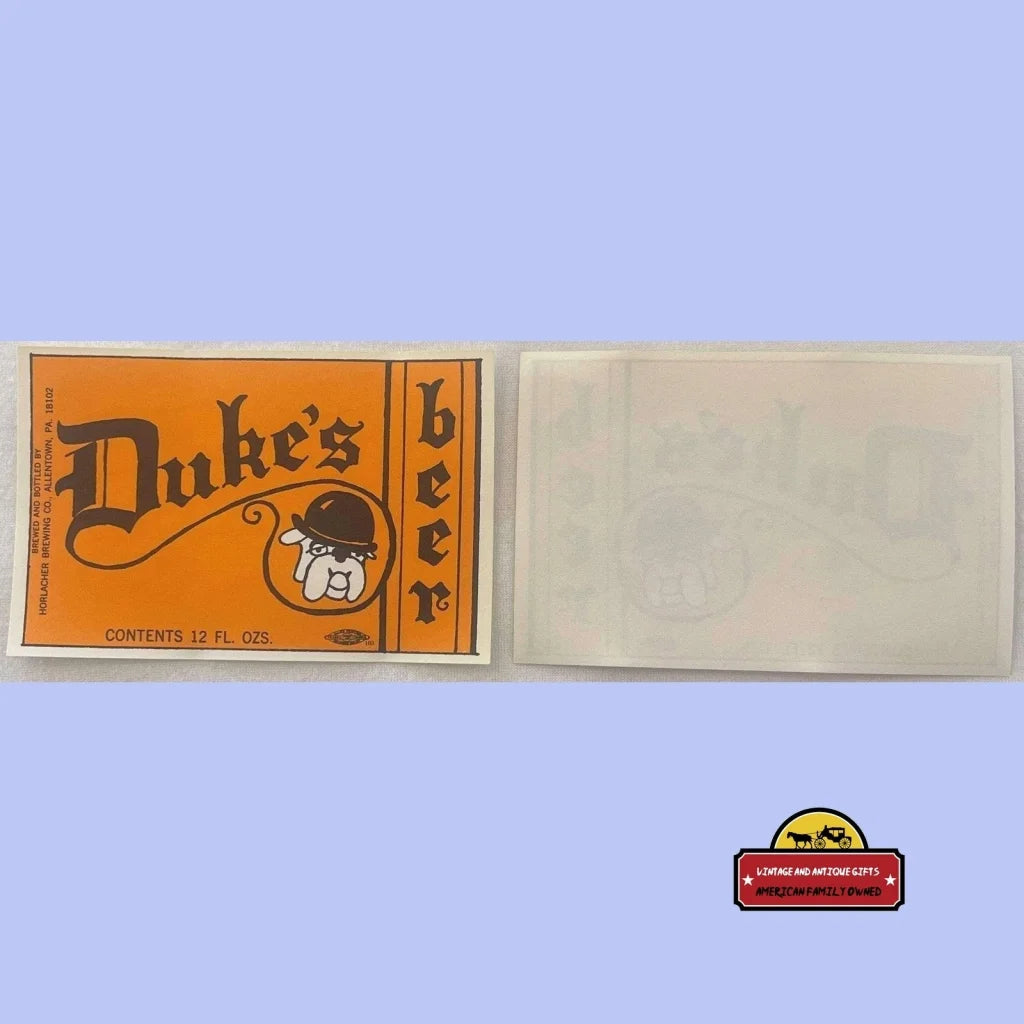
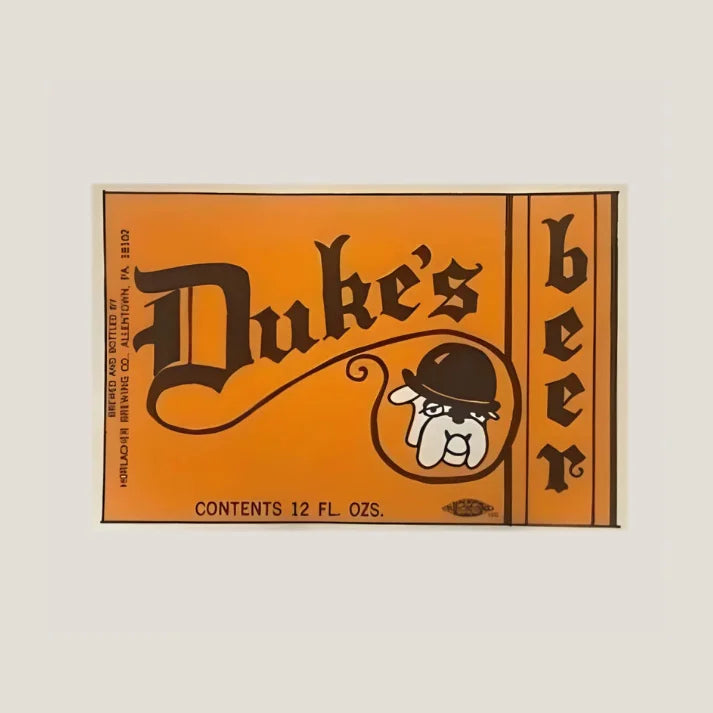
Vintage Duke's Beer Label 🐾 Horlacher Brewing Co. Allentown PA Bulldog Bowler Hat NOS Breweriana American Made

Regular price 4.50 USD
Regular price Sale price 4.50 USD
Sale Sold out
Shipping calculated at checkout.

Description

What Stops You Cold in a Box of Breweriana? 🐾 Meet the Bulldog in the Bowler Hat.

There is a certain kind of collector moment — and if you have been at this long enough, you know exactly the one I mean — where something small and flat and paper-thin reaches up out of a dealer's bin or an estate box and grabs you by the collar. Not because of grand provenance. Not because of a famous name. Because of a face. In this case, it is a bulldog's face. A white bulldog, chin lifted with the particular dignity of a dog who has decided he is better dressed than everyone in the room, wearing a dark bowler hat at a rakish angle, tucked inside a decorative circular frame on a blazing orange label from a Pennsylvania brewery most of the country has already forgotten. He looks like he has opinions. He looks like he has been waiting. And honestly? He has. This label has been sitting in New Old Stock condition since sometime in the early 1970s, and he has lost none of his authority. This is the kind of piece that does not just go into a frame — it anchors a room.

This is a vintage Duke's Beer label, produced by the Horlacher Brewing Company of Allentown, Pennsylvania, dating to the early 1970s, and it is New Old Stock — meaning it was never affixed to a bottle, never touched by condensation or bar-light or a bartender's thumb. It measures 3.5 by 2.25 inches, printed on crisp paper stock in a bold, saturated orange field with rich dark-brown typography and that unforgettable mascot centered in his decorative medallion frame. The brand name Duke's runs across the face in a heavy old-English blackletter script — the kind of lettering that has gravity, that announces itself the way a proper brewery name should. The word Beer is stacked vertically along the right side panel in matching blackletter style. A decorative swirl from the tail of the capital D in Duke's spirals downward and unfurls into the circular frame that cradles the bulldog mascot — white coat, dark hat, expression somewhere between deeply dignified and deeply suspicious of your recent life decisions. The color, the script, the dog: this is a label designed to catch your eye across a dim taproom from thirty feet out, and it still works.


🏭 Horlacher Brewing Company — A Lehigh Valley Institution That Outlasted Nearly Everything

The Horlacher Brewing Company is one of those regional American breweries whose story is inseparable from the story of the city that built it. Founded in Allentown, Pennsylvania in 1876 — the centennial year of the American republic, the year Ulysses S. Grant was finishing his second term in the White House — Horlacher came into existence at a moment when American brewing was entering its golden age of regional identity. Every city of any size had its own brewery, often more than one, each serving a specific neighborhood, a specific immigrant community, a specific set of tastes shaped by the particular water, the local grain supply, and the people who had settled there. In Allentown, that meant the Lehigh Valley's dense German-American working-class communities, the steel and textile workers, the people who had come to the valley to build things with their hands and wanted, at the end of a long shift, a cold beer that felt like it belonged to them.

Horlacher survived Prohibition — no small feat, as that particular era wiped the names of hundreds of American regional breweries off the map permanently. The brewery pivoted, as survivors did, and came back fighting when Repeal arrived in 1933. Through the mid-twentieth century, Horlacher kept its Allentown identity intact even as the national breweries began their long consolidation campaign, buying up regional names, closing local plants, and replacing distinctive local products with standardized national brands. Horlacher kept brewing. They kept their Allentown address. And they kept making Duke's.

Duke's Beer was one of Horlacher's flagship brands, and the bulldog mascot was the visual engine of its identity. Local legend has it that the bulldog was chosen specifically to project stubbornness — the kind of staying-power advertising a regional brewery needed to communicate to its loyal drinkers in the face of growing national competition. Whether that was a deliberate marketing strategy or just a designer's instinct, the result was a mascot with more personality than most corporate logos manage across entire brand-identity campaigns. The bowler hat added the crucial detail: this was not just a tough dog. This was a classy tough dog. A dog with standards. Lore passed down among Lehigh Valley breweriana collectors holds that Duke's was specifically positioned as the "dressed-up" option in Horlacher's lineup — a slightly more upscale presentation meant to compete on bar shelves with national brands that had bigger advertising budgets but, arguably, less charm.

Horlacher would ultimately close in 1978, a casualty of the same forces that shuttered dozens of beloved American regional breweries in the 1970s — rising ingredient costs, shifting consumer habits, and the relentless pressure of national distribution networks that regional operations simply could not match on volume pricing. The closure hit Allentown hard. These were local jobs, local identity, local pride. The brewery building itself became part of the Lehigh Valley's complicated post-industrial landscape — a story that Allentown shares with many of its neighboring cities, the kind of layered history that gives a place its particular character and makes its artifacts carry emotional weight far beyond their physical size.


🏙️ Allentown, Pennsylvania — The Lehigh Valley and the Weight of Industrial Memory

Allentown sits in the Lehigh Valley of eastern Pennsylvania, tucked between the Blue Mountain ridge to the north and the Lehigh River as it works its way toward the Delaware. It is the third-largest city in Pennsylvania, a fact that surprises people who think of the state as a story told between Philadelphia and Pittsburgh. The valley was industrial long before it was famous for being industrial — iron and silk, zinc and steel, textiles and cement, all of it powered by the river and the rail lines and the particular stubbornness of a workforce that built things meant to last. The Pennsylvania Germans — the Deitsch — were the cultural bedrock, but waves of immigrants from across central and southern Europe added their own layers to the Lehigh Valley's character through the late nineteenth and early twentieth centuries, creating the dense, proud, neighborhood-by-neighborhood working-class culture that American regional breweries like Horlacher were designed to serve.

When Billy Joel wrote about Allentown in 1982 — four years after Horlacher closed — he was writing about something that people in the valley already knew in their bones: that the industries which had defined the place were leaving, and that the memory of what had been built there carried a specific kind of grief that was also, underneath, a specific kind of pride. A Duke's Beer label from the early 1970s is, in its quiet way, an artifact of the years just before all of that arrived — a fragment of the Allentown that still had its brewery, still had its working-class taprooms, still had its bulldog on the label watching the door.

For collectors in the Lehigh Valley and across eastern Pennsylvania, Horlacher breweriana carries that layer of local meaning that no national-brand collectible can replicate. This is not nostalgia for a generalized past — it is nostalgia for a specific place, a specific community, a specific set of choices made by people who decided to stay and build something in the valley. Duke's Beer and its bowler-hatted mascot are part of that record.


🎨 Label Printing and the Art of Mid-Century American Breweriana

It is worth pausing to appreciate what went into making a label like this one, because the craft is part of what makes surviving NOS examples so appealing to collectors today. By the early 1970s, American brewery labels were produced primarily by specialized printing houses — often regional operations with deep relationships with the breweries they served — using lithographic printing processes that could achieve the kind of dense, saturated color fields and fine-line typographic detail you see on this Duke's label. That blazing orange was not an accident or an afterthought. Orange in bar-label design was a deliberate attention tool, chosen because it reads as warm and energetic under incandescent lighting — the exact lighting condition of virtually every American tavern of the era.

The blackletter typography — sometimes called Old English or Gothic script in American commercial printing of the period — was equally deliberate. It carried associations of tradition, of age, of craft, of the European brewing heritage that American regional breweries wanted to claim as their own inheritance. Horlacher, founded the year of the American centennial by German-American brewers in a German-American community, had every right to that inheritance, and the Duke's label wears it without self-consciousness. The swirling decorative element that transitions from the typography into the mascot medallion is the kind of detail that takes an experienced commercial artist to execute well — and here it works, creating visual flow that draws your eye from the brand name directly to the dog, which is, of course, where they wanted it.

New Old Stock labels like this one survive because someone, somewhere in the brewery's supply chain, set aside quantities that were never used — perhaps from an overprint run, perhaps from the end of a production cycle, perhaps simply because a storeroom was never properly cleared. When Horlacher closed in 1978, whatever remained in inventory eventually scattered into the collector market, where NOS brewery labels are prized specifically because they have never gone through the wet, cold, handling-intensive life of an actual bottling operation. The colors on this label are as close to how they came off the press as they will ever be.


🖼️ Display Ideas

  • 🪟 Frame it solo, oversized mat. A 3.5 x 2.25 inch label floating in a wide white or cream mat in a 5x7 or 8x10 frame becomes a graphic art piece. The orange field commands whatever wall you give it.
  • 🍺 Breweriana gallery wall anchor. Pair with other Pennsylvania brewery labels — Yuengling, Schmidt's, Reading, Stoney's — for a Keystone State brewing history display that tells a whole regional story.
  • 🐾 Dog-themed bar cart vignette. The bulldog mascot makes this a natural centerpiece for a framed display alongside other dog-mascot breweriana, vintage dog illustrations, or canine-themed antiques. The bowler hat gives it crossover appeal into vintage fashion and accessories collections.
  • 🏙️ Allentown / Lehigh Valley local history collection. Display with other Allentown and Bethlehem ephemera — postcards, trade cards, steel industry advertising — as a curated document of the valley's mid-century industrial culture.
  • 📚 Archival presentation in a collector's binder or display sleeve. For the serious breweriana archivist, this NOS label is a prime candidate for archival-sleeve display within a Pennsylvania brewery label collection, documented with date and provenance notes.
  • 🎁 Framed gift for the Allentown native or Lehigh Valley expat. There is no more personal gift for someone who grew up in that valley than a piece of its brewery history, framed and ready to hang. This one has a dog in a hat. It is, objectively, perfect.

🎁 Who Collects These — and Why Duke's Always Finds a Home

Breweriana collecting is one of the most richly layered corners of American advertising antiques, and it draws people in from several very different directions. There are the deep specialists — collectors who focus exclusively on Pennsylvania breweries, or on pre-Prohibition labels, or on lithographed tin signs, who want every surviving artifact from a specific brewery's history. For those collectors, a NOS Duke's Beer label from Horlacher's final decade of operation is a primary document: crisp, authentic, and increasingly difficult to find in this condition.

There are the regional collectors — people from Allentown, Bethlehem, Easton, and the surrounding Lehigh Valley communities who collect local history with the same emotional investment that other people put into family photographs. For them, a Horlacher label is not just breweriana. It is memory made tangible. It is the brewery their grandfather talked about, the label on the beer at their parents' kitchen table, the name on a building they drove past as children that is no longer a brewery anymore.

Then there are the collectors who arrive through the mascot door — people who collect vintage dog imagery, bulldog memorabilia, vintage advertising characters with outsized personality. The Duke's bulldog in his bowler hat is genuinely exceptional in this category. He is not a generic brewery hound. He is a character — styled, posed, expressive, and rendered with enough graphic confidence that he reads as an illustration worth collecting entirely apart from his brewery context.

And finally, there are the gift-givers — people who know someone who loves dogs, or Pennsylvania history, or vintage advertising art, or bar antiques, or simply things that are old and beautiful and made with care, who want something small enough to frame and specific enough to mean something. This label checks every one of those boxes simultaneously.


❓ Frequently Asked Questions

Is this label genuinely New Old Stock, and what does that mean for condition?

Yes — this is a New Old Stock label, meaning it was never applied to a bottle. It was produced by Horlacher Brewing Company as part of their commercial supply of Duke's Beer labels and survived the brewery's 1978 closure without having gone through the bottling process. What you see is as close as possible to how this label came off the press in the early 1970s — that saturated orange field, the crisp blackletter typography, the bulldog mascot in his full graphic glory. For collectors, NOS is the benchmark. Paper breweriana in NOS condition at this age is genuinely uncommon.

How old is this label, and how do we know it's from the early 1970s?

The label dates to the early 1970s based on its graphic style, typography conventions, and its place within Horlacher Brewing Company's documented production history. Horlacher operated continuously from 1876 until its closure in 1978, and the Duke's brand with this specific bulldog mascot and orange label design was active in the brewery's later production years. The printing style, color palette, and label construction are consistent with commercial brewery label printing of the early 1970s. Given that the brewery closed in 1978, this label is at minimum approximately fifty years old.

What is the label made of, and how should I handle it?

The label is printed on paper stock — the standard substrate for American bottle labels of this era. Paper breweriana from the 1970s is durable when stored and displayed correctly, but it is paper, and it responds to humidity, direct sunlight, and physical handling the way paper always does. For display, framing behind UV-protective glass or acrylic is the ideal approach — it protects the color from light fade and the paper from humidity fluctuation while letting you enjoy the label fully. Handle by the edges, avoid prolonged exposure to direct sunlight even before framing, and keep it away from moisture.

Why is Horlacher breweriana considered scarce, and what drives collector interest?

Horlacher's 1978 closure was part of a broader consolidation wave that eliminated dozens of American regional breweries during the 1970s, as national brands achieved distribution advantages and cost structures that smaller regional operations found increasingly difficult to compete with. The brewery's closure means the supply of authentic Horlacher breweriana is permanently fixed — nothing new will ever be produced, and every surviving piece represents a finite and diminishing pool of artifacts. That scarcity, combined with the brewery's century-plus history and its deep roots in Lehigh Valley community identity, drives sustained collector interest. Horlacher pieces in good condition find enthusiastic buyers in the Lehigh Valley local history community, in the broader Pennsylvania breweriana collecting world, and among specialists in American regional brewery ephemera.

Is the Duke's bulldog mascot well known among breweriana collectors?

Within the community of Pennsylvania breweriana collectors and Lehigh Valley local history enthusiasts, yes — the Duke's bulldog is a recognized and appealing mascot. Among the broader national breweriana collecting community, Horlacher is a regional name rather than a nationally famous one, which is part of what makes surviving artifacts interesting: they represent a layer of American brewing history that the big national-brand collectors are not competing for as aggressively. The bulldog mascot specifically — with the bowler hat, the attitude, the graphic confidence of the design — has crossover appeal that brings in collectors who might not otherwise be focused on Pennsylvania breweriana. He is simply a very good mascot, and good mascots have their own collector gravity independent of the brand's fame.

Can this label be framed, and what frame size works best?

Absolutely — framing is the most popular display choice for NOS brewery labels of this size and quality. At 3.5 by 2.25 inches, this label is compact enough that it benefits from generous matting to give it visual breathing room and allow the eye to appreciate the design without crowding. A standard 5x7 inch frame with a wide mat is a practical and visually effective option; an 8x10 frame with a wider mat gives it more presence on the wall and allows it to anchor a display or gallery arrangement. For archival quality, look for acid-free mat board and UV-protective glazing. The orange field reads beautifully against both white and cream mats; a dark brown mat echoes the typography and can make the orange really sing.

Is this the kind of piece that appreciates in collector value over time?

Regional American brewery labels in NOS condition have shown steady collector interest over the past several decades, particularly as the distance from the closures of regional breweries grows and the community of people with living memory of those brands becomes more passionate about preservation. Horlacher specifically benefits from Allentown's cultural moment — the city's industrial history has been the subject of sustained attention in American popular culture and local history circles, and that attention tends to lift interest in its artifacts. No responsible seller promises specific future value, but the fundamentals for this category are sound: finite supply, growing collector awareness, genuine regional emotional resonance, and an item in exceptional NOS condition with a mascot that makes people smile. Those are good fundamentals for anything you choose to add to a collection.

Shipping

🚚 Shipping & Handling

  • Shipping costs and timing are calculated at checkout.
  • Items curated and shipped directly by me include U.S. shipping at no additional cost, professionally packed to ensure safe arrival of your artifact.

Items from Vetted Pro Collectors
Shipping for items offered by vetted Pro Collectors is determined at checkout. All Pro Collector listings are reviewed to ensure fair, reasonable shipping practices.

For full details, please refer to our Shipping Policy.

Returns & Exchange

Product Page Return Policy

  • 60-Day Returns – Items must be in original condition.
  • Refunds – Issued after inspection (excluding shipping costs).
  • Return Shipping – Customer is responsible unless item is damaged or incorrect.
  • Damaged/Incorrect Items – Contact us within 48 hours for a replacement or refund.
  • Easy Returns – Email [email protected] or call 802-356-9872 to initiate a return.

For full details, visit our Refund Policy.

View full details