Skip to product information
1 of 3

Vintage and Antique Gifts

Vintage 1960s-1970s Town of Conway New Hampshire Police Tin Litho Toy Badge 🦅 NOS on Card Made in Japan

Vintage 1960s-1970s Town of Conway New Hampshire Police Tin Litho Toy Badge 🦅 NOS on Card Made in Japan

Regular price 18.00 USD
Regular price Sale price 18.00 USD
Sale Sold out
Shipping calculated at checkout.
Quantity

Town of Conway, New Hampshire: a White Mountains Name on a Dime-Store Police Badge 🦅

Conway has been sending visitors home with pictures of itself ever since landscape painters discovered its mountains in 1850. Chromolithograph views, depot tickets, ski lessons, scenic train rides: the town has long sent its name out into the world on small printed things. This badge carries it in a way few would expect: a carded Special Police toy badge, made in Japan for the five-and-dime counter, with TOWN OF CONWAY and NEW HAMPSHIRE printed on ribbons around a spread-winged eagle. It is still on its original card, inside a clear sleeve, New Old Stock. Tin litho badges stamped with a real town's name seldom come up for sale.

What Is on the Card and the Badge

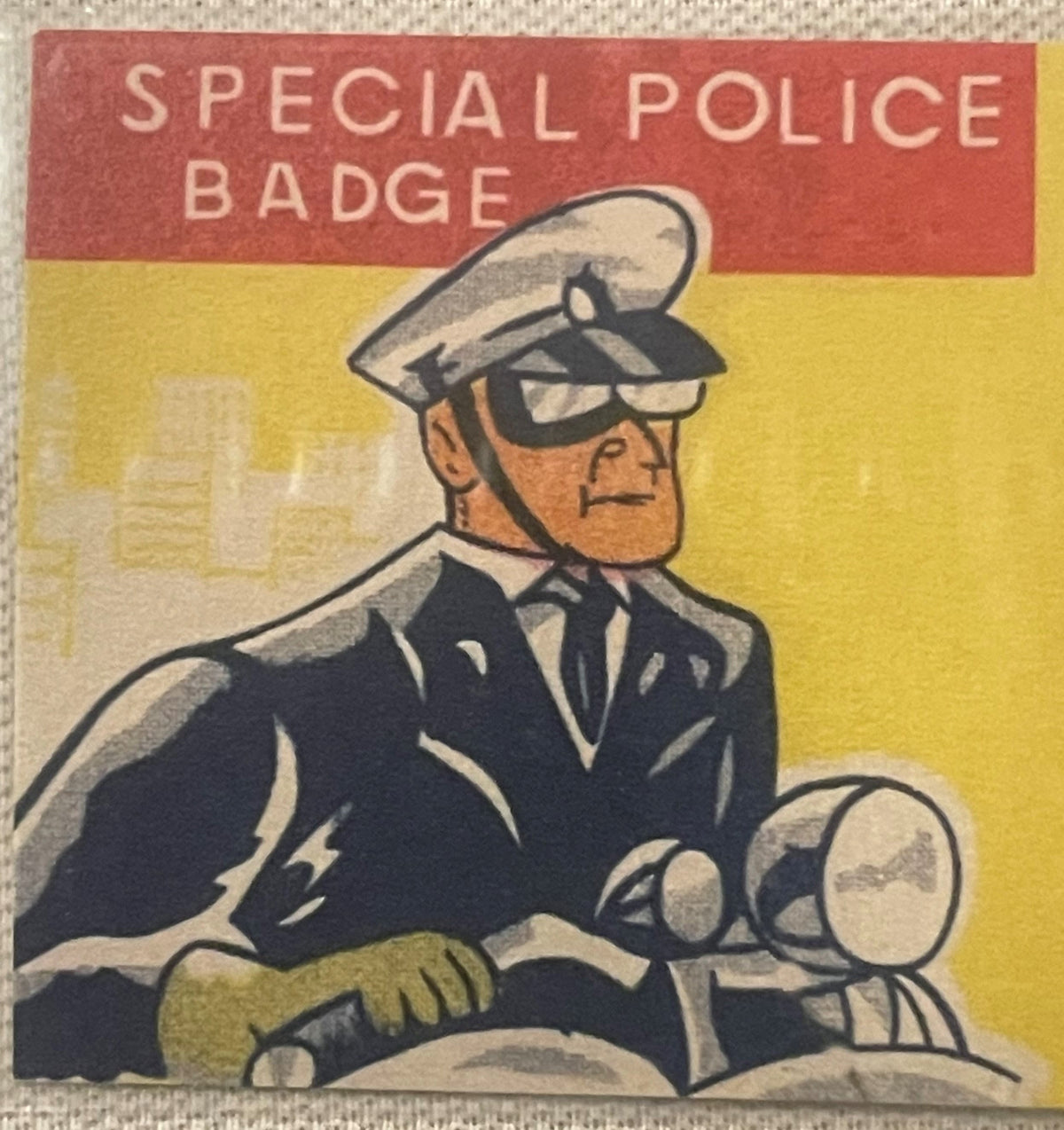
The card measures 4 x 2.25 inches. A red band across the top reads SPECIAL POLICE BADGE in white capitals. Below it, on a sunny yellow ground, a cartoon motorcycle officer rides in front of a pale city skyline: white peaked cap, riding goggles down over his eyes, a strap under his chin, dark uniform and tie, green gloves on the handlebars and a big round headlamp at the bottom edge. Small capitals at the lower right say JAPAN.

The badge is a round button about the size of a silver dollar, with a glossy red rim around a black shield outlined in blue. POLICE arches across the top in gold capitals, with a red star beneath it. An orange-and-gold eagle spreads its wings across the center, holding an olive branch in one talon and a sheaf of arrows in the other, with a stars-and-stripes shield on its breast: three white stars over red and white stripes. Red-edged ribbons run down both sides of the shield and end in scrolls at the bottom, reading TOWN OF CONWAY on the left and NEW HAMPSHIRE on the right.

The eagle's pose is borrowed from the highest source there is. An eagle clutching an olive branch and arrows, with a striped shield on its breast, is the design of the Great Seal of the United States, adopted by the Continental Congress in 1782 — peace in one talon, readiness in the other. On a toy, it gives a small-town badge the look of authority a child could wear.

Dating the Card

The goggled rider was not made for Conway alone. The same SPECIAL POLICE BADGE card, marked JAPAN, carries buttons for other places, and one of them reproduces the San Francisco Police Department's shoulder patch, a design the SFPD approved in 1969 and first wore in 1970. That fits the 1960s–1970s window these carded badges belong to.

It also makes this a late product of a famous trade. During the Allied occupation, from 1945 to 1952, Japanese exports were marked "Made in Occupied Japan"; after that, plain JAPAN. Collectors put the heyday of Japanese tin toys at roughly 1952 to 1962, after which plastic became the material of choice, labor costs rose, safety rules tightened and cheap toy making moved to Hong Kong and Taiwan. A tin litho badge on a JAPAN card from these years is a late product of that trade.

Conway: Chartered in 1765

In 1765 colonial Governor Benning Wentworth chartered sixty-five men to establish Conway, naming it for Henry Seymour Conway, who went on to become Commander in Chief of the British Army. The grant came with terms: to keep his land, a settler had to plant five acres for every fifty in his share, and do it within five years. The town grew along the Saco River and its tributary the Swift River, and today its villages include Conway, North Conway, Center Conway, Redstone, Kearsarge, Intervale and East Conway. With 9,822 people at the 2020 census, it is the most populous community in Carroll County.

The Painters Who Put North Conway on the Map

Benjamin Champney first saw the Conway country in 1838. In 1850 he came back with his friend John Frederick Kensett, and their paintings and enthusiasm drew so many Boston and New York artists that North Conway blossomed into what is often called the first artist colony in the United States. Champney married in 1853 and bought a house between Conway and North Conway that was his summer home for more than fifty years; his studio became a social center for visitors from all over the country. His paintings were turned into chromolithographs and sold to tourists who could not afford the originals, an early chapter in the souvenir trade that still runs through the valley.

The Railroad, the Depot and the Scenic Line

The Portsmouth, Great Falls and Conway Railroad entered Conway in 1871 and reached North Conway in 1872, and tourism expanded dramatically. In 1874 the railroad built North Conway's depot, an eclectic Russian-Victorian building designed by Nathaniel J. Bradlee, with a ticket office, a baggage room and separate waiting rooms for men and women. The last Boston-bound passenger train left in 1961, freight service ended on October 30, 1972, and the line was abandoned. Then Dwight A. Smith, with partners Carroll P. Reed and William Levy, restored the depot, and on August 4, 1974 the Conway Scenic Railroad opened to the public and sold its first 94 excursion tickets. The depot and yard joined the National Register of Historic Places in 1979.

Skis, Schneider and the Skimobile

North Conway's other great draw is snow. New York banker Harvey Gibson founded Cranmore, which opened for the 1937–38 season with a single rope tow, and for the next winter local mechanic George Morton designed the Skimobile: small cars running up a wooden trestle, pulled by a cable under the track. Gibson then did something far bigger. When the Nazis took over Austria in March 1938, the famed ski teacher Hannes Schneider was imprisoned and his school seized. Gibson used financial pressure to win the release of Schneider and his family, and on February 11, 1939 they stepped off the train at North Conway station and walked beneath an arch of raised ski poles held by junior skiers of the Eastern Slope Ski School. Gibson put Schneider in charge of Cranmore.

The Kancamagus, and the Legend of Chocorua

In August 1959 two dead-end stretches of mountain road were joined to open the Kancamagus Highway, which runs about 56 miles west from Conway to Lincoln and was paved in 1964. It is named for Kancamagus, the "Fearless One," grandson of Passaconaway and the third and final sagamore of the Penacook Confederacy.

South of town rises Mount Chocorua, and with it the White Mountains' best-known legend. The story goes that Chocorua, a chief of the Pequawket people, befriended a settler named Cornelius Campbell, and that Chocorua's son, left in the Campbells' care, drank a poison Campbell had mixed for foxes and died. Chocorua took his revenge, the Campbell family was found dead, and Campbell chased the chief to the summit and shot him there. With his dying breath, legend has it, Chocorua cursed the settlers, their land, their homes and their cattle. Boston writer Lydia Maria Child set the tale down in 1829 to accompany an engraving by Thomas Cole, who also painted the scene. Historian Mary Ellen Lepionka has written about how little evidence stands behind the tale, and Chocorua may never have lived, but the curse has been told for nearly two hundred years.

Dime-Store Counters, Sheriffs' Prizes and Rice-Paper Crates

Carded badges like this sold for pocket change on the novelty racks of variety chains such as the F. W. Woolworth Company and the S. S. Kresge Company and at small-town five-and-dimes. They did another job too: sheriffs handed tin litho badges like these out as prizes in youth programs, in the same America where AAA clubs began organizing School Safety Patrols in the 1920s and millions of schoolchildren wore belts and badges to cross younger classmates at the curb.

A dealer who sold off a retiring friend's old store stock of carded Japanese Special Police badges described the master cases as old rice paper, marked Made in Japan, and wholesale boxes of six dozen, 72 carded badges to a box, still surface now and then. That rice-paper crate is how collectors picture these badges crossing the Pacific.

Questions People Ask

Is this a police-issued badge?

No. It is a children's novelty: a printed tin button on a store card marked JAPAN, headed SPECIAL POLICE BADGE. It was made to be played with or given as a prize, never carried on duty.

How old is it?

The card it rides on was also used for a button copying San Francisco's 1970 police patch, which places this family of carded badges in the 1960s–1970s.

What does the eagle mean?

It follows the Great Seal of the United States: olive branch for peace, arrows for strength, and a striped shield for the union.

How big is the card?

4 x 2.25 inches, with a silver-dollar-size button.

What condition is it in?

New Old Stock, never worn, with the button still on its card and the card still sleeved.

Who is it for?

Anyone with roots in Conway, North Conway or the Mount Washington Valley; New Hampshire and White Mountains collectors; tin toy and dime-store collectors; a Conway officer or retiree; or a shadow box of small-town Americana.

Shipping

🚚 Shipping & Handling

  • Shipping costs and timing are calculated at checkout.
  • Items curated and shipped directly by me include U.S. shipping at no additional cost, professionally packed to ensure safe arrival of your artifact.

Items from Vetted Pro Collectors
Shipping for items offered by vetted Pro Collectors is determined at checkout. All Pro Collector listings are reviewed to ensure fair, reasonable shipping practices.

For full details, please refer to our Shipping Policy.

Returns & Exchange

Take your time — you've got a full six months. If a piece isn't right for you, send it back the way it reached you and we're good.

In the first 30 days your money goes straight back the way you paid. After that it's store credit, so you can put it toward something you'd rather have.

Return shipping we sort out between us, case by case. I don't make this difficult.

If something arrives damaged, or it isn't what I said it was, send me a photo within 48 hours and I'll make it right.

Email info@vintageantiquesgifts.com or call 802-356-9872 — that's me answering, not a call center.

The only things I can't take back are custom or special-order pieces and gift cards.

View full details