Skip to product information
1 of 4

Vintage and Antique Gifts

Vintage 1960s Coach and Four Sarsaparilla ๐Ÿบ Soda Bottle Label Philadelphia PA Coach & Four Products Co.

Vintage 1960s Coach and Four Sarsaparilla ๐Ÿบ Soda Bottle Label Philadelphia PA Coach & Four Products Co.

Regular price $5.50 USD
Regular price Sale price $5.50 USD
Sale Sold out
Shipping calculated at checkout.

Size: 3 1/2" x 2 1/2"

๐Ÿšš Free US Shipping โ€” ships within one business day. International shipping calculated at checkout.

Quantity

Remember Coach and Four Sarsaparilla? Sarsaparilla After the Sassafras Ban ๐Ÿฅค

Size: 3 1/2" x 2 1/2"

Classic American sarsaparilla was not made from the sarsaparilla vine at all. It was made from birch oil and sassafras root bark. Then, effective November 30, 1960, the Food and Drug Administration refused to allow safrole or oil of sassafras in food, on laboratory evidence that safrole caused cancer in test animals, and every commercial maker had to find the old flavor without its oldest ingredient. This Philadelphia label, printed after ZIP codes arrived in 1963, answers the question in its own fine print with two words: ARTIFICIAL SARSAPARILLA FLAVORING. It comes from Coach and Four Products Co., in the city where American soda began, and it was never put on a bottle.

๐Ÿท๏ธ What the Label Prints

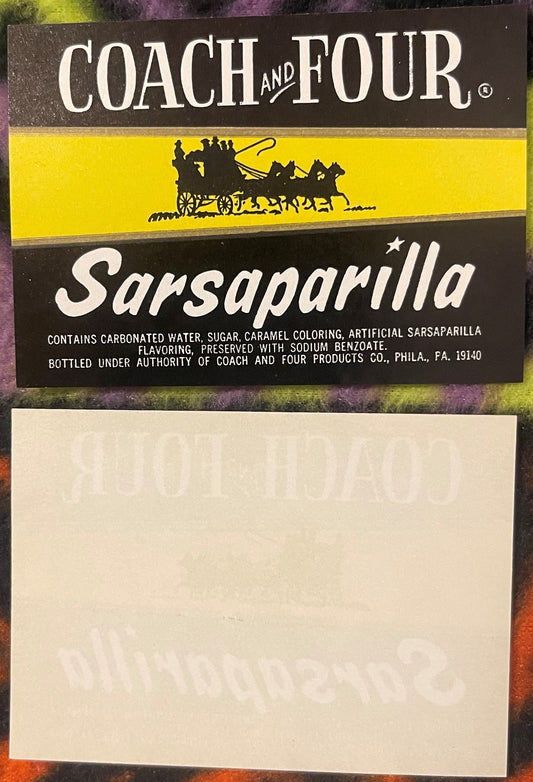
  • Brand: COACH AND FOUR in white serif capitals, the word AND set small between them, with the ยฎ registered-trademark mark
  • Picture: a black silhouette of a stagecoach behind four galloping horses, the driver's whip curling overhead and passengers riding up top, on a tan band edged in olive gold
  • Flavor: Sarsaparilla in white italic script, a small star over the i
  • Fine print: CONTAINS CARBONATED WATER, SUGAR, CARAMEL COLORING, ARTIFICIAL SARSAPARILLA FLAVORING, PRESERVED WITH SODIUM BENZOATE. BOTTLED UNDER AUTHORITY OF COACH AND FOUR PRODUCTS CO., PHILA., PA. 19140
  • Colors: near-black ground, tan and olive-gold band, white lettering
  • Back: plain paper, the front's design faintly visible through it in mirror image
  • Condition: unused, never applied to a bottle

๐Ÿงช Reading the Fine Print: Sarsaparilla After 1960

Safrole is the main aromatic oil of sassafras root bark; oil of sassafras is about 80 percent safrole. FDA laboratory studies showed safrole to be a carcinogen in test animals, and the order published in the Federal Register of December 3, 1960 made any food with added safrole or sassafras oil adulterated under federal law. The prohibition still stands in the Code of Federal Regulations, at 21 CFR 189.180. The ban changed the drink: commercial root beer and sarsaparilla makers turned to artificial flavorings and safrole-free extracts, with wintergreen, long part of the root beer recipe, ready to fill in.

Put that beside this label. Its ZIP code means it went to press after July 1, 1963, well after the ban took effect, and its ingredient panel lists carbonated water, sugar, caramel coloring and sodium benzoate along with the flavoring it names plainly as artificial. It is the post-sassafras sarsaparilla, spelled out on a label the size of a playing card.

๐Ÿค  Sarsaparilla: Patent Medicine, Then the Cowboy's Drink

The name belongs to Smilax, a tropical vine whose root was sold as medicine. In nineteenth-century America sarsaparilla was a patent medicine, its advertisements promising help for skin and blood problems, and like most soft drinks of the day it was first poured at drugstore soda counters. The Old West legend did the rest. Sarsaparilla still conjures, in a phrase quoted in its Wikipedia entry, "languid belles and parched cowboys," and the cowboy who orders one at a saloon bar is the picture most Americans carry of it. The twist the legend leaves out is that the American drink usually held no sarsaparilla root at all, only birch oil and sassafras. Today it is not easy to find in most countries, yet it stays a common soft drink in the Philippines, Taiwan, Singapore and Australia.

๐Ÿ”” Philadelphia, Where American Soda Began

The city printed on this label has a fair claim to the whole business. Dr. Philip Syng Physick, a Philadelphia physician, added carbon dioxide to plain water for his patients, and in 1807 the pharmacist Townsend Speakman began selling fruit juice mixed with carbonated water, often counted as the first American soft drink. Sixty-eight years later another Philadelphia pharmacist, Charles E. Hires, blended sarsaparilla, sassafras, wild cherry, wintergreen and ginger into a root beer he sold at his drugstore at Sixth and Spruce Streets. At the 1876 Centennial Exposition in Fairmount Park he gave away samples to a huge audience, and heavy advertising with trade cards carried Hires root beer to national fame. The temperance movement helped, handing drinkers a nonalcoholic glass with the name of a beer.

๐Ÿญ Coach and Four Products Co. and "Bottled Under Authority Of"

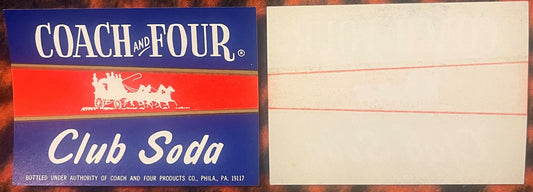
The label names one company: Coach and Four Products Co., Philadelphia. Its wording repays a close read. "Bottled under authority of" is licensing language, the phrase a label carries when a bottler fills bottles with the permission of the company that owns the brand, the same arrangement the big soft drink companies built with their franchise bottlers. So the name on the bottom line is the brand's owner, and the ยฎ beside COACH AND FOUR shows the name was a registered trademark. The same stagecoach picture turns up on the brand's Ginger Beer, Ginger Ale and Club Soda labels, a family of mixers and soft drinks sharing one design and one Philadelphia address.

The people behind it are on file at the U.S. Patent Office. The name COACH AND FOUR first went on soft drinks on June 26, 1956 and was registered on January 29, 1957 (trademark No. 640,759) by Sheffield Bottling Co., a Philadelphia partnership trading as "Coach 'N Four Products Co.," with Harry Labovitz signing as a partner. On July 11, 1969 the name and its goodwill passed to Coach and Four Products Company, the partnership of Harry Labovitz and Arthur Labovitz on North 6th Street in North Philadelphia, ZIP 19140, which is the company named on this label. The trademark was renewed in 1977 and lapsed in 1997.

๐Ÿ“ฎ 19140: Hunting Park and Nicetownโ€“Tioga

The ZIP code both dates the label and places it. The Post Office Department introduced five-digit ZIP codes on July 1, 1963, so a label printing 19140 was printed that summer or later. 19140 covers roughly Hunting Park and Nicetownโ€“Tioga in North Philadelphia, Pennsylvania. Hunting Park takes its name from a nineteenth-century park laid out on the James Logan estate and a race track known as the Hunting Park Course. Nicetown, the story goes, is named for Hans te Neues, a Mennonite immigrant who bought the land in 1699; another account credits the de Neus family, Dutch Huguenots who settled there about 1700. Tioga is a Mohawk and Iroquois word for a place where a stream forks or runs swiftly, and the name has been used in North Philadelphia since at least the mid-nineteenth century.

This was factory country. In 1918 women worked the ordnance shops of the Midvale Steel and Ordnance Company in Nicetown, and the district's industrial life peaked during World War II before declining right after the war. The Coach and Four address sits in that same working North Philadelphia.

๐ŸŽ The Coach and Four: A Philadelphia Painting and an Old Saying

A coach and four is a coach drawn by four horses, driven four-in-hand by one driver holding the reins of all four. Philadelphia has a famous one. Fairman Rogers, a civil engineer and retired University of Pennsylvania professor, founded the Philadelphia Coaching Club and commissioned Thomas Eakins to paint him driving a coaching party through Fairmount Park. The painting, first titled A May Morning in the Park (1879โ€“80) and now known as The Fairman Rogers Four-in-Hand, is in the Philadelphia Museum of Art. Eakins posed its horses from Eadweard Muybridge's 1878 photographs of horses in motion, which makes it one of the first paintings to show precisely how horses move.

The phrase has a lawyer's history too. Around 1670 the Irish lawyer Stephen Rice, fighting the Act of Settlement, is said to have vowed to drive a coach and six horses through it, and the saying that a coach and four can be driven through an Act of Parliament came to mean that a clever lawyer can always find a loophole. The silhouette on this label, whip raised and horses at full stretch, is the coach and four at speed.

๐Ÿ–ผ๏ธ Condition and Display

Unused and never applied, so the white lettering stays crisp against the dark ground. The back is plain, with the design readable through the paper in reverse. At 3.5 by 2.5 inches it suits a small frame, a shadow box beside an old soda bottle, or a kitchen or home bar wall.

  • Collectors of soda labels and soft drink advertising
  • Philadelphia history, especially North Philadelphia, Hunting Park and Nicetownโ€“Tioga
  • Root beer and sarsaparilla fans, and anyone who remembers ordering a sarsaparilla
  • Western and stagecoach collectors
  • A home bar or kitchen display

โ“ Questions People Ask

How old is this Coach and Four Sarsaparilla label?

It prints the ZIP code 19140, and ZIP codes began in July 1963, so it was printed in 1963 or later; it is a 1960s Philadelphia label.

Was this label ever on a bottle?

No. It is unused, with a clean, plain back.

Why does it say artificial sarsaparilla flavoring?

American sarsaparilla leaned on sassafras, and federal regulators barred sassafras oil and safrole from food in 1960. A soda bottled after that used other flavorings, and this label says so.

Who made Coach and Four soda?

The label credits Coach and Four Products Co. of Philadelphia. Its trademark was first used in 1956 and registered in 1957 by Sheffield Bottling Co., with Harry Labovitz signing as a partner, and on July 11, 1969 the brand passed to the partnership of Harry Labovitz and Arthur Labovitz on North 6th Street, the company printed on this label. It names no separate bottler.

What does "coach and four" mean?

A coach pulled by four horses, which is the picture in silhouette across the middle of the label.

Is sarsaparilla the same as root beer?

They are close relatives. Charles Hires' first root beer recipe included sarsaparilla among its roots and herbs.

Shipping

๐Ÿšš Shipping & Handling

  • Shipping costs and timing are calculated at checkout.
  • Items curated and shipped directly by me include U.S. shipping at no additional cost, professionally packed to ensure safe arrival of your artifact.

Items from Vetted Pro Collectors
Shipping for items offered by vetted Pro Collectors is determined at checkout. All Pro Collector listings are reviewed to ensure fair, reasonable shipping practices.

For full details, please refer to our Shipping Policy.

Returns & Exchange

Take your time โ€” you've got a full six months. If a piece isn't right for you, send it back the way it reached you and we're good.

In the first 30 days your money goes straight back the way you paid. After that it's store credit, so you can put it toward something you'd rather have.

Return shipping we sort out between us, case by case. I don't make this difficult.

If something arrives damaged, or it isn't what I said it was, send me a photo within 48 hours and I'll make it right.

Email info@vintageantiquesgifts.com or call 802-356-9872 โ€” that's me answering, not a call center.

The only things I can't take back are custom or special-order pieces and gift cards.

View full details

Preserving History: Authentic Objects Across Eras

โ€” Curated by Travis Weigel