Skip to product information
1 of 4

Vintage and Antique Gifts

Vintage 1960s Coach and Four Club Soda 🍾 Label Philadelphia PA Lithograph Stagecoach Four Horses

Vintage 1960s Coach and Four Club Soda 🍾 Label Philadelphia PA Lithograph Stagecoach Four Horses

Regular price $5.50 USD
Regular price Sale price $5.50 USD
Sale Sold out
Shipping calculated at checkout.

Size: 3 1/2" x 2 1/2"

🚚 Free US Shipping — ships within one business day. International shipping calculated at checkout.

Quantity

What Made Club Soda Plain? 🍾 Vintage 1960s Coach and Four Club Soda Label, Philadelphia PA

Size: 3 1/2" x 2 1/2"

This label is becoming uncommon now and is very collectible. Really cool stagecoach and colors! Club soda is the plainest thing a soda company ever bottled, just water and fizz, and it still has one of the best stories behind its name, so pull up a chair.

🐎 What's on it

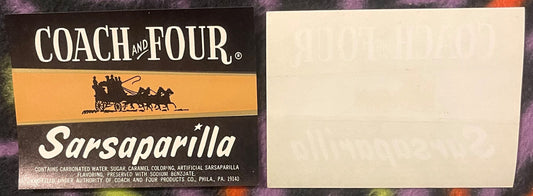
A small paper bottle label for Coach and Four Club Soda in royal blue, red and white. Across the top, COACH AND FOUR ® in tall white letters on blue. Through the middle, a bright red band between two thin gold rules, and on it a white silhouette of a coachman driving four horses at full gallop. Then Club Soda in a big white script, and along the foot: "Bottled under authority of Coach and Four Products Co., Phila., Pa. 19117." Unlike its ginger beer and sarsaparilla brothers, this one prints no ingredient list at all, because there isn't much to list. The back is plain paper. It's New Old Stock, printed and never pasted on a bottle.

👬 The people behind the stagecoach

The name COACH AND FOUR went on soft drinks for the first time on June 26, 1956, and a month later it was filed with the U.S. Patent Office by Sheffield Bottling Co., a Philadelphia partnership doing business as "Coach 'N Four Products Co." It was registered on January 29, 1957 as trademark No. 640,759, for "maltless soft drinks and carbonated waters." That's the little ® on the label. Signing for Sheffield, as a partner, was Harry Labovitz.

On July 11, 1969, Sheffield handed the name and all its goodwill to a new partnership, Coach and Four Products Company, made up of Harry Labovitz and Arthur Labovitz, on North 6th Street in North Philadelphia. That is the exact company name printed on this label. The trademark was renewed in 1977 and finally lapsed in 1997, forty-one years after that first bottle in 1956.

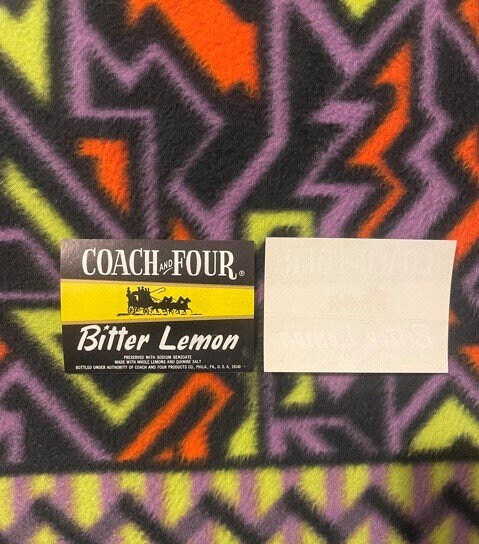
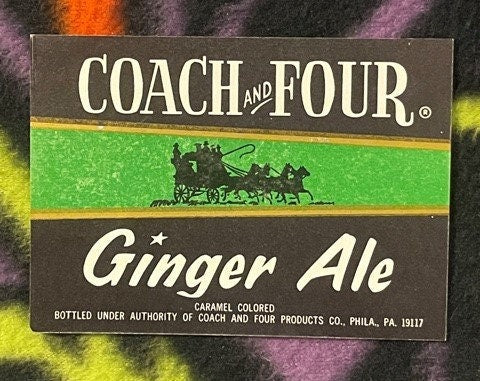
"Bottled under authority of" is franchise talk: the company owned the name and the recipes, and the bottles were filled and capped under its label. The Coach and Four line ran to ginger ale, ginger beer, tonic water, bitter lemon, club soda, sarsaparilla and black raspberry, and a club soda is exactly what you'd expect a mixer line to lead with. The big boys were in town too. Coca-Cola opened its Philadelphia bottling plant at 725 East Erie Avenue in Harrowgate in 1946, and all around it ran a whole world of smaller local bottlers making ginger ales, birch beers and mixers for the corner bars, delis and family basements of the city. Collectors tell that Coach and Four did its best business in the row-house neighborhoods north of Germantown Avenue, where the corner bars and delis stood thickest. That's a story passed around, not a record, but it's a good one.

📅 How old is it?

That five-digit ZIP, 19117, can't be earlier than July 1, 1963, the day the Post Office's Zone Improvement Plan, the ZIP code, began. And 19117 isn't in the city at all: it's Elkins Park, just over Philadelphia's northern line in Cheltenham Township, Montgomery County, even though the label still says "Phila." The company's ginger beer label prints 19140, North Philadelphia, where the 1969 partnership was on North 6th Street, so Coach and Four printed labels from two addresses over the years. With the 1969 company name on it, this is a late 1960s into 1970s piece, true vintage Philadelphia soda history.

🫧 Why is it called club soda?

Bubbly water is older than the United States. The English chemist Joseph Priestley worked out how to force "fixed air," carbon dioxide, into water and published his method in 1772. In 1783 a Geneva jeweler and amateur scientist named Johann Jacob Schweppe started making carbonated mineral water to sell, and yes, that's the Schweppes on the tonic bottle.

Philadelphia likes to claim the next step. The story goes that around 1807 the city's famous surgeon, Dr. Philip Syng Physick, had carbonated water made up for his patients, and that a Philadelphia druggist named Townsend Speakman stirred fruit juice into it and sold it as "Nephite Julep," which Philly still calls the first American soft drink. The details get argued over, but it's a hometown legend worth keeping.

The name itself came from Ireland. In 1877 the Dublin firm of Cantrell & Cochrane registered "Club Soda" as a trademark for a carbonated water made for the Kildare Street Club, one of Dublin's grand gentlemen's clubs, which had asked them to make it. The name stuck to the whole drink. And club soda isn't quite the same as seltzer: seltzer is just carbonated water, while club soda has a pinch of minerals added, things like sodium bicarbonate and potassium sulfate, to taste like a natural mineral spring.

In America, club soda's real job was the highball. Around 1895 "highball" turned up as the new word for the Scotch and soda that had just come over from Britain, and after the great French wine blight, whiskey and soda settled into American bars for good. Where the word came from is still argued: one camp says "ball" was old Irish slang for a glass, so a highball was a tall one, and another ties it to a railroad whistle code. Either way, every one of them needed a bottle of club soda, and a mixer line like Coach and Four kept the club soda, ginger ale and ginger beer side by side for the highball, the Moscow Mule and everything in between.

🎨 A coach and four

A coach and four is a carriage drawn by four horses, all four driven "four-in-hand" by one driver holding every rein. Philadelphia has the most famous one in American art. Around 1879 to 1880, Fairman Rogers, a Philadelphia engineer and devoted coachman, had Thomas Eakins paint him driving a coaching party through Fairmount Park. The painting, The Fairman Rogers Four-in-Hand, hangs in the Philadelphia Museum of Art, and Eakins posed its horses from Eadweard Muybridge's 1878 photographs of horses in motion, which makes it one of the first paintings to show exactly how horses move. A Philadelphia soda company choosing a coach and four for its label was picking one of the city's own great images.

🏡 Display

Imagine hanging this vintage advertising on your wall as home decor in any room! That blue and red really pops in a simple frame, it's right at home over a bar cart or in a game room, and it pairs up nicely with the rest of the Coach and Four flavors if you want the whole set together.

Shipping

🚚 Shipping & Handling

  • Shipping costs and timing are calculated at checkout.
  • Items curated and shipped directly by me include U.S. shipping at no additional cost, professionally packed to ensure safe arrival of your artifact.

Items from Vetted Pro Collectors
Shipping for items offered by vetted Pro Collectors is determined at checkout. All Pro Collector listings are reviewed to ensure fair, reasonable shipping practices.

For full details, please refer to our Shipping Policy.

Returns & Exchange

Take your time — you've got a full six months. If a piece isn't right for you, send it back the way it reached you and we're good.

In the first 30 days your money goes straight back the way you paid. After that it's store credit, so you can put it toward something you'd rather have.

Return shipping we sort out between us, case by case. I don't make this difficult.

If something arrives damaged, or it isn't what I said it was, send me a photo within 48 hours and I'll make it right.

Email info@vintageantiquesgifts.com or call 802-356-9872 — that's me answering, not a call center.

The only things I can't take back are custom or special-order pieces and gift cards.

View full details

Preserving History: Authentic Objects Across Eras

— Curated by Travis Weigel