Skip to product information
1 of 4

Vintage and Antique Gifts

Vintage Framed Bonfire Photograph American Hoechst Photo Contest Original Contest Entry Still Life 🥃

Regular price 39.00 USD
Regular price Sale price 39.00 USD
Sale Sold out
Shipping calculated at checkout.

Description

🔥 Someone Pointed a Camera at a Fire and Made Something Worth Keeping

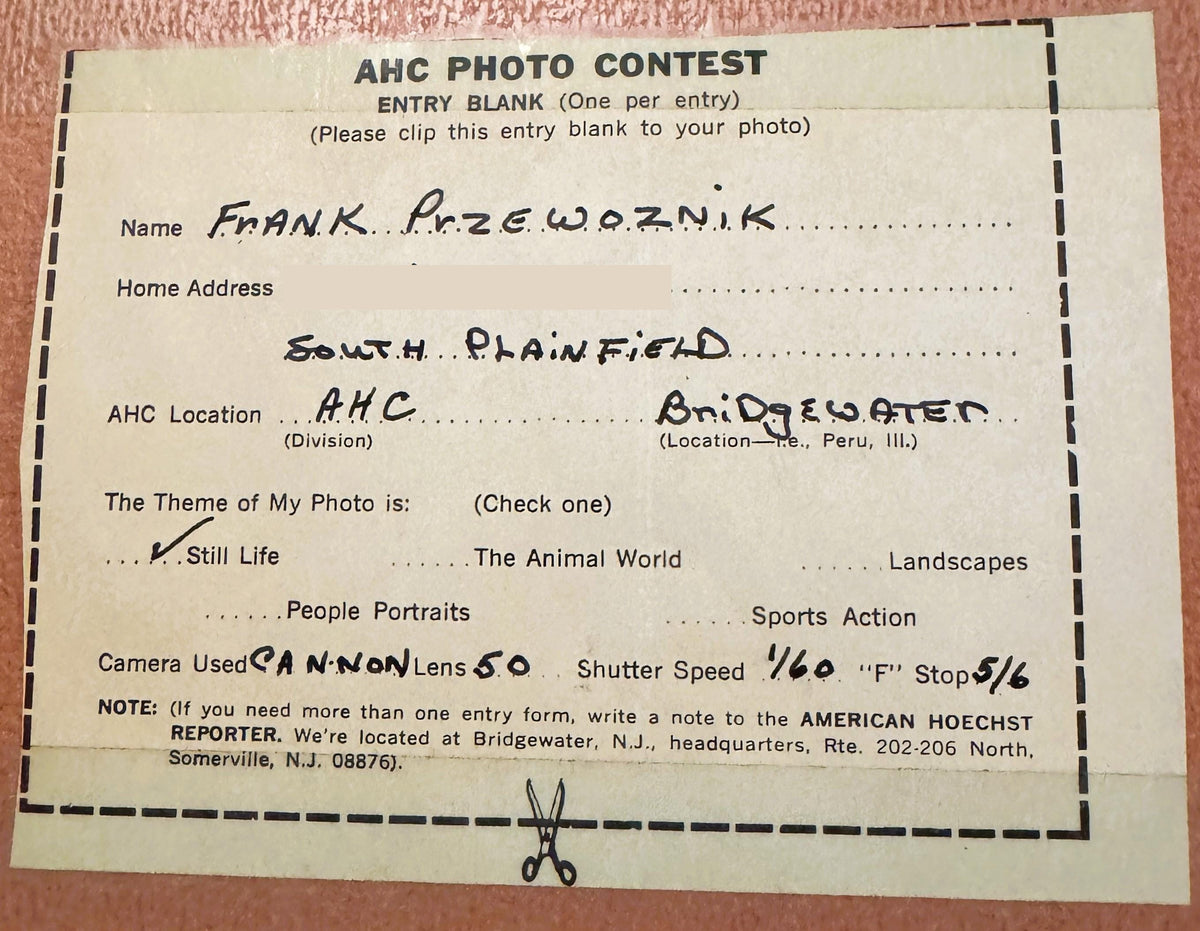
The original entry blank is clipped to the back of this photograph. It has been there since the day it was submitted. Name: Frank Przewoznik. Address: 63 Leeds Drive, South Plainfield, NJ. AHC Location: Bridgewater. Theme: Still Life — that box is checked. Camera: Canon. Lens: 50mm. Shutter speed: 1/60. F-stop: 5.6. Everything you would want to know about how a photograph was made, written in pen on the original contest form, preserved for somewhere between forty and fifty years inside the frame. 🔥

The photograph itself is striking. A bonfire captured close, against a dark background, the flames rising in vivid orange and amber from the base of burning logs, embers glowing red-hot at the bottom of the frame. The composition is deliberate — Frank Przewoznik did not point his Canon at a campfire from across the yard. He got close. He chose his exposure. He used a fast enough shutter to freeze the flame movement and a wide enough aperture to blur the background into darkness. This is a still life in the truest sense: a subject treated with the same intentionality that a studio photographer brings to a bowl of fruit or a vase of flowers, but the subject is fire — alive, moving, and almost impossible to photograph well.

Frank managed it. And it has been in a gold frame ever since, with the entry form still attached. Everything on this page is read from the piece, its frame, and that entry blank in the photographs; nothing is invented. 🔥


🏭 American Hoechst Corporation — The Company Behind the Contest

The AHC on the contest entry stands for American Hoechst Corporation, the American subsidiary of Hoechst AG — the German chemical and pharmaceutical giant that, alongside BASF and Bayer, formed the triumvirate that dominated global chemistry for most of the twentieth century. 🏭

Hoechst AG traced its origins to 1863, founded in the town of Hoechst am Main near Frankfurt by a group of chemists who set out to make synthetic dyes. It grew into one of the largest chemical companies in the world, with operations spanning pharmaceuticals, agricultural chemicals, industrial dyes, synthetic fibers, and plastics. By the postwar period it had re-established itself as a global industrial power, with subsidiaries and operations across North America, Europe, and Asia.

American Hoechst Corporation was Hoechst AG's American arm, with its New Jersey operations at Somerville and Bridgewater. The entry form itself prints the company's address — "Bridgewater, N.J., headquarters, Rte. 202-206 North, Somerville, N.J. 08876" — and names the firm's internal newsletter, the American Hoechst Reporter. The company organized employee activities that included this photo contest, which invited workers to submit work across categories printed right on the blank: Still Life, The Animal World, Landscapes, People Portraits, and Sports Action. It treated its workers as whole people with lives and hobbies outside the plant, published winning work in the company newsletter, and asked people to share something of themselves. Frank Przewoznik of South Plainfield, who worked at the Bridgewater division, chose to share this: a bonfire, photographed at close range with a Canon and a 50mm lens at 1/60th of a second. 🏭


📋 The Entry Blank, and a Bit of Handwriting

The single feature that lifts this photograph above almost every other vintage photo you will meet is the paperwork. The original "AHC PHOTO CONTEST / ENTRY BLANK" is still clipped to the back of the frame — the form even instructs the entrant to "clip this entry blank to your photo," and here it still is, forty-plus years later. It records the maker, his address, his division, his chosen category, and his exact camera settings, all in Frank's own hand.

And there is a small, human detail in that handwriting worth savouring. Where the form asks "Camera Used," Frank inked the word "CANNON" — spelled with the extra letter — and where it asks for the "F" Stop, he wrote it as "5/6." We read those, sensibly, as a Canon camera and an aperture of f/5.6, and that is how we catalogue the settings. But the verbatim spelling and the little slash are exactly the kind of period texture that makes a documented piece feel real: this was a working person filling in a form at his kitchen table, not a museum label. The normalized reading is Canon, 50mm lens, 1/60 shutter, f/5.6; the charming original is "CANNON ... 5/6," preserved in ink on the blank. 📋


📷 The Canon 50mm — The Photographer's Lens

The 50mm focal length has been called the "normal" lens for a reason: it sees approximately what the human eye sees. No compression, no distortion, no wide-angle drama or telephoto flatness — just the scene as it is, rendered with the full character of the glass between the camera and the subject. 📷

In the era when this photograph was made — the 1970s into the 1980s — the Canon 50mm was the standard lens that came with serious film cameras. The Canon FD 50mm f/1.8 and f/1.4 were among the most widely used photographic lenses in the world, beloved by amateurs and professionals alike for their sharpness, their rendering, and the way they captured available light. Every photography student, every serious amateur, every working photojournalist knew this lens. Frank used it at f/5.6, which suggests he wanted depth of field — sharpness through a range of the frame — and at 1/60th of a second, fast enough to suggest he was working with the fire's own light and without flash. He pointed a 50mm Canon at a bonfire in the New Jersey night and came away with this.


🖼️ Still Life Photography as a Fine-Art Tradition

Still life as a photographic category descends from centuries of painting tradition — Chardin in eighteenth-century France, Cezanne's apples and oranges, the Dutch Golden Age masters who made pewter jugs and tablecloths into occasions for meditation. The genre asks the photographer to bring the same attention the painters brought: how does light fall on this object, what does its texture look like at a certain angle, what relationship does it have with the darkness around it? 🖼️

Fire is an unusual subject for a still life because it is never still. It moves constantly, generating its own light, changing shape between one frame and the next. Capturing it requires either accepting the blur of motion or choosing a shutter speed fast enough to freeze a moment — a specific arrangement of flame that will never exist in exactly that form again. Frank Przewoznik chose the latter. The result is a photograph that has the presence of something composed, something painted, while remaining unmistakably a photograph of something real and alive. It lives in its gold frame as a piece of wall art that happens to have a complete story attached — literally, clipped to the back.


📐 The Frame and Its True Dimensions

The photograph is displayed behind glass in a vintage gold wood frame, and here are its measured dimensions, taken by tape so a buyer knows exactly what they are getting: the frame is 10.5 x 8.5 x 1.5 inches — that is 10 1/2 inches tall by 8 1/2 inches wide, standing 1 1/2 inches deep. It is a compact, ready-to-hang piece with a substantial profile for its size. (Please note that any larger figure shown in the structured size fields refers to the packing box, not the frame; the frame itself measures 10.5 x 8.5 x 1.5 inches.) The gold surface carries honest vintage wear — areas of natural patina consistent with age — but the frame is structurally sound and display-ready, and the color photograph behind the glass is vivid and intact, its flames still burning bright orange and amber against the dark. 📐


🔎 Condition & What's Included

🔥 Color photograph of a bonfire, framed behind glass in a vintage gold wood frame.
🖼️ Frame measures 10.5 x 8.5 x 1.5 inches (10 1/2 x 8 1/2 in, 1 1/2 in deep); gold surface shows honest natural patina consistent with age; structurally intact and display-ready.
📋 Original AHC photo contest entry blank clipped to the back — intact, legible, fully preserved, in Frank Przewoznik's own hand.
📐 Ready to hang.


🌟 Why a Documented, One-of-a-Kind Photograph Matters

Most vintage photographs arrive without context: you see an image, you might guess the era, and you rarely know who made it, how, or why. This one is different, and that difference is the whole point. It is authored — Frank Przewoznik of 63 Leeds Drive, South Plainfield, New Jersey. It is technically specified — Canon, 50mm, 1/60, f/5.6, entered as Still Life. It is provenanced — the American Hoechst Corporation employee photo contest, Bridgewater division. And it is one of a kind: a single framed print, with its original contest entry blank never separated from it, a piece of corporate and photographic Americana that has held together as a complete document for the better part of half a century. Someone pointed a Canon at a fire in the New Jersey night and walked away with this, and the entry form on the back still tells you exactly how he did it. 🌟

Shipping

🚚 Shipping & Handling

  • Shipping costs and timing are calculated at checkout.
  • Items curated and shipped directly by me include U.S. shipping at no additional cost, professionally packed to ensure safe arrival of your artifact.

Items from Vetted Pro Collectors
Shipping for items offered by vetted Pro Collectors is determined at checkout. All Pro Collector listings are reviewed to ensure fair, reasonable shipping practices.

For full details, please refer to our Shipping Policy.

Returns & Exchange

Take your time — you've got a full six months. If a piece isn't right for you, send it back the way it reached you and we're good.

In the first 30 days your money goes straight back the way you paid. After that it's store credit, so you can put it toward something you'd rather have.

Return shipping we sort out between us, case by case. I don't make this difficult.

If something arrives damaged, or it isn't what I said it was, send me a photo within 48 hours and I'll make it right.

Email [email protected] or call 802-356-9872 — that's me answering, not a call center.

The only things I can't take back are custom or special-order pieces and gift cards.

View full details