Skip to product information
1 of 10

Vintage and Antique Gifts

Vintage Pontiac Grand Am Dealer Sales Brochure 🍺 Colonnade Sedan, Pontiac Michigan Muscle Car Advertising, Mid-Century Auto Showroom Literatu

Vintage Pontiac Grand Am Dealer Sales Brochure 🍺 Colonnade Sedan, Pontiac Michigan Muscle Car Advertising, Mid-Century Auto Showroom Literatu

Regular price 7.00 USD
Regular price Sale price 7.00 USD
Sale Sold out
Shipping calculated at checkout.
Quantity
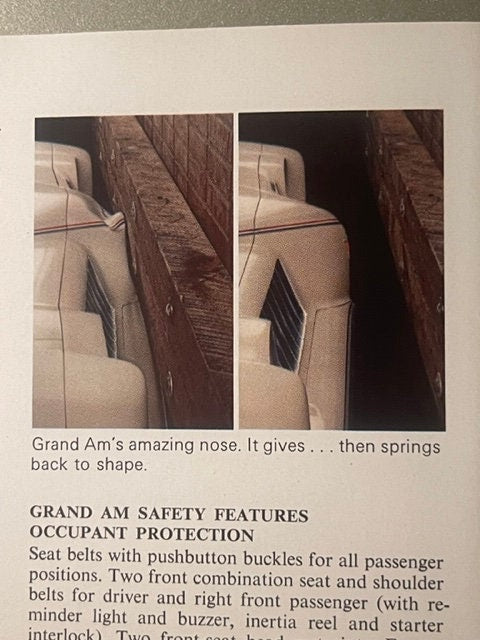
Remember When Detroit Decided It Could Out-Charm Europe? 🌍 There's a particular kind of confidence in this brochure's cover shot — a dark green Grand Am sedan, gold pinstripe catching the light, parked on wet cobblestones under studio lighting so dramatic it could be mistaken for a European touring poster. That wasn't an accident. For one brief, strange, wonderful stretch in the early 1970s, Pontiac decided American drivers shouldn't have to choose between a car that handled like an import and one that felt like home. This brochure is the sales pitch for that idea, and if you ever stood in a Pontiac showroom with your father or grandfather while a salesman flipped open a folder just like this one, it's going to feel like finding a photo you forgot you had. This is an original factory dealer sales brochure for the Pontiac Grand Am , produced by Pontiac Motor Division of General Motors out of Pontiac, Michigan, printed by offset lithography with glossy color photography throughout, measuring roughly 12 x 10.5½ inches (30.5 x 26.7 cm) . The cover carries the Pontiac arrowhead crest above the tagline printed right on the piece: "Grand Am — The mid-sized Pontiac with foreign intrigue...American ingenuity." Beneath it sits that dark green four-door Colonnade sedan, tan interior visible through the glass, gold pinstripe running the length of its flank, honeycomb wheel covers gleaming against the cobblestones. Inside the fold, a Cameo White 2-Door Colonnade Hardtop gets its own dramatic studio shot beside a pair of traffic cones, its slot-style wheels lit to show off every spoke, with the caption running underneath: "Grand Am 2-Door Colonnade Hardtop in Cameo White." A small line of fine print at the top of that spread notes that the options and accessories shown were offered by Pontiac at extra cost — a nice period touch that tells you exactly how showroom literature like this was meant to be used. This example is New Old Stock — never handed across a dealer counter, never carried home, simply a piece of automotive advertising history that sat waiting all these years to be found. 🏁 The Grand Am Gamble — Pontiac's Answer to Europe The tagline on this brochure's cover wasn't just copywriting flourish — it was Pontiac's entire strategy compressed into one sentence. By the early 1970s, GM's engineers and marketing brass had watched Mercedes-Benz, BMW, Toyota, and Nissan quietly carve out a new kind of American buyer: someone who wanted the comfort of a big domestic sedan but the poise and road manners of a European touring car. The American sports car of the day usually came without luxury, and the American luxury car usually came without sport — foreign makes were the ones mixing the two. Pontiac's answer was the Grand Am, introduced in the fall of 1972 as an entirely new nameplate, riding on GM's A-body platform alongside cousins like the Chevrolet Chevelle Laguna and Oldsmobile Cutlass Supreme. The name itself was a mash-up: "Grand" borrowed from the luxurious Grand Prix, "Am" borrowed from the muscle-bound Trans Am — luxury and performance fused into a single badge. What made the Grand Am genuinely different wasn't just marketing copy. It rode on Radial Tuned Suspension as standard equipment — in that first model year, one of only three GM cars built with radial tires matched to properly tuned shocks and sway bars from the factory, a genuinely big deal when radials were still a novelty for most American buyers. Up front it wore a flexible urethane "Endura" nose, engineered to absorb a light parking-lot bump and spring back into shape rather than dent. Inside, the Grand Am offered Strato bucket seats with manual recliners and adjustable lumbar support, a Grand Prix-derived instrument panel with a full Rally gauge cluster, a three-spoke padded wheel, and genuine African mahogany trim on the dash — details borrowed straight from the European sedans it was chasing. The timing, though, worked against it. The 1973 oil crisis split American car buyers into two camps almost overnight — total luxury or total economy — and left little room for an "in-between" like the Grand Am. Sales fell hard in its second year even after a fresh front and rear facelift, and Pontiac quietly retired the nameplate after just three model years. Collectors today describe it as a genuine box-office bomb in its moment — undone entirely by timing rather than by any shortcoming in the car itself. 🏙️ Pontiac, Michigan — The City Behind the Name Both the car and the company that built it carry the name of the city where they were made. Pontiac, Michigan, was founded in 1818 as the second organized settlement in what's now Metro Detroit, named for the Ottawa war chief Pontiac, who had led resistance against European encroachment in the region decades before the town existed. Local legend holds the chief himself as rugged yet charismatic — a warrior and a diplomat both — and it's his name that ended up stamped on everything from the city's welcome signs to the arrowhead crest on this brochure's cover. The city's abundant natural resources drew carriage manufacturers there long before the automobile existed, and by the time the horseless carriage arrived, Pontiac was already positioned to become a capital of the new industry. General Motors bought the Oakland Motor Car Company in 1909, and in 1926 the junior Pontiac nameplate was introduced alongside it — outselling Oakland so quickly that Oakland itself was discontinued in 1931, leaving Pontiac as its own full GM division. The Pontiac Motor Division's home assembly plant on Baldwin Avenue, built in 1927, was the very factory floor where Grand Ams like the ones pictured in this brochure rolled off the line. Old-timers around Oakland County still talk about the city's stretch of Woodward Avenue — the famous strip where, through the 1950s and '60s, young drivers cruised and drag-raced their hot rods on summer nights, a culture Pontiac's performance-minded marketing, this brochure included, was built to feed straight into. 🔧 The People Who Chased the Idea The engineering "feel" behind the Grand Am traces to a story collectors still love to retell: Pontiac engineer-turned-product-planner Bill Collins, on a business trip to Opel's headquarters in Germany, borrowed a BMW 3.0S and came home convinced American cars could — and should — handle every bit as well as their European rivals. Collins would go on to work alongside John DeLorean at the DeLorean Motor Company, and it's worth noting DeLorean's own fingerprints on Pontiac run deeper into the GTO and Firebird years — he'd left the division for Chevrolet in 1969 and GM entirely by 1973, right as the Grand Am launched. The chassis work that turned Collins's conviction into a production car fell to Pontiac chassis engineer John Seaton and his team, who built out the Radial Tuned Suspension package with heavy-duty bushings and thicker anti-roll bars — a project that reportedly ran under the working name "Europa" before Pontiac settled on Grand Am. The finished car was shepherded to market under general manager Martin J. Caserio, the first Pontiac chief in over a decade whose background leaned toward marketing and sales rather than pure performance — fitting, given the sales pitch stamped across this very brochure. 🏆 A Short Run, A Lasting Legacy Because the original Grand Am's run was so brief, dealer literature like this piece has become one of the more scarce pieces of Pontiac paper from the era — most of what survives from the mid-the period tends to be for the much longer-lived Grand Prix, Firebird, or Bonneville lines, not this three-year experiment in mixing worlds. Pontiac would later revive the Grand Am name in the 1980s for a completely different compact car, which means a piece like this — with its Colonnade-era sedan and hardtop body styles, its Endura nose, its arrowhead crest above that "foreign intrigue" tagline — captures a very specific, very short chapter that a lot of Pontiac history skips right past. The brand itself is gone now, discontinued by General Motors in 2010, which only adds to why collectors and Pontiac loyalists hold onto showroom pieces like this one — it's a direct paper trail back to a division, and a city, that don't build cars anymore. 🖼️ Display Ideas 🖼️ Framed and matted as a standalone piece for a garage, den, or home office wall 🚗 Paired with other Pontiac or GM dealer literature for a themed automobilia gallery wall 📖 Laid open flat under glass on a coffee table or credenza to show both the cover and the Cameo White spread 🏁 Displayed alongside a model car or die-cast Grand Am for a small dedicated shadow box 🎁 Given as a milestone or Father's Day gift for a lifelong Pontiac or GM enthusiast 🏢 Hung in a home bar, workshop, or "man cave" styled after a 1970s dealership showroom 🎁 Who Collects These Pontiac loyalists and GM historians chase pieces like this first, especially anyone drawn to the short-lived Colonnade era of the early-to-mid 1970s. Automobilia collectors who focus specifically on dealer showroom literature value it for its scarcity next to longer-running Pontiac nameplates. Muscle car and performance-era enthusiasts appreciate it as a documented turning point in Pontiac's identity — the moment the division tried something genuinely different. And it makes a natural gift for anyone with a personal memory tied to the Grand Am itself: a father, grandfather, or family friend who once brought one of these home from a Pontiac showroom just like the ones this brochure was printed for. ❓ FAQ What exactly is a "Colonnade" sedan? "Colonnade" was GM's term for its 1973–1977 mid-size body style, defined by fixed, pillared window frames rather than the pillarless hardtop look of earlier years — you can see it clearly in both the four-door sedan and two-door hardtop pictured in this brochure. What year is this brochure from? It comes from the original Grand Am's first, brief production run, which spanned 1973 to 1975. No manufacture date is legible on the piece itself, so rather than guess at a single year, it's best described within that documented window. Is this brochure new or was it used by a dealer? This is New Old Stock — it was never handed to a customer or carried out of a dealership. It's simply original showroom literature that was never distributed at the time. What size is the brochure? It measures 12 x 10.5½ inches (30.5 x 26.7 cm). How is this different from that era Pontiac Grand Am? Pontiac revived the Grand Am nameplate in the 1980s for a completely different, smaller front-wheel-drive car. This brochure is for the original Colonnade-era Grand Am — the mid-size sedan and hardtop built during the nameplate's very first, short run. Was the original Grand Am a popular car? It sold modestly and lasted only three model years, largely due to timing — it launched right as the 1973 oil crisis reshaped what American buyers wanted, splitting the market toward either pure economy or pure luxury rather than the hybrid Pontiac was offering. Where was the car in this brochure actually built? At Pontiac Motor Division's home assembly plant on Baldwin Avenue in Pontiac, Michigan — the same city, and the same division, whose name is printed right on the brochure's cover.

Shipping

🚚 Shipping & Handling

  • Shipping costs and timing are calculated at checkout.
  • Items curated and shipped directly by me include U.S. shipping at no additional cost, professionally packed to ensure safe arrival of your artifact.

Items from Vetted Pro Collectors
Shipping for items offered by vetted Pro Collectors is determined at checkout. All Pro Collector listings are reviewed to ensure fair, reasonable shipping practices.

For full details, please refer to our Shipping Policy.

Returns & Exchange

Take your time — you've got a full six months. If a piece isn't right for you, send it back the way it reached you and we're good.

In the first 30 days your money goes straight back the way you paid. After that it's store credit, so you can put it toward something you'd rather have.

Return shipping we sort out between us, case by case. I don't make this difficult.

If something arrives damaged, or it isn't what I said it was, send me a photo within 48 hours and I'll make it right.

Email info@vintageantiquesgifts.com or call 802-356-9872 — that's me answering, not a call center.

The only things I can't take back are custom or special-order pieces and gift cards.

View full details
  • 5 stars: 5 (100%)
  • 4 stars: 0 (0%)
  • 3 stars: 0 (0%)
  • 2 stars: 0 (0%)
  • 1 star: 0 (0%)
6
6***a (193)

Excellent seller, item well packaged, very professional

d
d***b (474)

Item like new, excellent packaging, Neat O thank you note from the kids, Thank you!

o
o***o (1150)

Great condition, super packaging. Honest seller, fast shipping.

c
c***3 (1147)

like new brochure, shipped quickly very nice ebay seller.

i
i***b (815)

Thank you so much.