Skip to product information
1 of 3

Vintage and Antique Gifts

Vintage 1980s All Me California Raisin Tin Pin WOW The Memories! 📌

Vintage 1980s All Me California Raisin Tin Pin WOW The Memories! 📌

Regular price 5.50 USD
Regular price Sale price 5.50 USD
Sale Sold out
Shipping calculated at checkout.
Quantity

Size: 1.5 inches

Do You Remember the Moment the Raisins Came on TV and Everything Stopped? 🍇

There is a very specific kind of memory that belongs entirely to the 1980s — the kind where you are sitting on a shag carpet in front of a console television, and suddenly something comes on the screen that makes absolutely no sense and yet is completely, undeniably perfect. A cluster of wrinkled brown raisins, wearing red sunglasses and high-top sneakers, strutting and moonwalking across a stage to the opening bars of "I Heard It Through the Grapevine." Nobody asked for it. Nobody predicted it. And yet the entire country stopped what it was doing and watched, open-mouthed, grinning like children. That is the California Raisins. And that is exactly the spirit captured right here, pressed into a single round lithographed pin-back button — a tiny, exuberant circle of pure American pop culture nostalgia.

What you are looking at is a genuine vintage California Raisins CALRAB Applause pin-back button, a piece of licensed merchandise from the absolute peak of one of the most surprising and beloved advertising phenomena in American history. The button is round — that classic pinback format that every kid of the era clipped to a backpack, a jacket lapel, a bulletin board, or a bedroom curtain — and it is lithograph-printed in a vivid palette of white, brown, red, blue, and black.

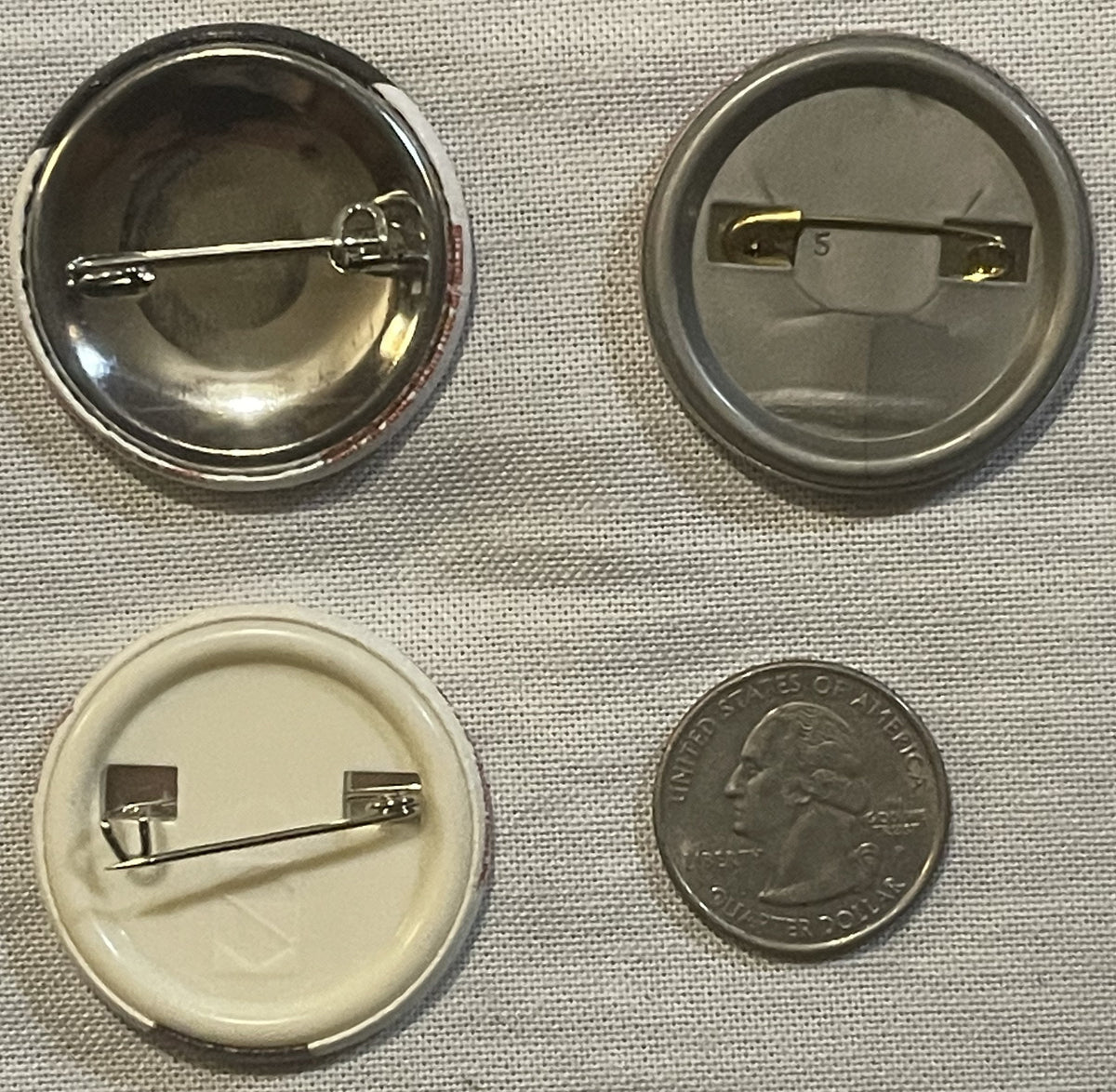
The central image is the cartoon raisin character himself: arms crossed, legs planted wide, wearing those unmistakable oversized red sunglasses and a pair of red canvas high-top sneakers, rendered in the bold, confident line work of commercial cartoon illustration at its most charismatic. The back carries a classic safety-pin style clasp — the honest workhorse hardware of American pin-back button manufacturing.

This is a New Old Stock (NOS) example: it came to us as old store inventory, never having found its permanent home — until now. It is an excellent early example of American advertising collectible art, a physical artifact from the era when CALRAB and Applause Licensing put the Raisins on every product imaginable and a nation of children and adults eagerly snapped them up.

This button originates from the world of Fresno, California — the agricultural heart of the San Joaquin Valley — and from the broader creative ecosystem of Woodland Hills, California, where Applause Licensing operated. It is, in every sense, a California story: California grapes, California growers, California advertising creativity, and California claymation wizardry, all pressed into a small round button that traveled from a warehouse shelf into the hands of collectors who understood, even then, that something special was happening.


🍇 The Company, the Board, and the Valley Behind the Raisins

To understand why this button matters, you have to understand what CALRAB was and why it existed. The California Raisin Advisory Board — universally abbreviated to CALRAB — was not a corporation in the conventional sense. It was a California state marketing commission, a cooperative body representing approximately five thousand raisin grape growers spread across the sun-baked expanse of the San Joaquin Valley, with its headquarters anchored in Fresno. These were farming families, generations deep in the raisin industry, trying to move a product that Americans associated with school lunches and fruitcake — not exactly the sexiest grocery category in the supermarket aisle. CALRAB's job was to change that, to make raisins desirable, modern, and exciting. For years, they tried conventional approaches. Nothing broke through at scale. And then, in the mid-1980s, a copywriter at the San Francisco offices of Foote, Cone & Belding named Seth Werner said something that sounded, on its face, completely absurd: "We have tried everything but dancing raisins singing 'I Heard It Through the Grapevine.'"

The idea was handed to Will Vinton Studios in Portland, Oregon — the pioneer shop of Claymation, the stop-motion technique that Vinton's team had elevated to an art form. Character designs were developed by Michael Brunsfeld, and the animated figures that emerged were not generic cartoon fruit. They were a band, styled as a caricature of African American rhythm-and-blues groups, with the swagger and soul of Motown and funk built into every frame of their movement. The voice and energy powering that first commercial came from Buddy Miles — the drummer who had played with Jimi Hendrix and Carlos Santana — laying down "I Heard It Through the Grapevine" with a depth and groove that made the whole thing feel like a genuine R&B performance, not a grocery advertisement. The first commercial cost $300,000 and debuted in 1986. Raisin sales jumped 20%. The country was smitten.

It is worth pausing here to say plainly what modern scholars and the Smithsonian's own records now note: the characters were built on caricatures of African American musical culture, and that context is part of the full history of this campaign — a history that contemporary researchers have begun to examine carefully, including at academic conferences as recently as 2025. Recording that context is part of being honest stewards of this material culture. The Raisins were beloved. They were also a product of a particular cultural moment with its own complexities. Both things are true, and the collector who understands the full picture holds the object more completely.


🌟 The People Who Made It Real — Vinton, Werner, Miles, and the Stars Who Joined

Will Vinton was already a legend in animation before the Raisins arrived. His studio in Portland had pioneered the trademarked Claymation process and produced work of genuine artistic ambition. But nothing in his career — or arguably in the history of American advertising animation — matched the cultural footprint of the California Raisins. The characters he and his team built were not props; they had personality, with individual gestural quirks and a bandleader presence that made audiences forget they were watching dried fruit promote a commodity. The first band of four characters would eventually be named — in the 1988 Emmy-nominated mockumentary special Meet the Raisins! — as A.C., Bebop, Stretch, and Red. That special followed the Emmy-winning A Claymation Christmas Celebration in 1987, in which the Raisins appeared and helped cement claymation holiday programming as its own sub-genre of American television. The Raisins were, briefly, as famous as any entertainment property in the country.

And the celebrities agreed. Ray Charles appeared with the Raisins. Michael Jackson — at the absolute apex of his global fame — agreed to participate in a Raisins commercial, and lore passed down among collectors and animation historians holds that Jackson agreed to do so for free, with only one condition: that the production be handled exclusively by Will Vinton, whose work Jackson had admired from their collaboration on the Captain EO project. Whether every detail of that negotiation is precisely as reported, the underlying truth is confirmed: Jackson's claymation likeness appeared alongside the Raisins, lending the campaign a credibility and a cultural cachet that no amount of advertising budget could have simply purchased.

Local legend among San Joaquin Valley raisin growers holds that many of the farmers who funded the CALRAB campaign never quite believed the characters would connect the way they did — that the Raisins felt like a gamble born of desperation more than confidence, and that when the sales numbers came back after the first commercial aired, there was genuine disbelief in the Fresno offices. The campaign had worked almost too well, and what followed — the Emmy awards, the Smithsonian collections, the licensed merchandise avalanche — was something the growers had not budgeted for in either their imaginations or their balance sheets.


🏭 Applause Licensing and the Merchandise Moment

The pin-back button you are looking at did not emerge from CALRAB's agricultural offices or Vinton's animation studio. It came from the merchandise licensing operation that took the Raisins characters and turned them into a product category of their own. Applause Licensing, based in Woodland Hills, California, held the rights to produce and license the Raisins' commercial image across a vast range of consumer goods. The Henry Ford Museum's catalog records confirm Applause Licensing's role in the merchandise program, and the same Applause name appears on the Raisins' record releases and on the PVC figurines that became the most iconic piece of the merchandise line. Genuine period collectibles — buttons, figures, posters, and beyond — typically carry both the CALRAB and Applause marks, most commonly with copyright dates of 1987 or 1988, reflecting the peak merchandise years of the campaign.

The merchandise itself was staggering in its breadth. Lunch boxes, T-shirts, Halloween costumes, PVC figures, comic books, a Nintendo video game, fan clubs, posters — and yes, pin-back buttons. These buttons were the democratic collectible of the era: inexpensive enough for a child's allowance, small enough to pin anywhere, and vivid enough to be an immediate conversation piece. They circulated through school hallways and state fairs and grocery store promotions, and they ended up in the kind of cardboard boxes and store display cases that New Old Stock items typically inhabit until a collector with the right eye finds them decades later.

The campaign's end came not from a failure of popularity but from a failure of economics that is almost poetic in its irony. CALRAB, as a nonprofit marketing commission, could not profit from the Raisins' fame. Every dollar of merchandise success had to cycle back into more advertising, driving costs higher until the grower-members, having been strained nearly to breaking, voted to dissolve the board. CALRAB closed on July 31, 1994. The trademarks and copyrights became property of the State of California, which subsequently licensed them to the California Raisin Marketing Board beginning in 1998. The Raisins did not die — but the era that produced this button, that specific electric moment of CALRAB and Applause and Will Vinton and Buddy Miles, ended cleanly and definitively on that July day in Fresno.

The Smithsonian Institution's National Museum of American History has acquired pieces from this campaign into its permanent collection, a recognition that these objects are not merely novelties but genuine artifacts of American commercial and cultural history. Researchers studying the era work from the Will Vinton Archive at the Academy of Motion Picture Arts and Sciences alongside Smithsonian materials — the Raisins are, by any reasonable measure, a documented chapter in the story of how America advertised to itself.


🖼️ Display Ideas

  • 📌 Pin it to a vintage denim jacket displayed on a wall hook — pair it with other 1980s pop culture buttons for an era-defining jacket display that reads as both fashion history and Americana.
  • 🍇 Build a California Raisins dedicated shadow box — center the button alongside PVC figurines, a vintage Raisins lunchbox, and a reproduction of the original print advertisement for a curated collector's vignette.
  • 🎵 Frame it with a vinyl copy of the California Raisins record — Applause produced several Raisins records; displayed together, the button and the album sleeve tell the full multimedia story of the campaign.
  • 🏪 Incorporate it into a vintage Americana general store display — mounted on a period corkboard or pegboard alongside other NOS advertising pins and buttons from the era, it reads as an authentic slice of 1980s retail nostalgia.
  • 🖼️ Display it in a small round button frame on a bookshelf dedicated to California history or San Joaquin Valley agricultural heritage — this is as much a piece of California's farming story as it is an advertising artifact.
  • 🎬 Pair it with a framed claymation animation cel or production still from the Will Vinton era — together, they document both the art form and the commercial culture it served.

🎁 Who Collects These

The collector world for California Raisins memorabilia is wider and more passionate than casual observers expect. At its core are the 1980s nostalgia collectors — adults who grew up watching the commercials and the holiday specials, who remember the exact feeling of that first Claymation raisin strut across the television screen, and who collect these objects as a form of time travel back to a specific, irretrievable moment of childhood. For them, a pin-back button is not a small thing; it is a portal.

Alongside them are the advertising and Americana collectors — serious students of American commercial art who track CALRAB and Applause merchandise the same way others track Coca-Cola trays or Planters Peanuts Mr. Peanut items. These collectors understand that the Raisins campaign is a documented landmark of American advertising history, Smithsonian-level material, and they collect accordingly. Then there are the California history enthusiasts, particularly those with ties to Fresno and the San Joaquin Valley, for whom the Raisins represent a specific chapter in the story of their region's agricultural economy and cultural identity. And finally, there is a growing community of animation history collectors drawn to anything connected to Will Vinton Studios and the Claymation legacy — a legacy that is experiencing renewed appreciation as stop-motion animation enjoys a creative renaissance and new audiences discover the depth of Vinton's contribution to the form.


❓ Frequently Asked Questions

What exactly is CALRAB, and why does it appear on California Raisins merchandise?

CALRAB stands for the California Raisin Advisory Board, the state marketing commission headquartered in Fresno, California, that represented approximately five thousand raisin grape growers in the San Joaquin Valley. CALRAB was the entity that commissioned and funded the California Raisins advertising campaign through its agency, Foote, Cone & Belding. Because CALRAB held the rights to the Raisins characters as the originating marketing body, its name appears alongside Applause Licensing on merchandise produced during the campaign's peak years. Seeing "CALRAB" on a piece of California Raisins merchandise is a strong indicator of period authenticity — it connects the object directly to the original grower-funded campaign rather than to later successor organizations or unlicensed production.

Who was Applause, and what was their role in producing this merchandise?

Applause Licensing was a California-based licensing company headquartered in Woodland Hills, California, that held the rights to produce and authorize California Raisins merchandise during the campaign's commercial peak. Applause was the entity responsible for bringing the Raisins characters off the television screen and onto consumer products — the PVC figures, the pin-back buttons, the posters, and a wide range of other licensed goods. The Henry Ford Museum's collection records confirm Applause's role in the merchandise program, and their name appears on period Raisins record releases as well. When both "CALRAB" and "Applause" appear on a piece of Raisins merchandise, you are looking at the full chain of authenticity: the grower board that owned the characters and the licensing company that produced the goods.

How do I know if my California Raisins button is a genuine period piece versus a later reproduction?

The most reliable indicators on period lithograph pin-back buttons are the copyright markings along the button's curl or on its back. Genuine CALRAB and Applause pieces from the campaign's peak years — typically 1987 and 1988 — carry both names and a copyright date in very small printed text. The construction detail matters as well: period buttons used a safety-pin style clasp, which is exactly what this example carries. The lithograph printing process itself, producing fine-line color artwork on a metal button face, is characteristic of the era's button manufacturing. Reproductions and later pieces tend to show differences in printing sharpness, color saturation, and backstamp detail. When in doubt, reading any fine-print text around the button's edge is the most direct path to confirmation.

Why are California Raisins collectibles significant enough to be in the Smithsonian?

The California Raisins campaign is recognized by the Smithsonian's National Museum of American History as a legitimate artifact of American commercial and cultural history — not as a novelty but as a documented landmark. The campaign represented a genuine breakthrough in advertising animation, introduced Claymation to a mass national audience, won Emmy Awards, drew participation from major cultural figures including Michael Jackson and Ray Charles, boosted a struggling agricultural commodity's sales by a documented 20% after a single commercial, and generated a merchandise and entertainment phenomenon that touched virtually every corner of American pop culture between 1986 and 1994. Researchers studying the period work from both the Smithsonian's holdings and the Will Vinton Archive at the Academy of Motion Picture Arts and Sciences. Objects from the campaign are primary source material for understanding how American advertising, animation, and commodity marketing intersected in the late twentieth century.

What is the significance of the specific visual details on this button — the red sunglasses and red sneakers?

The red sunglasses and red canvas high-top sneakers are the defining visual signature of the California Raisins characters, and their presence on this button is not incidental — it is the entire point. Will Vinton's character designers gave the Raisins their look specifically to evoke the visual language of African American R&B and funk performance culture: the oversized aviator-style sunglasses, the bold sneakers, the wide-legged stance, the crossed arms. These details were deliberate costume choices that signaled "musician" and "performer" to an audience instantly. The red color choice is particularly vivid against the dark brown of the raisin character, creating the high-contrast pop-art energy that made the Raisins immediately legible on television and in print at very small sizes — including on a pin-back button worn on a jacket across a crowded school hallway.

What is New Old Stock (NOS), and what does it mean for a piece like this?

New Old Stock — NOS — refers to merchandise that was produced during a product's original commercial run and remained in storage or retail inventory, never having been sold through to an end consumer. For a collector, NOS status means you are acquiring a piece that was part of the original production and distribution cycle, not a later reproduction or reissue, and that it has spent its life in storage conditions rather than in active use. For a pin-back button like this one, NOS provenance means the lithograph artwork, the clasp hardware, and the button's overall integrity are exactly as they came from the original production run. The piece is offered here as an excellent early example of American advertising collectible art — part of the documented CALRAB and Applause licensed merchandise wave that accompanied one of the most celebrated advertising campaigns in American history.

Is there a collector market for California Raisins pin-back buttons specifically, or are the PVC figures more sought-after?

Both categories have active collector markets, and they tend to attract overlapping but distinct audiences. The PVC figurines are undoubtedly the most recognized category of Raisins merchandise — they were produced in multiple waves, some with accessories and instruments, and command a wide range of prices depending on completeness and specific release. But pin-back buttons occupy a particular place in the collector ecosystem precisely because they are small, wearable, and intimate in a way that figurines are not. A button was something a child chose to put on their body — a declaration of identity and enthusiasm. That wearability gives buttons a different emotional resonance for collectors who remember wearing them. Within the broader category of 1980s advertising pin-back buttons, California Raisins examples are among the most immediately recognizable and eagerly sought, and the presence of both CALRAB and Applause markings on a button is the authentication detail that separates the serious collector piece from the generic licensed novelty.

Shipping

🚚 Shipping & Handling

  • Shipping costs and timing are calculated at checkout.
  • Items curated and shipped directly by me include U.S. shipping at no additional cost, professionally packed to ensure safe arrival of your artifact.

Items from Vetted Pro Collectors
Shipping for items offered by vetted Pro Collectors is determined at checkout. All Pro Collector listings are reviewed to ensure fair, reasonable shipping practices.

For full details, please refer to our Shipping Policy.

Returns & Exchange

Take your time — you've got a full six months. If a piece isn't right for you, send it back the way it reached you and we're good.

In the first 30 days your money goes straight back the way you paid. After that it's store credit, so you can put it toward something you'd rather have.

Return shipping we sort out between us, case by case. I don't make this difficult.

If something arrives damaged, or it isn't what I said it was, send me a photo within 48 hours and I'll make it right.

Email info@vintageantiquesgifts.com or call 802-356-9872 — that's me answering, not a call center.

The only things I can't take back are custom or special-order pieces and gift cards.

View full details