

Skip to product information
1 of 5

Vintage and Antique Gifts

Retro Tampa Bay Devil Rays MLB Folding Hand Fan Play By Play Genuine Merchandise Devil Rays Era 1998-2007 Souvenir Novelty ✨

Retro Tampa Bay Devil Rays MLB Folding Hand Fan Play By Play Genuine Merchandise Devil Rays Era 1998-2007 Souvenir Novelty ✨

Regular price 8.00 USD
Regular price Sale price 8.00 USD
Sale Sold out
Shipping calculated at checkout.
Quantity

Remember When Tampa Bay Baseball Was Brand-New and the Rays Were Still Devils? 🐟

There is something genuinely moving about holding a souvenir from a team's earliest days — before the championships, before the name change, before anyone outside Florida really knew what a Devil Ray was. This folding hand fan is exactly that kind of artifact: a vivid, colorful, New Old Stock piece of Tampa Bay baseball history, pulled straight from its original dealer box, never waved at a game, never bent by a breeze off the bay. It captures the team exactly as they were introduced to the world — with that bold, almost aggressive purple-and-green color scheme, that swooping manta ray silhouette, and a name that would only last a single chapter in the franchise's story.

I found these and I could not let them disappear. Pieces like this — genuinely unused, still in the original trade box, from a team that no longer carries this name — are the kind of thing that quietly vanishes from the record if nobody saves them. So I did. And now I'm hoping they find their way to someone who loves them as much as I do. Go Rays. 🌴💚


⚾ What You're Getting: The Fan Itself

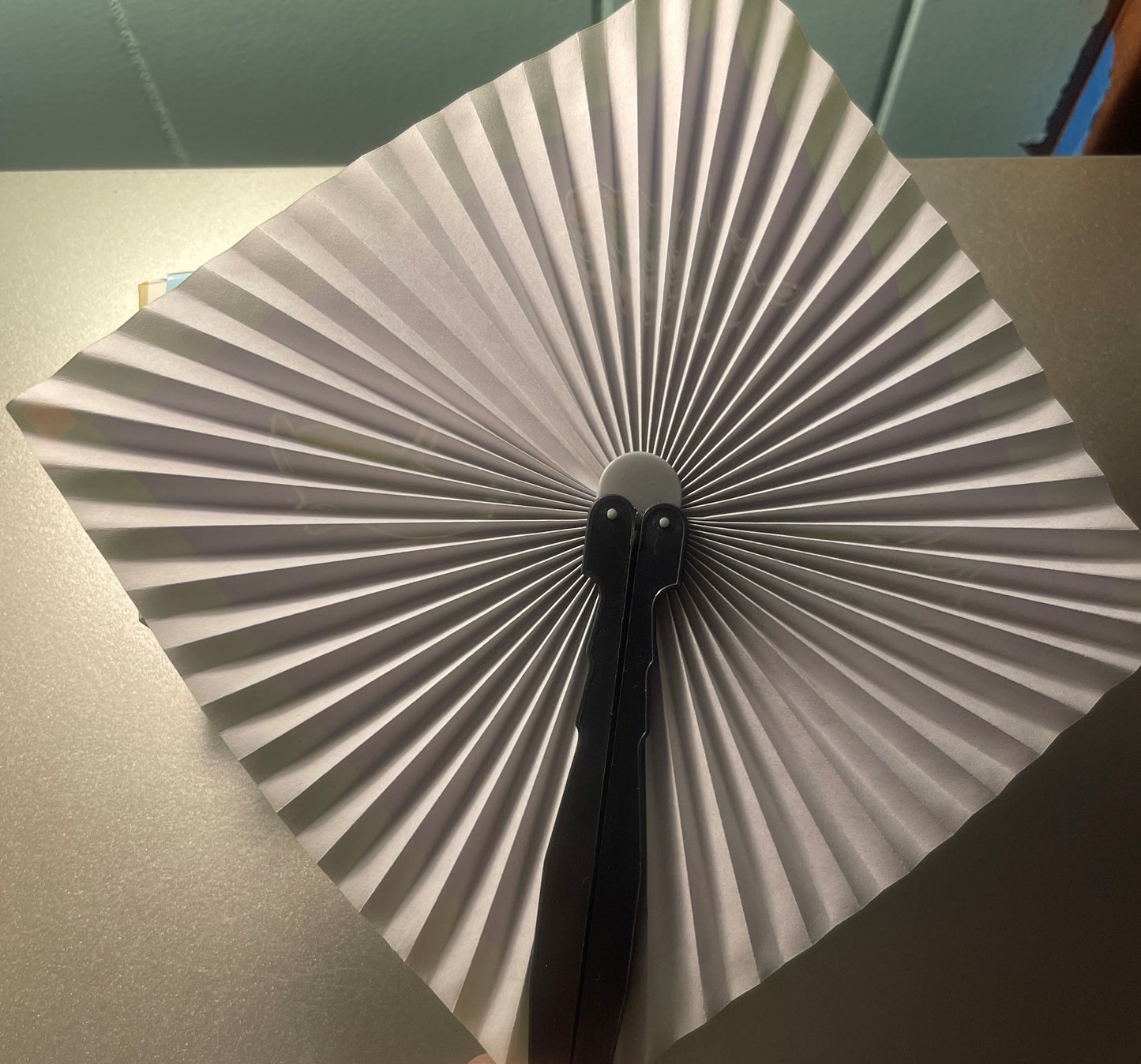
This is an officially licensed MLB folding hand fan produced under the Play By Play "Genuine Merchandise Major League" label — the same San Antonio, Texas company that was, at its peak, the largest novelty supplier in the United States. The fan is lithographed in offset color printing across a pleated paper construction with a sturdy black plastic handle and pivot mechanism that locks it open with a satisfying snap. Closed, it measures approximately 6¾ inches in length; fully fanned out, it opens to roughly 11 inches wide by 9½ inches tall — large enough to make a genuine statement, whether you're waving it courtside or hanging it on a wall.

The color palette is pure late-1990s Tampa Bay: deep purple and lime green, edged in black, with orange and blue accents that pop against the pleated paper. The classic Devil Rays sting ray logo and wordmark sit at the top of the fan face, flanked by the swirling ray graphics the team used in its original identity. It's a genuine burst of era-specific design energy — the kind of bold, slightly over-the-top branding that the expansion era absolutely loved.

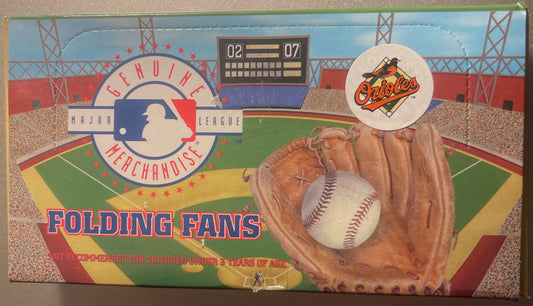
The original dealer box carries the full MLB Genuine Merchandise logo, a stadium scene illustration, the Tampa Bay Devil Rays team logo badge, and the product codes JJ004 DVR (the item and team SKU — "DVR" standing for Devil Rays) and 77-710DR Dz — with "Dz" indicating the fans shipped by the dozen, a hallmark of the carnival and amusement-trade novelty market. This is New Old Stock, factory fresh, from that original case.


🐠 The Team That Almost Had a Different Name: Tampa Bay Devil Rays History

The story of how this team got its name is one of those delightful pieces of baseball lore that deserves to be preserved alongside the souvenir itself. When ownership group leader Vince Naimoli was awarded the franchise — formally approved on March 9, 1995, for the 1998 season — he initially set his sights on calling the team the Tampa Bay Sting Rays. It was an obvious, regional choice: the warm Gulf waters around Tampa Bay are home to both southern stingrays and cownose rays, and the name had an immediate identity.

There was just one problem. The naming rights to "Sting Rays" were already held by the minor league Maui Stingrays. The Maui club was willing to sell — for $35,000. Naimoli, unwilling to cut that check, pivoted instead to a different species of rays entirely, and the franchise was introduced to the world as the Tampa Bay Devil Rays, named for the large, filter-feeding manta-family rays that glide through the Gulf of Mexico. For $35,000 in naming rights, the Devil Rays identity was born.

The team began play at Tropicana Field in St. Petersburg, Florida in 1998 — and here's one of those geographical quirks that always amuses historians: despite being called "Tampa Bay," the team has never played in Tampa. The stadium sits squarely in St. Petersburg, across the bay, and it opened originally as the Florida Suncoast Dome in 1990 before being renamed Thunderdome, then finally Tropicana Field. The "Tampa Bay" umbrella name was always about the regional market, not the city limits.

Those first seasons were not exactly glorious on the field. The Devil Rays finished last in the AL East in their inaugural 1998 season and kept that tradition going through most of their first decade — finishing last or second-to-last in all but one of their first ten years. But the early fan culture was alive with the energy of a city finally having its own Major League team, and the souvenir merchandise from those first seasons carries that inaugural excitement in a way that later merchandise simply cannot replicate.

The "Devil Rays" name itself had a finite lifespan. Stuart Sternberg purchased controlling interest in the team from Naimoli and, following the 2007 season, officially rebranded the franchise as simply the Tampa Bay Rays. The devil was dropped from the name, the manta logo was softened, and the original identity was retired. That makes every piece of merchandise bearing the full "Devil Rays" name a document of a specific, closed chapter — produced only between 1998 and the end of the 2007 season, the only years that name was in active use.

Collectors' lore holds that the original Devil Rays branding was actually beloved by a vocal segment of the fanbase, and that the name change was controversial enough in St. Pete that "Devil Rays" gear continued to be worn as a quiet statement of old-school loyalty long after the rebrand. Whether you believe in that particular piece of fan mythology or not, it has given original "Devil Rays" merchandise a cultural weight that goes well beyond simple nostalgia.


🎪 Play By Play Toys & Novelties: The San Antonio Company Behind the Fan

The story of Play By Play Toys & Novelties, Inc. is one of the more remarkable American business stories of the 1990s novelty trade — and it's directly tied to the history of this fan. The company was based at 4400 Tejasco, San Antonio, Texas 78218, traded on NASDAQ under the ticker PBYB, and at its height employed 620 people with sales of $74.2 million (as of 1997). It was, by the mid-1990s, the largest supplier of stuffed toys and novelties in the United States.

Founder Arturo Torres arrived in America from Cuba in 1961 — one of the great waves of Cuban emigration — and took a job washing dishes at a Pizza Hut in Texas. Over the following decades he built a restaurant empire, eventually operating 240 Pizza Hut and Taco Bell franchises before selling them for $125 million and redirecting his energy into the novelty toy business. Play By Play started — depending on which corporate record you consult — in either 1986 (the formal incorporation date in SEC filings) or 1990 (the date cited by the company's surviving European successor). The 1986 figure appears in the legal documents; 1990 may represent when the toy operation took its fully recognizable form. Both dates are documented; I can't fully reconcile them from available sources, and I'd rather flag the discrepancy honestly than paper over it.

What's not in dispute is the trajectory: Torres started Play By Play as a vending-machine prize supplier — the kind of stuffed animals and novelties you'd win at a carnival midway or find in a claw machine at the local pizza place. From there the company expanded aggressively into licensed sports merchandise, children's entertainment characters, and consumer novelties, landing license agreements with Warner Bros., Nintendo, Paws Inc. (Garfield) and others for properties including Looney Tunes, Batman, Superman, and Pokémon alongside professional sports team logo licensing from MLB, NBA, NFL, and NHL. The "Dz" by-the-dozen packaging on this Devil Rays fan box is a direct echo of that carnival-and-amusement-trade DNA — these fans were sold wholesale by the case, intended for gift shops, stadium concessions, and prize redemption counters.

In May 1996, Play By Play made its boldest move: the acquisition of Ace Novelty Company, a Bellevue, Washington–based novelty house, for $44 million. That purchase vaulted Play By Play to the top of the American novelty supply chain. For a brief, glittering window in the late 1990s, it was the dominant name in the space.

The decline was swift and public. By May 2001, the company received a NASDAQ Staff Determination that its securities would be delisted from the NASDAQ National Market, effective May 2, 2001, moving to the OTC Bulletin Board. The American operation wound down rapidly in the years that followed. By 2002, the Play By Play brand had migrated to Spain, and in 2006 Spanish toy giant FAMOSA acquired both the Feber and Play By Play brands; since 2019 the name has lived on inside the Famosa–Giochi Preziosi group, an Italian-Spanish toy conglomerate. The San Antonio chapter — the one that made this fan — is long closed.

What this corporate timeline means for collectors is significant: the window during which Play By Play's U.S. operation was producing and distributing sports-licensed novelties under the "Genuine Merchandise Major League" banner aligns almost exactly with the earliest Devil Rays seasons. The fan in this listing is a product of that overlap — an artifact of a San Antonio novelty empire at its height, licensed to a brand-new Florida baseball franchise, packaged by the dozen for stadium gift shops and souvenir stands that are themselves now long gone.


🌊 St. Petersburg, Florida: The City That Waited Decades for the Bigs

The fan may say "Tampa Bay," but the story lives in St. Petersburg — a city that had been chasing a Major League Baseball franchise with a kind of civic obsession for the better part of a decade before the Devil Rays ever took the field. The Florida Suncoast Dome — later Tropicana Field — was actually built in 1990 specifically to attract a franchise, sitting largely empty for years while various relocation rumors swirled around teams like the Giants, White Sox, and Mariners. Local legend holds that St. Pete came agonizingly close to landing relocated franchises at least twice before the expansion process finally delivered them a team of their own. The city had essentially built the ballpark on faith and waited for baseball to show up.

When 1998 finally arrived and the Devil Rays took the field, the atmosphere in St. Pete was less about winning — the roster was, charitably, a work in progress — and more about the sheer fact of having arrived. The first season merchandise, the inaugural programs, the souvenir fans and pennants and keychains, were all souvenirs of that arrival moment. Old-timers in the St. Pete collector community will tell you that the early Devil Rays merchandise has a specific emotional register that later Rays gear, even the World Series run gear from 2008 and beyond, simply doesn't carry — because it was the merchandise of finally, after all those empty years in the dome.

The dome itself became one of baseball's more peculiar environments: a fixed-roof stadium in Florida, built before retractable roofs were standard practice, where the catwalks in the rafters are actually in play according to local ground rules, and where the artificial turf and indoor acoustics created a game-day experience unlike any other park in the league. Souvenir items from the early Devil Rays era carry that specific indoor-baseball-in-Florida strangeness with them — and there is genuine collector affection for it.


📜 The Folding Fan as Baseball Americana

The folding hand fan is one of the older forms of sporting-event merchandise — predating refrigerated stadiums, predating broadcast television, predating almost everything else in the souvenir trade. Paper fans were summer-crowd staples in American ballparks long before air conditioning made them obsolete as practical objects, and they survived as promotional novelties well into the modern era precisely because they carry that old-fashioned, game-day-in-the-heat feeling that no bobblehead or foam finger can quite replicate.

The lithographed, folding paper fan with a plastic handle — exactly the construction of this Devil Rays piece — was a mainstay of the carnival and ballpark novelty trade from the mid-twentieth century onward. The pleated paper, the pivot rivet, the decorative printing across the fan face: these are the design elements of a form that was already well-established when Play By Play started packaging them by the dozen. What changes from era to era is the licensed image on the face, and that image is everything to a collector. A crisp, unused, original-box Devil Rays fan from the franchise's founding era is a genuinely rare survival — because the whole point of a paper fan was to be used, waved, bent, and eventually discarded. The ones that made it through decades in a warehouse case without ever being opened are the survivors of pure chance.

Lore passed down among MLB novelty collectors holds that much of the earliest Devil Rays merchandise was produced in relatively small quantities compared to established franchises — because no one knew how the market would respond to an expansion team in a dome in St. Pete — and that the factory overruns and dealer-box remainders that weren't sold through the first few seasons were often simply written off and destroyed rather than warehoused. Finding a sealed case of NOS merchandise from those first years is the kind of discovery that makes the collector community genuinely excited, because the supply is not being replenished. There will not be more.


🖼️ Display Ideas

  • 🏟️ Shadow box with game-day companions: Mount the fan open alongside a ticket stub or program from a 1998–2007 Devil Rays game for a complete early-era tableau — the colors will anchor the whole piece.
  • 📌 Wall fan display: Open fully and hang directly on the wall as a graphic art piece; the purple-and-green color scheme reads beautifully as wall art in a sports room, game room, or Florida-themed space.
  • 🧺 Vintage baseball vignette: Pair with other Devil Rays inaugural-season pieces — a pennant, a schedule card, a media guide — for a dedicated shrine to the franchise's founding chapter.
  • 🏖️ Florida room accent: The tropical purple and lime green palette fits naturally in a sunroom, lanai, or Florida-themed interior where it reads as both regional color and pop art.
  • 🎁 Gift for the St. Pete native: This is the kind of gift that stops a lifelong Tampa Bay baseball fan cold — the good kind of stopped, the "where did you even find this" kind.

🎁 Who Collects These

The people drawn to a piece like this tend to fall into a few distinct and passionate camps. There are the Tampa Bay baseball diehards — lifelong fans who remember those first Devil Rays seasons with genuine affection, who wore the purple and green before it was replaced by the current identity, and who treat original "Devil Rays" branded merchandise as the team's founding artifacts. For them, this fan is a direct line back to 1998 and everything that first season meant to a region that had waited so long.

There are the MLB expansion era collectors — people who focus specifically on the merchandise produced by the four 1998 expansion franchises (Devil Rays, Diamondbacks, Rockies, and Marlins) in their inaugural seasons, treating those early pieces as the founding documents of each franchise. Original branding on early-era items commands serious attention in this collecting community.

Then there are the paper fan and novelty Americana collectors — people who appreciate the folding fan as a form, who understand the Play By Play lineage and the carnival-trade history of this type of piece, and who seek out NOS examples precisely because the used ones rarely survive in this condition. And finally there are the St. Petersburg and Tampa Bay Florida locals and expats — people who grew up going to Tropicana Field, who moved away and want a piece of home on their wall, or who stayed and want to mark the passage of an era that the franchise has officially moved on from.

All of them are right to want this. It's exactly what each of them thinks it is. 🌴


❓ Frequently Asked Questions

Q: Does the "Devil Rays" branding help pin down when this was made?
A: Yes, meaningfully. The team used the "Devil Rays" name exclusively from their first season in 1998 through the end of the 2007 season, when Stuart Sternberg rebranded the franchise as the Tampa Bay Rays. Any merchandise bearing the "Devil Rays" name was produced within that window. The U.S. Play By Play operation — the San Antonio company that produced this fan under the Genuine Merchandise license — was effectively wound down by the early 2000s, which narrows the most probable production period further. That said, I present this as a well-supported range, not a confirmed single year, because I cannot verify the exact production date from the piece itself.

Q: What does "02 – 07" on the box mean?
A: Honestly, I want to be straight with you: I could not verify what that specific code denotes from any available source. It's consistent with the team's active-branding window, but whether it represents a production date, a lot code, or something else entirely is unconfirmed. I'd rather flag that plainly than guess at it.

Q: What does "Dz" mean on the product code?
A: "Dz" is standard trade shorthand for dozen — indicating these fans were packaged and sold wholesale by the case of twelve. This is classic carnival and amusement-trade novelty packaging, consistent with Play By Play's origins as a vending-machine and prize-redemption supplier. Individual fans were distributed from these dealer cases into gift shops, stadium concession stands, and souvenir counters.

Q: Is this genuinely New Old Stock, or does "NOS" just mean it's old?
A: This fan was pulled directly from the original dealer box — it is genuinely unused and unplayed-with, in the original trade packaging. "NOS" in the collectibles world specifically means merchandise that was never sold through to an end consumer: it sat in warehouse or dealer inventory rather than making it to a game-day fan. That's the status of this piece, and it's what makes it an excellent early example of MLB expansion-era Americana rather than a used souvenir.

Q: Why does the box say "Made in China" if Play By Play was a San Antonio company?
A: Play By Play designed, developed, licensed, and distributed its products from San Antonio — the creative and commercial operation was thoroughly American. Like virtually all novelty manufacturers of the 1990s, the actual manufacturing was contracted overseas, primarily in China. This was standard industry practice across the entire category during this era; the licensed design, the MLB relationship, and the distribution chain were all the San Antonio operation's work.

Q: Does the fan actually hold up structurally, or is it fragile?
A: The construction — pleated paper with a plastic pivot handle — is the same format that the carnival and novelty trade used precisely because it holds up to handling. As the seller notes, these fans feel surprisingly solid in hand; they were built to be waved through nine innings of a Florida summer game, not just admired on a shelf. This one has the additional advantage of never having been through those nine innings.

Q: Is the original dealer box included?
A: No. This fan came from the original Play By Play dealer box, shown in the photos for reference and provenance only — the MLB Genuine Merchandise logo, the stadium scene illustration, the Tampa Bay Devil Rays badge, and the product codes are all visible there, but the box itself is not part of this listing. ⚾🐟

Shipping

🚚 Shipping & Handling

  • Shipping costs and timing are calculated at checkout.
  • Items curated and shipped directly by me include U.S. shipping at no additional cost, professionally packed to ensure safe arrival of your artifact.

Items from Vetted Pro Collectors
Shipping for items offered by vetted Pro Collectors is determined at checkout. All Pro Collector listings are reviewed to ensure fair, reasonable shipping practices.

For full details, please refer to our Shipping Policy.

Returns & Exchange

Take your time — you've got a full six months. If a piece isn't right for you, send it back the way it reached you and we're good.

In the first 30 days your money goes straight back the way you paid. After that it's store credit, so you can put it toward something you'd rather have.

Return shipping we sort out between us, case by case. I don't make this difficult.

If something arrives damaged, or it isn't what I said it was, send me a photo within 48 hours and I'll make it right.

Email info@vintageantiquesgifts.com or call 802-356-9872 — that's me answering, not a call center.

The only things I can't take back are custom or special-order pieces and gift cards.

View full details
  • 5 stars: 1 (100%)
  • 4 stars: 0 (0%)
  • 3 stars: 0 (0%)
  • 2 stars: 0 (0%)
  • 1 star: 0 (0%)
r
r***r (119)

Arrived quickly, well packaged, and in great condition with the nicest note from Travis and the kids. Very positive experience. Would recommend and buy from this seller again.