Skip to product information
1 of 4

Vintage and Antique Gifts

Vintage Golden Pheasant Beer Label 🍺 from 1950s Michigan

Vintage Golden Pheasant Beer Label 🍺 from 1950s Michigan

Regular price $5.50 USD
Regular price Sale price $5.50 USD
Sale Sold out
Shipping calculated at checkout.

Size: 3 1/2" x 3"

🚚 Free US Shipping — ships within one business day. International shipping calculated at checkout.

Quantity

Who Brewed Golden Pheasant? 🍺 Vintage 1950s Beer Label, Sebewaing Brewing Co., Michigan

Size: 3 1/2" x 3"

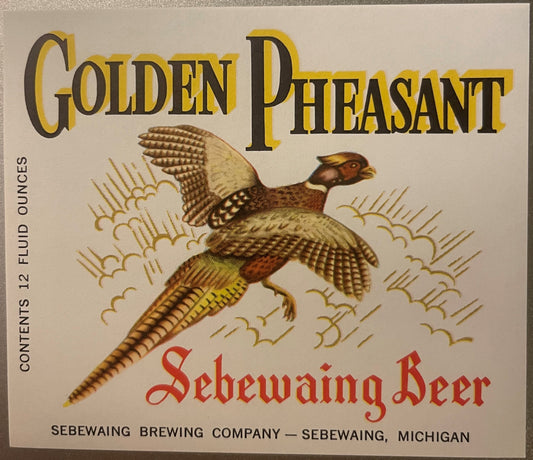
🍺 An original, never-applied Golden Pheasant beer label from the Sebewaing Brewing Company of Sebewaing, Michigan, 1950s. 3 1/2" x 3" ~

A ring-necked pheasant bursts up out of golden clouds, wings wide and that long barred tail streaming behind, under GOLDEN PHEASANT in big black letters with a gold shadow. Underneath, Sebewaing Beer in red old-German blackletter, and along the bottom Sebewaing Brewing Company — Sebewaing, Michigan, with Contents 12 Fluid Ounces running up the side. The back is plain. It's a great piece for any bird hunter.

🐦 Why a pheasant

Ring-necked pheasants were brought to Michigan from China in 1895, and from 1937 through 1959 the state's hunters averaged better than a million birds a year, topping 1.4 million in 1944. Sebewaing's corner of the Thumb drew hunters and fishermen, and that's why pheasants kept showing up on Sebewaing labels and ads. The Sebewaing Rotary Club's 1981 history of the brewery calls the pheasant the company's trademark, "a refreshment symbol across the state," and the store shelves kept a spot for "Pheasant Beer." When the brewery added a canning line, the pheasant went on its yellow can too. The birds fell off steeply in the 1960s as farming changed, and in 1971 the state started buying land in the Thumb just for pheasant habitat.

🦁 The brewery with the lions

The brewery on East Main Street goes back to the 1860s and E. O. Braendle, and after a fire burned the wooden building on June 3, 1896, it was rebuilt with brick walls three feet thick to help fireproof it. Prohibition shut the beer off (Michigan outlawed beer making on April 30, 1918, well ahead of the rest of the country), and in 1927 the new Sebewaing Products Company was making malt extract in the building instead. It was legal because you could bake with it, and plenty of it went into home-made beer. When Prohibition ended, a group of investors led by a Detroiter, William Wreford, bought it in May 1933 and named it the Sebewaing Brewing Company, and the first batch of Old Style Beer went out in April 1934. Old Stock Ale followed in October 1935, then Sebewaing, Sport and, from 1958, Golden Pheasant, brewed only into the early 1960s. By the late 1950s the brewery was turning out about 38,000 barrels a year, only seven-tenths of one percent of all the beer brewed in Michigan, and it was a steady employer of about 30 men. From 1948 most of the beer went out through three A&P warehouses, and while other beers sold for $3.75 to $4 a case, Sebewaing held steady at $2.75 and $2.90. Right up to its last day there was a free tap at the brewery, open to anybody, and you could buy "shorts" for $1 a case of 24: bottles that came off the line with the label left off or stuck on crooked.

And then there were the lions. The brewery got hold of some lion cubs from a traveling carnival and used them to sell beer as the "Kings of Beer and Ale." The man who bought the three cubs was the brewery's president, Dr. J. E. Wurm, a local veterinarian and auto dealer. The Old Style label traded its flying goose for a lion's head, and in July 1940 The New York Times wrote up a Sebewaing Brewing trailer going down the road with four African lions in a steel-barred cage in the back. By 1948 the lions were too much to keep. Some went to zoos, and one, a female named Queenie, was mounted by a brewery employee, Frank Taschner. The end came in the 1960s: a sale to Buckeye Brewing of Toledo in 1965 fell apart over a local lawsuit, and at 7 a.m. on June 7, 1965 the brewery whistle blew for brewing again. It never got back on its feet. The brewery closed for good in 1966, dumping thousands of gallons of beer into the Sebewaing River, usually in the middle of the night, and for weeks people passing by wondered about the thick foam on the water. The locals knew. The main building came down in the early 1980s.

🌾 Sebewaing, the Sugar Beet Capital

Sebewaing sits on the Sebewaing River where it runs into Saginaw Bay, in Huron County at the tip of Michigan's Thumb. The Rev. John J. F. Auch, a Lutheran missionary born in Württemberg, Germany, founded it in 1845, when he and two other missionaries were sent up from Ann Arbor to preach to the Chippewa, and German families settled it, which is exactly why a town that size had its own brewery. The name comes from the Ojibwe. The village's own history says it was first spelled Sibbewaing, for a crooked creek that ran nearby, and the Ojibwe word ziibiiweng means "by the stream." Ground was broken for a sugar factory in September 1901 and its first campaign started in October 1902. Later the Michigan Sugar Company's slicing mill made it the Sugar Beet Capital, and the town still throws the Michigan Sugar Festival every June.

Crate and beer labels are a reminder of a bygone era, and the printing on them is unparalleled even to this day in my opinion. They aren't making any more of them, so once the limited supply for sale is gone and on display with collectors or in galleries, they will be very difficult to acquire. Imagine this one framed in a man cave or a hunting cabin instead of a museum!

Shipping

🚚 Shipping & Handling

  • Shipping costs and timing are calculated at checkout.
  • Items curated and shipped directly by me include U.S. shipping at no additional cost, professionally packed to ensure safe arrival of your artifact.

Items from Vetted Pro Collectors
Shipping for items offered by vetted Pro Collectors is determined at checkout. All Pro Collector listings are reviewed to ensure fair, reasonable shipping practices.

For full details, please refer to our Shipping Policy.

Returns & Exchange

Take your time — you've got a full six months. If a piece isn't right for you, send it back the way it reached you and we're good.

In the first 30 days your money goes straight back the way you paid. After that it's store credit, so you can put it toward something you'd rather have.

Return shipping we sort out between us, case by case. I don't make this difficult.

If something arrives damaged, or it isn't what I said it was, send me a photo within 48 hours and I'll make it right.

Email info@vintageantiquesgifts.com or call 802-356-9872 — that's me answering, not a call center.

The only things I can't take back are custom or special-order pieces and gift cards.

View full details

Preserving History: Authentic Objects Across Eras

— Curated by Travis Weigel