Skip to product information
1 of 2

Vintage and Antique Gifts

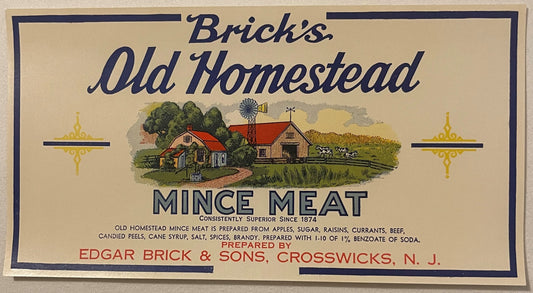
Antique Brick's Mince Meat Label 🥧 UNPRINTED Large Version, Edgar Brick & Sons Crosswicks NJ, Blank Panel 1910s

Antique Brick's Mince Meat Label 🥧 UNPRINTED Large Version, Edgar Brick & Sons Crosswicks NJ, Blank Panel 1910s

Regular price $10.49 USD
Regular price Sale price $10.49 USD
Sale Sold out
Shipping calculated at checkout.

Size: 9 1/2" x 5"

🚚 Free US Shipping — ships within one business day. International shipping calculated at checkout.

Quantity

Who Made Brick's Mince Meat? 🥧 Real Beef, a Blank Line, and America's Biggest Mincemeat Maker

Size: 9 1/2" x 5"

Read the recipe on this label and the first surprise is the fourth ingredient: BEEF. The second surprise is what is missing. Under DISTRIBUTED BY, where a grocer's or wholesaler's name belonged, the paper is empty. This is the unprinted large version of a Brick's mince meat label, from the Crosswicks, New Jersey firm that grew out of a village general store to become, at its World War II peak, the largest mincemeat manufacturer in the United States — in a Quaker village that still has a British cannonball mortared into the wall of its meeting house.

🏷️ Exactly What Is Printed on It

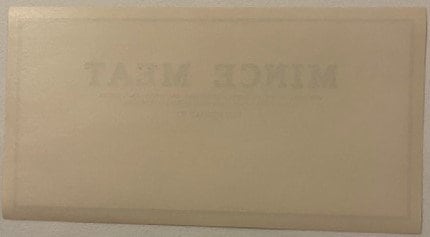
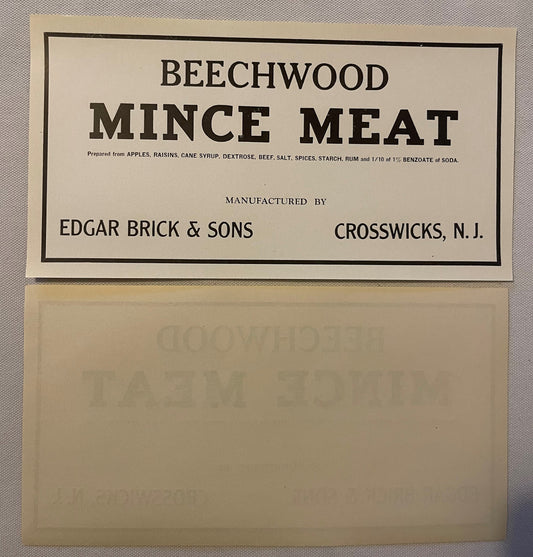
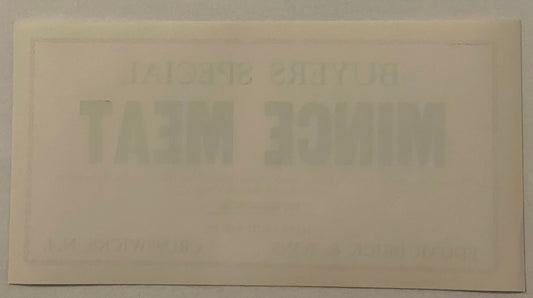
A wide cream paper label inside a heavy black rule. Across the top, in big black slab-serif capitals, MINCE MEAT. Beneath it, in small capitals: "COMPOSED OF APPLES, SUGAR, RAISINS, BEEF, CANE SYRUP, SALT, SPICES. ALCOHOL AND 1-10 OF 1 PER CENT. OF BENZOATE OF SODA." Then a single line, DISTRIBUTED BY, and below it the whole lower half of the sheet is open space. No brand name, no maker's name, no address is printed anywhere. The reverse is blank, with the big lettering showing faintly through in mirror image. It has never been pasted to a tin.

🧪 The Fine Print That Dates It: Dr. Wiley's Benzoate War

That little benzoate line is a piece of American food law. After the Pure Food and Drug Act of 1906, the government's chief chemist, Dr. Harvey W. Wiley — the man whose "Poison Squad" of volunteers had eaten measured doses of preservatives at government tables — pushed to outlaw benzoate of soda altogether. The canners fought back hard. In 1907 the Department of Agriculture's Food Inspection Decision 76 promised packers immunity from prosecution if benzoate stayed under one-tenth of one percent and its presence appeared on the label. President Theodore Roosevelt then appointed a Referee Board of consulting scientists, headed by Ira Remsen of Johns Hopkins, in February 1908. In January 1909 the board called benzoate safe in small amounts, and on March 3, 1909, practically the last act of the Roosevelt administration, a decision allowed benzoate in food so long as every container was plainly labeled with its presence and amount.

This label does exactly that: "1-10 of 1 per cent." It is Wiley's fight, set in type on a grocery label, and it means the sheet cannot be older than those rules — it is a 1910s label. Wiley lost the benzoate battle, but the fight changed what an American food label had to tell the person holding the can.

🍷 Alcohol in the Recipe

ALCOHOL is right there in the ingredients too. Mincemeat has leaned on spirits for centuries: medieval recipes mixed meat and fruit with vinegars and wines, brandy took their place by the 18th century, and the alcohol helped the mixture keep. Brick's went on using it straight through Prohibition. A Brick's Banquet Hall label from those dry years, offered by a rare-book dealer, prints "FEDERAL PROHIBITION PERMIT N.J. H-926" and declares 14 per cent alcohol by volume, and the dealer notes a 1922 court ruling that culinary products could legally contain alcohol.

🏪 Edgar Brick & Sons: From a Village Store to the Nation's Largest

Edgar and Susan Brick opened a general store on Main Street in Crosswicks in the 1850s. For years Edgar sold mincemeat made in Philadelphia, and he was not satisfied with it, so in 1874 he began making his own. The first year he sold 76 pounds. After five years of climbing sales he needed a bigger building, and in 1879 the factory was created by moving two local farmhouses onto the property and joining them together. By the turn of the 20th century Edgar Brick & Sons was the largest mincemeat maker in New Jersey. Its printed labels carried the slogan "Consistently Superior Since 1874," under brand names including Banquet Hall and Old Homestead.

Edgar Brick died in 1920, and his three sons, Arthur, Josiah and Charles, took over; Brick family members ran the business for the rest of its life. At its peak, during World War II, the company employed 40 workers and produced three million pounds of mincemeat a year, which made it the largest manufacturer of mincemeat in the United States. Local legend in Crosswicks holds that in the autumn weeks before the holidays, when the Brick factory was at its busiest, the whole village could smell the mincemeat cooking. Mincemeat production ended in 1968 and the company closed in 1979. The Hamilton Uniform Company bought the joined-farmhouse factory in 1980, and Preservation New Jersey's listing describes the old building sitting vacant and deteriorating.

🏛️ Crosswicks: A Quaker Village With a Cannonball in the Wall

Crosswicks is a small village in Chesterfield Township, Burlington County, on Crosswicks Creek about 5.7 miles from Trenton. Quakers settled it in 1677, and its name comes from the Lenape "Crossweeksung," translated as "house of separation." The Friends Meeting House went up in 1773, the third meeting house on the site; the first had been built of logs in 1693.

The Revolution walked straight through the pacifist Quakers' door. General John Cadwalader's troops occupied the meeting house at the end of December 1776, and early on January 2, 1777, orders from George Washington, carried by Dr. Benjamin Rush, sent them marching to the Second Battle of Trenton. On June 23, 1778, five days before the Battle of Monmouth, American forces under Brigadier Generals Philemon Dickinson and William Maxwell fought the British over the bridge at Crosswicks Creek, and three cannonballs struck the meeting house. One is still there, mortared into the brick wall where it hit.

Local lore adds a twist. The story goes that a caretaker once dug the cannonball out of the wall and kept it at his house for safekeeping, and that after his death, sometime in the early 20th century, the ball was returned and a mason plastered it back into place. The 50-acre Crosswicks Historic District, with 95 contributing buildings, has been on the National Register of Historic Places since 1976; the village counted 849 residents at the 2020 census.

🎄 The Legend of the Banned Mince Pie

Every December somebody repeats the tale that Oliver Cromwell banned mince pies, and in some tellings they are still technically illegal in England. It is one of the hardiest legends in the kitchen, and it is a myth. Parliament, not Cromwell, passed the 1647 ordinance banning Christmas, Easter and Whitsun festivities, and the ban held on paper until the Restoration of 1660. As the Cromwell Museum points out, the Christmas bans never mentioned mince pies at all. The pie simply became the symbol of the fight over Christmas feasting, and the story has been told that way for some 350 years.

The irony is that English Puritans are credited with carrying the dish to America, where it never left the table. Mince pie is still a Christmas and Thanksgiving tradition in the northeastern United States, and in a New Jersey kitchen a century ago, a tin of mince meat with real beef in it was what turned a pie crust into a holiday.

🔍 Condition

Unused and never applied: crisp black printing on clean cream stock, blank back with light show-through from the front. As pictured.

🖼️ Displaying It

  • 🍽️ Framed plain and black over a sideboard or in a pantry, where the big MINCE MEAT lettering does the talking.
  • 🎄 Brought out each November and December beside old pie tins and holiday baking gear.
  • 🏛️ Part of a New Jersey or Burlington County history wall.
  • 🧪 A conversation piece for anyone interested in early American food law.

❓ Questions People Ask

Why is there nothing after "Distributed By"?

This is the unprinted version of the label. The recipe and the preservative statement are printed, and the distributor's line was left open.

Did mince meat really contain meat?

Yes. This label lists beef fourth, after apples, sugar and raisins.

What does the benzoate of soda line mean?

One-tenth of one percent sodium benzoate, a preservative. Federal food rules from 1907 and 1909 accepted that amount as long as the label said so.

Who were Edgar Brick & Sons?

A mincemeat company in Crosswicks, New Jersey, started in 1874, the largest in the United States during World War II, closed in 1979.

How big is it?

9.5 x 5 inches.

Shipping

🚚 Shipping & Handling

  • Shipping costs and timing are calculated at checkout.
  • Items curated and shipped directly by me include U.S. shipping at no additional cost, professionally packed to ensure safe arrival of your artifact.

Items from Vetted Pro Collectors
Shipping for items offered by vetted Pro Collectors is determined at checkout. All Pro Collector listings are reviewed to ensure fair, reasonable shipping practices.

For full details, please refer to our Shipping Policy.

Returns & Exchange

Take your time — you've got a full six months. If a piece isn't right for you, send it back the way it reached you and we're good.

In the first 30 days your money goes straight back the way you paid. After that it's store credit, so you can put it toward something you'd rather have.

Return shipping we sort out between us, case by case. I don't make this difficult.

If something arrives damaged, or it isn't what I said it was, send me a photo within 48 hours and I'll make it right.

Email info@vintageantiquesgifts.com or call 802-356-9872 — that's me answering, not a call center.

The only things I can't take back are custom or special-order pieces and gift cards.

View full details

Preserving History: Authentic Objects Across Eras

— Curated by Travis Weigel