

Skip to product information
1 of 4

Vintage and Antique Gifts

Antique 1930s Caledonia Brand Valencias Orange Crate Label 🍊 — Placentia Mutual Orange Ass'n, CA

Antique 1930s Caledonia Brand Valencias Orange Crate Label 🍊 — Placentia Mutual Orange Ass'n, CA

Regular price $13.00 USD
Regular price Sale price $13.00 USD
Sale Sold out
Shipping calculated at checkout.

Size: 10" x 10 3/4"

🚚 Free US Shipping — ships within one business day. International shipping calculated at checkout.

Quantity

Who Packed Caledonia Brand Valencias? 🍊 Caledonia Brand Valencias, Placentia Mutual Orange Ass'n.

Size: 10" x 10 3/4" ~ Little to no storage wear.

Scottish thistles on a California orange box! This is an antique 1930s Caledonia Brand Valencias crate label from the Placentia Mutual Orange Association of Placentia, Orange County, California, printed by the Western Litho. Co. of Los Angeles and never pasted on a crate. Caledonia is the old Latin name for Scotland, and the whole label is dressed for it.

🔍 What's on it

The label prints VALENCIAS over CALEDONIA BRAND, with a Scottish thistle laid across a tartan for the name, the California Red Ball emblem in the corner, the packer's line PLACENTIA MUTUAL ORANGE ASS'N., PLACENTIA, ORANGE COUNTY, CALIFORNIA, and REG. U.S. PAT. OFF. Hidden in tiny type on the tartan is the printer: LITHO. IN U.S.A. - WESTERN LITHO. CO., LOS ANGELES 143.

🏴 Why a thistle?

Caledonia was what the Romans called the wild, forested country of the Scottish Highlands, and over the centuries it became the romantic, poetic name for all of Scotland. And if you're going to dress an orange box up as Scotland, the thistle is the flower you reach for.

There's a great old legend behind it. The story goes that a band of Norsemen tried to creep up on a sleeping Scottish camp in the dark, barefoot so nobody would hear them, and one of them stepped square on a thistle. His yell woke the Scots, and that was the end of the surprise. Some tellings put it at the Battle of Largs in 1263. Legend or not, the thistle stuck: it was on the silver coins King James III issued in 1474, and Scotland's highest order of chivalry, the Order of the Thistle, carries it with the motto "Nemo me impune lacessit," which means "No one provokes me with impunity." I think that's a pretty fierce motto for a box of sweet Valencias!

🔴 What the Red Ball meant

The Red Ball told the buyer the grade. Growers' associations that shipped through the California Fruit Growers Exchange packed their very best fruit under the Sunkist mark, and the good mid-grade fruit under Red Ball. Inspectors came around to make sure the fruit in the box matched the mark on the label, and a packer who cheated could be fined or put out of the Exchange. The Exchange itself became Sunkist Growers in 1952.

The Red Ball was a trademark in its own right. The Exchange first used it on April 3, 1911, filed for it on December 21, 1922, and had it registered on November 27, 1923, so the little emblem in the corner of this label was already a registered mark when this sheet came off the press.

🌳 Placentia, the "pleasant place"

Placentia got its name from Sarah Jane McFadden, who in 1878 renamed the local school district with a Latin word she took to mean "a pleasant place to live." It's also where the Valencia orange got its start in California. A 1934 marker on the Cal State Fullerton campus, put up by the Native Daughters of the Golden West, says the first Valencia orchard in California was planted there in 1880 by R.H. Gilman on the property of the Placentia Fruit Co. (the county historical society puts Gilman's first grove a few years earlier, in 1875). Either way, Valencias took over, and the City of Placentia still says proudly that it "was the first to market the Valencia orange." By 1936 Orange County was growing a sixth of the nation's Valencia crop on 64,000 acres, and citrus brought in two-thirds of the county's farm income. Around 1910 Placentia was a busy Santa Fe Railroad stop for shipping oranges, and the Placentia Mutual Orange Association's packing house, which stood at Melrose and Crowther Avenues, was listed as a California historic resource in 1984.

The groves didn't last. In 1949 alone nearly 7,000 acres of Orange County orange trees disappeared, as the post-war building boom took the land.

Placentia Mutual outlasted a lot of its neighbors, though. In 1963 the town's other Exchange packer, the Placentia Orange Growers Association, which had been packing on Bradford Avenue since 1908, merged with Placentia Mutual, and all of its business moved over to Placentia Mutual, according to the Cal State Fullerton University Archives.

🏴 One of a set

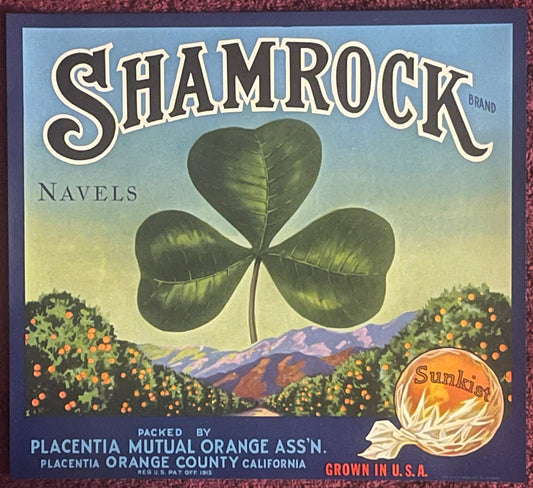
Caledonia wasn't a one-off. The Bowers Museum in Santa Ana, writing about this same association's Shamrock label, says that in the 1930s Placentia Mutual ran a whole line of brands named for the countries of the United Kingdom: Albion for England, Caledonia for Scotland and Cambria for Wales, with Shamrock likely rounding out the set for Ireland. The association was still in the hands of its founding president, John C. Tuffree, and Samuel Kraemer, who built its first packing house in 1911. Kraemer came from a German immigrant family and Tuffree's mother was born in Peru, so the British Isles theme was pure salesmanship, and a fun one. The trademark records show the association filing for the CAMBRIA name too, in 1947, and still filing new brands as late as 1965 with COACHELLA GYPSY.

Caledonia didn't only go on oranges, either. The Tustin Area Historical Society keeps a Caledonia Brand Marsh Seedless Grapefruit label from Placentia Mutual in its collection, catalogued at about 1930.

🖨️ Western Litho. Co.

Western Lithograph Company was started in Los Angeles in 1899 by Anton Ernest Stoetzer, and from the beginning its main business was colorful crate labels for California citrus growers. It went through a few owners early on, was renamed Gilbert-Jones-Rugg for a few years (the Yorba Linda Public Library puts the new name at 1907), got its old name back by 1910, and ran until Brown-Bigelow bought it in 1953.

📜 The Caledonia trademark

The Caledonia name goes back a long way. Placentia Mutual filed the CALEDONIA mark on June 2, 1924, and it was registered on September 30, 1924 (registration No. 189,883) for "fresh citrous fruits," spelled the old way. It went on the books as an illustrated design mark, not just a word, and the filing claimed an even earlier registration of April 13, 1915. The record gives its first use as 1906. The mark was renewed for decades, its third renewal coming through on April 15, 1985, later passing to the Blue Banner Company of Riverside, and it wasn't allowed to lapse until July 2, 2005. That's close to a hundred years of the Caledonia name, from that first use to the day it lapsed.

🏡 Display

Imagine hanging this antique advertising on your wall as home decor in any room! That tartan and thistle look great framed in a kitchen, a den or a pub room, and it's a perfect gift for anybody with Scottish roots, or anybody from Placentia or Orange County.

Crate labels are a reminder of a bygone era, and the lithography on them is unparalleled even to this day, in my opinion. Museums and art institutes have galleries dedicated to them, and more and more collectors are seeking them out to preserve their history. Nobody is ever going to print these again. The supply for sale is all there is, and once it is framed on collectors' walls and tucked into gallery collections, these labels will be very hard to come by.

Shipping

🚚 Shipping & Handling

  • Shipping costs and timing are calculated at checkout.
  • Items curated and shipped directly by me include U.S. shipping at no additional cost, professionally packed to ensure safe arrival of your artifact.

Items from Vetted Pro Collectors
Shipping for items offered by vetted Pro Collectors is determined at checkout. All Pro Collector listings are reviewed to ensure fair, reasonable shipping practices.

For full details, please refer to our Shipping Policy.

Returns & Exchange

Take your time — you've got a full six months. If a piece isn't right for you, send it back the way it reached you and we're good.

In the first 30 days your money goes straight back the way you paid. After that it's store credit, so you can put it toward something you'd rather have.

Return shipping we sort out between us, case by case. I don't make this difficult.

If something arrives damaged, or it isn't what I said it was, send me a photo within 48 hours and I'll make it right.

Email info@vintageantiquesgifts.com or call 802-356-9872 — that's me answering, not a call center.

The only things I can't take back are custom or special-order pieces and gift cards.

View full details

Rescuing American History Since 2007

— Travis & the Kids