Skip to product information
1 of 5

Vintage and Antique Gifts

Antique 1930s Diamond S Brand Bartlett Pears Crate Label Pair 🍐 — E. M. Simpson, Hood, California

Antique 1930s Diamond S Brand Bartlett Pears Crate Label Pair 🍐 — E. M. Simpson, Hood, California

Regular price $5.50 USD
Regular price Sale price $5.50 USD
Sale Sold out
Shipping calculated at checkout.

Size: 11" x 8"

🚚 Free US Shipping — ships within one business day. International shipping calculated at checkout.

Quantity

Who Packed Diamond S Pears? 🐴 Diamond S Brand Bartlett Pears, E. M. Simpson, Hood, California

Size: 11" x 8" each ~ Little to no storage wear.

This one's a pair - two of these Diamond S pear labels come to you together.

Two handsome horses on a pear label, and I think I know why. This is an antique 1930s Diamond S Brand Bartlett Pears crate label, shipped by E. M. Simpson of Hood, California, down in the Sacramento River Delta, and never used.

🔍 What's on it

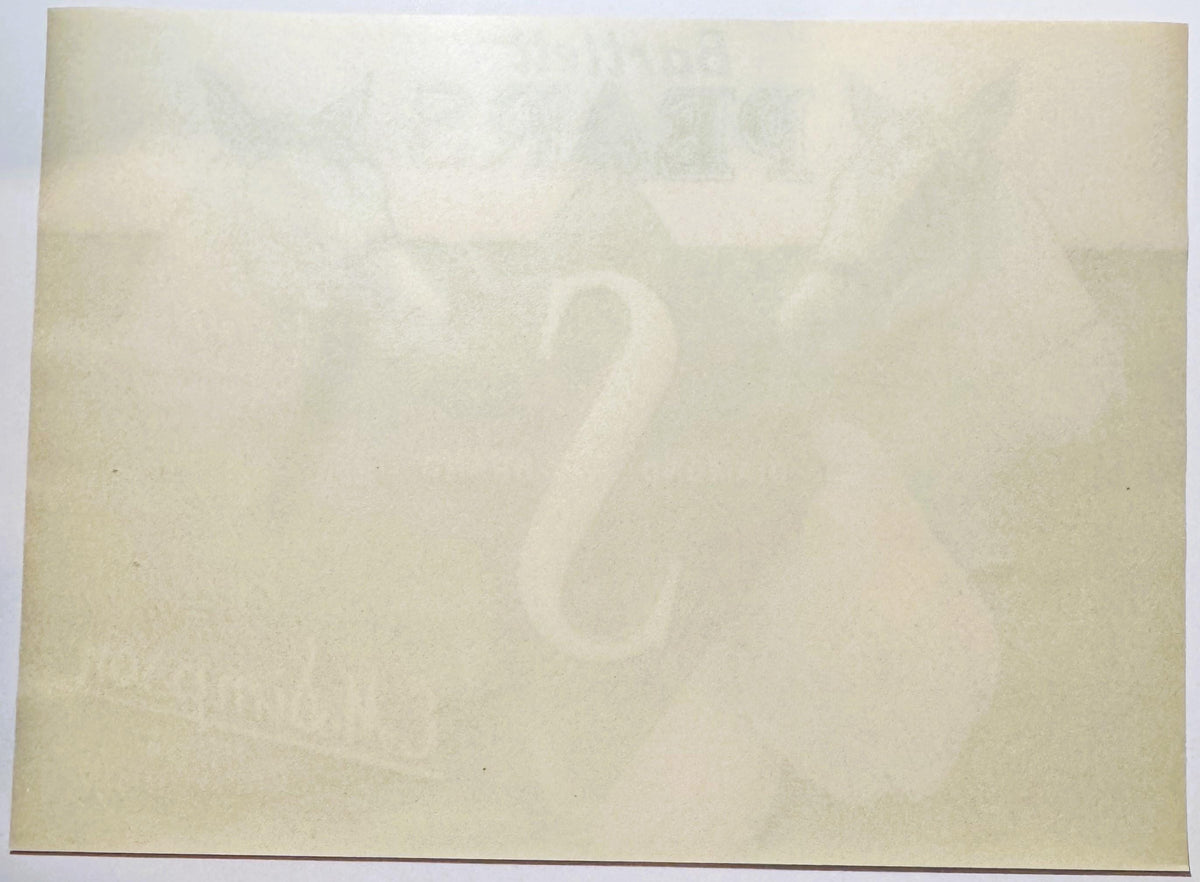
Two horse heads face in from either side, palomino-chestnut with cream manes, in fine leather bridles with pearl-studded brow bands and beaded throat chains. Between them, the brand mark: a big white letter S inside a tilted blue diamond outlined in red, with DIAMOND on one side and BRAND on the other in yellow. Bartlett PEARS across the label, two ripe yellow Bartlett pears with dark green leaves at the lower left, E. M. Simpson in a yellow signature script over HOOD, CALIFORNIA, and NET WT. 46 LBS. in pale blue along the bottom, on a cream band over solid black. No printer is named. The back is plain.

🐎 E. M. Simpson and the Diamond S Ranch

The name, the town and the brand all match a real man and a real ranch. In the Pacific Rural Press of March 29, 1919, "E. M. Simpson, Diamond S Ranch, Hood" is listed among California's prominent Hereford breeders, with eighteen cows of Beau Eaton, Beau Defender, Hesiod Lad and Hesiod breeding, and the note "Demand very heavy; all sold out." He showed Herefords at the 1918 State Fair, and at the California International livestock show that November of 1919 he was entered with Clydesdales and American Saddle Horses. By the 1920s the Sacramento city directories list an E. M. Simpson of Hood as president of the Friend & Terry Lumber Co.. So a man who showed fine horses shipped his pears under a label with two fine horses on it. Same name, same town, same Diamond S: it's the same man. And Friend & Terry was an old name in Sacramento: its own ad in the 1927 directory says "Est. 1853," back in the Gold Rush years.

Dig into those old farm papers and you get to know his stock by name. At the 1918 State Fair his Hereford bull Beau Randolph took first in the class for bulls two years and under three, and his cow Madame Juanita took second among the two-year-old cows. By the spring of 1919 his herd bull was Maxwell Berenda, brought in from Whitehall Estates. That November, in the light-horse classes at the California International, his American Saddle Horses were entered right alongside horses from San Francisco and Tulare. I love that you can still read the names of a Delta rancher's prize cattle a hundred-odd years later.

The lumber company kept him busy in town, too. The Sacramento directories carry him as president of Friend & Terry from at least 1922 through 1927, with Lawrence H. Chapman as manager in 1922 and 1923 and J. H. Shepard by 1927, at the yard on Second and S Streets. A rancher at Hood, a lumberman in Sacramento, and a man who knew a good horse when he saw one.

🍐 Hood and the Delta pears

Hood sits on the Sacramento River about fifteen miles south of Sacramento. It started out as Richland, a grain-shipping landing from 1860, but as the Delta switched from grain to fruit, Richland faded and its post office closed in 1888. In 1909 the Southern Pacific had the Hood Investment Company build a new town on the spot, and it was named for William Hood, the railroad's chief construction engineer. The railroad put up a big packing shed, seed farms and creameries, and even the Hotel Netherlands, for its dream of the "Netherlands of America." All along that stretch of river, Bartlett pears became the crop that meant Delta prosperity, and neighboring Courtland called itself the "Bartlett Pear Capital of the World." Courtland still throws an annual Pear Fair for the Delta's Bartlett harvest, a tradition since 1972. Courtland was a river town of its own long before that, a steamer landing from 1870, named for Courtland Sims, son of James V. Sims. Hood itself got its own post office in 1912, so the HOOD printed on this label is the railroad's town.

🌳 Why They're Called Bartletts

The pear on this label has a funny family history of its own. It turned up between 1765 and 1770 in the yard of John Stair, a schoolmaster in Aldermaston, England, and over there it's still the Williams pear. In 1799 James Carter brought some of the trees across to Massachusetts, where they were planted on Thomas Brewer's grounds in Roxbury. Enoch Bartlett of Dorchester later bought the place, had no idea where the trees came from, and sold the fruit under his own name. Nobody worked out that the Bartlett and the Williams were the same pear until 1828, and by then the name had stuck. In 1985 it was still 80 percent of all the pears grown in the United States. Not bad for a pear that got its American name by accident.

🏡 Display

Imagine hanging this antique advertising on your wall as home decor in any room! Those horses look great framed in a den, a tack room or a kitchen, and it's a perfect gift for a horse lover, a Hereford breeder, or anybody from the Delta.

Crate labels are a reminder of a bygone era, and the lithography on them is unparalleled even to this day, in my opinion. Museums and art institutes have galleries dedicated to them, and more and more collectors are seeking them out to preserve their history. Every label sold is one fewer left for sale anywhere. Nobody is printing more, and once these are on display with collectors or in galleries, they will be very difficult to acquire.

Shipping

🚚 Shipping & Handling

  • Shipping costs and timing are calculated at checkout.
  • Items curated and shipped directly by me include U.S. shipping at no additional cost, professionally packed to ensure safe arrival of your artifact.

Items from Vetted Pro Collectors
Shipping for items offered by vetted Pro Collectors is determined at checkout. All Pro Collector listings are reviewed to ensure fair, reasonable shipping practices.

For full details, please refer to our Shipping Policy.

Returns & Exchange

Take your time — you've got a full six months. If a piece isn't right for you, send it back the way it reached you and we're good.

In the first 30 days your money goes straight back the way you paid. After that it's store credit, so you can put it toward something you'd rather have.

Return shipping we sort out between us, case by case. I don't make this difficult.

If something arrives damaged, or it isn't what I said it was, send me a photo within 48 hours and I'll make it right.

Email info@vintageantiquesgifts.com or call 802-356-9872 — that's me answering, not a call center.

The only things I can't take back are custom or special-order pieces and gift cards.

View full details

Rescuing American History Since 2007

— Travis & the Kids