Skip to product information
1 of 7

Vintage and Antique Gifts

Antique 1934 Pennsylvania Railroad 1000 Bond 📜 Series E, Coupon Sheet, Penn Station Vignette, American Bank Note Co

Antique 1934 Pennsylvania Railroad 1000 Bond 📜 Series E, Coupon Sheet, Penn Station Vignette, American Bank Note Co

Regular price $19.00 USD
Regular price Sale price $19.00 USD
Sale Sold out
Shipping calculated at checkout.

Size: 15" x 10"

🚚 Free US Shipping — ships within one business day. International shipping calculated at checkout.

Quantity

🚂 What Did It Feel Like to Hold a Piece of the "Standard Railroad of the World"?

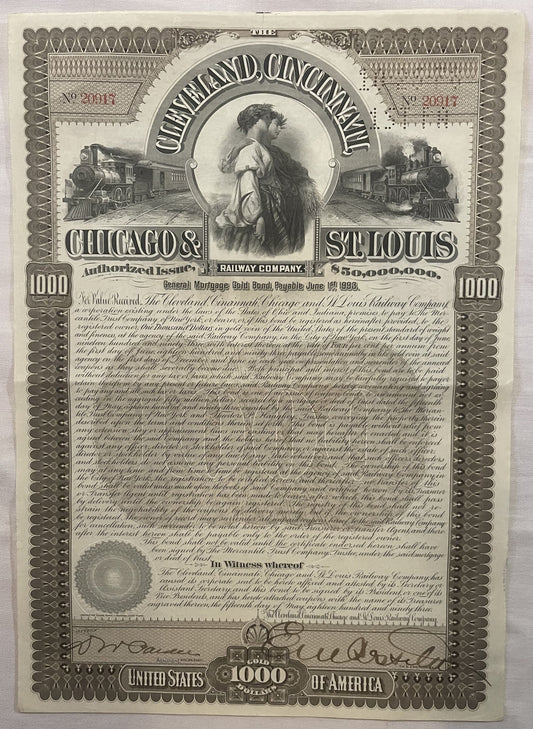
Size: 15" x 10" ~ Cancelled with punch holes. They vary a little one to the next.

There was a time when American wealth didn't live in a phone app or a brokerage statement — it lived on paper like this. Heavy, engraved, engine-turned paper, stamped with a serial number in red ink, bearing the promise of a company so vast it once employed more people than the entire United States Army. Folks who bought bonds like this one weren't just investing in a company — they were buying a stake in the tracks, tunnels, and terminals that carried the mail, the milk, the soldiers, and the salesmen of an entire nation. Hold one of these today and you're holding the actual paper trail of that world — a world where "The Pennsylvania Railroad" wasn't just a name, it was practically a synonym for American industrial might.


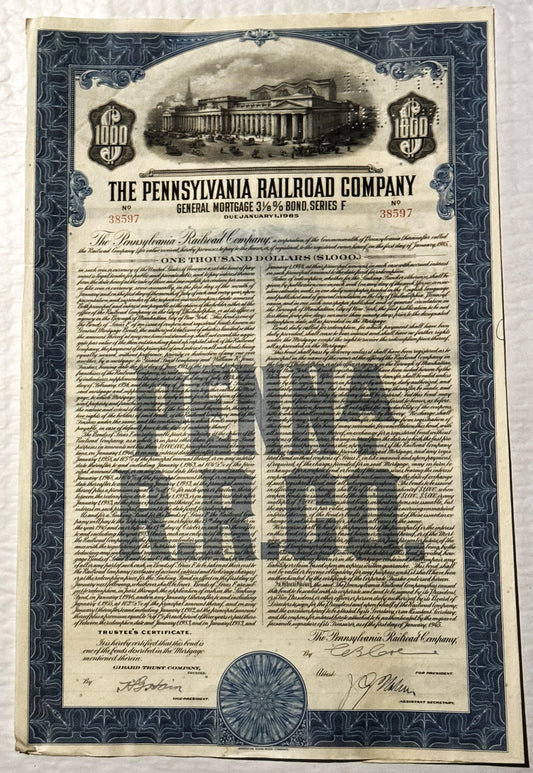
This is The Pennsylvania Railroad Company General Mortgage 4¼% Bond, Series E — a $1,000 coupon bond certificate, dated July 1, 1934, and due a full half-century later on July 1, 1984. Collectors habitually call railroad paper of this vintage "gold bonds," but this one is not, and it says so in its own engraved text — the promise it makes is to repay in lawful money, not in gold coin. There is a reason for that, and it is worth the whole section below. It measures a substantial 15 x 10 inches across the main bond body alone, not counting its attached sheet of interest coupons, which fold out to extend the piece considerably further.

Engraved by the American Bank Note Company — the premier security printer of its era — the certificate is worked in rich olive-green and black intaglio ink on crisp cream stock, with a fine steel-engraved vignette of the railroad's grand New York terminal spanning the top of the document like a piece of architectural fine art.

Below it, in bold gothic lettering, runs the company's name, and beneath that, dense engraved legal text sets out the terms of the mortgage in the ornate, formal language of another century. Enormous pale block letters reading PENNSYLVANIA are printed into the body text as a security tint — a protective underprint, not a stamp — and a row of small punch-cancellation holes runs across the top, the mark left when the bond was paid off and retired at the end of its run.

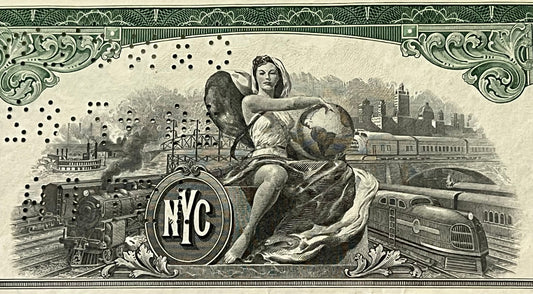
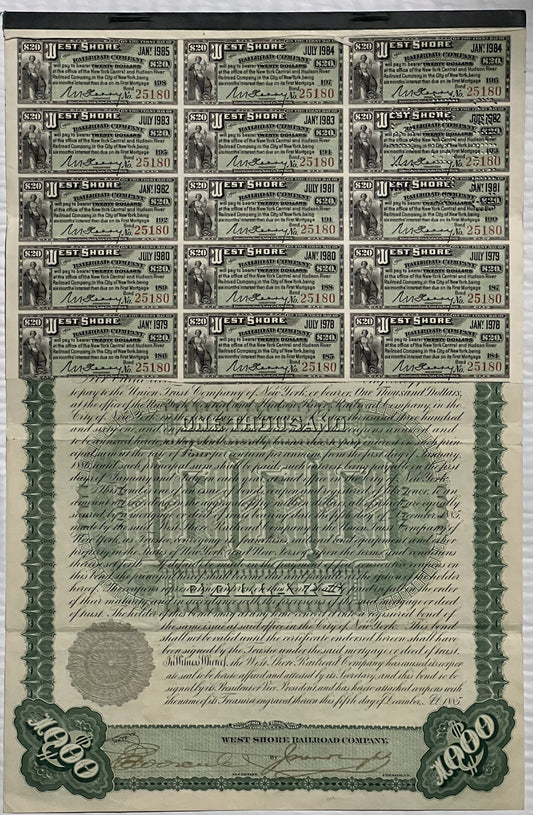
Along the side, a run of small engraved coupons — each one a miniature companion to the main vignette, dated across a span of years — forms a striking repeating border, more a piece of graphic art than a mere financial instrument.


🏛️ The Pennsy: Once the Biggest Corporation on Earth

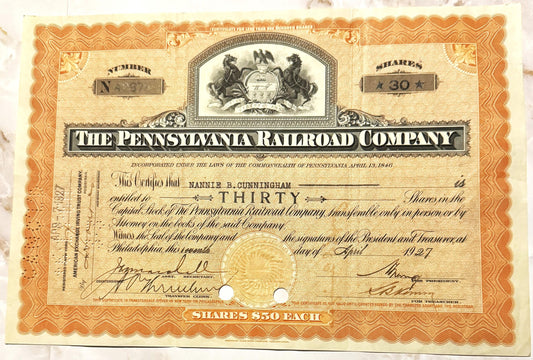
Old-timers in railroading circles didn't call it the Pennsylvania Railroad — they called it "the Pennsy," and they said it the way you'd say the name of a family member. Chartered in 1846 to build a rail line linking Philadelphia to Pittsburgh and, by extension, the whole western frontier beyond the Allegheny Mountains, the Pennsylvania Railroad grew at a pace almost impossible to imagine today. By the late 1800s and into the early 20th century, it had become — by most measures of the day — the largest railroad and one of the largest corporations of any kind in the entire world, so vast and so profitable that it proudly billed itself as "The Standard Railroad of the World." It wasn't idle boasting. The Pennsy's network eventually stretched across more than a dozen states, its rails carried a meaningful share of all freight tonnage moved in America, and its passenger trains — the famous Broadway Limited among them — linked New York and Chicago in overnight luxury. Its keystone-shaped herald became one of the most recognized corporate symbols in the country, stamped onto boxcars, timetables, and — yes — bonds just like this one.

A bond like this was born of a specific, and very deliberate, piece of corporate finance. The certificate itself tells us that the underlying mortgage securing these bonds traces back to a trust indenture dated June 1, 1915, made between the Pennsylvania Railroad Company and its trustees, the Girard Trust Company and William H. Ely. That 1915 indenture created a framework under which the railroad could issue new "General Mortgage" bonds in lettered series — A, B, C, D, and on — over the following decades, each series representing a fresh round of long-term borrowing secured against the same broad pool of railroad property and franchises. Series E, the series represented here, was issued under that same 1915 mortgage nearly two decades later, in the depths of the Great Depression, when even a corporate giant like the Pennsylvania Railroad needed to raise long-term capital to keep its network running, its equipment modern, and its enormous payroll met.

The bond's own text notes that a sinking fund was required under a supplemental indenture, with payments regulated in accordance with the federal Interstate Commerce Commission — a reminder that by the 1930s, American railroads operated under some of the tightest federal financial oversight of any industry in the country.

The bond required more than a single signature to become valid. Its printed text plainly states that it "shall not be valid or become obligatory for any purpose until it shall have been authenticated by the certificate of the Corporate Trustee." That meant a bond like this passed through the hands of the railroad's own Assistant Secretary and an officer signing "For President," and then on to the Girard Trust Company, whose vice president signed a separate Trustee's Certificate confirming the bond was one of the genuine instruments described in the underlying mortgage. It's a small but telling detail of how seriously American finance treated paper like this — layers of corporate and independent trustee oversight, all to protect the investor holding the bond in their hand.


🗽 The Terminal in the Vignette: Penn Station's Lost Temple

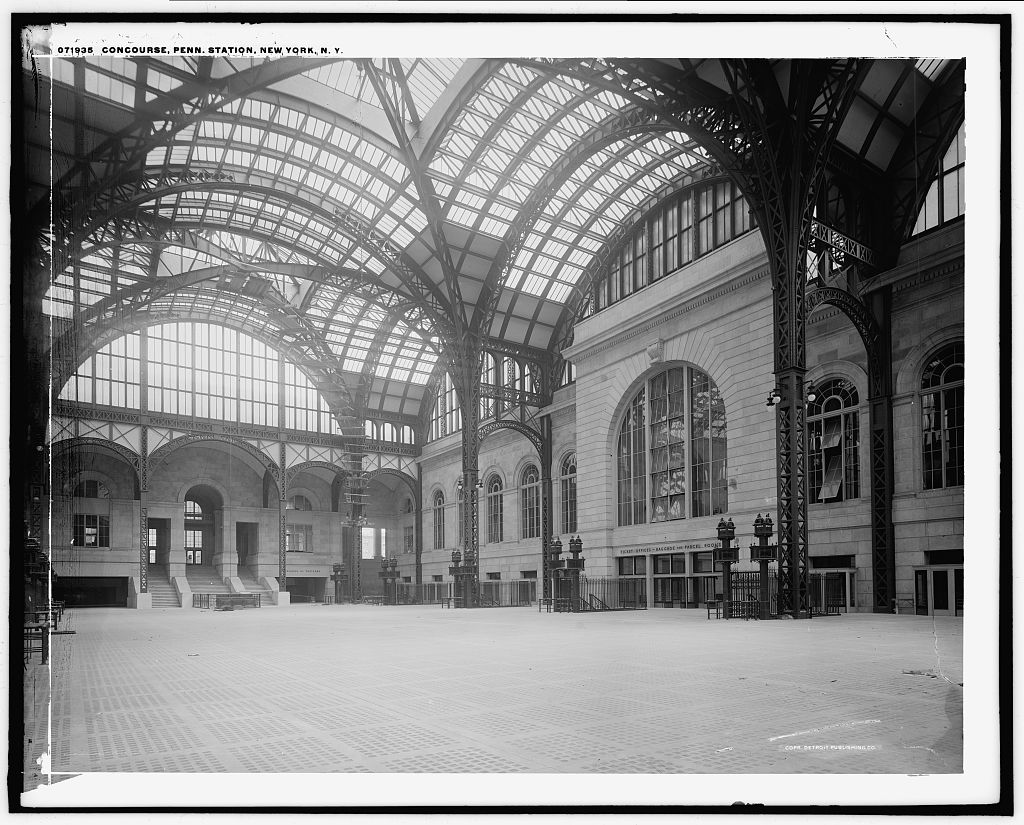
The building engraved across the top of this bond is Pennsylvania Station in New York — but not the low-ceilinged, fluorescent-lit Penn Station travelers pass through today. This is the original Pennsylvania Station, the great Beaux-Arts terminal designed by the renowned architectural firm McKim, Mead & White and opened in 1910, built specifically so the Pennsylvania Railroad could finally bring its trains directly into Manhattan under the Hudson and East Rivers rather than stopping short in New Jersey. It was modeled in part on the Baths of Caracalla in ancient Rome, its main waiting room a soaring hall of pink granite columns, vaulted glass-and-steel ceilings, and Doric colonnades that made travelers feel, for a moment, like they were entering a cathedral rather than a train station. For over half a century it stood as one of the most magnificent public buildings in America — and it is precisely this building, this exact colonnaded façade with the streetcars, automobiles, and pedestrians bustling in front of it, that the American Bank Note Company's engravers rendered onto this bond in the 1930s as the proud emblem of everything the Pennsylvania Railroad had built.

Local legend and architectural history alike record what happened next: in 1963, with rail travel in decline and the real estate above deemed more valuable than the terminal below, the original Pennsylvania Station was demolished to make way for a new Madison Square Garden and an underground replacement station. The loss stunned architects, preservationists, and ordinary New Yorkers alike — one prominent architectural historian famously wrote that "until the first blow fell, no one was convinced that Penn Station really would be demolished, or that New York would permit this monumental act of vandalism." The public outcry over its destruction is widely credited as the spark that led directly to the creation of the New York City Landmarks Preservation Commission in 1965, an agency whose very existence traces back to the outrage over this one building's loss. So the terminal pictured on this bond isn't just a pretty vignette — it's a memorial, in engraved steel, to a building whose destruction changed how America thinks about preserving its own architectural history.


💰 Clipping Coupons: How Investors Actually Got Paid

The very phrase "clipping coupons," still used today to describe living comfortably off investment income, comes directly from bonds exactly like this one. Rather than mailing a check twice a year, the Pennsylvania Railroad printed a long strip of small, individually numbered coupons right onto the bond itself — one for every semi-annual interest date over the life of the bond, running here across a long span of years from the 1930s all the way out toward the 1984 maturity date.

When an interest date arrived, the bondholder would literally clip the correct coupon free with a pair of scissors and present it — at the railroad's own office in Philadelphia, or at its agency in the Borough of Manhattan, the bond's text specifies — to collect their semi-annual interest at the 4¼% rate, payable in whatever the United States counted as legal tender on the day.

Each little coupon carries its own miniature engraving and its own serial number, tying it back to its parent bond, and each was clipped and redeemed on schedule for decades by whoever held the bond. The coupons that survive attached today are simply the ones nobody ever got around to redeeming before the bond itself was ultimately retired — a quiet reminder of just how long these instruments were built to last, and how much of that promised interest actually did get paid out, one careful snip at a time, across generation after generation of investors.


💵 Why This Bond Is Not a Gold Bond — and Why Everyone Calls It One

Almost every dealer listing for railroad paper of this vintage says "gold bond," and the shorthand is honest enough: for decades before this sheet was printed, American corporate bonds really did promise repayment in gold coin of a stated weight and fineness. It was the standard clause, and it was there to protect the lender from a government that might devalue the currency underneath him.

Then the government did exactly that. In April 1933 Franklin Roosevelt's Executive Order 6102 required Americans to turn in their gold coin and bullion, and on June 5, 1933 Congress passed a Joint Resolution declaring gold clauses in contracts — public and private — contrary to public policy, so a debtor could discharge them in any legal tender. Every bond printed afterward had to be worded differently, and the fight over the ones already outstanding went to the Supreme Court. It was settled on February 18, 1935 in the Gold Clause Cases, and the lead case is a railroad case: Norman v. Baltimore & Ohio Railroad Co., decided 5-4, with Chief Justice Hughes holding that Congress's power over the currency was broad enough to void the promise. Justice McReynolds dissented furiously, and bondholders across the country woke up owed dollars instead of gold.

This sheet is dated the first day of July 1934 — thirteen months after the Joint Resolution and seven months before the Court upheld it. Read the engraved line and you can see the change happening in real time: the Pennsylvania Railroad promises to pay one thousand dollars "in such coin or currency of the United States of America as at the time of payment is legal tender for public and private debts." That single clause is the whole of the New Deal's monetary revolution, set in copperplate script. The nickname stuck anyway — which is why so many of these are sold as gold bonds that are nothing of the kind.


🖨️ The Craft Behind the Paper: American Bank Note Company

Notice how difficult a document like this would be to forge, and you're noticing the entire point of the American Bank Note Company's existence. Formed in the 19th century through the merger of several of the country's leading banknote engraving firms, American Bank Note Company became the go-to security printer for governments, railroads, and corporations across the Americas — the same engravers responsible for currency, postage stamps, and stock certificates were the ones commissioned to render the Pennsylvania Railroad's terminal in such fine, dense steel engraving that no photographic or lithographic copy of the era could convincingly reproduce it. The tight parallel guilloché lines bordering the certificate, the fine cross-hatching in the vignette's sky and stonework, the dense engine-turned lettering of "1000" in the corner medallions — all of it exists not merely for beauty but for security, the engraver's equivalent of a bank vault door. It's a wonderful example of American commercial engraving at its technical peak, produced at a moment when a corporation's bonds needed to be, quite literally, works of art good enough to stop a counterfeiter cold.


🛤️ From the Pennsy's Peak to the Collector's Wall

By the time this bond's 1984 due date actually arrived, the Pennsylvania Railroad itself had long since vanished from the American corporate landscape. In 1968, the Pennsy merged with its longtime rival, the New York Central Railroad, to form the Penn Central Transportation Company — a merger meant to save two struggling giants that instead produced, in 1970, one of the largest corporate bankruptcies in American history up to that time. Penn Central's rail operations were eventually folded into Conrail in 1976, while its passenger routes — and Pennsylvania Station itself — passed into the newly formed Amtrak. So bonds like this one, issued with such confidence in 1934 by a company that called itself the standard of the entire railroad world, ultimately outlived the very corporation that issued them, becoming collectible relics of a business empire that no longer exists in name.

That very fact is a large part of why paper like this holds such appeal today. The hobby of collecting old stock and bond certificates has its own name among enthusiasts — scripophily — and pieces tied to famous, vanished giants like the Pennsylvania Railroad sit near the top of most collectors' want lists, prized as much for their engraved artistry as for the corporate history bound up in them. A bond like this survives as tangible evidence of an era when a single company's rails, terminals, and rolling stock genuinely helped knit a continent together — and when investing in that vision meant holding a document beautiful enough to frame.


Shipping

🚚 Shipping & Handling

  • Shipping costs and timing are calculated at checkout.
  • Items curated and shipped directly by me include U.S. shipping at no additional cost, professionally packed to ensure safe arrival of your artifact.

Items from Vetted Pro Collectors
Shipping for items offered by vetted Pro Collectors is determined at checkout. All Pro Collector listings are reviewed to ensure fair, reasonable shipping practices.

For full details, please refer to our Shipping Policy.

Returns & Exchange

Take your time — you've got a full six months. If a piece isn't right for you, send it back the way it reached you and we're good.

In the first 30 days your money goes straight back the way you paid. After that it's store credit, so you can put it toward something you'd rather have.

Return shipping we sort out between us, case by case. I don't make this difficult.

If something arrives damaged, or it isn't what I said it was, send me a photo within 48 hours and I'll make it right.

Email info@vintageantiquesgifts.com or call 802-356-9872 — that's me answering, not a call center.

The only things I can't take back are custom or special-order pieces and gift cards.

View full details
  • 5 stars: 1 (100%)
  • 4 stars: 0 (0%)
  • 3 stars: 0 (0%)
  • 2 stars: 0 (0%)
  • 1 star: 0 (0%)
t
t***3 (295)

Great condition and fast shipping!

Preserving History: Authentic Objects Across Eras

— Curated by Travis Weigel