Skip to product information
1 of 16

Curated Gift Sets

Antique 1800s-1920s Courtship Label Set 💌 Victorian Candy Box Lady, Rudolph Valentino Cigar Band, La Balca, Rosa Y Yo, Engagement

Antique 1800s-1920s Courtship Label Set 💌 Victorian Candy Box Lady, Rudolph Valentino Cigar Band, La Balca, Rosa Y Yo, Engagement

Regular price $31.00 USD
Regular price Sale price $31.00 USD
Sale Sold out
Shipping calculated at checkout.
Quantity

💌 How Did Sweethearts Court a Hundred Years Ago? Five Antique Candy Box and Cigar Labels Tell the Whole Romance

Size: Candy Box Lady 6" x 3", Valentino Cigar Band 2 3/4" x 1/2", La Balca 4 1/2" x 4 1/2", Rosa Y Yo 2 3/4" x 2 1/4", Engagement 9 1/2" x 7" ~ All five never used.

Five pieces of old paper, five different makers, and not one of them was ever meant to sit next to the others. I lined them up anyway, because in this order they tell a love story from the first box of chocolates to the ring. She gets the candy. Everybody swoons over the movie star. There's a moment out on the terrace. Somebody finally says "Rose and I." And in the last picture she's looking at her ring while he leans back and smokes a cigar named Engagement.

If you've never run across these before, here's what you're looking at. One is the picture card from a fancy box of candy, from the 1800s. The other four came out of the cigar business in the 1910s and 1920s. A cigar band is the little paper ring wrapped around a single cigar. A cigar box label is a printed picture glued to the wooden box the cigars were sold from, and a box usually wore more than one: a big one inside the lid, where you saw it the moment the box was opened on the store counter, and smaller ones on the outside. All five are what the trade calls new old stock, which just means old but never used. Not one of them ever got glued to anything. Each piece comes from my stack of unused ones.

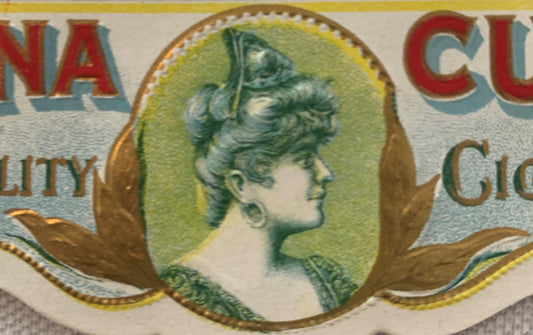
🍫 First, the Chocolates: The Lady in the Big Blue Hat

Courting started with candy, and fancy candy started with the box. Richard Cadbury, of the English chocolate family, liked to paint. In 1868 his company sold a box decorated with his own painting of his young daughter holding a kitten, and that same year it sold a heart-shaped box of chocolates for Valentine's Day. Late Victorians kept a pretty box for buttons and trinkets long after the last chocolate was gone. The idea caught on so well that "chocolate box" became the art world's put-down for anything too pretty and sentimental.

This card did that same job. A little printed beauty was there to greet you before you ever reached the sweets, a small picture meant to be admired and very often kept. And her hat has a criminal record. That big plumed brim is the Gainsborough look, named for the English painter Thomas Gainsborough. In May 1876 his portrait of the Duchess of Devonshire, smiling under a hat just like it, sold in London for $51,540, reported as the highest price yet paid for a painting at auction. Three weeks later a thief named Adam Worth took it from the gallery. A Scotland Yard detective called him the "Napoleon of Crime," and the writer Vincent Starrett later said Arthur Conan Doyle based Sherlock Holmes's enemy Professor Moriarty on him. The Duchess didn't come home until March 28, 1901, in Chicago, and while she was missing, her hat was everywhere.

Those two tiny words at the foot of the card, PRINTED IN GERMANY, are there because the law said so. Starting March 1, 1891, the McKinley Tariff made imported goods say in plain English where they came from. And Germany was where you went for pretty paper. The card is a chromolithograph, which is a long word for a color picture built up one color at a time, each color drawn on its own slab of limestone and printed in perfect line with the last.

🎬 Then, the Daydream: Rudolph Valentino on a Cigar Band

Meanwhile, the whole country was in love with somebody else. Rodolfo Guglielmi was born in Castellaneta, in the south of Italy, on May 6, 1895, and landed in New York two days before Christmas in 1913. He danced for a living until The Four Horsemen of the Apocalypse made him a star overnight in 1921 and got America doing the tango. The Sheik came out that same year and made him the Latin Lover for good. His name is what puts this band in the 1920s: before 1921 hardly anybody knew it.

Then it all stopped. He died in New York on August 23, 1926, just 31 years old. An estimated 100,000 people lined the streets of Manhattan, windows were smashed as fans tried to get in, and it took more than 100 mounted police to restore order. And here's the legend. For decades a mysterious woman in black has come to his crypt at Hollywood Forever with a red rose, usually on the anniversary of his death. The first one seems to have been a publicity stunt dreamed up by a press agent in 1928, but the tradition stuck, and there's still a woman in black today.

Each band like this was put on a cigar by hand with a dab of glue, and by 1900 Americans were going through about 2 billion of them a year. Kids saved them and pasted them into scrapbooks, and collecting them even has a name, vitolphilia.

💛 Then, the Moment: La Balca

Now we're out on the terrace by the water. A gentleman in red sits up on his horse, a young woman in flowing white reaches up to hold him, and the dog just waits. That's a whole silent movie about the size of your palm, and it's exactly what cigar labels were selling along with the smoke: romance, adventure and old-world Europe.

This is an outer label, the kind that went on the outside of the box to sell La Balca before anybody lifted the lid. Collectors know this shape as the octagon, a square with its corners clipped off. It was printed by the Calvert Lithographing Company of Detroit, started by Thomas Calvert in 1863, and it's embossed, meaning a metal die pressed the picture up off the paper so you can feel it with your finger. The raised parts were then dusted with metallic powder to read as gold. Turn it over and the title, the horse, the rider and the woman are all pressed right through to the blank back, backwards. Amazing gold embossed label!

🌹 Then, the Words: Rosa Y Yo

Sooner or later somebody has to say it out loud. Rosa y yo is plain, everyday Spanish for "Rose and I," which reads like the first line of a love letter and matches the picture exactly. This is the smallest label in the set, the little oval tag that went on the outside of the box where you'd see it on the counter.

A Spanish name on an American cigar was no accident in those years. Spanish and Cuban names meant Havana tobacco, and Havana meant quality. The brand's bigger labels say Clear Havana, the trade's way of saying a cigar made in the United States entirely from Cuban leaf, which was the specialty of the factories of Tampa and Key West. In Tampa, rows of rollers worked by hand at long tables while a reader called a lector read newspapers and novels aloud to the whole room.

💍 And Finally, the Ring: Engagement

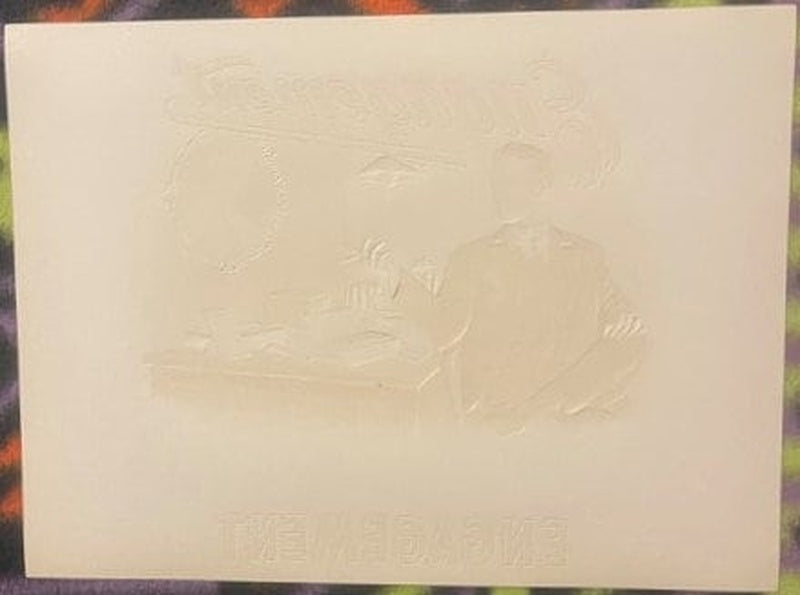
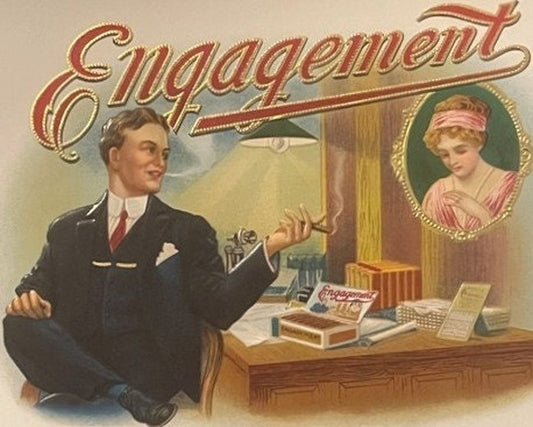
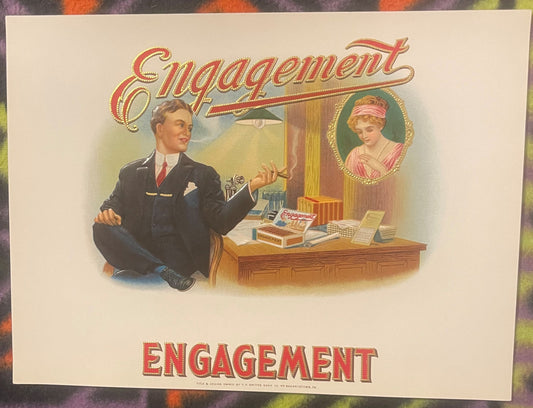
Here's the punchline of the whole set. Up in the gold oval on the wall, a young woman looks down at the ring on her finger. Below her, a young man leans back from his desk with a cigar, smiling. And on that desk sits an open box of cigars with this very picture inside its lid, printed small. The box on the desk is the box the customer was holding. The label doesn't show a proposal. It shows the hour after, when the ring is on and he has sat back to enjoy a cigar about it, which is a better advertisement than any list of tobacco blends.

This is the big one, the inner-lid label, made to be glued inside the lid. The line of small type at the bottom says the title and design were owned by F.X. Smith's Sons Co. of McSherrystown, Pennsylvania, which just means no other factory could use that name or that picture. Francis Xavier Smith started the business in 1863, the summer Union and Confederate cavalry fought through the streets of next-door Hanover on the eve of Gettysburg. At its height the factory had about 600 workers turning out 60,000 to 80,000 hand-rolled cigars a day. The Gettysburg Times called it Adams County's last cigar maker in 2012, and in 2018 it was sold and the work moved to the Dominican Republic. That's 155 years of Pennsylvania cigar making, and labels like this one are what is left of its romance.

The room in the picture helps with the age. A candlestick telephone, an electric desk lamp and a stiff high collar all belong to the 1910s, and a cigar house kept good artwork on the presses for years, so I have this one as 1910s-1920s. Collectors tell a story that Engagement was meant to have a companion, a Married label to carry the romance from proposal to altar.

🖼️ Where It Goes

Hang all five in a row from the candy to the ring, over a dresser or down a hallway, or bring them out every February. Cigar labels show you what antique advertising is all about, with the wonderful graphics that lithography and embossing provided that modern printing just can't reproduce, and that process is unparalleled even to this day in my opinion. Most of these artists were very good but desperate for work during that era, got paid very little and received no recognition for their work. The majority of them will remain unknown, but we can keep their art alive forever. Museums and art institutes have galleries dedicated to labels like these, and the Cooper Hewitt in New York holds a Rudolph Valentino cigar label of its own, so that little band is in very good company. My pictures seriously don't do them justice. There is no new press run coming. When the last of these are hanging in collections and galleries, they will be very hard to track down for sale.

Shipping

🚚 Shipping & Handling

  • Shipping costs and timing are calculated at checkout.
  • Items curated and shipped directly by me include U.S. shipping at no additional cost, professionally packed to ensure safe arrival of your artifact.

Items from Vetted Pro Collectors
Shipping for items offered by vetted Pro Collectors is determined at checkout. All Pro Collector listings are reviewed to ensure fair, reasonable shipping practices.

For full details, please refer to our Shipping Policy.

Returns & Exchange

Take your time — you've got a full six months. If a piece isn't right for you, send it back the way it reached you and we're good.

In the first 30 days your money goes straight back the way you paid. After that it's store credit, so you can put it toward something you'd rather have.

Return shipping we sort out between us, case by case. I don't make this difficult.

If something arrives damaged, or it isn't what I said it was, send me a photo within 48 hours and I'll make it right.

Email info@vintageantiquesgifts.com or call 802-356-9872 — that's me answering, not a call center.

The only things I can't take back are custom or special-order pieces and gift cards.

View full details

Preserving History: Authentic Objects Across Eras

— Curated by Travis Weigel