
Skip to product information
1 of 4

Vintage and Antique Gifts

Antique Crane's Imported Embossed Cigar Label 🚬 Indianapolis, IN 1900s - 1920s

Antique Crane's Imported Embossed Cigar Label 🚬 Indianapolis, IN 1900s - 1920s

Regular price $6.95 USD
Regular price Sale price $6.95 USD
Sale Sold out
Shipping calculated at checkout.

Size: 5 1/4" x 2 3/4"

🚚 Free US Shipping — ships within one business day. International shipping calculated at checkout.

Quantity

🚬 Can a Sheet of Paper This Small Hold a Whole Vanished World?

Size: 5 1/4" x 2 3/4"

It can. And this one does. There is a particular kind of quiet that settles over you when you hold something genuinely old and genuinely beautiful — something that was never meant to survive, yet somehow did. A cigar box label is ephemeral by design. It was printed to dress a box of cigars for the few weeks between the wholesaler's floor and the tobacconist's counter, to catch the eye of the man leaning over the glass, and then to go into the stove with the empty box.

Most were. This one was not. What you are looking at — and what will soon be in your hands — is an antique gold-embossed cigar box label from the House of Crane, the Indianapolis cigar house that wholesaled out of one address on South Meridian Street for nearly seventy years. It is New Old Stock: never pasted to a box, never sold across a counter, never handled in the ordinary course of trade.

It survived, crisp and uncreased, from an era when tobacciana was considered a legitimate arena for serious commercial art, and when a printer's reputation could rise or fall on how well his gold caught the light at the tobacconist's counter. The label measures approximately 5.25 inches by 2.75 inches — modest in scale, monumental in execution.

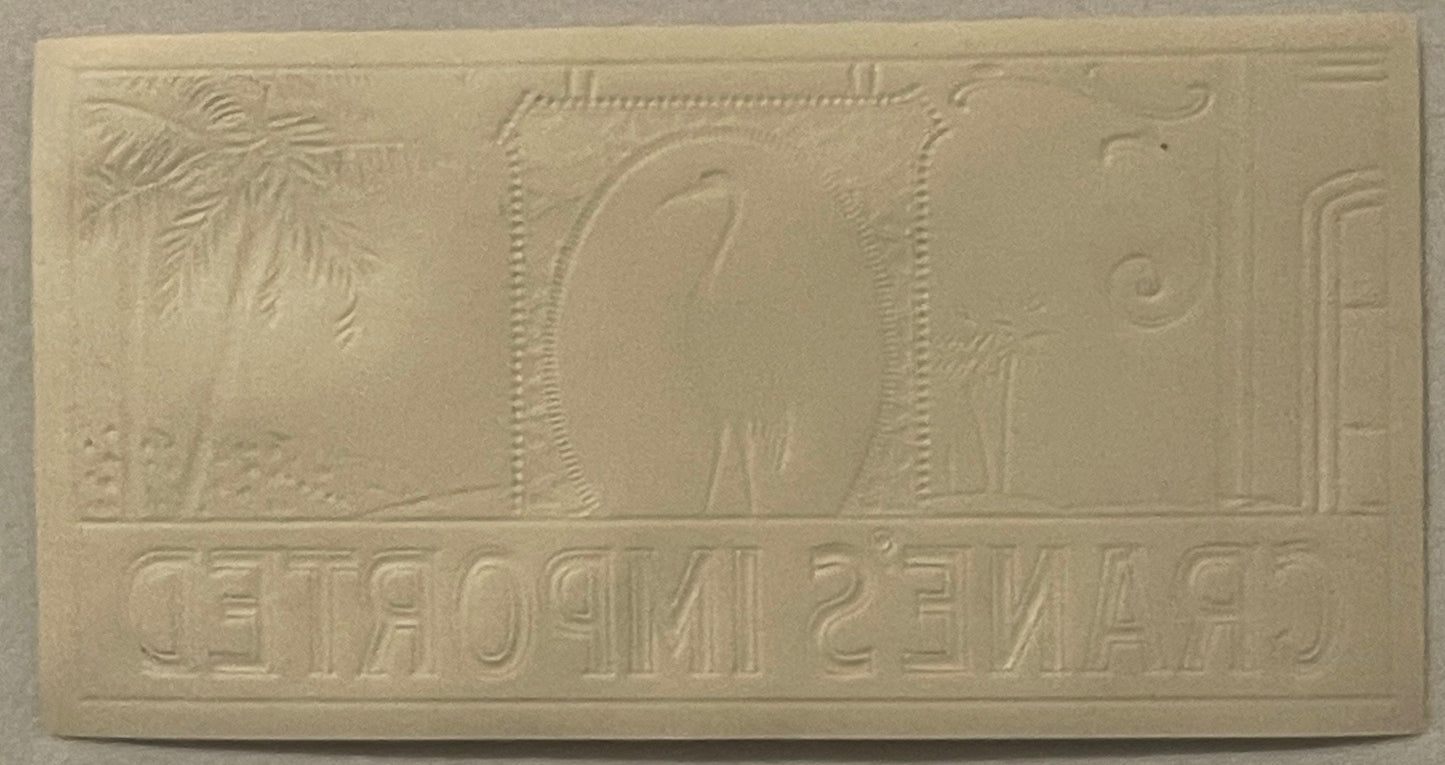
Here is what is actually on it. A tall wading bird stands dead center, embossed in gold and raised up off the paper so he catches the light and shifts when you tilt him, in a beaded oval frame with a little hook-and-eye rail across the top, as though the whole thing were a shop sign hung out over the street. Either side of him, a tropical landscape: palms, still water, a headland, and at the far left the arch and window of a stucco building. Along the bottom, one line of type and only one: CRANE'S IMPORTED. That is every word printed on this sheet. Turn it over and there is no ink at all, just the whole design pressed through in blind relief, lettering and all, reading backwards. That is what a deep emboss does to paper this thin.

The whole composition tilts and shimmers differently depending on the angle of light — a quality that was entirely intentional, because these labels were meant to be noticed across a room, inside a glass-lidded humidor, by a customer who hadn't yet decided what he was buying today.

🏛️ South Meridian Street, Indianapolis, and the World That Made This Label

To understand what this label meant, you have to understand the street it came from. South Meridian Street in Indianapolis was, in the late nineteenth and early twentieth centuries, one of the great commercial spines of the American Midwest. Indianapolis was not a coastal city, not a port city in the maritime sense, but it was something arguably more important to interior commerce: it was a railroad city.

Lines radiated from Indianapolis in every direction — to Chicago, to Cincinnati, to Louisville, to St. Louis — and that made it a natural clearing house for goods moving through the center of the continent. Dry goods, hardware, pharmaceuticals, and yes, tobacco: all of it moved through Indianapolis, and the men who brokered it built their offices and warehouses along Meridian Street, where brick facades climbed three and four stories and the sidewalks hummed with deliverymen and drummers and buyers from every county in Indiana.

The building that housed the House of Crane went up in 1866 and 1867, when a merchant named Edward Beck put up an Italianate commercial block on South Meridian Street — solid brick, built to last, built to impress. Italianate was the prestige style of that postwar moment: bracketed cornices, tall narrow windows with hood moldings, a facade that announced, in the visual language of the era, that serious business was conducted within. Beck's building started out with no cigars in it at all — the wholesalers who took space there sold liquor, hats, clothes, coffee and hardware. The House of Crane moved into the south half in 1911, did well enough to take over the entire building by 1916, and remodeled the storefront and interior when it did. The prism glass transoms date from that remodeling: ribbed glass set above the windows to bend daylight back into the depth of the floor, which is how you lit a long narrow commercial room before anyone trusted electricity to do it all day.

That building became one address in a district defined by ambition. The cigar trade was not a peripheral business in this world. It was central to it. In an era before widespread cigarette smoking, before the cultural disruptions of two world wars reshaped tobacco habits entirely, the cigar was the gentleman's daily companion.

A five-cent cigar was not a luxury — it was a ritual, as ordinary as coffee, as socially embedded as a handshake. A ten-cent or twenty-five-cent cigar was a statement of arrival. Cigar wholesalers like the House of Crane occupied a prestigious position in the commercial ecosystem: they sourced leaf, managed imports, maintained relationships with manufacturers and blenders, and presented the finished product to retailers across a wide regional territory.

The label was their calling card on every box that left their warehouse. The word "Imported" on this label is not mere puffery — it is a specific commercial claim. Premium cigar tobacco in the early twentieth century was understood to come from particular growing regions, and a wholesaler who could credibly claim imported leaf was positioning himself at the top of the regional market.

The House of Crane was making that claim in gold, literally, on every box.

🖨️ The Art of the Embossed Cigar Box Label

The printing of cigar bands and cigar box labels was, by the turn of the twentieth century, one of the most technically demanding niches in American commercial printing. The industry had developed its own specialized lithographers — firms in New York, Cincinnati, and Chicago who competed fiercely for tobacco accounts and who brought genuine artistic ambition to what was, nominally, packaging work.

Gold embossing — the process that gives this label its raised, light-catching surface — was among the most expensive finishing techniques available. The paper had to be printed in base colors first, then run through a separate embossing die that simultaneously applied the metallic foil and pressed the design into relief.

Registration between the two passes had to be essentially perfect, or the gold would drift off the scrollwork and the whole effect would collapse. The printers who did this work well were craftsmen of the first order, and they knew it. This sheet still carries every bit of that gold, unpasted and unhandled, exactly as it came off the press.

The paper these were printed on is thin, because thin paper is what takes a deep emboss and holds it — and thin paper is vulnerable to humidity, to acid migration, to the slow catastrophe of time. A label that actually went onto a box got damp, got glued, got torn off and thrown out with the box. Sheets that stayed flat and unpasted in the wholesaler's stock skipped every one of those hazards.

This one is crisp. The gold is gleaming. The colors are as they were when they left the press.

Who printed it is still an open question. There is no imprint anywhere on the sheet — not along the bottom edge, not in the margins, not on the back. One thing is plain, though: this is not the work of a regional job shop. The registration between the color pass and the embossing die is dead on, and that was specialist work.

🌆 They Took the Building Down. They Kept the Front of It.

Here is the part I like best. Beck's Italianate block came down in 1990 — and its front wall did not. The facade was kept on the site and built into Circle Centre, so the brick face that announced the House of Crane to the street-level commerce of Indianapolis is still standing exactly where it always stood. Cigars were wholesaled out of that address for nearly seventy years. You can walk up to the front of the building this label shipped from and put your hand on it.

That is not the ordinary fate of a commercial building. Most of them go down and stay down, and the paper that came out of them survives only by accident — carried forward in collections, in estate sales, in the bottom drawers of desks that outlasted the offices they furnished. This one got to keep both: the wall and the paper.

The bird is worth a minute on his own. Look closely at his bill: it is long, and it curves down. A real crane's bill is straight — a long decurved bill like that belongs to an ibis. So whoever drew him was after a handsome wading bird and a good pun rather than a correct one. In gold, on a red ground, from across a glass counter, he wins that argument comfortably.

It is also, of course, a visual pun: Crane's cigars, the Crane bird. This kind of brand integration — where the logo is the name, rendered in image — was considered sophisticated design practice in this era, and it suggests that whoever commissioned these labels was thinking carefully about visual identity in a way that anticipates what we would now call branding strategy.

🖼️ Display Ideas

  • 🪞 Frame it in a small shadow-box mount with a period Indianapolis photograph or a map detail of South Meridian Street — the geography and the object tell the story together.
  • 📚 Tuck it into a dedicated tobacciana album alongside other regional cigar bands, trade cards, and box labels — where the embossing stays protected and the full context of the era becomes visible across multiple pieces.
  • 🗂️ Display it in a glassine sleeve on a backing card with handwritten provenance notes — collector-style presentation that acknowledges the research this piece rewards.
  • 🏠 Group it with other Indianapolis or Indiana ephemera — letterheads, trade cards, billheads, and labels from the same commercial district — to build a micro-archive of a specific place and moment.
  • 🎨 Use it as the centerpiece of a small gold-embossed lithograph grouping: cigar bands, match labels, and trade cards from the same printing era, where the shared technique creates a visually coherent display even across different subjects.
  • 🎁 Present it as a curated gift to a collector of Americana, Indiana history, or tobacciana — mounted and matted, with a brief provenance card that gives the recipient everything they need to understand what they're holding.

🎁 Who Collects These

Cigar band and label collecting — vitolphilia, to use the collector's term for it — has a long and serious history. The practice peaked in the early twentieth century, when children and adults alike collected and traded bands and labels the way a later generation would collect stamps, and the best collections were maintained in dedicated albums with as much care as any philatelic holding.

That tradition never entirely disappeared, and today it exists alongside a broader and growing field of tobacciana collecting that encompasses labels, tins, humidors, trade cards, and paper ephemera of every kind. But this label draws collectors from several overlapping worlds. Indianapolis and Indiana local history collectors pursue it because the House of Crane is part of the documented commercial history of South Meridian Street. Paper ephemera and chromolithography collectors pursue it for the printing itself — the embossed gold technique, the compositional quality, the NOS condition. Americana and advertising art collectors pursue it as a miniature example of early twentieth-century commercial design at its most accomplished.

And gift-givers who know a collector — of cigars, of Americana, of Indiana history, of fine printing — find in this label a genuine artifact of a world that has closed. It is the kind of piece that rewards being held.

The embossing is tactile. The gold catches light in a way that photographs only approximate. The condition, for something more than a century old and never intended to survive, is quietly astonishing.

❓ Frequently Asked Questions

Is this label in display condition?

This is New Old Stock — meaning it was never pasted to a box, never used in the ordinary course of trade, and has come down to us in essentially original condition. "Crisp and gleaming" is not promotional language here; it is a literal description. For display, framing, album mounting, or gifting, it is in ideal condition. It is a survivor, not a restoration.

What exactly does "gold embossed lithograph" mean — how was this made?

Chromolithography was the dominant commercial color-printing technology of the late nineteenth and early twentieth centuries, in which multiple stones or plates, each carrying one color, were printed in precise sequence to build up a full-color image. Gold embossing was a separate finishing step: a die pressed the gold foil into the paper while simultaneously raising the design in relief, so that the gold elements physically stand above the surrounding surface. This is why the scrollwork on this label catches light differently at different angles — it is three-dimensional in a very slight but perceptible way. It is also why this technique was expensive and reserved for prestige packaging. You can feel the quality before you can fully articulate it.

What was the House of Crane, exactly?

A cigar wholesaler — "Importers and Jobbers," as they styled themselves on their own bank checks — working out of South Meridian Street in Indianapolis. They bought cigars in volume, put their own brands on them, and moved them out to retailers across Indiana and beyond. They left a good paper trail: checks drawn on the Fletcher American National Bank survive dated 1916, 1917, 1924, 1926, 1927, 1929, 1932 and 1936, an invoice from 1913, leather advertising coin purses with the name stamped into them, and labels like this one. The Indiana Album holds a House of Crane piece dated around 1920 that its own catalog describes as a crane in gold — the same gold bird you are looking at here.

Is the crane a decoration, or the actual brand mark?

It is the brand mark, and it is doing double duty. The gold bird on the red oval is the house's visual identity — a logo in the modern sense, though nobody used the word that way at the time — and it is a straight visual pun on the Crane name. Name-to-image branding like that was considered sophisticated commercial design in this era, and it is one of the details that separates a prestige label program from a commodity one. The joke on all of us is that the bird they drew has the long down-curved bill of an ibis rather than the straight bill of an actual crane. The pun mattered more than the ornithology.

Can this be safely framed under glass for long-term display?

Yes, with a few collector's best practices in mind. Use UV-filtering glass or acrylic to protect the paper and ink from light degradation over time. Mount it without adhesive contact on the front face — a small paper hinge at the back edge, or a recessed mat that holds it by its borders, will keep the embossing undisturbed and allow future re-matting without damage. Avoid hanging in direct sunlight or in rooms with significant humidity fluctuation.

The label itself measures approximately 5.25 inches by 2.75 inches, so it presents best with generous negative space around it — a small mat window of perhaps 4 by 3 inches, in a 5-by-7 or 6-by-8 frame, gives it room to be seen without being dwarfed by its surroundings. Many collectors prefer an off-white or cream mat that echoes the paper tone of the period, though a deep black mat will make the gold bird and the red oval pop dramatically. If grouping multiple labels in a single frame, a row or grid layout with consistent spacing between pieces creates the impression of a curated album page — which is, historically, exactly how serious collectors presented them.

Is this appropriate as a gift for someone who doesn't collect tobacciana specifically?

Entirely. The appeal of this label extends well beyond tobacco collectors into anyone who responds to fine printing, to local and regional history, to the material culture of early twentieth-century American commerce, or simply to the category of beautiful small things that have somehow survived. It is the kind of gift that prompts a story — about Indianapolis, about South Meridian Street, about the craft of embossed lithography, about the vanished world of the cigar trade — and that kind of gift is valuable precisely because it cannot be found on any ordinary shelf. Frame it with a brief provenance card, and you have given someone a genuine artifact with a genuine history attached.

Unfortunately, the majority of these artists will remain unknown, but we can keep their art alive forever.

Shipping

🚚 Shipping & Handling

  • Shipping costs and timing are calculated at checkout.
  • Items curated and shipped directly by me include U.S. shipping at no additional cost, professionally packed to ensure safe arrival of your artifact.

Items from Vetted Pro Collectors
Shipping for items offered by vetted Pro Collectors is determined at checkout. All Pro Collector listings are reviewed to ensure fair, reasonable shipping practices.

For full details, please refer to our Shipping Policy.

Returns & Exchange

Take your time — you've got a full six months. If a piece isn't right for you, send it back the way it reached you and we're good.

In the first 30 days your money goes straight back the way you paid. After that it's store credit, so you can put it toward something you'd rather have.

Return shipping we sort out between us, case by case. I don't make this difficult.

If something arrives damaged, or it isn't what I said it was, send me a photo within 48 hours and I'll make it right.

Email info@vintageantiquesgifts.com or call 802-356-9872 — that's me answering, not a call center.

The only things I can't take back are custom or special-order pieces and gift cards.

View full details
  • 5 stars: 4 (100%)
  • 4 stars: 0 (0%)
  • 3 stars: 0 (0%)
  • 2 stars: 0 (0%)
  • 1 star: 0 (0%)
t
tattman45

beautiful vintage label, completely satisfied

Thank you for your support and kind words!

K
Kristopher

Great seller, great stuff, quick shipping. Thanks

Thank you, we appreciate it Hope to see you again soon.

t
taglineantiques

Quick shipping and securely packaged! A++

Thank you so much! I missed responding to this review. I am so sorry but we appreciate your kind words and support!

L
Lillian

Another great Antique cigar label at a great price and quality. It arrived well packaged and quickly! Thank you so much for a great hard to find selection.

Preserving History: Authentic Objects Across Eras

— Curated by Travis Weigel