Skip to product information
1 of 3

Vintage and Antique Gifts

Antique Winter's Havana Specials Cigar Band Lithograph Black White Tobacciana Pennsylvania Cigar Label Collector 🚬

Antique Winter's Havana Specials Cigar Band Lithograph Black White Tobacciana Pennsylvania Cigar Label Collector 🚬

Regular price 5.50 USD
Regular price Sale price 5.50 USD
Sale Sold out
Shipping calculated at checkout.
Quantity

What Does a Hundred Years of Survival Look Like on a Slip of Paper? 🚬

There is a particular kind of quiet that settles over you when you hold something this old and this small and realize — truly reckon with — the fact that it is still here. Tucked away somewhere, passed over, overlooked, preserved by accident or affection or simple good fortune, this antique cigar band from Winter's Havana Specials has made it through more than a century intact. No tears through the letterpress ink. No crumbling at the edges that so often claims paper this fine and this thin. Just a clean, authoritative little strip of printed history, sitting in your hand the way it once sat on a premium cigar in a tobacconist's glass case somewhere in America's Golden Age.

This is what nostalgia actually smells like when you get close enough. Not a reproduction. Not a facsimile. The genuine article — a survivor from that extraordinary era, roughly 1878 to 1915, when cigar culture was American culture and a well-dressed band was a maker's handshake with the world.


🚬 What You Are Actually Holding

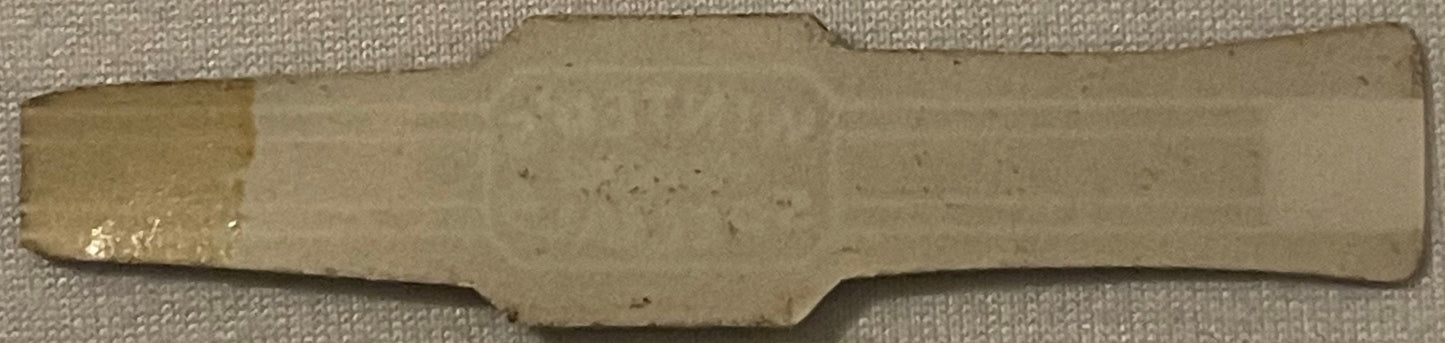
Let's be specific, because specificity is what separates a collector from a casual browser. This is an original antique cigar band from the Winter's Havana Specials brand — a genuine tobacciana artifact from the Golden Age of American cigar manufacturing. The band measures 2¾ inches by ¾ inches, formed in the classic elongated cigar-band silhouette that collectors immediately recognize: wider and gently flared at one end, tapering toward the other, with that characteristic waist-cinch in the center profile that gives the form its elegant, almost corseted figure. It is not a blob of printing. It is a considered shape — a designed object from an era that took small things seriously.

The face is printed in deep black with crisp white linework — a bold, high-contrast palette that reads as confidently today as it did when it came off the press. Three parallel white rules run the full length of the band on either side of a central cartouche, and inside that cartouche the brand hierarchy is laid out with the kind of typographic authority that only letterpress printing can deliver: WINTER'S in strong block letters at the top, Havana in flowing script beneath — that one word doing enormous commercial work, promising Cuban leaf, premium quality, and cosmopolitan taste all at once — and SPECIALS completing the trio below in matching bold type. Clean. Authoritative. A miniature billboard that understood exactly what it was selling and to whom.

This piece is what collectors call NOS — New Old Stock — meaning it was never placed on a cigar and put into use. It survived in unissued condition, which is precisely why the printing remains this sharp and the paper this sound. Finding a cigar band from this period in used condition is already a small triumph. Finding one in this state of preservation is something else entirely.


🏭 The Industry Behind the Band — 80,000 Makers and a War Fought in Printed Paper

To understand why this little strip of paper matters, you have to understand the world that made it. At the peak of the American cigar industry — that window between the end of Reconstruction and the opening rumbles of the First World War — the United States was home to as many as 80,000 individual cigar manufacturers. Eighty thousand. From grand factory operations in Tampa, Florida and Newark, New Jersey to one-room rolling shops in Pennsylvania Dutch country and storefront operations in New York and Chicago, cigars were being made everywhere, by everyone, for a market that consumed them by the billions annually.

Competition on this scale demanded differentiation, and differentiation, in the days before radio and before the moving picture advertisement had fully taken hold, meant print. The cigar box label. The inner lid lithograph. And — smallest and perhaps most intimate of all — the cigar band. Tobacconists dressed their product the way jewelers dressed their display cases. Every band was a miniature canvas, a tiny handshake between maker and buyer, a promise pressed into paper. The lithographers and letterpress houses that supplied the industry — many of them operating out of Cincinnati, Ohio, which became one of the great centers of American commercial printing during this era — were turning out designs of extraordinary sophistication for what were, technically, disposable items.

That disposability is precisely why survivors are so valued today. Most bands were discarded with the ash. The ones that made it through — collected by children in an era when cigar band collecting was as mainstream a hobby as postage stamps, or stored away in a printer's sample drawer, or tucked into a desk somewhere and simply never used — are now the documentary evidence of an industry that shaped American commerce, American culture, and American daily life for generations.

The black and white aesthetic of the Winter's Havana Specials band places it within a specific and distinguished tradition. While the chromolithographic explosion of the 1880s and 1890s produced dazzling multi-color band designs — eagles, portraits, scenic vignettes, allegorical figures rendered in six or eight colors — there was a parallel current of high-contrast monochrome design that relied entirely on typographic strength and linework elegance. These bands spoke in a different register: less theatrical, more authoritative. They said quality does not need to shout. They were, in their own way, the premium tier — the brands that trusted their reputation more than their decoration.


🌿 Havana — The Word That Moved Mountains (and Markets)

The word Havana on a cigar band was never merely geographic. It was aspirational shorthand, a quality signal, a promise made in script. Cuban tobacco — specifically the long-filler leaf grown in the Vuelta Abajo region of western Cuba — had held the pinnacle of international cigar prestige since the eighteenth century, and American manufacturers knew precisely what they were communicating when they worked the word into their branding. Some cigars bearing "Havana" designations in this era were indeed rolled with genuine Cuban leaf, imported through the busy tobacco trade that moved through the port of Tampa and the Key West wharves, where Cuban rollers had established vibrant communities and workshops beginning in earnest in the 1870s.

The designation "Specials" completing the Winter's brand name is equally loaded with period meaning. In the vocabulary of Golden Age tobacciana, "Specials" signaled a top-of-line offering within a manufacturer's portfolio — the cigars a maker put their best leaf into, the ones they led with at trade shows and stocked at the front of the case. It was not a casual word. A "Special" was a statement of intent. Paired with "Havana," it formed a compact but powerful declaration: this is our finest work, made with the finest material. The band, then, was not just packaging. It was a sworn affidavit, pressed in ink.


📜 Local Legend and Collector Lore — The Stories That Travel With These Things

Lore passed down among tobacciana collectors holds that the great period of NOS cigar band discovery — those magical decades when attic cleanouts and estate sales were regularly turning up wrapped packets of unissued bands from defunct manufacturers — peaked in the years between 1940 and 1970, as the businesses and families of the original Golden Age makers finally wound down for the last time. Printing houses that had folded in the 1920s Depression years left behind sample books and stock drawers that sat undisturbed for a generation before someone finally cleared them out. Bands like this one, in this condition, often have that provenance — not from a collector's careful custody, but from a simple, lucky, decades-long nap in a forgotten drawer.

Local legend within the tight-knit world of American tobacciana collectors holds, further, that black and white bands in particular were undervalued for most of the twentieth century precisely because they lacked the chromatic flash of the great lithographic labels. Dealers in the postwar decades reportedly sorted them out of lots as the "plain" ones, selling them for a fraction of what a colored band might fetch. The collector community has long since reversed that judgment — the restraint and graphic confidence of monochrome bands is now recognized as a distinct aesthetic achievement — but those early assessments mean that well-preserved examples like this one sometimes carry a quieter pedigree, having passed through the market without ever attracting the feeding frenzy that a colorful eagle label might have generated.

Among the oral traditions of the collector circuit, there also runs a persistent and charming rumor that children's cigar band albums from the 1890s and early 1900s — those formal, illustrated collecting books that were actually marketed to young hobbyists — occasionally surface at estate sales still filled with their original contents, and that finding a complete or near-complete album is considered one of the signal discoveries of the field. The bands inside, never glued down in the better albums but simply slipped into paper sleeves, emerge in the same NOS condition as this piece: printing intact, paper sound, colors (or in this case, the deep black) undimmed. The hobby that parents encouraged as wholesome and organized turns out, a century later, to have been one of the most effective preservation systems the industry never planned.


🖼️ Display Ideas

  • 🪵 Shadow box framing — mount this band on a deep cream or charcoal linen mat inside a slim walnut shadow box; at 2¾ inches it becomes a jewel-like focal point, especially paired with a period cigar box label or a reproduction Victorian tobacconist advertisement behind it.
  • 📖 Collector's album or journal page — affix with archival corner mounts (never adhesive directly on the piece) alongside other Golden Age cigar bands, tobacco trade cards, or lithographic labels in a dedicated tobacciana album; the black and white palette creates striking contrast against colored companions.
  • 🧳 Curated curiosity display — group this band with other small antique paper ephemera — stock certificates, Victorian calling cards, trade tokens, apothecary labels — in a flat glass-topped display tray or museum-style case for a collector's cabinet effect.
  • 🎨 Framed typography wall art — for the graphic design or printing history enthusiast, this band framed in isolation under UV-protective glass against a stark white mount reads as a masterclass in Victorian commercial lettering; the interplay of block type, flowing script, and ruled borders is genuinely beautiful at any size.
  • 🏠 Study or home bar vignette — displayed in a small standing clip-frame or easel mount on a bookshelf, side table, or home bar surface alongside other vintage tobacco, whiskey, or Americana objects, this piece anchors a vignette with authentic period character that no reproduction can replicate.
  • 🎁 Presented as a gift with context — enclosed in an archival glassine sleeve inside a small gift box with a printed card describing the Golden Age of American tobacco and the story of cigar band collecting; this becomes one of the most thoughtful and genuinely unusual gifts a collector or history lover could receive.

🎁 Who Collects These — and Why They Can't Stop

Tobacciana collectors are among the most dedicated and knowledgeable in the American antiques field — a community that has been quietly, seriously building since at least the 1930s and that maintains active clubs, specialized publications, and a depth of institutional knowledge that rivals any other paper ephemera discipline. For them, a clean NOS cigar band from the Golden Age is a primary document — evidence of a brand, a printer, a regional manufacturer, a typographic moment — and the hunt for examples they haven't yet encountered is genuinely endless, given that 80,000 manufacturers means 80,000 (or more) potential brand names to discover.

Paper ephemera collectors more broadly — those who chase Victorian trade cards, advertising fans, letterpress broadsides, stock certificates, and the full gorgeous universe of nineteenth-century commercial print — find cigar bands irresistible for their combination of design ambition and extreme smallness. The craft required to execute a complete typographic or illustrative composition within a ¾-inch height strip is extraordinary, and collectors of printing history recognize it immediately.

Americana and social history enthusiasts are drawn to pieces like this for what they represent beyond their own surfaces — the daily life of American men and women in the Gilded Age and Progressive Era, the rituals of the tobacconist's shop, the culture of the cigar as status object, social lubricant, and masculine ritual. A cigar band is a portal.

Interior designers and vintage stylists have discovered tobacciana's enormous decorative potential — the graphic language of the Golden Age translates beautifully into contemporary spaces, and authentic pieces carry an authority that printed reproductions simply cannot match. A framed antique band in a study, a bar room, or a collector's cabinet adds instant, genuine depth.

And then there are the gift-givers — people searching for something genuinely rare, genuinely old, genuinely particular for the collector who has everything. This piece, properly presented, is that gift. It arrives with a century of history already attached. No assembly required.


❓ Frequently Asked Questions

How old is this cigar band, and how is that date range determined?

The Winter's Havana Specials band dates to the period approximately 1878 through 1915 — the recognized Golden Age of American cigar manufacturing and cigar paper art. This date range is established through a combination of factors that tobacciana researchers and paper ephemera experts use to bracket these pieces: the style and execution of the letterpress printing, the specific typographic conventions visible in the band's design (the particular pairing of bold block lettering with flowing script was a signature of late nineteenth and very early twentieth century commercial printing), the paper stock and its aging characteristics, and the historical context of the brand name itself. No single cigar band of this era carries a printed manufacture date — that simply wasn't done — so honest attribution always expresses a range rather than a single year. Within that range, this band is a genuine antique by any standard definition.

What does "NOS" mean, and why does it matter for condition?

NOS stands for New Old Stock — a term used across antiques and collectibles to describe items that were manufactured during a period but never actually put into use or circulation. For a cigar band, NOS means this band was printed, stored, and never applied to a cigar. It never experienced the handling, the humidity, the oils from fingers, or the mechanical stress of being wrapped around a cigar and later removed (or discarded with it). The practical result of NOS status is exactly what you see here: printing that remains crisp and deep, paper that has retained its integrity, and edges that have not suffered the tearing or fraying that used bands almost inevitably show. NOS tobacciana from the Golden Age is significantly rarer than used examples precisely because the entire designed purpose of a cigar band was to be used — the ones that weren't are survivors by accident, and that accident is what makes them so desirable to serious collectors.

Is the black and white design less desirable than colored cigar bands from the same era?

This is a question the collector community has effectively answered over the past few decades, and the answer is a clear no — though the history of how that answer evolved is itself interesting. During the mid-twentieth century, when the chromolithographic explosion of the 1880s–1910s was still the primary lens through which collectors viewed Golden Age cigar art, multi-color bands with pictorial designs commanded the most immediate attention at shows and in dealer lots. Black and white bands were sometimes undervalued in that context simply because they lacked obvious visual flash. The mature collector's view, now broadly shared, is that monochrome typographic bands represent a distinct and sophisticated design tradition — one that demanded more of its letterpress execution and relied entirely on composition, proportion, and the quality of the printing rather than color to make its impression. The Winter's Havana Specials band, with its confident cartouche, its three-level typographic hierarchy, and its ruled border system, is an excellent example of this tradition at its most assured.

How should I store or handle this band to preserve it?

Antique paper ephemera of this age responds well to a few simple, consistent practices. Handle the band as little as possible with bare hands — the oils and acids on skin are paper's quiet enemy over long time spans. When you do handle it, cotton gloves or clean nitrile gloves are ideal. For storage, an archival-quality polyester sleeve or acid-free paper envelope is the correct environment — these materials are pH neutral and will not off-gas acids onto the paper the way standard plastic sleeves or manila envelopes can over decades. Keep the stored piece away from direct light (both UV and visible light cause fading in antique printing inks over time), away from humidity extremes, and away from heat sources. If you choose to display it framed, UV-filtering glass or acrylic is worth the investment for a piece this age. These are not complicated requirements — they are simply the same conditions that kept this band pristine for a century already, replicated intentionally.

Was cigar band collecting actually a popular hobby in the original era?

Genuinely and enthusiastically yes — and this is one of the more charming historical footnotes attached to pieces like this one. Cigar band collecting was a mainstream American hobby from roughly the 1880s through the early decades of the twentieth century, enjoyed particularly by children and young people who would ask fathers, uncles, and family friends to save their bands. Dedicated collector's albums were commercially printed and sold — structured books with illustrated pages and sleeves designed specifically to receive bands in organized arrangements. Tobacco companies, aware of this secondary collecting culture, sometimes deliberately varied their band designs to encourage accumulation and brand loyalty. The hobby existed in the same cultural space as stamp collecting and trade card collecting, all three of which peaked in roughly the same era and for similar reasons: the explosion of industrial printing had made beautiful small paper objects ubiquitous, and the collecting impulse — human and ancient — immediately found them. The collector community that exists today is, in a very real sense, the direct heir of those Victorian-era children's albums.

Can this band be authenticated or appraised by a specialist?

Yes, and for serious collectors building documented collections, professional assessment is always worthwhile. The primary resources for tobacciana authentication and appraisal in North America include the International Seal, Label and Cigar Band Society (ISCLBS), which has maintained the specialized knowledge base of this field for decades and whose members include the most experienced eyes in the discipline. Paper ephemera dealers and auction specialists who focus on American printed advertising materials from the nineteenth and early twentieth centuries are also a valuable resource — they handle enough volume of period material to speak to condition, rarity, and market context with real authority. For a piece in this condition and from this period, formal appraisal is a straightforward process for any specialist who has worked with Golden Age tobacciana. The characteristics that place a band in this era — paper, printing method, typographic style, aging patterns — are well understood by experienced practitioners.

What makes the "Havana Specials" designation significant from a historical standpoint?

Both words in that designation were doing serious commercial work in the Golden Age marketplace. "Havana" was the most powerful single word in American cigar marketing for most of the nineteenth century and into the early twentieth — it signaled Cuban leaf, which held the unquestioned global prestige position in tobacco quality.

Whether a given cigar actually contained Cuban-grown tobacco or was made with domestic leaf blended or styled to approach Cuban characteristics varied by manufacturer and by the particular economic and trade conditions of any given year, but the word itself was an immediate quality signal to any consumer who bought premium cigars. "Specials" was the companion signal within a brand's own hierarchy — the word used to designate the top tier of a manufacturer's output, the cigars that represented their best available work.

Together, "Havana Specials" formed a two-word statement of intent: finest leaf, finest construction, premium tier. For a collector reading this band today, those two words are also a reminder of how much weight American commercial language once placed on individual words — how much meaning a printer could pack into a ¾-inch strip of paper when the stakes of standing out in a market of 80,000 competitors were real, immediate, and unforgiving.

Shipping

🚚 Shipping & Handling

  • Shipping costs and timing are calculated at checkout.
  • Items curated and shipped directly by me include U.S. shipping at no additional cost, professionally packed to ensure safe arrival of your artifact.

Items from Vetted Pro Collectors
Shipping for items offered by vetted Pro Collectors is determined at checkout. All Pro Collector listings are reviewed to ensure fair, reasonable shipping practices.

For full details, please refer to our Shipping Policy.

Returns & Exchange

Take your time — you've got a full six months. If a piece isn't right for you, send it back the way it reached you and we're good.

In the first 30 days your money goes straight back the way you paid. After that it's store credit, so you can put it toward something you'd rather have.

Return shipping we sort out between us, case by case. I don't make this difficult.

If something arrives damaged, or it isn't what I said it was, send me a photo within 48 hours and I'll make it right.

Email info@vintageantiquesgifts.com or call 802-356-9872 — that's me answering, not a call center.

The only things I can't take back are custom or special-order pieces and gift cards.

View full details