
Skip to product information
1 of 5

Vintage and Antique Gifts

Emil Flohri Chinese Children Antique Color Print c. 1910s-20s Chinatown Festival Street Scene Signed Wall Art Decor ๐Ÿ–ผ๏ธ

Emil Flohri Chinese Children Antique Color Print c. 1910s-20s Chinatown Festival Street Scene Signed Wall Art Decor ๐Ÿ–ผ๏ธ

Regular price 22.00 USD
Regular price Sale price 22.00 USD
Sale Sold out
Shipping calculated at checkout.
Quantity

Size: 16 x 12 inches

๐Ÿฎ Two Children, One Festival Morning, Signed FLOHRI

Every so often a picture crosses our table that is quietly, effortlessly captivating โ€” the kind you keep glancing back at while you work. This is one of them: a warm, richly colored American art print of two children dressed for a festival, standing together on a sunlit Chinatown street. And down in the lower right, worked directly into the artwork, is a name that turns a charming decorator print into a collectible with a real pedigree: FLOHRI. This is the work of Emil Flohri, and once you know his story, you will never look at this little scene the same way again.

At Vintage and Antique Gifts, the pieces we love most are the ones carrying a name, a maker, a moment โ€” something a modern reproduction can never counterfeit. This print has all three. It is genuine early-twentieth-century American publisher's art, a color lithograph from the golden age of the illustrated print, and it is signed in the plate by one of the more fascinating illustrators of his generation.

๐ŸŽจ Who Was Emil Flohri?

Emil Flohri (1869โ€“1938) was an American illustrator with one of the great two-act careers in the business. In his first act he was a busy magazine artist, best known for the bold color chromolithograph work he produced for Judge, the popular illustrated humor and satire weekly of the era. His images reached households across the country in the years when a good color print was how ordinary people brought art into the parlor. Then came the second act. Flohri went west and into the movies, where he spent his later years painting backgrounds for Hollywood animation โ€” including work in the Walt Disney studio. From the pages of a national magazine to the painted worlds behind the earliest animated films: that is the arc of the hand that signed this print.

Because of that story, the FLOHRI signature is more than a flourish. It is the searchable, collectible thread that ties this cheerful street scene to a documented American artist โ€” the reason a print like this deserves to be identified by name rather than filed away as an anonymous "old picture."

๐Ÿ–Œ๏ธ Walking Into the Scene

Let the picture pull you in, because Flohri packed it with life. Two children stand in the foreground on pale, sun-warmed paving stones. The taller of the two, on the right, wears a magnificent golden-yellow festival costume โ€” a tunic and trousers trimmed in bands of blue and gold, a circular medallion worked across the chest, wide flowing sleeves, and embroidered slippers. On the head sits an ornate beaded headdress, and behind it, opened like a great sunburst, a golden paper parasol fans out its slender ribs to frame the child's face like a halo. Beside this small dignitary stands a younger companion in a soft teal-blue jacket with gold brocade cuffs and hem, dark trousers, and a little blue cap banded in gold, one hand holding a small posy of yellow blossoms.

Behind the pair, the artist has built a whole living street. There are shopfronts hung with signboards and lettering, a round paper lantern glowing at the upper left, a flowering plum branch reaching up from a vessel, glazed ceramic jars, a basket of pale narcissus, and wooden display tables โ€” the busy, welcoming clutter of a Chinatown block dressed for celebration. The palette is all warm gold, teal, terracotta, and soft gray, lit as if by a bright, gentle morning. It reads instantly as a New Year or festival scene, and it carries all the affectionate, storybook charm of the best turn-of-the-century illustration.

๐Ÿ‡บ๐Ÿ‡ธ An American Print of a Chinatown Scene

Here is an important point of honesty, and one we want to be clear about: this is an American-made decorator and calendar-style art print that depicts a Chinese festival scene. It is not an antique object from China, and we would never present it as one. It belongs to a proud American tradition โ€” the popular color publisher's print that hung in parlors, decorated calendars, and brightened ordinary walls in the early twentieth century. The subject is a lovingly rendered Chinatown street; the artwork, the artist, and the printing are American through and through. Down in the lower right, alongside the FLOHRI signature, the plate also carries a small publisher's copyright line reading "ยฉ L A PUB. CO," trimmed close at the paper's edge โ€” the maker's mark of the publishing house that issued it.

The print carries no printed title of its own, so the name it goes by โ€” a print of two Chinese children โ€” is simply descriptive of what Flohri painted, a convenient handle rather than a caption the artist gave it.

๐Ÿ“œ Age, Honesty, and Condition

Our best reading places this print in the 1910s into the 1920s โ€” the heart of the era when publisher's color prints like this were in their prime, and consistent with the roughly 16-by-12-inch format Flohri prints of this kind are known in. We offer that as our considered window rather than a stamped date.

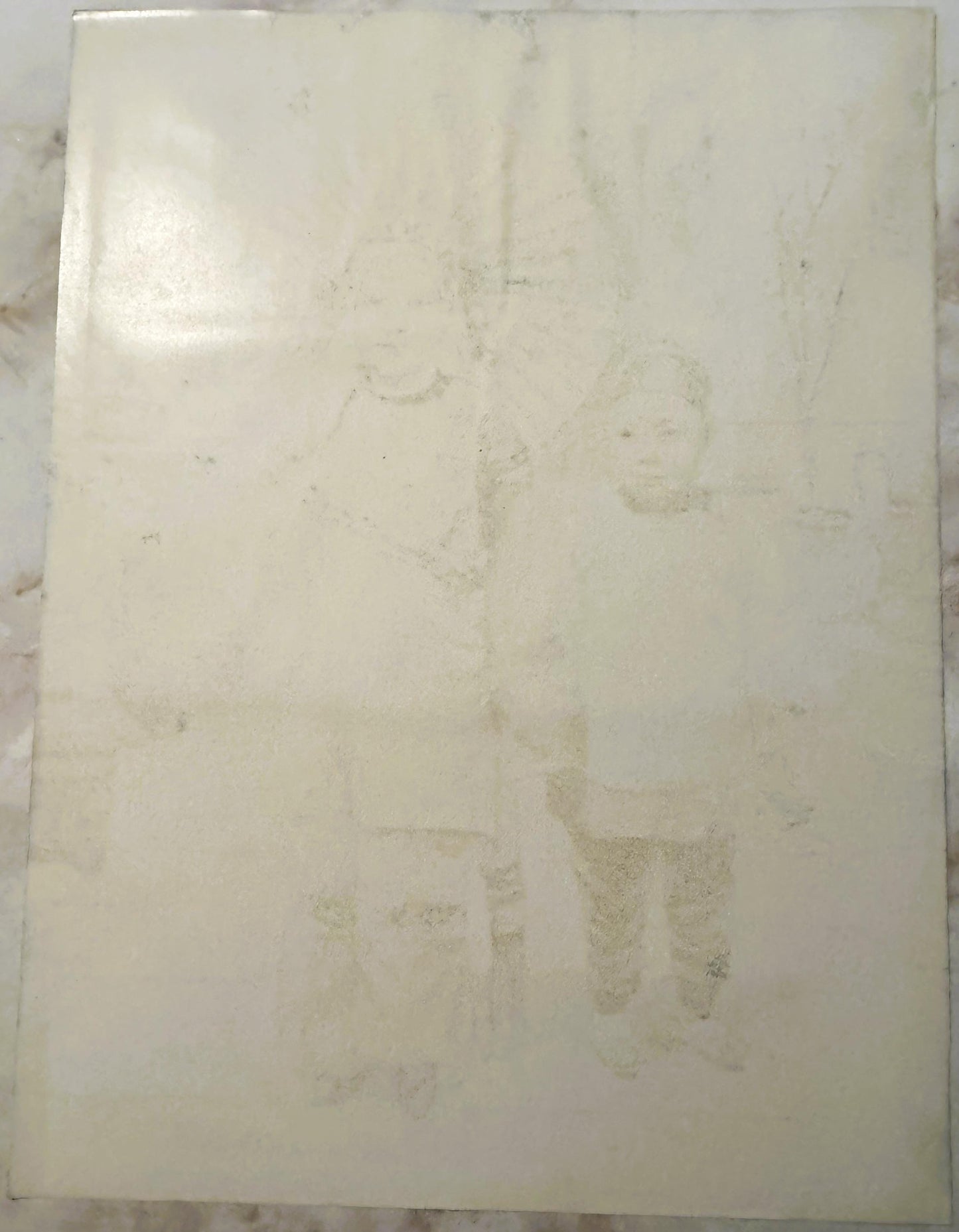
Now the plain truth about its state, because you deserve to know exactly what you are buying. The colors are strong and the image is bright and complete. The paper has mellowed to a warm cream, and along the left and right margins there is a scatter of small tan age-spots โ€” the natural, expected character of hundred-year-old paper stock, and confined to the margins around the printed scene. The sheet is a thin publisher's stock, so on the blank reverse the printed picture reads through faintly, a soft mirror impression of the front. There is no printing on the back. None of this touches the strength or charm of the image; it is simply the honest fingerprint of a print that has genuinely lived through a century.

๐ŸŽ The Age of the Parlor Print

To understand why a picture like this exists, it helps to remember what a color print meant a hundred years ago. Before every home had a camera, a magazine on every table, and a screen in every pocket, a beautifully printed color picture was a genuine luxury and a genuine pleasure. Publishing houses issued them by the thousands โ€” as standalone parlor prints, as calendar art, as premiums and decorations โ€” and families framed them, pinned them, and treasured them. They were, quite literally, how ordinary people lived with art. An artist like Emil Flohri, trained in the demanding discipline of magazine chromolithography, brought real craft to that popular form: careful drawing, a rich and considered palette, and a storyteller's eye for a scene worth lingering over. This print is a survivor of that vanished everyday world, and part of its charm is imagining the parlor wall it may first have brightened.

The subject โ€” children dressed for a New Year or festival day โ€” sits squarely in a tradition the period loved: tender, closely observed images of childhood, rendered with warmth rather than sentimentality. Flohri gives his two small subjects real presence. They meet your eye. They are dressed in their finest and are plainly proud of it. That directness is a large part of why the image still works its quiet magic on anyone who passes it.

๐Ÿ”Ž The Details That Reward a Second Look

Spend a moment with the smaller passages and the picture keeps giving. Notice the way the parasol's slender ribs fan into a golden halo behind the taller child's head, turning a simple prop into a small piece of theater. Notice the gold brocade at the younger child's cuffs and hem, painted with just enough shimmer to read as embroidered silk. Notice the plum branch and the basket of narcissus tucked into the background โ€” both traditional flowers of spring and the New Year, quietly reinforcing the festival theme. Notice the signboards and lanterns that give the street its depth and bustle, and the soft morning light that lays gentle shadows across the paving stones. This is the work of an illustrator who knew that the background is where a picture earns its warmth, and he did not stint on it.

๐Ÿ–ผ๏ธ How to Live With It

This is a print made to be enjoyed on a wall. Matted and framed โ€” a warm cream mat would flatter the golden palette beautifully โ€” it becomes an instant conversation piece: bright, human, and full of story. It suits a gallery wall of vintage illustration, a collection of early-twentieth-century American prints, a room that leans into color and warmth, or the shelf of anyone who collects Emil Flohri, animation history, or the popular art of the illustrated age. It also makes a thoughtful, unusual gift for a lover of vintage art, Chinatown history, or beautifully drawn children.

Most of all, it is exactly the kind of object we exist to rescue and pass along: a genuine, signed, hundred-year-old American art print with a documented artist behind it, saved from the anonymous bin and returned to someone who will hang it, learn its story, and love it. If that is you, welcome โ€” this is a lovely one to own.

Shipping

๐Ÿšš Shipping & Handling

  • Shipping costs and timing are calculated at checkout.
  • Items curated and shipped directly by me include U.S. shipping at no additional cost, professionally packed to ensure safe arrival of your artifact.

Items from Vetted Pro Collectors
Shipping for items offered by vetted Pro Collectors is determined at checkout. All Pro Collector listings are reviewed to ensure fair, reasonable shipping practices.

For full details, please refer to our Shipping Policy.

Returns & Exchange

Take your time โ€” you've got a full six months. If a piece isn't right for you, send it back the way it reached you and we're good.

In the first 30 days your money goes straight back the way you paid. After that it's store credit, so you can put it toward something you'd rather have.

Return shipping we sort out between us, case by case. I don't make this difficult.

If something arrives damaged, or it isn't what I said it was, send me a photo within 48 hours and I'll make it right.

Email info@vintageantiquesgifts.com or call 802-356-9872 โ€” that's me answering, not a call center.

The only things I can't take back are custom or special-order pieces and gift cards.

View full details