Skip to product information
1 of 7

Vintage and Antique Gifts

Antique JBL Toilet Articles Box 🧴 Dr. J.B. Lynas & Son Logansport Indiana Advertising Carton

Antique JBL Toilet Articles Box 🧴 Dr. J.B. Lynas & Son Logansport Indiana Advertising Carton

Regular price 7.00 USD
Regular price Sale price 7.00 USD
Sale Sold out
Shipping calculated at checkout.
Quantity

What Was Sitting on a Logansport Vanity a Century Ago? 🧴

Long before "beauty routine" was a hashtag, it was a small green-and-cream box tucked into a lady's dresser drawer in Cass County, Indiana — a box just like this one. Pick it up and you're holding a genuine piece of small-town American commerce: a toilet articles carton from Dr. J.B. Lynas & Son of Logansport, Indiana, printed in that unmistakable trio of dark forest green, warm cream, and deep navy blue that the company wrapped around nearly everything it sold. There's something quietly moving about a box this modest — no grand claims, just "Quality First" printed plainly beneath a rose-crowned Art Nouveau maiden — that has outlasted the soaps, salves, and perfumes it once held by a full century.


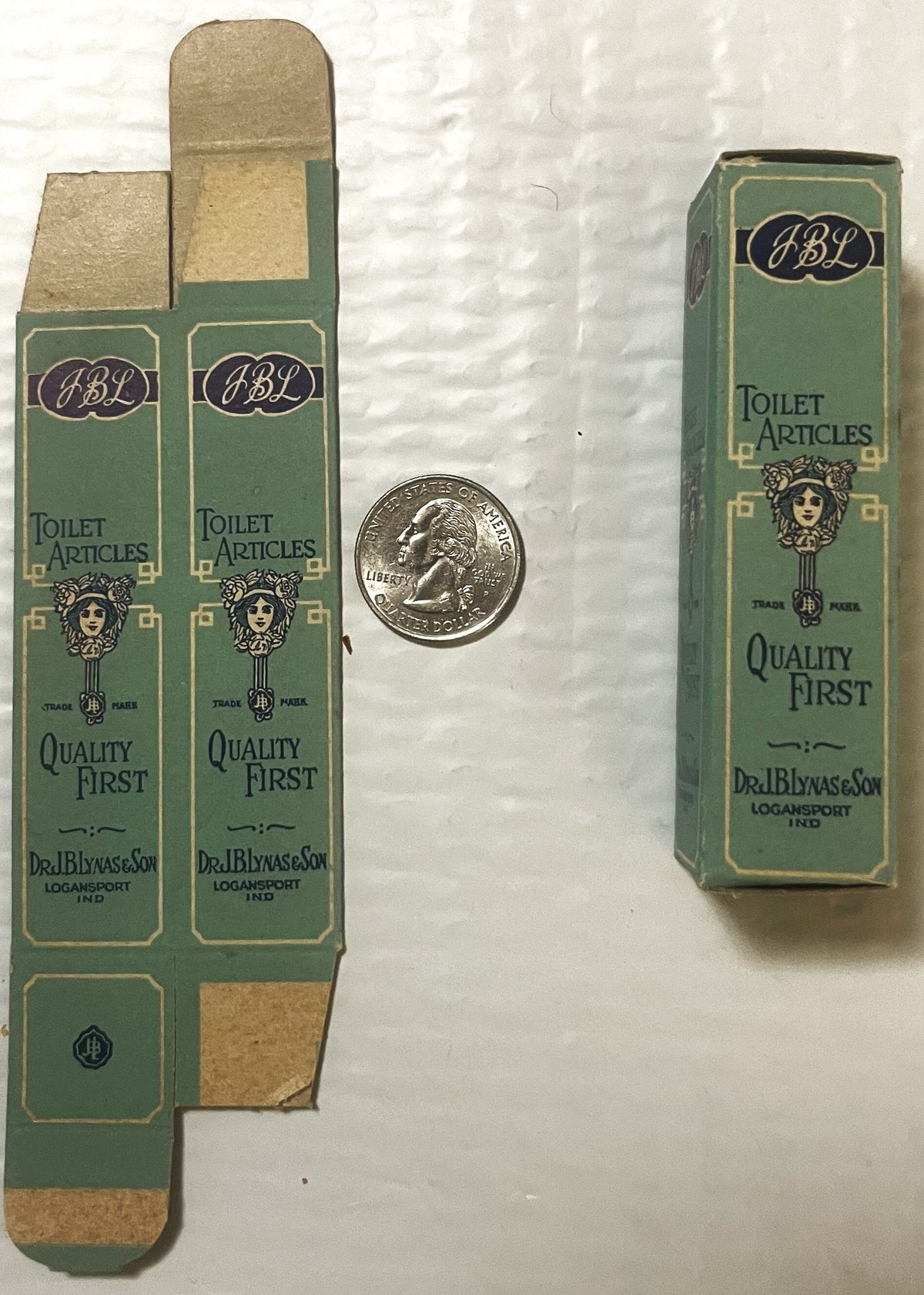
This is a New Old Stock (NOS) "JBL Toilet Articles" carton manufactured by Dr. J. B. Lynas & Son, the family-run remedies-and-toiletries house of Logansport, Indiana, dating stylistically to the 1910s–1920s. The design work is lithographed straight onto uncoated paperboard, and it's a lovely little study in early-20th-century commercial art: an oval navy band cradles the flowing script "JBL" monogram, a double-rule cream border with squared corner keys frames the panel beneath it, and at the center of that panel stands the brand's signature trademark — an Art Nouveau woman's head, hair swept up and crowned in roses, rendered in confident black linework against the sage-green ground.

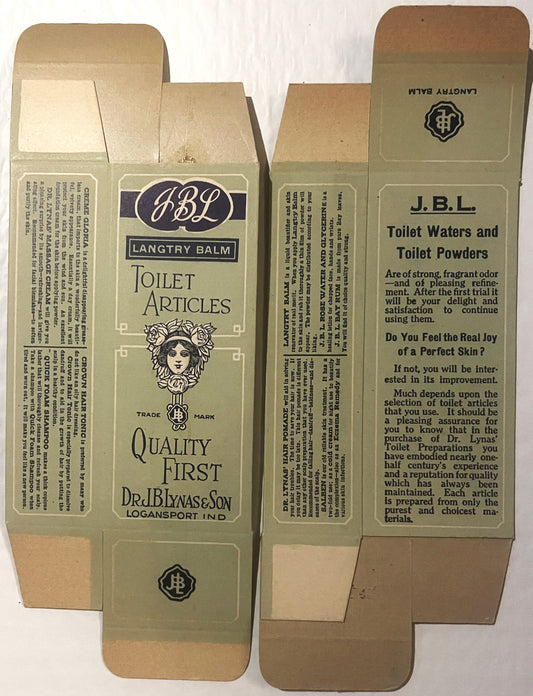
Below her, the text runs in tidy period lettering: TOILET ARTICLES / TRADE MARK / QUALITY FIRST / Dr. J.B. Lynas & Son / LOGANSPORT IND / B No. 5. The lid carries its own small flourish — a dark navy emblem stamped like a wax seal, set inside the same cream double-rule border, the "JBL" monogram compressed into the center.

Measured flat and unfolded, as this carton is shown, it runs 2 inches by 7 inches — a slim, elongated die-cut blank that folds down into its small upright box form, the shape built for a single toiletry item rather than a large parcel. Examples here include both the flattened, unassembled carton blanks and a fully folded box with its lid detail visible, giving a rare side-by-side look at how the same lithographed sheet became a finished retail package.


🏭 The Company Behind the Monogram

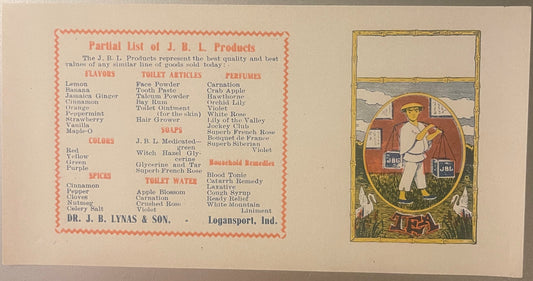
The "JBL" on this box stands for a real man with a real Hoosier story: Dr. James B. Lynas, born February 14, 1835, in Dearborn County, Indiana. He began studying medicine at just seventeen, and by 1861 he'd made his way to Logansport, where he set up practice. It was there, in 1866, that the doctor started doing something that would quietly outlive his medical career — mixing up "family remedies" in small batches to sell alongside his practice. The names alone are worth preserving: Catarrh Remedy, Hoosier Cough Syrup, Ready Relief, Rheumatic Liniment, White Mountain Salve, Egyptian Salve, and Liver Pills. They caught on fast. Within a few years, Dr. Lynas's home-brewed remedies were pulling in roughly $10,000 a year — a striking sum for a side business run out of a doctor's office in a small Indiana river town.

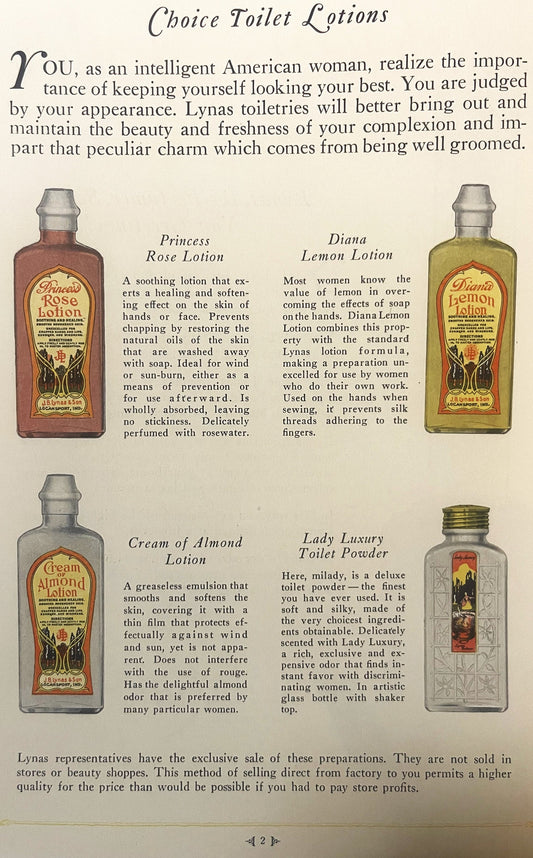
From there the line only grew. Dr. Lynas added flavoring extracts — vanilla, cherry, lemon, the pantry staples every household kitchen needed — and then, sensing where the real growth was, expanded into soaps, lotions, and perfumes made specifically for women. That pivot toward "toilet articles" is exactly what this box represents: the moment a small-batch home-remedy man became a full-fledged beauty and toiletries manufacturer.

When Dr. Lynas died in 1901, his son George H. Lynas stepped in and took the reins, and by 1904 the business was formally incorporated under the name that would appear on packaging for decades to come: Dr. J. B. Lynas & Son. The company kept expanding its "toilet article" catalog through this period — soaps like Witch Hazel Glycerine Soap and the well-remembered Queen Beauty Toilet Soap, San Remo Toilet Water, Crown Hair Tonic, Langtry Balm, and De La Claire's American Beauty Face Powder all carried the JBL name into homes across the region and, through the company's traveling sales force, well beyond Indiana's borders.

Growth called for a real headquarters. In December of 1906, the local Logansport paper reported that the company had awarded a contract for a modern four-story business block, to be built on East Market Street — brick and stone, four floors facing Erie Avenue and three facing Market Street, built to house the entire operation under one roof. By 1913, at the height of the company's reach, reports place somewhere between 1,400 and 1,500 people connected to the firm — a number that almost certainly reflects not just the Logansport factory floor but a nationwide army of door-to-door representatives, in the same mold as the traveling salesmen of Rawleigh, Watkins, and Jewel, carrying JBL soaps, tonics, and toilet articles from farmhouse to farmhouse long before mail-order catalogs and drugstore chains took that business over.

The company's story, like so many great small-town manufacturers, eventually wound down gently rather than collapsing. George H. Lynas passed away in December of 1926, and by 1938 his brother Will had sold the family business. Dr. J. B. Lynas & Son was finally dissolved as a company in 1965 — nearly a century after the founder first started mixing cough syrup behind his medical practice.


🏙️ Logansport, Indiana — the Town That Built It

Logansport sits at the confluence of the Wabash and Eel Rivers in Cass County, Indiana, a classic 19th-century river town that grew into a regional manufacturing and rail hub. It's the kind of place where a company like Lynas didn't just employ people — it became part of the skyline. The four-story Lynas building on East Market Street, built in 1906–1913, still stands as one of the visible reminders of that era, and local history keeps alive a detail worth passing on: giant "JBL" letters were mounted along the top of the building, visible for blocks, a genuine landmark for a generation of Logansport residents who grew up under that sign the way another town might grow up under a courthouse clock. Old-timers in the area have long pointed to that rooftop signage as one of downtown Logansport's defining features from the early 1900s onward.

The Cass County Historical Society, founded in 1907, has long served as the keeper of this local memory — the Lynas story, the building, the family, and the products are woven into the kind of county-level history that survives mostly through local societies like this one rather than national archives. It's a reminder that a box like this one isn't just a piece of advertising ephemera; it's a fragment of a specific American Main Street, printed and folded in a factory that once loomed over that town's daily life.


👨‍👩‍👧 The Lynas Family, in Their Own Building

There's a warmth to how thoroughly this remained a family concern. James built it from his own medical practice; George ran it after him and simultaneously served as president of the Kiddie Knead bread company nearby on Erie Avenue; Will sold it decades later when the family's run finally came to its natural end. Local history even preserves a small, human detail about the Market Street building itself: tucked away on its third floor was a little in-house apron-making operation, run by an experienced seamstress and equipped with its own recreation room for the women who worked there — a quiet aside that speaks to the kind of paternalistic, all-under-one-roof manufacturing culture common to companies of this size and era. It's easy to imagine the same building holding vats of perfume and soap on one floor and rows of sewing machines turning out aprons on another, all under that same rooftop JBL sign.


💄 "Toilet Articles" — What the Box Actually Held

The phrase "toilet articles" sounds almost quaint today, but in the 1910s and 1920s it was simply the polite catch-all term for the small daily rituals of personal care — soaps, powders, waters, balms, tonics — the exact category this box was built to house and to sell. The rose-crowned woman's head stamped across the front panel is a textbook piece of Art Nouveau commercial trademark art: flowing hair, floral crown, soft confident features, the visual shorthand every turn-of-the-century beauty brand reached for to promise elegance and refinement in a mass-produced package. Beneath her, the words "Quality First" served as the company's plain, no-nonsense promise to the customer — the same straightforward pitch you'll find echoed across the firm's other product lines, from hair tonic to face powder.

The small "B No. 5" printed at the base of the panel almost certainly marks this carton as one specific item within a larger, systematically numbered product line — the kind of internal cataloging a company running dozens of soaps, waters, and salves under one shared box design would need to keep its inventory straight. It's a small detail, but it's a genuine window into just how organized and expansive the Lynas toiletries catalog had become by this point.


🕰️ Why This Little Box Still Matters

Household advertising cartons like this one were built to be used once and thrown away — which is exactly why so few survive in this kind of unused, folded-flat condition. The fact that the Smithsonian's National Museum of American History holds a Dr. J.B. Lynas & Son "Queen Beauty" toilet soap in its own collection tells you something important: this wasn't a fringe regional operation, it was significant enough in the story of American toiletries manufacturing to earn a place in a national institution's holdings. A surviving box like this one — never filled, never shelved in a drugstore, never thrown out — is a small act of accidental preservation, letting a piece of early Hoosier commercial art sit on a modern shelf exactly as crisp and complete as the day it left the Market Street factory.


🖼️ Display Ideas

  • 💚 Set it upright on an open bathroom shelf beside your everyday soaps and lotions for a bit of century-old color
  • 🪞 Prop it on a vintage vanity tray next to a hand mirror or perfume atomizer for an authentic period beauty-counter look
  • 📚 Line it up with other Indiana advertising ephemera in a curio cabinet as a piece of genuine Cass County history
  • 🖋️ Frame the flattened, unfolded carton flat under glass to show off the full lithographed artwork in one uninterrupted panel
  • 🎁 Give it to a Logansport native or Hoosier-history collector as a piece of hometown pride they won't find anywhere else
  • 📷 Use it as a styling prop in vintage-inspired photography, tucked among old bottles and brushes

🎁 Who Collects These

This little box sits at the crossroads of several serious collecting worlds. Indiana and Cass County local-history collectors chase down Lynas material specifically because it's tied to a real, documented Logansport landmark. Antique advertising and drugstore-ephemera collectors prize early "toilet articles" packaging for its graphic design as much as its history. Art Nouveau enthusiasts are drawn to the rose-crowned trademark maiden as a lovely, small-scale example of the era's commercial illustration style. And genealogy researchers with Lynas or Logansport roots often seek out surviving company material as tangible connections to family and town history alike.


❓ FAQ

What did a JBL "Toilet Articles" box actually hold?

Dr. J. B. Lynas & Son manufactured a wide range of soaps, face powders, toilet waters, balms, and hair tonics under this shared box design, with a small printed code — here, "B No. 5" — identifying the specific item within their larger toiletries catalog.

How old is this box?

Its Art Nouveau trademark artwork, flowing script logo, and ornate corner-key border are all consistent with toiletry packaging of the 1910s–1920s, and the "& Son" wording in the company name confirms it dates to after the firm's 1904 incorporation.

Who was Dr. J.B. Lynas?

James B. Lynas was a practicing Indiana physician who began selling his own family remedies in Logansport in 1866; the business grew into a full toiletries and remedies manufacturer under his son George's leadership after 1901.

Is this the same "JBL" as the speaker company?

No — this JBL predates and has no connection to the modern audio brand founded decades later; it refers exclusively to Dr. J. B. Lynas & Son of Logansport, Indiana.

Is the box assembled or flat?

This listing includes both styles shown — flattened, unassembled carton blanks as they came off the press, as well as a fully folded box form with its lid detail visible, giving a full picture of the packaging from printed sheet to finished box.

What does the rose-crowned woman on the box represent?

She's the company's registered trademark figure, a classic Art Nouveau beauty motif used across the Lynas toiletries line to signal elegance and quality to the era's shoppers.

What condition is this box in?

It's offered as New Old Stock — genuine unused period packaging that never left the factory's inventory for retail use.

Shipping

🚚 Shipping & Handling

  • Shipping costs and timing are calculated at checkout.
  • Items curated and shipped directly by me include U.S. shipping at no additional cost, professionally packed to ensure safe arrival of your artifact.

Items from Vetted Pro Collectors
Shipping for items offered by vetted Pro Collectors is determined at checkout. All Pro Collector listings are reviewed to ensure fair, reasonable shipping practices.

For full details, please refer to our Shipping Policy.

Returns & Exchange

Take your time — you've got a full six months. If a piece isn't right for you, send it back the way it reached you and we're good.

In the first 30 days your money goes straight back the way you paid. After that it's store credit, so you can put it toward something you'd rather have.

Return shipping we sort out between us, case by case. I don't make this difficult.

If something arrives damaged, or it isn't what I said it was, send me a photo within 48 hours and I'll make it right.

Email info@vintageantiquesgifts.com or call 802-356-9872 — that's me answering, not a call center.

The only things I can't take back are custom or special-order pieces and gift cards.

View full details
  • 5 stars: 1 (100%)
  • 4 stars: 0 (0%)
  • 3 stars: 0 (0%)
  • 2 stars: 0 (0%)
  • 1 star: 0 (0%)
n
norgal10

Five-star review