Skip to product information
1 of 3

Vintage and Antique Gifts

Antique 1930s Flor De Manuel Babies 👶 Gold Embossed Cigar Label

Antique 1930s Flor De Manuel Babies 👶 Gold Embossed Cigar Label

Regular price $5.50 USD
Regular price Sale price $5.50 USD
Sale Sold out
Shipping calculated at checkout.

Size: 8 1/2" x 6 1/2"

🚚 Free US Shipping — ships within one business day. International shipping calculated at checkout.

Quantity

Who Made Flor de Manuel Cigars? 👶 Antique 1930s Flor de Manuel Babies Gold Embossed Cigar Box Label

Size: 8 1/2" x 6 1/2" ~ Little to no storage wear.

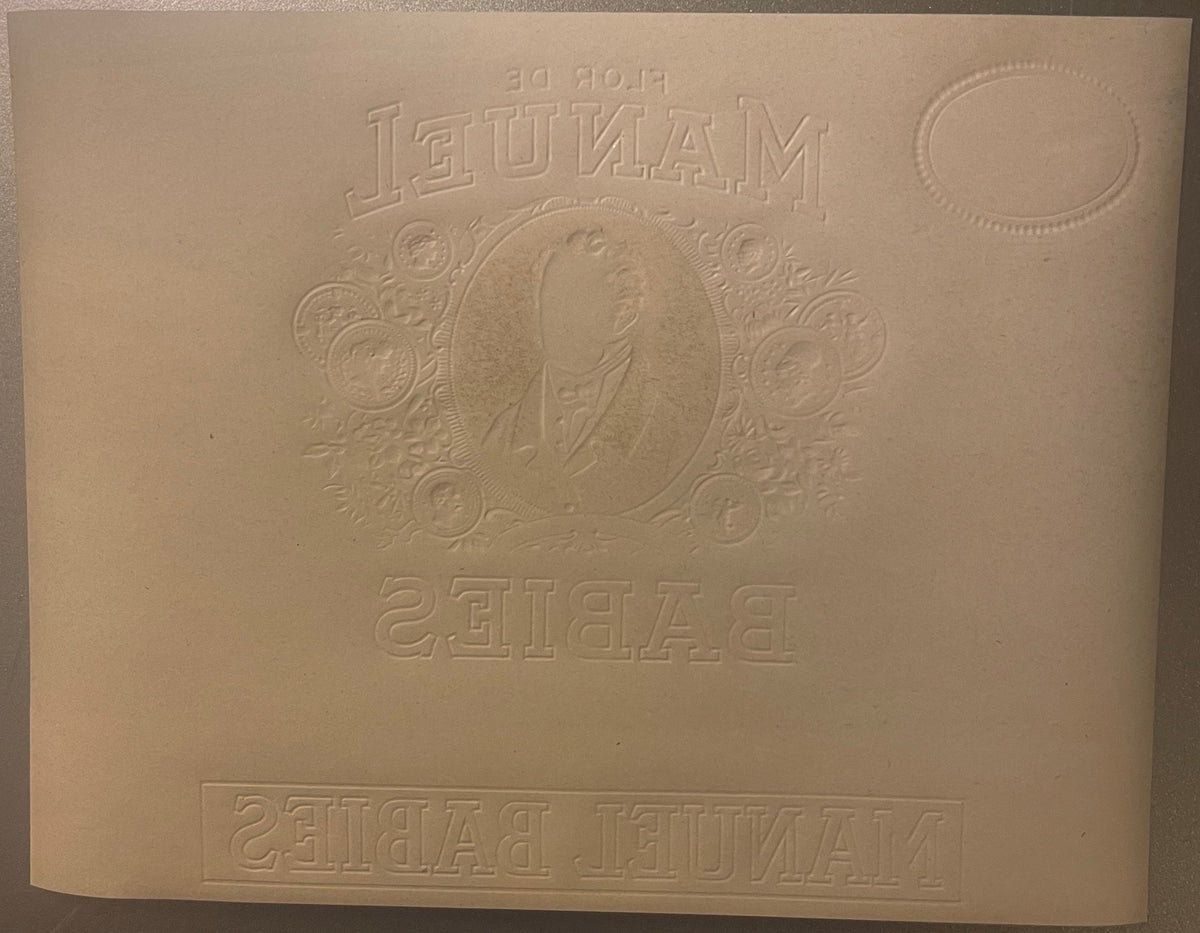
Big, bold and rich with raised gold. A gentleman in a high collar looks out of an oval portrait, with embossed gold coins and flowers all around him. FLOR DE MANUEL arches over the top, a SUPERIORES ribbon runs under the frame, and BABIES crosses the label in large embossed letters. A matching MANUEL BABIES strip runs along the bottom, and a blank gold beaded oval sits up in the corner, left open for a factory number. Turn the label over and the whole design is pressed through the plain back in mirror image. On labels like this the raised areas were highlighted with gold or bronze leaf, and that's where the glow comes from.

The rest of the printing is tiny. REG. IN U.S. PAT. OFF. sits under the ribbon, and the printer's line reads CONSOLIDATED LITHOGRAPHING CORPORATION BROOKLYN N.Y. Both of those turn out to have stories behind them.

🏙️ Who owned the name

That small REG. IN U.S. PAT. OFF. is there because Flor de Manuel was a registered trademark. The Mazer-Cressman Cigar Company of Detroit filed for it on June 19, 1924, and the registration for cigars came through on November 4, 1924, as trademark No. 191,148. Detroit was a serious cigar town. Its cigar industry grew into the second largest in the country, behind only Tampa.

Mazer-Cressman was brand new that year. In February 1924 the Mazer Cigar Manufacturing Company of Detroit merged with Allen R. Cressman's Sons of Philadelphia, and the new company was one of the largest in the business. On October 12, 1924, about 1,500 employees turned out to see the new plant open. Albert Kahn designed it, the same architect who did Ford's River Rouge complex. Manuel, Humo, Dime Bank and Counselor cigars were made there, and in 1930 the company rolled 2.3% of all the cigars made in America.

The Mazers came from Russia and settled in Pittsburgh. Jacob Mazer was one of the top bicycle racers in Pennsylvania, and he took up basketball while the game was still brand new. He served in the Spanish-American War, moved to Detroit afterward, and went into cigars with his brother. The workers have a story too. On February 18, 1937, about 400 women and girls sat down at their benches in the Grandy Street plant and refused to give them up. It was part of a wave of cigar factory sit-downs across Detroit that winter. They went back to work on April 16 with a 3% raise. By that summer a New York firm, E. Rosenwald & Bros., owned the plant.

👶 So what's a "Babies"?

That big word across the middle is the name of a cigar size, and I love that the old tobacco trade papers tell its story. In 1938 the Tobacco Leaf announced "the new Flor de Manuel Babies, manufactured by J. Mazer Sons Cigar Co., Detroit," calling it "the latest product in the five-cent field." So the Mazer family name was still on the Manuel line after the old plant changed hands.

The little cigar caught on. In 1939 a Mazer of J. Mazer Sons told the same paper business was very good and that "Manuel Babies are moving briskly in eastern Pennsylvania," and the U.S. Tobacco Journal listed "Manuel Babies, Counsellor, Dime Bank and Literary Digest, a nickel." By 1948 the trade press was describing "the MANUEL BABIES, a small size Panatela cigar," going out in a Reynolds Metals pack. A nickel cigar with a name like a nursery rhyme. That's marketing.

🏭 The Pennsylvania connection

In 1949 the Babies moved east to J.C. Winter & Co. of Red Lion, Pennsylvania. The U.S. Tobacco Journal reported Winter's sales force "highly enthused over this outstanding acquisition to the line," and by 1950 Winter's brand list read Flor De Manuel Babies, Flor De Manuel New President, Flor De Manuel Diplomat and Flor De Manuel Corona. Tobacco Leaf called it plainly: "Manuel Babies, a J. Winter brand." Other Flor de Manuel Superiores labels print the name of J.C. Winter & Co. right on the sheet, "J.C. WINTER & CO. INC." on either side of a big red MANUEL strip. By the end of the First World War Winter's firm was running as many as 32 cigar factories. The names Manuel and Counselor also show up on the brand list of Van Slyke & Horton, a cigar firm that ended up as the sales company of J.C. Winter & Co.

📻 On the radio

Flor de Manuel was a trendy name in its day, and it was one of the first cigar brands to go on the radio. That was a big change in how products got sold. By 1931 radio was the craze, and Flor de Manuel was one of the cigar brands paying for shows, mostly music and comedy-variety hours. Phillies, White Owl, Robt. Burns, Cremo, La Palina and Dutch Masters were all doing the same.

🖨️ The printer in Brooklyn

Consolidated Lithographing Corporation was the work of Jacob A. Voice, who came to New York from Romania as a small boy. He started in lithography in 1903, had a company of his own by 1911, and gave it the Consolidated name in the mid-1920s. A 1926 ad in the Retail Tobacconist billed it as "Consolidated Lithographing Corporation, successors to Pasbach-Voice." Around 1930 Consolidated took over the American Lithographic Company's cigar label business. In January 1935 TIME magazine called it the biggest cigar band maker in the world, turning out 70% of America's cigar bands, about 3.5 billion of them. The company worked in Brooklyn from 1926 until 1952, then moved to Long Island and kept printing until about 1980. Printers' Ink reported in 1952 that for lack of space it had to move its plant out to Nassau County, and by 1956 the trade papers had it at Carle Place, N.Y. So that BROOKLYN N.Y. on the foot line is a Brooklyn-years printing.

Cigar labels of the day were printed from stone. Brass dies pushed the design up off the paper, and some of the gold on them was bronze powder rubbed with brushes until it shone. That printer's name tells you the label is no older than the mid-1920s, and BABIES, the size the trade papers called new in 1938, puts this printing in the late 1930s, from Consolidated's Brooklyn years.

🖼️ Hang it up

It's big enough to anchor a wall in a den, an office or a bar, and it looks terrific in a plain black frame. Nothing printed today quite matches it. The artists who drew labels like this were skilled, badly paid and almost never credited. Most of their names are gone, but the labels are still here, and we can keep their art alive.

Museums give cigar labels wall space now. The New Mexico History Museum put on a whole gallery show of cigar box labels, Out of the Box: The Art of the Cigar, and the University of South Florida library keeps labels from more than 600 cigar brands. There's only so much of this old stock left to go around. Once the last of it is framed in collections and galleries, labels like this will be very difficult to get.

Shipping

🚚 Shipping & Handling

  • Shipping costs and timing are calculated at checkout.
  • Items curated and shipped directly by me include U.S. shipping at no additional cost, professionally packed to ensure safe arrival of your artifact.

Items from Vetted Pro Collectors
Shipping for items offered by vetted Pro Collectors is determined at checkout. All Pro Collector listings are reviewed to ensure fair, reasonable shipping practices.

For full details, please refer to our Shipping Policy.

Returns & Exchange

Take your time — you've got a full six months. If a piece isn't right for you, send it back the way it reached you and we're good.

In the first 30 days your money goes straight back the way you paid. After that it's store credit, so you can put it toward something you'd rather have.

Return shipping we sort out between us, case by case. I don't make this difficult.

If something arrives damaged, or it isn't what I said it was, send me a photo within 48 hours and I'll make it right.

Email info@vintageantiquesgifts.com or call 802-356-9872 — that's me answering, not a call center.

The only things I can't take back are custom or special-order pieces and gift cards.

View full details

Rescuing American History Since 2007

— Travis & the Kids