Skip to product information
1 of 8

Vintage and Antique Gifts

Antique King Bee Grape Soda 🐝 Cork-Lined Crown Bottle Cap | NOS Late 1930s–1950s Regional Soda Cap

Antique King Bee Grape Soda 🐝 Cork-Lined Crown Bottle Cap | NOS Late 1930s–1950s Regional Soda Cap

Regular price $6.00 USD
Regular price Sale price $6.00 USD
Sale Sold out
Shipping calculated at checkout.

Size: 1 1/4"

🚚 Free US Shipping — ships within one business day. International shipping calculated at checkout.

Quantity

Remember When Soda Had a Mascot and a Story? 🐝 Meet the King Bee

Size: 1 1/4"

There's something about holding a bottle cap like this one that stops you cold. It's small — barely an inch and a quarter across — and yet it carries an entire world inside it. A purple and silver crown, a cheerful little bee illustration riding the top of the lettering, the words King GRAPE Bee lithographed in bold white against that deep, rich purple. This is not a reproduction. This is not a souvenir. This is an original, unused cork-lined crown bottle cap from the era of regional soda bottling — a piece of everyday American commercial art that has somehow survived completely intact, never applied, never crushed, its original cork liner still present on the reverse exactly as it left the bottling works. New Old Stock, as collectors say. The real thing, untouched by time's usual erasure.

🗓️ What Actually Dates This Cap

Nothing printed on it gives a year — no date, no patent line, no ZIP code, and the skirt carries no bottler or town. What the cap does carry are two marks that bracket it.

The floor: the skirt declares LESS THAN 1/10 OF 1% BENZOATE OF SODA — ARTIFICIAL FLAVOR & COLOR. An artificial flavor and color declaration of that kind is the labeling the Federal Food, Drug and Cosmetic Act of 1938 brought in, so the cap is not earlier than that.

The ceiling: the liner is cork. Cork was the crown-cap standard from William Painter's 1892 patent, and the bottling industry replaced it with plastic and composition liners through the 1960s. A cork liner therefore says before that changeover — it does not, on its own, argue for any particular early decade.

Between those two marks sits this cap: the late 1930s through the 1950s, the years these regional grape crowns were printed and stockpiled. No bottler is printed on the skirt, so none is named here.


I've been doing this long enough to know that when something this small makes you stop and look, there's always a reason. With this King Bee cap, the reason is simple: it's a survivor from a chapter of American beverage history that was vivid, locally rooted, wildly creative — and almost completely gone. And the bee is still flying.


🐝 What This Is — The Cap, the Brand, the Craft

What you're looking at is a standard crown bottle cap — the same form factor that William Painter patented in the 1890s and that became the universal closure for carbonated beverages across America. Crown caps are small enough to dismiss, but they were serious business. They had to seal airtight under pressure, survive the bottling line, travel in crates, and arrive at the soda fountain or corner grocery without failure. The cap form became so reliable, so universal, that it persisted through the entire era of regional American soda bottling with very little structural change. What changed was everything printed on the top.

This King Bee cap is lithographed — meaning the design was printed directly onto the metal by a lithographic press, a process that required skilled craftspeople and purpose-built equipment. The deep purple field, the bold white lettering, and the charming little bee illustration above the text were not stamped or embossed as an afterthought: they were laid down in ink, color by color, with registration and craft. That's why the color on a well-preserved example like this still reads so cleanly. Lithography on small metal was exacting work, and the regional crown suppliers who served America's hundreds of small bottlers took genuine pride in it.

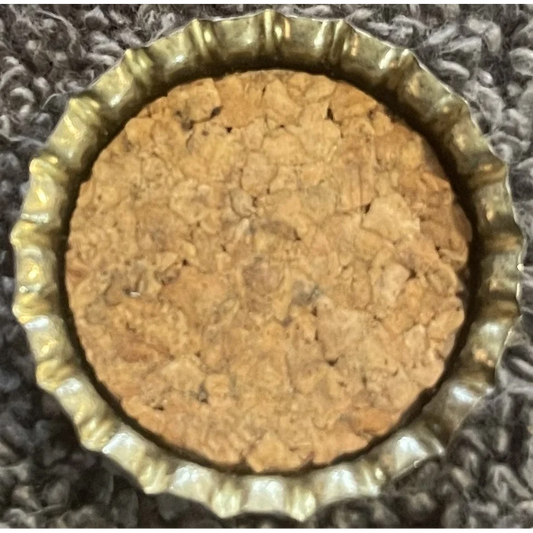
Turn the cap over and you'll find the other half of its story: the cork liner. A full, intact, granulated cork insert — the kind that was standard in crown caps before the industry transitioned to plastic-lined closures. Cork liners provided the compressible seal that kept carbonation inside the bottle. When you see a cork-lined crown today, you are looking at construction used until the industry moved to plastic through the 1960s. The shift away from cork was gradual through the postwar years, and by the time plastic liners dominated, the regional bottling era that had produced brands like King Bee was already winding down. The cork liner on this cap is not just a construction detail — it is a timestamp written in material.

The brand name itself — King Bee, with its grape flavor designation — belongs to the tradition of mascot-driven, character-based branding that regional soda producers embraced enthusiastically in the decades before postwar standardization swept the beverage industry toward national uniformity. A king bee. A bee that rules. It's confident, playful, and exactly the kind of small-brand personality that a local or regional bottler would invest in to stand out on a crowded soda case. The bee illustration above the lettering is rendered with real charm — wings spread, body detailed — a tiny piece of commercial illustration that someone drew, someone approved, and someone pressed into metal tens of thousands of times.

This example is New Old Stock — unused, never applied to a bottle, preserved outside the normal cycle of use and disposal that claimed virtually every other cap from the same production run. That is the distinction that makes it a collectible rather than just a curiosity.


🏭 The Regional Bottling Era — America's Most Creative Soda Chapter

To understand why a bottle cap like this one matters, you have to understand the world it came from. For the better part of half a century — roughly from the early decades of the twentieth century through the 1950s — American soda bottling was a radically local enterprise. The carbonated beverage business was built on geography. Water quality, distribution range, local taste, and the economics of glass bottle returns all conspired to keep bottling close to the customer. A bottler in one town might produce a completely different lineup of flavors and house brands than a bottler two counties over, even if both were also bottling national franchise lines on the side.

This meant that the American soda landscape in the cork-crown era was astonishingly diverse. Hundreds of regional brands flourished — brands with names like Gateway, Mission, Bireley's, Kist, Sun, and, yes, King Bee — each one a local or regional identity, each one a small flag planted in the ground of American consumer culture. Collectors who work this territory know that King Bee appears in documented lots alongside these other genuine mid-century grape soda brands, which tells us something important: King Bee was not a fantasy label or a printer's sample. It was a real brand, circulating in the real market, turning up in real collections. It shared shelf space and collector boxes with Kist and Mission and the rest of the regional grape-soda cohort.

Grape was one of the defining flavors of regional American soda bottling. It had a devoted following, particularly in areas of the South and Midwest, and it lent itself to vivid branding — purple was a natural, immediate color signal, and the flavor's sweetness and distinctiveness made it a reliable seller for bottlers who needed flavors their customers would come back for. A brand named King Bee Grape was making a specific promise: this is the king of grape sodas, the one that rules. That's marketing that works in twenty words or fewer, which is exactly what you need when your entire canvas is a one-inch metal disc.

The crown cap suppliers who served these regional bottlers were themselves a specialized industry — companies that could print in small runs, accommodate dozens of house brands, and deliver product that would hold up on the bottling line. The lithography on caps like this one was not incidental. It was a competitive craft, and the best-printed caps — the ones with the cleanest registration, the richest color, the sharpest illustration — were a source of genuine pride for the bottlers who ordered them. When you look at the King Bee cap under good light, the quality of that purple and the crispness of the bee illustration tell you that whoever ordered this cap cared about how it looked.


🏺 The Cork Liner — Why It Dates the Story

It's worth dwelling on that cork liner for a moment, because it's one of the things that makes this cap so legible as a historical artifact. Cork was the original crown cap liner material, chosen because it compressed reliably, recovered its shape, and provided an effective gas-tight seal against the glass lip of a bottle. For the first half of the twentieth century, virtually every crown cap in America was cork-lined. The granulated cork you see on the reverse of this King Bee cap — that orange-tan, textured disk — is composed of compressed cork particles bonded together, a construction method that was refined over decades of bottling-industry experience.

The transition away from cork liners was driven by cost, consistency, and the development of plastic and foil-faced alternatives that could be produced more cheaply and applied more uniformly on high-speed bottling lines. That transition ran through the 1960s for most commercial bottlers. What this means for the collector is straightforward: a cork-lined crown cap is, by its very construction, a product of the earlier era of American soda bottling. It does not need a date stamped on it to place it in time. The cork does that work.

The fact that this cap's cork liner is intact and present — not crumbled, not missing, not replaced — is part of what makes it New Old Stock rather than simply old. Caps that were used went through the bottling process, took the compression of application, and spent their working lives sealed against a glass lip. Their liners were compromised by design. A cap with an intact liner that has never been applied is a cap that escaped the process entirely — set aside, stored, preserved by the particular accidents of commercial history that occasionally save things from their intended fate.


🖼️ Display Ideas

  • 🪵 Frame it in a deep shadow box alongside other regional grape-soda cork caps for a stunning mid-century soda Americana wall display — the purple reads beautifully against natural wood or black matting.
  • 🗺️ Mount it on a vintage map of your state or region as part of a locally themed Americana vignette — regional soda history is deeply tied to place, and the juxtaposition is a conversation starter.
  • 🧲 Display it on a small magnetic or pinned collection board with other crown caps organized by color or flavor — the King Bee's purple and the bee illustration make it a natural centerpiece of any grape-soda grouping.
  • 🏪 Pair it with other vintage soda and bottling ephemera — a syrup bottle, a soda-fountain glass, an old bottling-works photograph — as part of a general store or soda-fountain vignette.
  • 🔍 Display it under a small magnifying dome or glass paperweight to showcase the lithography and the bee illustration at a scale that lets visitors really see the printing craft.
  • 📚 Tuck it into a collector's binder or archival display page alongside research notes on the regional soda era — this cap is as much a research artifact as it is a display piece, and treating it that way honors what it represents.

  • 🎁 Who Collects These

    Crown bottle cap collecting is one of the most democratic and deeply researched corners of American advertising and beverage history. The people drawn to cork-lined crown caps tend to be serious students of the regional bottling era — collectors who understand that the history of American soda is not just the history of the national brands but the history of hundreds of local and regional operations that served communities, employed families, and produced some of the most vivid small-format commercial art in American history. A King Bee grape soda cap is exactly the kind of piece that serious crown-cap collectors actively seek: a confirmed regional brand, a strong mascot illustration, a grape flavor designation, and the cork liner that anchors it in the right era.

    Beyond the dedicated crown-cap collecting community, this piece speaks to collectors of vintage advertising art, American graphic design history, mid-century Americana, and beverage industry ephemera. It's a natural addition to a general store antiques collection, a soda-fountain display, or any assemblage of early American commercial art. Historians of the American bottling industry and researchers tracing regional brand history will find it equally compelling — it's a primary source, however small.

    Gift buyers who know their recipient collects vintage soda items, Americana, or regional advertising art will find this cap is the kind of highly specific piece that makes a memorable gift precisely because it can't be manufactured or reproduced. What's here is what survived.


    🏭 WHS — the Mark of W. H. Hutchinson & Sons, Chicago

    There is a small WHS stamped on the flange of this cap, in ink-dark letters easy to take for somebody's pencil mark. It is not. It is a manufacturer's mark, and it belongs to W. H. Hutchinson & Sons of Chicago — a name with one of the better stories in the bottling trade behind it.

    William H. Hutchinson was a Chicago soda bottler and a maker of bottling plant. In 1879 his son Charles G. Hutchinson patented the Hutchinson's Patent Spring Stopper — a wire loop and rubber disc that sealed a soda bottle from the inside, and that you opened by thumping it down with your thumb. It swept the trade and made every rival closure obsolete. By 1882 the family had sold the bottling side to the Hayes brothers so the firm could concentrate on manufacturing.

    Then William Painter's crown cap arrived and did to the Hutchinson stopper exactly what the stopper had done to everything before it: cheaper, more sanitary, quicker to apply. Rather than go down with their own patent, W. H. Hutchinson & Sons went into making crown caps, shipping them out of Chicago by the gross in wooden barrels stencilled W H HUTCHINSON & SONS CHICAGO and marked to be kept dry — because of the cork. The mark on this cap belongs to the people whose own invention the crown cap destroyed.

    ❓ Frequently Asked Questions

    Is this a reproduction, or is it genuinely from the original production run?

    This is an original cap from the original production run — New Old Stock, meaning it was produced during the active life of the King Bee brand, stored, and preserved without ever being applied to a bottle. The lithography, the metal, and most tellingly the cork liner are all consistent with original period production. Cork-lined crown caps are not reproduced for the collector market in any meaningful way — the economics don't support it, and the cork liner itself is the detail that would immediately distinguish an original from any later copy. What you are seeing in the photographs is what the cap actually is: a genuine survivor from the regional American soda bottling era.

    What does "NOS" mean, and why does it matter for this cap?

    NOS stands for New Old Stock — a term collectors use for items that were produced during the original era, held in storage or inventory, and never put into service or used for their intended purpose. For a bottle cap, that means it was never applied to a bottle, never went through the bottling line, and the cork liner was never compressed against a glass lip. The cap exists in its as-manufactured state. This is distinct from simply being "old" — a used cap that survived on a bottle would show the marks of application. An NOS cap is, by definition, a different category of survival, and for collectors interested in original production quality, lithography detail, and liner condition, NOS examples are the benchmark.

    What can you tell me about the King Bee brand — where was it bottled, and who made it?

    King Bee is a confirmed, documented grape soda brand from the regional American bottling era, appearing in collector records alongside other genuine mid-century regional brands. The specific bottling company, city of origin, and production dates have not been definitively established in the documentary sources that survive today — which is entirely typical for regional soda brands of this era, many of which left no surviving business records, newspaper archives, or trade-directory entries in digitized form. What the cap itself tells us is significant: the quality of the lithography, the investment in a distinctive mascot illustration, and the standard cork-lined crown construction all point to a real commercial bottling operation with real brand identity. The absence of a surviving paper trail does not diminish the cap — it's simply the reality of how most regional soda history was preserved, which is to say, incompletely. The cap is the record.

    Why does the cork liner matter, and is it common to find these with the liner intact?

    The cork liner matters for two reasons: historical and aesthetic. Historically, the presence of a cork liner rather than a plastic or foil-faced liner places this cap in the earlier decades of crown-cap production, before the industry's gradual postwar transition to alternative liner materials. It is a material timestamp. Aesthetically, an intact cork liner is a sign of NOS status — caps that went through the bottling process had their liners compressed and often damaged by the application equipment and the seal against the bottle lip. Finding a cap with a full, intact, granulated cork liner is a genuine marker of preservation quality. It is not universal among surviving old caps, which is part of what makes NOS examples worth seeking out.

    How should I store or display this cap to preserve it?

    Crown bottle caps are among the more forgiving of vintage advertising artifacts — they're metal, they're small, and they don't have the fragility of paper or cardboard ephemera. That said, the lithography and the cork liner both benefit from stable conditions: away from prolonged direct sunlight, which can affect printed color over time, and away from high humidity, which is the enemy of both the metal and the cork. For display, a shadow box, a framed collection board, or an archival-quality collector page all work well. Many collectors mount caps with small dabs of museum-quality adhesive putty or use purpose-built crown cap display boards. The cap is substantial enough to handle carefully without special equipment — just treat it with the same consideration you'd give any piece of original commercial art from its era.

    Is this the kind of piece that appreciates in value over time?

    Regional cork-lined crown caps with strong mascot branding and confirmed brand identity have a devoted collector base. Grape soda caps with distinctive character branding like King Bee occupy a particularly sought-after niche within crown cap collecting, where flavor, era, and visual impact all factor into desirability. The broader market for vintage American advertising art and regional commercial ephemera has been consistently strong, and small-format pieces with this level of graphic character tend to hold collector interest well.

    Is there anything printed on the cap beyond what's visible in the main face photograph?

    The primary design — King GRAPE Bee with the bee illustration, lithographed in purple and silver-white — is the dominant printed element, as shown in the face photographs. The reverse shows the intact granulated cork liner, which is the standard reverse presentation for a cork-lined crown of this type. Many crown caps of this era carried small-print bottler information, city or state designations, or printer's marks either on the outer edge or incorporated into the liner area; the photographs show what is present and legible on this example. If you are researching the cap's origin and looking for bottler attribution or geographic markings, examining the edge and the liner surround under magnification and good raking light is always the recommended approach for caps of this era.

    Shipping

    🚚 Shipping & Handling

    • Shipping costs and timing are calculated at checkout.
    • Items curated and shipped directly by me include U.S. shipping at no additional cost, professionally packed to ensure safe arrival of your artifact.

    Items from Vetted Pro Collectors
    Shipping for items offered by vetted Pro Collectors is determined at checkout. All Pro Collector listings are reviewed to ensure fair, reasonable shipping practices.

    For full details, please refer to our Shipping Policy.

    Returns & Exchange

    Take your time — you've got a full six months. If a piece isn't right for you, send it back the way it reached you and we're good.

    In the first 30 days your money goes straight back the way you paid. After that it's store credit, so you can put it toward something you'd rather have.

    Return shipping we sort out between us, case by case. I don't make this difficult.

    If something arrives damaged, or it isn't what I said it was, send me a photo within 48 hours and I'll make it right.

    Email info@vintageantiquesgifts.com or call 802-356-9872 — that's me answering, not a call center.

    The only things I can't take back are custom or special-order pieces and gift cards.

    View full details
    • 5 stars: 4 (100%)
    • 4 stars: 0 (0%)
    • 3 stars: 0 (0%)
    • 2 stars: 0 (0%)
    • 1 star: 0 (0%)
    D
    David

    Sorry for the delay. Thought I left feedback already. It's a very nice crown and nice addition to my collection. Thank you.

    b
    blackbartid

    Excellent! Outstanding communication! I will definitely do business again! Well done

    D
    David

    Very nice looking cap. Thank you.

    t
    thebarn3

    Well packed, fast to ship !

    Thank you, We appreciate it!

    Preserving History: Authentic Objects Across Eras

    — Curated by Travis Weigel