

Skip to product information
1 of 4

Vintage and Antique Gifts

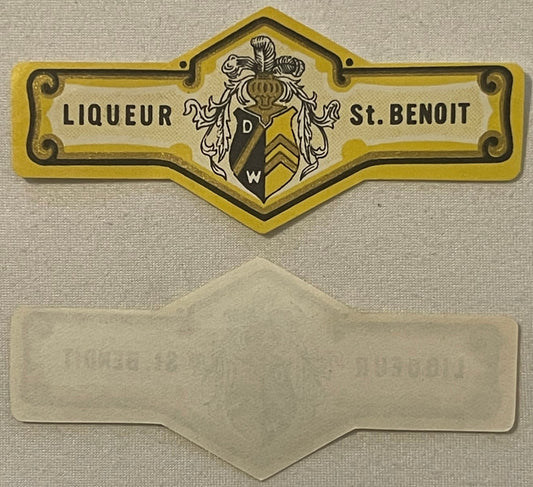
Antique 1920s - 1930s Creme De Cacao Belgian Label 🍫 St. Benoit, Courtrai

Antique 1920s - 1930s Creme De Cacao Belgian Label 🍫 St. Benoit, Courtrai

Regular price $11.00 USD
Regular price Sale price $11.00 USD
Sale Sold out
Shipping calculated at checkout.

Size: 3" x 2 1/2"

🚚 Free US Shipping — ships within one business day. International shipping calculated at checkout.

Quantity

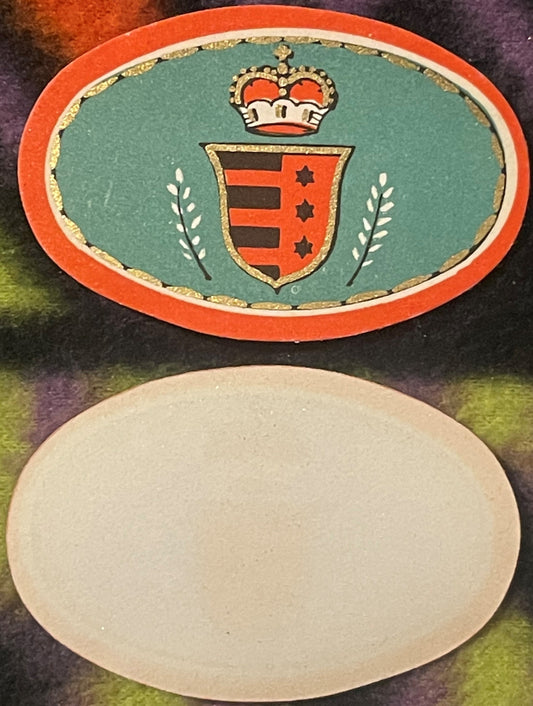
St.-Benoit Crème de Cacao Label 🍫 Registered at Courtrai (Kortrijk), Belgium

Size: 3" x 2 1/2"

Imagine this antique advertising hanging on your wall as home decor in any room or giving it as a gift to someone! A little die-cut shield for a bottle of chocolate liqueur - CREME DE CACAO, St.-BENOIT, "(Marque Déposée)," and at the foot, R. C. Courtrai 23.473. Never used. I have a stack, so yours will look just like this one. The St. Benoit name turns up on neck labels by the hundred, but this crème de cacao shield? I haven't found another one for sale anywhere.

🔎 What That Little Line Tells You

Marque Déposée is French for registered trademark. R.C. is the registre du commerce, Belgium's trade register, and 23.473 is the firm's own number on it at Courtrai - the French name for Kortrijk, in West Flanders, and the only place printed on the label. That line dates it, too: Belgium's trade register was created by a law of 30 May 1924 and came into force in 1927, so no label carrying an R.C. number can be older than that. Every firm on the register filed its name, home and address, its trade and when it meant to start, so somewhere in the Courtrai court's books, number 23.473 has real people's names beside it. And no, St. Benoit isn't Bénédictine - that's Fécamp, in Normandy, a different liqueur altogether.

🍫 Crème de Cacao and the Alexander

Crème de cacao is flavored with cacao beans, often with vanilla, and the "crème" means sugar, not cream - European law today puts a crème liqueur at 250 grams of sugar a liter or more. White is clear, made from a distillate of the beans; dark keeps the beans' color; 20 to 25 percent alcohol is usual, and chocolate liqueurs already show up in French and English recipes of the 1800s. Cacao came to Europe from Mexico and South America: Spanish conquistadors met it in Mexico in 1519 and carried it home, and in the 1600s and 1700s most of the cacao Europe bought came from Venezuela. Drinks writers like to tell the story that French monks were the first to brew alcohol with cacao after the beans reached Europe, which makes a liqueur named for Saint Benedict sit nicely beside it, though nothing on this label claims a monastery. Its place behind the bar came through the Alexander: Hugo Ensslin (1878-1929), a German-born New York bartender, printed one of equal parts gin, white crème de cacao and sweet cream in his Recipes for Mixed Drinks, issued in 1916 and 1917 - one of the last big cocktail books before Prohibition. Swap the gin for brandy and you have the Brandy Alexander, the version the International Bartenders Association recognizes today.

⚔️ Golden Spurs and a Golden River

On 11 July 1302, outside Kortrijk, in what is now Belgian Flanders, the townsmen of Flanders - weavers, fullers and ordinary folks on foot, fighting in militias organized by guild - cut down the mounted knights of the King of France under Count Robert II of Artois. About 500 pairs of spurs off the French dead were hung in the town's Church of Our Lady. The French took them back in 1382 after the Battle of Roosebeke, but it has been the Battle of the Golden Spurs ever since, and in 1973 the date became the official holiday of the Flemish Community. Kortrijk's fortune was flax, retted by the ton in the river Leie, and local legend had it the Leie's water had special powers for the job - the Golden River. Flax historians say it was probably the other way around, and the retting turned the river yellow, but the flax did bring the gold: "Courtrai flax" was reckoned the best there was. The Texture museum, in a 1912 flax depot on the Leie, tells the story.

🗣️ Why It's All in French

Kortrijk speaks Dutch, yet every word on this label is French. In 19th-century Belgium the authorities and the courts were run by the French-speaking upper classes and worked in French, and at first French was the only language the schools taught in; the Equality Law of 1898 made Dutch and French co-equal, and the language laws of 1932 made Dutch the language of administration in Flanders. Courtrai instead of Kortrijk is a little printed piece of that long argument.

⛪ The Saint on the Bottle

Benoît is French for Benedict (in Kortrijk's own Dutch he's Sint-Benedictus) - Benedict of Nursia (about 480-547), who founded twelve communities of monks at Subiaco, then Monte Cassino around 530, and wrote the Rule of Saint Benedict, which most of the monasteries of the Christian West went on to adopt - he's widely called the father of Western monasticism. Pope Paul VI named him patron protector of Europe in 1964. His feast day is 11 July, the same day as the Golden Spurs - a nice double anniversary for a Courtrai liqueur. His Rule is still the one Belgium's Trappist monks live by, at Westmalle, Chimay, Orval, Rochefort and, in West Flanders itself, Saint Sixtus Abbey at Westvleteren, where the monks first brewed beer in 1838.

Bottle labels went out with the empties, so an unused one is leftover stock - and for a small Courtrai mark that's a thin supply. Darling framed over a home bar with an Alexander recipe card.

Shipping

🚚 Shipping & Handling

  • Shipping costs and timing are calculated at checkout.
  • Items curated and shipped directly by me include U.S. shipping at no additional cost, professionally packed to ensure safe arrival of your artifact.

Items from Vetted Pro Collectors
Shipping for items offered by vetted Pro Collectors is determined at checkout. All Pro Collector listings are reviewed to ensure fair, reasonable shipping practices.

For full details, please refer to our Shipping Policy.

Returns & Exchange

Take your time — you've got a full six months. If a piece isn't right for you, send it back the way it reached you and we're good.

In the first 30 days your money goes straight back the way you paid. After that it's store credit, so you can put it toward something you'd rather have.

Return shipping we sort out between us, case by case. I don't make this difficult.

If something arrives damaged, or it isn't what I said it was, send me a photo within 48 hours and I'll make it right.

Email info@vintageantiquesgifts.com or call 802-356-9872 — that's me answering, not a call center.

The only things I can't take back are custom or special-order pieces and gift cards.

View full details

Preserving History: Authentic Objects Across Eras

— Curated by Travis Weigel