Skip to product information
1 of 4

Vintage and Antique Gifts

Antique Embossed Prudential Cigar Label 🚬 ~ Gold Detailing, 1900s-1920s

Antique Embossed Prudential Cigar Label 🚬 ~ Gold Detailing, 1900s-1920s

Regular price $6.00 USD
Regular price Sale price $6.00 USD
Sale Sold out
Shipping calculated at checkout.

Size: 9" x 7"

🚚 Free US Shipping — ships within one business day. International shipping calculated at checkout.

Quantity

Who Made Prudential Cigars? 🚬 Prudential Cigar: A Gold Embossed Inner Label

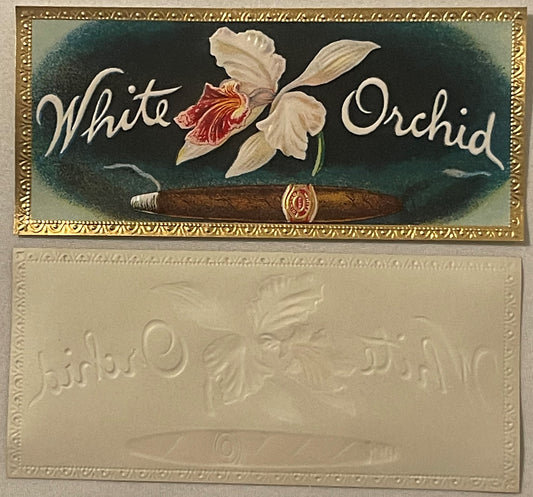
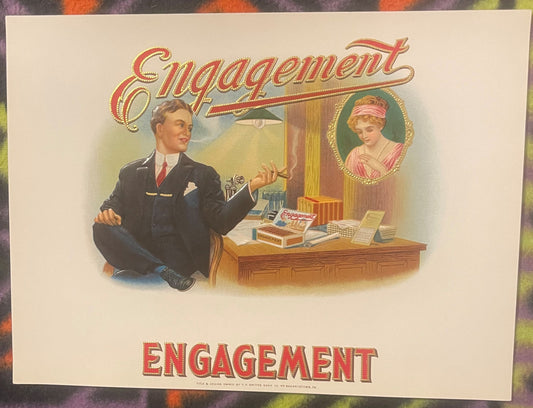
Size: 9" x 7" ~ NOS unused stock. Minor corner wear on some. Never would see it in a frame but please see the pictures and video and judge for yourself.

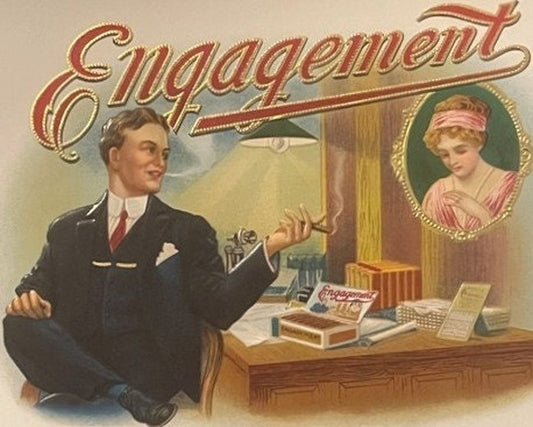
An antique Prudential embossed cigar label from the 1900s to the 1920s! This is a very neat cigar label and isn't very common. Great colors and embossing!

PRUDENTIAL is spelled out in big gold-shaded letters on a scrolled banner across an airbrushed oval. Pinned to the top of the banner is a gold coin with a classical profile head ringed by stars, pressed into a rosette with ribbons trailing down behind, like a first-prize ribbon at the fair. CIGAR sits below, and a second PRUDENTIAL runs along the bottom of the sheet. Flip it over and the back is blank, but the embossing is so deep you can read PRUDENTIAL backwards right through the paper.

🥇 The Medal on the Ribbon

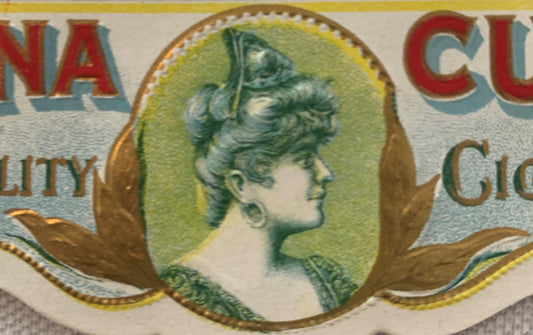
Get up close to that gold coin and it's a lovely little thing: a Liberty-style head in profile, hair pinned up, ringed with tiny stars inside a beaded rim, all pressed up in real relief. It sits on a scalloped red seal with pale blue ribbon loops and two tails hanging down behind the banner. On old cigar labels a gold disc like this almost always stood for a prize medal from the big exhibitions and trade fairs, the way a brand showed off its honors right on the lid. And the fashion for embossed gold coins and medals on labels took off in the 1890s, which fits a label from the 1900s to the 1920s.

🏭 A Prudential in the Trade Papers

The label never prints who rolled the cigars, but the name was out working in the trade. In 1911 The Tobacco World, the cigar men's paper out of Philadelphia, reported "Prudentials," in seed and Havana, made by Hilbronner & Jacobs of Philadelphia, and called them big sellers. Seed and Havana means a blend: American-grown seed-leaf tobacco with Cuban Havana leaf mixed in. Their man on the road, Morris Burke, billed as "The Stogie King," placed the Prudentials with the Klauber & Wangenheim Company of Los Angeles and San Diego, an old wholesale house founded in 1869 that carried the Prudential and El Gonzales brands across California, Arizona, New Mexico and Nevada.

Henry Hilbronner and Samuel Jacobs ran the firm, and that same year they moved out of the Denckla Building into a remodeled factory at Eleventh and Christian streets in South Philadelphia, with offices on the ground floor and the cigar making on the floors above. A good steady name like Prudential was made for a cigar box lid, and in 1911 it was out there selling from coast to coast.

The trade weekly Tobacco told the rest of their story in 1920. Hilbronner & Jacobs had started in 1905 out at Perkasie, Pennsylvania, moved into the city at Eleventh and Christian, and ended up in a four-story factory turning out about 50,000 cigars a day, sold through big Philadelphia dealers like John Middleton, Thomas Martindale and Finley Acker - and the two partners sold on the road themselves, with no salesmen at all. Then on May 1, 1920 they quit. Their building had been sold, cigar boxes were short and labor was a headache, and Samuel Jacobs didn't mince words: "In my long experience, I have not known such a muddle as exists at this time. I am out, and glad of it." The machines and about 110 workers went over to Bobrow Brothers, but the brand names didn't. Their office manager of fifteen years, H. M. Kreh, took control of the old titles - Prudential among them - and set up at 49 South Front Street to keep making them for the trade out West.

And the name was on cigars long before that. On July 21, 1891, J. B. Axt of Newark, New Jersey, registered a trademark for a "Newark Prudential" brand of cigars - the registration sheet is in the Library of Congress. A different brand from a different town, but it tells you cigar men liked the sound of Prudential for a good long while.

✨ Gold, Stone and a 38-Ton Press

It's an amazing gold embossed label. The raised parts of labels like this one were highlighted with 22-karat gold or bronze leaf. By 1892 lithographers were stamping them with precision-machined dies in 38-ton presses, and the colors came off as many as 25 separate Bavarian limestones, each one 3 to 4 inches thick and weighing up to 600 pounds. A single label could take a dozen skilled specialists a month to create and cost upwards of $6,000 in the dollars of the day.

Picture 100-year-old antique advertising up on your wall as home decor, in whichever room suits it!

📦 Why Every Cigar Box Had One

In 1865 a federal law required all cigars, foreign or domestic, to be packed in wooden boxes of 25, 50, 100 or 250. That put a box in front of every smoker in America, and the inside of the lid became a brand's billboard. Tony Hyman, the cigar box historian, wrote in Cigar Aficionado that more than 1.5 million brands of U.S. cigars appeared and disappeared between 1870 and 1920, from about 150,000 factories, and that colorful inside labels became essential to make a brand stand out. After 1920 photoengraving and four-color presses arrived just as fully 80 percent of American cigar factories were closing, and the labels were never as grand again.

Cigar labels are antique advertising at its best. The graphics that lithography and embossing could produce are something modern printing simply can't reproduce, and sadly it was mostly a lost art once the 1920s were over. To me they are a reminder of a bygone era, and I still think the lithography behind them is unequalled today. Museums and art institutes keep galleries devoted to them, and more and more collectors are looking for them in order to preserve their history. Old stock like this doesn't come back. Once the supply for sale is gone and these labels are framed in homes and galleries, they will be very hard to get.

My photos really don't do it justice. Labels like these had to be printed on heavy paper stock, and that keeps them vibrant and new looking for a long, long time.

This item has reached full antique status.

🎨 The Artists

Most of the artists behind these were very good, but they were desperate for work in that era, were paid very little and got no recognition for what they made. Sadly, most of them will remain unknown, but we can keep their art alive forever.

Shipping

🚚 Shipping & Handling

  • Shipping costs and timing are calculated at checkout.
  • Items curated and shipped directly by me include U.S. shipping at no additional cost, professionally packed to ensure safe arrival of your artifact.

Items from Vetted Pro Collectors
Shipping for items offered by vetted Pro Collectors is determined at checkout. All Pro Collector listings are reviewed to ensure fair, reasonable shipping practices.

For full details, please refer to our Shipping Policy.

Returns & Exchange

Take your time — you've got a full six months. If a piece isn't right for you, send it back the way it reached you and we're good.

In the first 30 days your money goes straight back the way you paid. After that it's store credit, so you can put it toward something you'd rather have.

Return shipping we sort out between us, case by case. I don't make this difficult.

If something arrives damaged, or it isn't what I said it was, send me a photo within 48 hours and I'll make it right.

Email info@vintageantiquesgifts.com or call 802-356-9872 — that's me answering, not a call center.

The only things I can't take back are custom or special-order pieces and gift cards.

View full details

Rescuing American History Since 2007

— Travis & the Kids