Skip to product information
1 of 3

Vintage and Antique Gifts

Antique White-Cat 🐱 Cigar Box Label 1920s Embossed Gold Chromolithograph Tobacco Art

Antique White-Cat 🐱 Cigar Box Label 1920s Embossed Gold Chromolithograph Tobacco Art

Regular price 8.00 USD
Regular price Sale price 8.00 USD
Sale Sold out
Shipping calculated at checkout.
Quantity

😺 Antique White-Cat Cigar Box Label — 1900s–1920s Gold Chromolithograph by Consolidated Lithographing Corporation, Brooklyn, NY

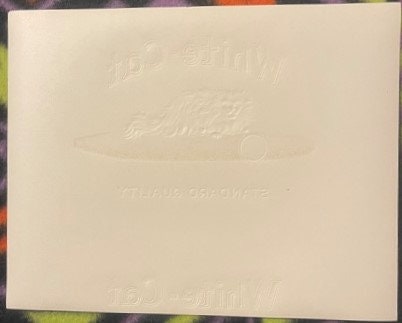
This is an antique inner cigar box label produced by the Consolidated Lithographing Corporation of Brooklyn, New York, in the 1920s — one of the golden age's most accomplished commercial printing houses, whose embossed chromolithographic work served the American cigar trade at the absolute peak of the craft. The White-Cat label measures 7 x 9 inches and depicts a long-haired white cat draped across a full-size cigar, the whole composition built up in multi-color stone lithography with pronounced embossed relief and a warm, confident palette of cream, deep blue, russet brown, and brilliant red. It is an original surviving piece from the era when a lithography house in Brooklyn could treat the inside of a wooden cigar box with the same seriousness a fine press brought to a book cover — and this one proves it.

There is a moment in early American commercial printing — stretching roughly from the 1880s through the first quarter of the twentieth century — when the cigar industry decided that the inside lid of a wooden box deserved genuine artistry. 🎨 Not decoration. Not filler. Artistry. Stone lithography, color built up layer by layer, each pass through the press registered by hand against every layer that came before it. Embossed gold. Metallic inks. Portrait medallions. Mascot animals. Heraldic crests. The result was something that was never meant to hang on a wall, never meant to be saved, and yet here one is — over a hundred years later, clean and vivid and completely intact.

The White-Cat label belongs to that tradition completely and without apology.


🐱 The Cat, the Cigar, and the Composition

The central figure is a long-haired white cat — full-coated, pale-eyed, and utterly unimpressed, as cats tend to be — lying draped across the full length of a fat, rolled cigar. The cat is rendered with genuine care. The fur is layered, soft-looking even in print, the tail curling loosely off one end of the cigar. The animal has the particular composure of a Persian or Angora — heavy through the chest, alert without being startled, the kind of cat that has clearly decided this cigar is its domain and would appreciate it if you did not make a fuss about it.

The cigar itself is rendered in rich, warm browns with the characteristic spiral seam of a hand-rolled product, and a small branded band near one end carries the White-Cat name in miniature — the label within the label, a charming visual recursion that the lithographers clearly enjoyed. The background behind the central vignette deepens into an atmospheric blue-gray, giving the whole composition that sense of depth that only multi-stone chromolithography can produce.

The embossing is pronounced. You can feel the raised surface of the lettering and the central design through your fingertips — the tactile calling card of quality production from the 1920s, a detail that mass offset printing would never again reproduce at this level once the lithographic printing houses closed or modernized. Museums and art institutes have built permanent collections around American cigar label lithography for exactly this reason. The craft was extraordinary, and it is gone.


🏭 Consolidated Lithographing Corporation — Brooklyn's Printing Powerhouse

The Consolidated Lithographing Corporation of Brooklyn, New York, is confirmed by surviving labeled examples and dealer attributions as the maker of the White-Cat label. Brooklyn in the early twentieth century was not simply a borough — it was one of the great industrial and creative engines of American manufacturing, and its printing district was a particular point of pride. The lithography houses clustered in Brooklyn and lower Manhattan employed some of the most technically accomplished commercial artists in the country, craftsmen who brought genuine skill to work that the buying public would see for only the few seconds it took to open a box and light a cigar.

Consolidated's imprint appears on surviving labels referencing both a Brooklyn, NY address and, in later production, a Carle Place, Long Island address — suggesting the company operated across at least two locations over the span of its working life. 🖨️ The Brooklyn operation is documented through surviving labeled examples from the early 1900s through at least the 1920s, which places the White-Cat label squarely in the middle of the company's active production period.

Legend among tobacciana collectors holds that the Brooklyn lithography houses competed fiercely for cigar accounts, and that the mascot-animal label was one of the most contested territories in that competition. A cat was a deliberate choice — cats carried associations of elegance, domesticity, and quiet confidence that mapped well onto a mid-grade cigar brand positioning itself as refined without being pretentious. The story passed down in the trade holds that the White-Cat name was chosen specifically to stand out in a tobacconist's case crowded with eagles, cavaliers, lions, and generic heraldic imagery. A white cat, improbably perched on a cigar, would stop a buyer's eye precisely because it was unexpected.

Whether the specific lithographic artist who rendered that cat was a staff designer or a commissioned talent with broader credentials, no name has been confirmed in surviving records. Collectors and dealers in the tobacciana community have noted — without documentation — that some of the mascot-animal labels from this era show a draftsmanship and sensitivity to animal portraiture that goes well beyond workaday commercial illustration. The White-Cat label, with its carefully rendered fur and the cat's particular quality of self-possession, is one of the pieces that prompts that conversation.


📜 The Golden Age of Cigar Label Art — A Brief History Worth Keeping

The cigar box label as an art form has its origins in the years immediately following the Civil War. The federal government, seeking tax revenue from tobacco commerce, required manufacturers to place tax stamps on their products — and manufacturers, being manufacturers, recognized immediately that this requirement was also an opportunity. If you had to put paper on the box anyway, why not make the paper beautiful? Why not make it memorable? Why not make it the thing that sold the cigar before the buyer ever smelled the leaf?

By the 1880s, the inner lid label had become the prestige piece of the cigar package — the first thing a customer saw when they opened the box, the image that would sit on the counter or in the humidor for the life of the purchase. 🎩 Cigar manufacturers competed on label design with the same intensity they competed on tobacco quality, and the lithographic printing houses that served the trade grew accordingly, investing in multi-stone presses, embossing equipment, and the skilled craftsmen who knew how to use them.

The era ran roughly from the 1880s through the 1920s, with the peak years falling in the first two decades of the twentieth century. After that, offset printing began to displace stone lithography, costs came down, and the extraordinary level of craft that produced labels like the White-Cat began to disappear. By the mid-twentieth century it was effectively gone, replaced by faster and cheaper processes that could produce color printing but could not produce this — the layered depth, the embossed relief, the warmth of ink printed from stone rather than plate.

The story told among dealers and collectors is that many surviving original labels came to light through warehouse finds — leftover production stock at cigar factories, gathered up during the 1970s and 1980s as the old factory buildings were cleared or sold. The labels had sat undisturbed for decades, protected by the very darkness and neglect that had kept them from being used. They emerged from those warehouses exactly as they had left the press: vivid, intact, and carrying a century of history in paper and pigment and raised gold ink.


✨ What You Are Looking At

The label measures 7 x 9 inches — a substantial format for an inner lid label, generous enough to fill the inside of a full-size cigar box lid with visual authority. The color palette is warm and confident: the deep blue-gray atmospheric ground of the central vignette, the rich russet browns of the cigar, the brilliant red of the brand name lettering edged in gold, the cream and soft white of the cat itself. The whole composition is balanced and legible at a distance, which was always the practical requirement — a tobacconist's case demanded imagery that could be read and recognized quickly, and the White-Cat design delivers that without sacrificing any of its elegance up close. 🎨

The embossing adds a dimension that reproduction simply cannot convey. The raised surface of the lettering and the central design respond to raking light the way no flat-printed piece can — the label changes as the light changes, the relief catching shadows at different angles throughout the day. This is one of the reasons that shadow box display, with some air between the glass and the label surface, is the proper way to show a piece like this. The embossed depth is part of what was made. It deserves to be seen.

The condition is clean and intact. The colors remain vivid, the embossing pronounced, the paper sound.


🖼️ Display Ideas Worth Considering

  • 🖼️ Deep shadow box with a navy or charcoal mat — the red lettering and cream cat float brilliantly against dark backgrounds, and the embossed relief becomes visible when properly lit from an angle
  • 🖼️ Floating mount between two panels of UV-protective glass — lets the embossed surface catch ambient light from different directions throughout the day
  • 🖼️ Gallery wall grouping with other period cigar labels or Victorian commercial ephemera — the mascot-animal format sits naturally in that company, and the 7 x 9 inch size anchors a grouping without overwhelming it
  • 🖼️ Home library, study, or bar wall alongside period trade cards, vintage tobacco tins, or antique humidors — the visual language of the White-Cat label is exactly right for a room built around dark wood, warm leather, and collected history
  • 🖼️ Cat collector's display alongside vintage feline-themed ephemera, Victorian cat portraits, or antique cat-motif ceramics — the label crosses cleanly between tobacciana and cat art collecting
  • 🖼️ Tobacciana shelf display paired with an antique cigar cutter, period matchsafe, or vintage tobacco tin from the same 1920s era
  • 🖼️ Archival linen mount inside a simple gold frame — the label floats beautifully against a neutral linen ground, and the warm ivory of the cat reads clearly without competition

🎁 Who This Piece Speaks To

  • 🎁 The tobacciana collector building a display around the golden age of American cigar packaging and commercial printing
  • 🎁 The cat art collector who knows that Victorian and Edwardian-era feline imagery in commercial printing is its own serious collecting category
  • 🎁 The paper ephemera enthusiast who appreciates what multi-stone chromolithography with embossed gold elements actually represents as a craft achievement
  • 🎁 The Brooklyn history devotee looking for something tangible from the borough's commercial printing and manufacturing past
  • 🎁 The framer or shadow box artist who understands what a 7 x 9 inch embossed chromolithograph does under proper display lighting
  • 🎁 The American commercial art collector who recognizes stone lithography at the peak of its craft
  • 🎁 The home bar, den, or study decorator looking for genuinely antique printed material that carries warmth, humor, and a century of story
  • 🎁 The gift-giver who wants something genuinely old, genuinely beautiful, and genuinely unlike anything else on the shelf

❓ Questions Collectors Ask

What exactly is a cigar box inner label, and how is it different from the outer label?

An inner label — also called an inner lid label — was glued to the inside of the cigar box lid, visible the moment a customer or tobacconist opened the box. Outer labels wrapped the outside of the box and were typically smaller and more utilitarian. Inner labels were the prestige piece of the package: larger, more elaborately printed, and designed to make an impression at the moment of first encounter. The White-Cat label, at 7 x 9 inches, is an inner lid label — the full-size showpiece format.

How do I date a cigar box label to the 1920s?

Several features together place a label in the 1920s production window: the use of multi-stone chromolithography (displaced by offset printing in the 1930s and beyond), pronounced tactile embossing on lettering and central design elements, the specific color palette and lettering style conventions of the period, and in this case the confirmed attribution to the Consolidated Lithographing Corporation of Brooklyn, whose surviving labeled examples cluster in the early 1900s through the 1920s. The combination of chromolithographic depth, embossed relief, and period typography is consistent across all verified sources for this label.

How can I tell an original 1920s label from a modern reproduction?

Original chromolithographic labels from the 1920s carry tactile embossing that is raised and firm to the touch — the result of mechanical die-pressing that modern offset or digital printing cannot replicate. The inks have the particular warmth and depth of pigments printed from stone rather than plate, and the paper stock of the period has a specific weight and tooth distinct from modern coated papers. A reproduction will typically be flat, with no embossed relief, and the color will have the slightly cooler, more uniform quality of digital or offset reproduction. The embossing on an original is the most reliable authentication point.

Why do cat collectors and tobacciana collectors both pursue labels like this one?

Mascot-animal cigar labels occupy a productive intersection between two serious collecting categories. Tobacciana collectors prize the chromolithographic craft, the period commercial art history, and the documentation of American cigar brands and their printing houses. Cat art collectors — a category with deep roots in Victorian and Edwardian decorative arts — seek feline imagery across any medium that captures the period's particular affection for cat portraiture. A white long-haired cat rendered with genuine care by a Brooklyn lithographic artist in the 1920s qualifies fully in both traditions, which is why White-Cat labels appear consistently in both collector markets.

What is the Consolidated Lithographing Corporation, and why does the maker attribution matter?

The Consolidated Lithographing Corporation of Brooklyn, New York, is a confirmed producer of American cigar box labels during the golden age of cigar packaging art. Its imprint appears on surviving labels with both a Brooklyn, NY address and a later Carle Place, Long Island address, documenting an active production history through at least the 1920s. Maker attribution matters to collectors for the same reason it matters in any collecting category: it places the piece in a documented production tradition, connects it to a specific printing house with a known body of work, and makes the label's provenance traceable rather than anonymous.

How should I display and care for a 1920s chromolithographic label?

The primary enemies of antique paper ephemera are ultraviolet light, humidity fluctuation, and physical contact with acidic materials. Display behind UV-protective glass in a stable indoor environment — shadow box framing with a small air gap between the glass and the label surface is ideal, because it allows the embossed relief to remain visible and prevents the paper from being pressed flat against the glazing. Archival mat board and backing are worth the small additional cost. Avoid hanging in direct sunlight or near heat sources. Handle the label by its edges, minimally and with clean hands.

Is the White-Cat brand documented as an actual commercial cigar, or is it a label-only artifact?

The White-Cat was a genuine commercial cigar brand, not a label produced speculatively. Inner lid labels of this scale and production quality were made in quantity to be applied to boxes of cigars actually sold in the American market. The "Standard Quality" designation printed on the label is a period convention indicating the brand's market positioning — mid-grade, accessible, and consistent — as opposed to the "Havana Quality" or "All Havana" language used by brands claiming premium Cuban tobacco. The White-Cat was a real product on real tobacconists' shelves, and this label was printed to go inside those boxes.


🌟 The Summary

An original antique White-Cat cigar box inner label, produced by the Consolidated Lithographing Corporation of Brooklyn, New York, in the 1920s. 😺 Measures 7 x 9 inches. Multi-color stone chromolithography with pronounced embossed relief throughout the lettering and central design. A long-haired white cat rests across a full-size rendered cigar against a deep atmospheric ground, the whole composition framed by the confident red-and-gold White-Cat brand lettering above and "Standard Quality" below. Clean, intact, vivid — a genuine piece of American commercial printing from the moment when that craft was at its absolute finest, made by a Brooklyn printing house whose work still impresses anyone who picks it up a hundred years after it left the press.

The cat is still looking at you. It has been for over a hundred years. 🐱

Shipping

🚚 Shipping & Handling

  • Shipping costs and timing are calculated at checkout.
  • Items curated and shipped directly by me include U.S. shipping at no additional cost, professionally packed to ensure safe arrival of your artifact.

Items from Vetted Pro Collectors
Shipping for items offered by vetted Pro Collectors is determined at checkout. All Pro Collector listings are reviewed to ensure fair, reasonable shipping practices.

For full details, please refer to our Shipping Policy.

Returns & Exchange

Take your time — you've got a full six months. If a piece isn't right for you, send it back the way it reached you and we're good.

In the first 30 days your money goes straight back the way you paid. After that it's store credit, so you can put it toward something you'd rather have.

Return shipping we sort out between us, case by case. I don't make this difficult.

If something arrives damaged, or it isn't what I said it was, send me a photo within 48 hours and I'll make it right.

Email info@vintageantiquesgifts.com or call 802-356-9872 — that's me answering, not a call center.

The only things I can't take back are custom or special-order pieces and gift cards.

View full details
  • 5 stars: 10 (100%)
  • 4 stars: 0 (0%)
  • 3 stars: 0 (0%)
  • 2 stars: 0 (0%)
  • 1 star: 0 (0%)
S
Stephen

Great seller and fast shipping

r
r***a (489)

Item was packed very well and arrived in excellent shape! As advertised and great price! Thank you! Highly recommend!!

A
Angela

Really nice vintage piece and the additional little surprise gift was an awesome touch!

k
k***e (15)

Great looking Cigar label added to Man Cave.

C
Cliff

Great all around. Good people, needs to say more in his ads, weather this items are original or reproductions.

h
heartlandcatrescue

FAST SHIPMENT - EXACTLY AS DESCRIBED!!

Thank you!

p
purple222

Second of four items purchased and shipped together. Nice crisp coloring & detail on artwork. Great communication! Thank you!

Thank you, cigar labels are so amazing IMO! Such a neat piece of history and incredible detail and colors. So happy you liked it and it went to a good home!

l
lea20

Beautiful. Thank you.

Pleasure is all ours!

c
charles_mantiques

VERY HAPPY !

Thank you, we are so glad! Happy Holidays

p
pabruce_co

Awesome graphics! Thank you.

Thank you!