Skip to product information
1 of 2

Vintage and Antique Gifts

Vintage 1930s Evening Star Lemon Crate Label 🌟 San Fernando Heights Lemon Ass'n — California Lithograph Art

Vintage 1930s Evening Star Lemon Crate Label 🌟 San Fernando Heights Lemon Ass'n — California Lithograph Art

Regular price 10.00 USD
Regular price Sale price 10.00 USD
Sale Sold out
Shipping calculated at checkout.
Quantity

🌟 When Did the San Fernando Valley Smell Like Lemons at Midnight — and Someone Turned It Into Art?

There is a moment, late in the evening, when the San Fernando Valley would have been something almost impossible to picture today — row upon row of lemon trees disappearing into the darkness, the air heavy and citrus-sweet, and somewhere in a lit packing house, women's hands moving with practiced speed over fruit that would travel by rail across a continent. That world is gone. But the art it produced? That survives. And this is one of the finest examples of it I've had the pleasure of holding.

This is an original lithographed lemon crate label for the Evening Star brand, produced by the San Fernando Heights Lemon Association of San Fernando, California — a grower-owned cooperative that packed and shipped lemons under the sub-brand designation California Red Ball. The label text reads exactly as it was printed: EVENING STAR — CALIFORNIA — Red Ball — GROWN IN U.S.A. — San Fernando Heights Lemon Ass'n., San Fernando, California.

This piece is New Old Stock (NOS) — a label that was printed, stored, and never pasted to a crate. It comes to you the way it left the lithographer's press: an excellent early example of American commercial art, produced during the golden era of California citrus label design. Available sources document surviving copies at approximately 12½ × 8¾ inches, consistent with the standard lemon-label format of the period.

The lithography was executed by Western Lithograph Company of Los Angeles — operating from 1908 onward — one of the dominant commercial printers in Southern California's citrus-label trade. The Huntington Library's Jay T. Last Collection, one of the most authoritative archival sources in the entire field of citrus label scholarship, documents this exact label with Western Litho as its printer and records a catalogued example dated to 1931. Dealer records, CSUN's San Fernando Valley History Digital Library, and the Los Angeles County Museum of Art all hold institutional examples, placing the label's known period of production across the 1930s through the 1940s. Without a legible printer's date code on any specific physical copy, that span is the honest, defensible range — and it's a rich one.


🏛️ The Art on the Label — A Mission, a Star, and a Valley in Full Bloom

The image on this label is doing a great deal of storytelling in a very small space. At the center stands a Mission-style building — cream stucco walls, red-tiled domes, a stone bell tower, arched walkways draped in flowering vines — flanked on either side by tall, mature fan palms that frame the entire scene like a stage curtain. To the right, the land opens into orderly rows of citrus groves rolling toward distant, sun-burnished hills. A vintage automobile — dark, low, and very much of its era — rests in the foreground drive, placing a human timestamp on the scene.

Above it all, a white five-pointed star blazes at the center of a full sunburst, its rays fanning out across a deep blue twilight sky dotted with smaller stars. The typography — bold yellow letters outlined in red — arches across the top in the confident hand of a craftsman who understood that these labels would be stacked in railroad cars and warehouses and needed to announce themselves across a room.

The building is understood among collectors and historians to be a stylized rendering of Mission San Fernando Rey de España, the eighteenth-century mission that sat less than a mile from the association's packing house. Whether the artist rendered it from life or from artistic memory, the choice was intentional: the mission image was the Valley's most powerful visual shorthand for permanence, California heritage, and the romance of a land that had been bearing fruit, in one form or another, for well over a century.

The colors — that saturated cobalt blue sky, the sun-gold lettering, the warm cream of the mission walls, the deep greens of the grove — were achieved through the painstaking stone or plate lithography process of the era. Each color required a separate pass through the press, with precise registration between layers. The results, as our seller has long said and as anyone holding one of these labels immediately understands, are unparalleled. No digital print reproduces the slight tactile presence, the slight ink depth, the quality of a lithograph made when this craft was at its commercial peak. Museums and art institutes have known this for decades; their permanent collections confirm it.


🌙 The Celestial Series — Evening Star and Her Sisters

One of the most compelling pieces of lore surrounding this label is that Evening Star was never a standalone brand. It was part of a deliberately conceived celestial series, and collectors who know the San Fernando Heights labels know to look for the full set.

The original group transferred to the association when it took over operations from the Pacific Packing Company included Silver Moon, Blue Moon, Evening Star, and Southern Cross. Over time the lineup evolved: Morning Sun came in, Silver Moon rotated out, and the working set became Evening Star, Morning Sun, and Blue Moon. Among these, Blue Moon is considered the rarest — collectors who have spent years assembling the series often report it as the last and hardest to find. Southern Cross is similarly elusive. Evening Star, by contrast, is the most recognized of the group, the one that most often turns up in collections and institutional holdings — which is its own testimony to how widely it was used and how well it represented the association's brand.

Lore passed down among citrus-label collectors holds that the celestial theme was chosen with particular care for a lemon operation — lemons, after all, were primarily a nighttime harvest crop in the hottest months, picked in the cool dark hours before dawn to protect fruit quality. Whether or not that was the designer's precise intention, the Evening Star imagery and the harvest reality mapped onto each other with a poetry that felt true enough to stick in the telling.


🍋 The San Fernando Heights Lemon Association — Rise, Prosperity, and the World It Made

The company behind this label has a genuinely fascinating arc, and understanding it turns this piece of paper into something much more than decoration.

The agricultural transformation that made the association possible came down to one thing: water. The San Fernando Valley had long grown citrus alongside wheat and field crops, but it was the opening of the Los Angeles Aqueduct in 1913 — carrying snowmelt from the eastern Sierra Nevada across hundreds of miles of desert — that unlocked the valley's full agricultural potential. The Pacific Packing Company had established a lemon packing plant just south of Mission San Fernando around 1911. In 1915, Pacific sold the facility to a newly organized grower cooperative: the San Fernando Heights Lemon Association. The use of "Heights" in the name has always struck local historians as slightly peculiar — the terrain around San Fernando is notably flat — but the name stuck, and the association grew into a genuine regional institution.

Growth came steadily. A 1922 entry in a national engineering and contracting journal documented the association erecting a new one-story building with basement, measuring 9 by 12.5 feet, at a cost of $24,000 — serious capital investment by the standards of a cooperative packing house. By June 1925, the Van Nuys News was reporting what was believed to be a record price: over $14 a box for association lemons shipped to Cleveland. The packing house sat at Sepulveda and San Fernando Mission Boulevards, and the fruit moved east on the Southern Pacific Railroad, reaching markets across the country.

By the time this label was being printed and pasted, the Valley's citrus economy had reached genuine scale: 11,000 acres of lemon, orange, and grapefruit trees and ten packing houses operating across the region. When World War II arrived, that scale acquired national significance — a documented twenty-five percent of Valley citrus production was directed to supplying Vitamin C for United States armed forces and Allied troops. The lemons packed under this very label, in those years, were doing more than feeding civilian grocery shelves.


👩 The People Who Made It Run — Women, Families, and the Packing House Floor

Behind every label in this celestial series was a human operation, and the human story of the San Fernando Heights packing house is one that deserves to be told alongside the art history.

The work of wrapping, sorting, and packing the fruit was performed almost entirely by women, and almost entirely by Latinas. Archival photographs from the CSUN San Fernando Valley History Digital Library show the interior of the packing house — roughly eighteen women standing at conveyor lines, moving Sunkist-branded crates, with a handful of men at a counter in the background. One woman at the left of the frame has been specifically identified: Luz Mendez Calvo (1896–1982), a name now attached to the archive and preserved there.

The generational reach of this work runs deep in the Valley. Family historian Anthony Llamas, researching the López Adobe history, documented that his grandfather Daniel Llamas grew up working the ranches and fields of the San Fernando Valley, and that his great-grandmother Jacoba Llamas, along with other family members and neighbors, worked in the San Fernando Heights citrus packing house. These weren't anonymous workers — they were founding families of the Valley's Latino communities, and the picker and packer neighborhoods they built in proximity to operations like this one were, as historians now recognize, among the first suburban neighborhoods established by Latino families in all of Southern California.

Herbert S. Sykes managed the plant for roughly three decades. His testimony recorded in local sources speaks to the operational side: mechanization, consolidation of plant operations, and evolving grading and packing practices kept the association profitable through the middle decades of the twentieth century even as the landscape around it began to change.


🎬 The Hollywood Angle — When the Packing House Became a Movie Set

Here is a story that circulates in local San Fernando Valley history circles and that is too good — and too well-documented in its essential facts — to leave out of any honest account of this label.

In the late 1940s, the association was struggling. Postwar labor shortages hit the packing houses hard: there simply weren't enough workers to wrap and pack the fruit at the volume the operation required. The association's solution was, by any measure, inspired. They contracted with Hollywood studios for filming at the packing house — turning the facility into an active movie location. The reasoning, as local lore has long held it, was that the promise of being seen on camera, or even just of working in the same building where a film was being shot, would draw workers who might otherwise not apply. The gamble worked: the packing house was reportedly inundated with new workers hoping to be discovered in the background of a production. A 1950 news article documented that the arrangement had been in place for a couple of years by that point. The specific film title produced at the location has not been confirmed in surviving sources — but the arrangement itself is a matter of record, and it is exactly the kind of story that makes a piece of paper like this label connect to something larger than a crate of fruit.


🏚️ The End of the Grove Era — and Why These Labels Matter Now

The postwar boom that rescued the association's labor problem ultimately ended its reason for existing. The same flood of new residents arriving in the greater Los Angeles region through the late 1940s and 1950s were buying lots and building houses on the land that had grown lemons. The nearby San Fernando Lemon Association closed in 1948. Citrus acreage across the Valley fell from 11,000 acres to 6,000 over the following decade; the number of operating packing houses dropped from eight to five. By the time the contraction was complete, the San Fernando Heights facility had closed as well — though some of its structures, remarkably, were still standing in recent decades, repurposed as storage.

This is the context in which New Old Stock labels like this one carry their particular weight. When the packing houses closed, cases and bundles of unused labels — printed, stored, never applied — were left behind. Some were saved, some were sold off, some found their way into collections. What you are holding is one of those survivors: a piece of commercial art created at full professional scale, by skilled lithographic craftsmen, intended to travel the country on a crate of fruit and instead preserved intact. The Huntington Library catalogues it. LACMA holds it. CSUN's digital archive preserves it. It belongs in that company.


🖼️ Display Ideas

  • 🌴 Framed in a California kitchen or breakfast nook — the cobalt, gold, and red palette works with both Spanish Colonial and mid-century modern interiors, and the citrus subject matter is an obvious conversation piece where food and family gather.
  • 🏡 Gallery wall anchor for a San Fernando Valley or Los Angeles history theme — pair with vintage maps, photographs of the Valley before development, or other citrus-region ephemera for a wall that tells a place's story.
  • 🌙 Complete the celestial set — collectors who display Evening Star alongside Morning Sun, Silver Moon, and the elusive Southern Cross or Blue Moon create an instantly arresting themed grouping that tells a brand story no decorator could invent.
  • 🍋 Farmhouse or cottage entryway — the scale (roughly 12½ × 8¾ inches) sits beautifully in a slim antique frame above a console table or in a tight entry hall, adding a warm, storied Americana note without overwhelming a small space.
  • 🏛️ Office or library wall for California history enthusiasts — the mission imagery, the archival provenance, and the documented institutional holdings (Huntington, LACMA, CSUN) make this a natural complement to a collection of California books, maps, or mission-era prints.
  • 🎁 Framed as a meaningful gift — for anyone with roots in the San Fernando Valley, ties to California's agricultural heritage, or a love of vintage American commercial art, this is the kind of gift that carries real history in its image.

🎁 Who Collects These

Citrus crate labels occupy a genuinely broad collecting universe, and Evening Star sits near the top of most serious collectors' want lists within it.

California history collectors seek these as primary documents of the agricultural era that shaped the state's economy and culture before the suburban build-out of the postwar decades. San Fernando Valley historians and community members — particularly those with family ties to the citrus industry — find in these labels a direct visual connection to the world their grandparents and great-grandparents worked in. Lithography and commercial art enthusiasts are drawn to the Western Lithograph Company's production quality: these labels represent the craft at its commercial height, with color registration, tonal range, and compositional skill that still draws the attention of graphic designers and print historians a century on.

Americana collectors value citrus labels as a category alongside advertising tins, patent medicine labels, and seed packets — ephemera that was made to be used and discarded, survived against the odds, and now represents a documentary record of a vanished commercial culture. Mission and California colonial revival enthusiasts are specifically drawn to Evening Star's imagery, which depicts the Mission San Fernando setting with a romantic fidelity that makes it a natural companion to Arts and Crafts, Craftsman, and Spanish Colonial interior schemes. And then there are the decorators and interior designers who have discovered, as museums discovered decades ago, that the color sense and compositional confidence of a well-executed citrus label outperforms almost any reproduction print at the same scale and price point.

Museums and art institutes have been mounting gallery exhibitions of these labels for years. As our collector's voice has long maintained: once the surviving supply of originals is absorbed into collections and display, the opportunity to own one at this level simply closes.


❓ Frequently Asked Questions

Q: Is this an original label or a modern reproduction?
This is an original New Old Stock lithographed label — a genuine period piece that was printed, stored, and never applied to a crate. It is not a reproduction print or a digital facsimile. The lithography process, paper stock, and ink characteristics are those of the original production run.

Q: Can you pin down the exact year it was printed?
The Jay T. Last Collection at the Huntington Library — the most authoritative archival source for California citrus labels — documents a catalogued example dated to 1931, with Western Lithograph Co. as the printer. Dealers handling warehouse stock copies generally attribute surviving examples to the 1940s, and CSUN's holding is dated circa 1940. The honest range for the brand's production period is the 1930s through the 1940s. Without a legible printer's date code visible on a specific physical copy, a single exact year cannot be confirmed — but that documented range is well established across multiple institutional sources.

Q: Who was Western Lithograph Company, and does that matter for value?
Western Lithograph Company of Los Angeles — operating from 1908 onward — was one of the dominant commercial printers serving the California citrus industry during its peak era. Attribution to a specific named printer, especially one documented in a major institutional archive like the Huntington's Jay T. Last Collection, adds provenance weight that undocumented labels lack. It places this piece within a specific, traceable production history.

Q: What are the other labels in the Evening Star celestial series, and are they equally available?
The full set associated with the San Fernando Heights Lemon Association includes Silver Moon, Blue Moon, Evening Star, and Southern Cross from the original Pacific Packing Company transfer, with Morning Sun added later. Among these, Blue Moon is considered the rarest — collectors who have pursued the full set report it as the last and hardest piece to acquire. Southern Cross is similarly scarce. Evening Star is the most frequently encountered of the group, which reflects the extent of its use and the depth of its original print run.

Q: The label shows a mission building — is that actually Mission San Fernando?
The building is understood among collectors and local historians to be a stylized rendering of Mission San Fernando Rey de España, which sat approximately a mile from the association's packing house at Sepulveda and San Fernando Mission Boulevards. Whether rendered from direct observation or artistic interpretation, the mission imagery was the Valley's most recognizable visual symbol of California heritage and permanence — a deliberate and commercially effective choice by the label's designer.

Q: Are there institutional collections that hold this label? Does that affect authenticity?
Yes — and it matters. The Jay T. Last Collection at the Huntington Library holds and catalogs this label with full attribution. LACMA holds an example. CSUN's San Fernando Valley History Digital Library holds an example and associated association records. Digital Commonwealth holds a catalogued record. Institutional holdings of this depth confirm both the label's authenticity as a historical artifact and its standing as a recognized piece of California commercial art history.

Q: How should I frame or display it to best preserve it?
For long-term preservation, use UV-protective glazing (glass or acrylic) to protect the lithographic inks from light exposure, and acid-free mat board if you mat it. The label's scale — approximately 12½ × 8¾ inches — fits comfortably in a standard frame with a mat, or can be floated on a backing in an oversized frame for a bolder display. Avoid humidity extremes and direct sunlight. Beyond that, the art does its own work — the colors and composition hold a room.

🔴 The Red Ball Device, and the Exact Setting

Two small printing details worth having straight. The device at the lower left is a solid red disc — a red ball — carrying a pale scalloped cartouche lettered CALIFORNIA above Red Ball. That puts CALIFORNIA on the sheet twice: once in that cartouche and once in the SAN FERNANDO, CALIFORNIA line beneath the association.

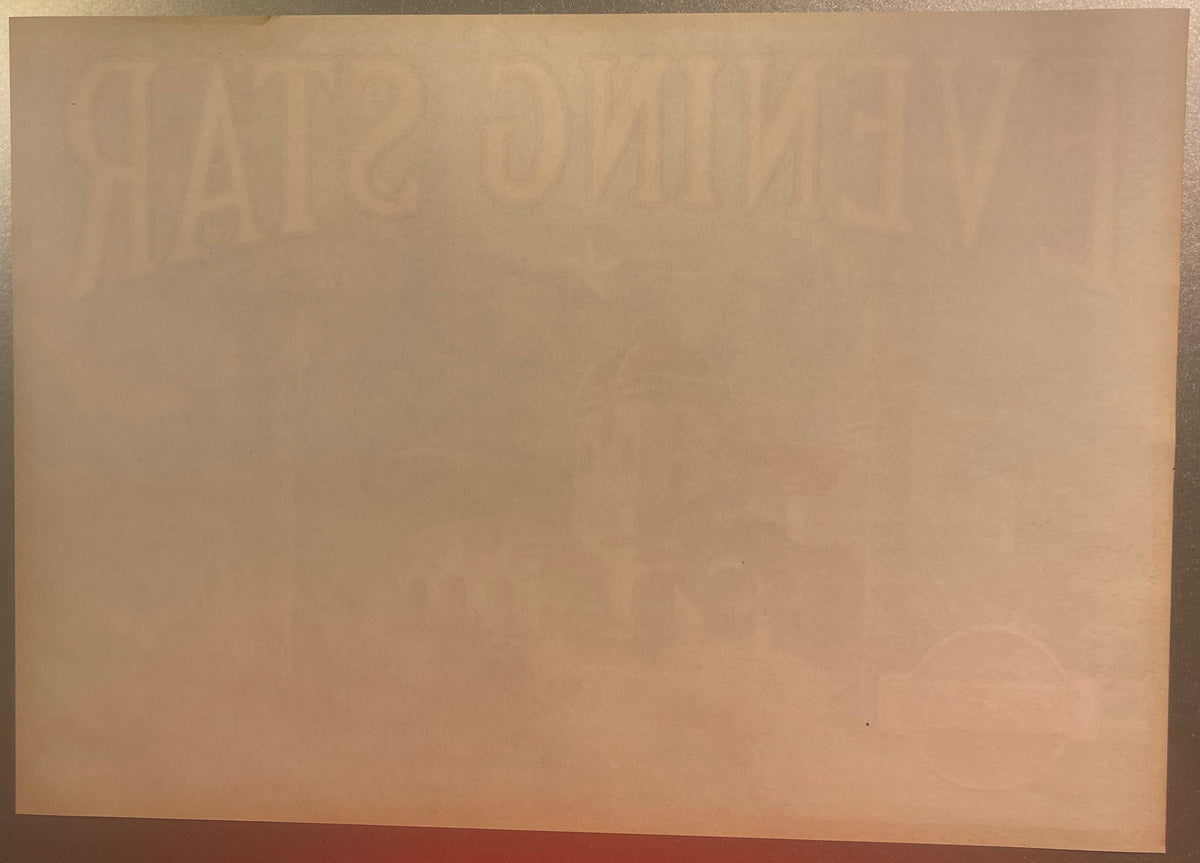
The country line is set with spaced initials as GROWN IN U. S. A., and the association line carries a terminal period exactly as printed: SAN FERNANDO HEIGHTS LEMON ASS'N. Worth noting too that no standalone fruit word is printed on this sheet — LEMON appears only inside the association's name — and there is no count, size or grade line, no copyright line and no lithographer's imprint on any edge; the reverse is blank.

Shipping

🚚 Shipping & Handling

  • Shipping costs and timing are calculated at checkout.
  • Items curated and shipped directly by me include U.S. shipping at no additional cost, professionally packed to ensure safe arrival of your artifact.

Items from Vetted Pro Collectors
Shipping for items offered by vetted Pro Collectors is determined at checkout. All Pro Collector listings are reviewed to ensure fair, reasonable shipping practices.

For full details, please refer to our Shipping Policy.

Returns & Exchange

Take your time — you've got a full six months. If a piece isn't right for you, send it back the way it reached you and we're good.

In the first 30 days your money goes straight back the way you paid. After that it's store credit, so you can put it toward something you'd rather have.

Return shipping we sort out between us, case by case. I don't make this difficult.

If something arrives damaged, or it isn't what I said it was, send me a photo within 48 hours and I'll make it right.

Email info@vintageantiquesgifts.com or call 802-356-9872 — that's me answering, not a call center.

The only things I can't take back are custom or special-order pieces and gift cards.

View full details
  • 5 stars: 1 (100%)
  • 4 stars: 0 (0%)
  • 3 stars: 0 (0%)
  • 2 stars: 0 (0%)
  • 1 star: 0 (0%)
n
n***n (3637)

Dig this authentic fruit crate label!