Skip to product information
1 of 2

Vintage and Antique Gifts

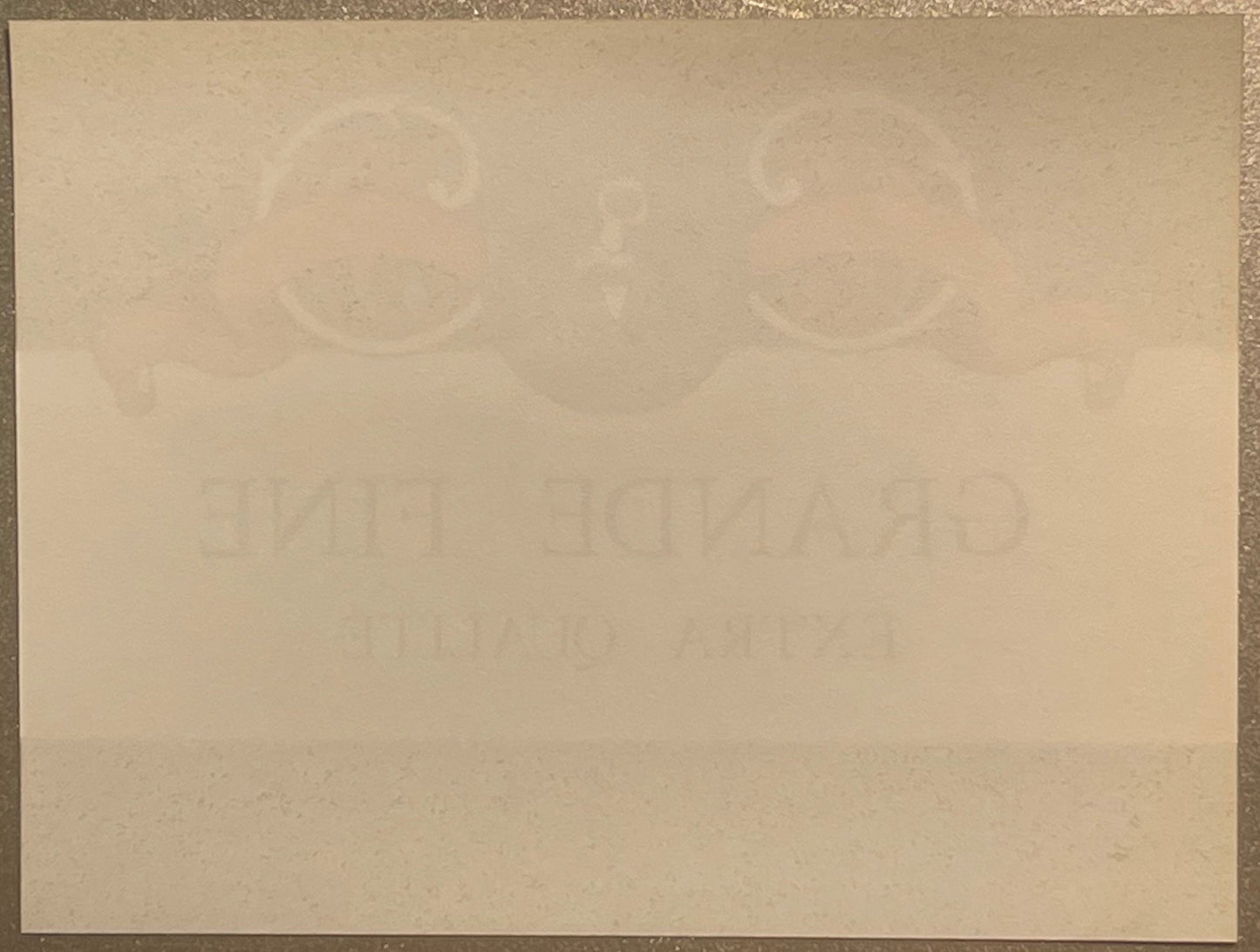
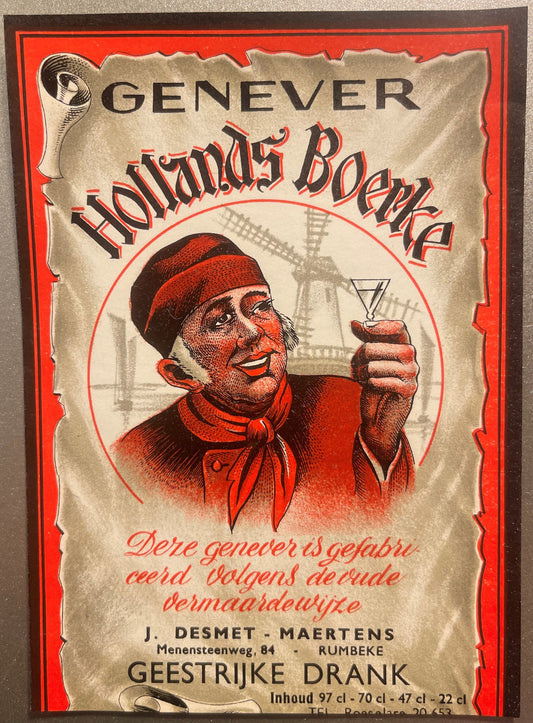
Antique Vintage 1920s Grande Fine Extra Qualite Wine Label 🥃 Elegant!

Antique Vintage 1920s Grande Fine Extra Qualite Wine Label 🥃 Elegant!

Regular price 8.00 USD
Regular price Sale price 8.00 USD
Sale Sold out
Shipping calculated at checkout.
Quantity

What Stories Hide Behind a Gilded Label from a Quiet Flemish Road? 🥃

There is a particular kind of quiet magic that comes from holding a piece of paper that once dressed a bottle of spirits in a Belgian townhouse — a label that carried a family's name, their pride, their craft, and their reputation into the hands of neighbors, café owners, and celebration tables across West Flanders. This is one of those pieces. The Grande Fine Extra Qualité label from Maison J. Desmet-Maerte of Rumbeke, Belgium is a richly produced color lithograph in gold, red, white, dark brown, and black — complete with a heraldic shield crest, a figure pouring a drink, and sweeping red banners that give the whole composition an air of ceremony and old-world prestige. It is New Old Stock (NOS), never applied to a bottle, preserved flat and intact as printed — a survivor from a world of small family spirit houses that quietly shaped the daily life and conviviality of Flemish Belgium.

The label reads, verbatim: GRANDE FINE EXTRA QUALITÉ / SPIRITUEUX / MAISON J. DESMET-MAERTE / CHAUSSÉE DE MENIN 165, RUMBEKE / TEL 051- / cont 018-048-070-097 L. / 13.491 — every line a small window into how a mid-20th-century Belgian spirits house presented itself to the world. This is not a mass-market curiosity. It is a genuine artifact of Flemish commercial and social history, produced with the full investment of the color lithographer's craft at a moment when a label was understood to be the face of a family and a guarantee of quality.


🏷️ The Label Itself — Craft, Color, and the Lithographer's Art

Let's spend a moment with the object before we go deeper into its world, because the printing itself is worth understanding. This is a color lithograph — not a modern offset print, not a digital reproduction, but a label produced through the stone-or-plate lithographic process that defined commercial label-making from the mid-nineteenth century well into the twentieth. In that process, each color is laid down in a separate pass: the gold field first, then the dark ground of the crest, then the vivid red of the banners, then the fine black letterforms. Registration — the precise alignment of one color layer over another — was a point of professional pride for the lithographer's shop, and when you look at this label you can see that pride at work in the clean, confident lines where gold meets red meets black.

The design vocabulary is unmistakably European prestige-spirits: a heraldic shield crest at the center top, rendered in dark brown and gold, bearing a crowned figure who leans forward in the act of pouring a drink into a stemmed glass — an image both dignified and warmly human, the universal gesture of hospitality given heraldic weight. Flanking the shield, ornate scrollwork curls outward in the gold ground, and two sweeping red banners cross the composition horizontally, tying the whole arrangement together with a flourish that says, without a single word, this is a house of quality. Below, the cream-white panel carries the product name in bold serif capitals — GRANDE FINE / EXTRA QUALITÉ — and beneath that, in the warm gold-bronze lower register, the house name and address are set in clean, confident type.

The color palette — that particular combination of burnished gold ground, deep red banners, cream panel, and near-black heraldic detail — was not chosen casually. It echoes the livery of Cognac and French brandy houses, a deliberate visual language telling the buyer that this product aspired to the same register of quality as the great French fine houses. In Belgium, where French commercial and cultural prestige carried enormous weight well into the mid-twentieth century, that signal mattered enormously at the point of sale.


🏡 Rumbeke and the Chaussée de Menin — A Road That Made a Region

To understand this label, you have to understand its address: Chaussée de Menin 165, Rumbeke. That road — in Flemish, Steenweg op Menen — is one of the oldest and most historically loaded highways in all of Belgium. It was built between 1751 and 1754 as part of the great Enlightenment-era effort to bind the Austrian Netherlands together with proper paved roads, connecting Bruges to Menen in a straight, hard-surfaced line that cut through the agricultural heartland of West Flanders. For two and a half centuries, it has been the commercial spine of this part of the province — the road along which goods moved, along which farmers brought their harvest to market, along which travelers stopped for refreshment, and along which small family businesses planted their flags.

Rumbeke itself is a sub-municipality of Roeselare, the principal city of the western Roeselare arrondissement in West Flanders. Roeselare and its satellites — of which Rumbeke is one — sit in the flat, fertile, canal-crossed landscape that has defined Flemish agricultural and small-industrial life for centuries. This is a landscape of deep roots: of families whose surnames appear in parish registers going back three hundred years, of communities where a business carrying two family names — a husband's and a wife's — was understood immediately as a statement of generational commitment.

The agricultural richness of the Rumbeke area is documented in the heritage record: in the nineteenth century, the area was famous for chicory cultivation, with the number of chicory kilns in Rumbeke alone rising from five in 1849 to thirty-one by 1866 — a figure that speaks to the industrious, diversified, food-and-drink orientation of this community's economy. The same productive agricultural base that fed chicory roasting and malting also supported the small distilleries and spirits houses that were woven through Flemish commercial life. The region's cafés, its Sunday tables, its civic celebrations all ran on locally produced and locally bottled spirits — and it was family houses like Maison J. Desmet-Maerte that supplied them.

The telephone prefix on the label — Tel 051- — places this label in the era of the Roeselare regional telephone exchange, area code 051, which covers Roeselare and its surrounds to this day. That detail, combined with the typographic style and the printing conventions visible on the label, suggests this is an early-to-mid-twentieth-century production — though the precise dating remains open, as no manufacture mark was legible on the label itself. What I can say with confidence is that it comes from a period when a telephone number on a spirits label was itself a mark of business modernity, a signal that this was a house connected to the world and ready to take your order.


👨‍👩‍👧 The Desmet-Maerte Family — A Name That Carries Its Own History

The double surname Desmet-Maerte is, in itself, a piece of living Flemish social history. In Belgium — and particularly in Catholic, rural Flanders — it was standard practice for a family business to carry the combined surnames of the husband and wife who founded it: Desmet (his name) joined to Maerte (her family name), hyphenated and given to the world as a single identity. This was not mere convention. It was a public declaration: this house is a partnership, a family enterprise, a commitment made by two people and their descendants. When you read Maison J. Desmet-Maerte, you are reading the story of a marriage that became a business.

The Desmet surname is among the most deeply rooted in Rumbeke and the broader Roeselare area — genealogical records document Desmet family members in Rumbeke parish registers across the eighteenth, nineteenth, and twentieth centuries. The name itself derives from the Flemish word for smith (de smet), making it among the oldest occupational surnames in the Flemish tradition. The Maerte name is equally Flemish, with strong roots in the West Flanders region. Together, Desmet-Maerte reads unmistakably as a family of this particular soil — not newcomers, not outsiders, but people whose names had been written into this community's records for generations before J. Desmet picked up a pen and signed a spirits license.

I have to be honest with you, as I always am: the specific history of J. Desmet — his first name, his dates, his story, the arc of the house he built — is not documented in the sources I have been able to reach. Small Belgian spirits houses of this kind were intensely local institutions. Their records lived in municipal archives, in excise registers, in the memory of their neighbors — not in the national press or in the databases that have been digitized and made searchable today. The absence of an easy online record is not a sign of obscurity or insignificance; it is, if anything, a sign of how thoroughly local this enterprise was, how completely it belonged to Rumbeke and to the people who lived and drank and celebrated there.

Collectors who specialize in Belgian spirits ephemera will tell you — and lore passed down among European label collectors holds — that the family spirits houses of West Flanders were among the most design-conscious of their era. Competing for shelf space in the café and the grocer's shop, they invested in their labels with a seriousness that larger producers sometimes didn't bother with. A house like Maison J. Desmet-Maerte, operating from a fixed address on a well-traveled highway, needed its bottle to announce itself across a crowded shelf. Hence: the heraldic crest, the gold ground, the red banners, the confident typography. This was a family putting its best face forward, every time a bottle left the cellar.


🍇 Grande Fine — The Prestige of the Grape Brandy Tradition

The product name itself tells a story worth knowing. Fine — in French and Belgian commercial usage — specifically denotes a grape-based brandy or eau-de-vie, a spirit distilled from wine or grape pomace in the tradition of Cognac and Armagnac. Grande Fine amplifies that claim: this is not merely a fine, but a great one, a top-of-house offering. Extra Qualité then adds a third layer of assurance — extra quality, the best the house produces.

The word Spiritueux on the label is the French generic term for spirits — the category designation that told the buyer and the excise inspector alike that this was a taxable, regulated product properly presented. In Belgian commercial practice of the early-to-mid twentieth century, French-language labeling on spirits was not merely tolerated but expected, even on products made and sold in the Flemish-speaking provinces. French carried prestige, and prestige was precisely what a house called Grande Fine Extra Qualité was selling.

The reference number L. 13.491 at the bottom of the label is almost certainly a license or excise registration number — the Belgian spirits trade was closely regulated, and licensed producers and blenders carried identifying numbers that would have been traceable to a specific register in the relevant municipal or provincial authority. This number, if followed into the archives of the Stadsarchief Roeselare or the Belgian excise records of the period, could very likely tell us exactly when J. Desmet-Maerte registered as a spirits dealer and how long the house operated. That archival thread remains to be pulled — but the number's presence confirms that this was a properly licensed, above-board spirits operation, not a casual backroom bottler.

The content volumes listed — cont 018-048-070-097 L — indicate the bottle sizes for which this label was designed, expressed in liters: roughly a fifth, a half-liter, a seventy-centiliter, and a liter, the standard progression of Belgian spirits retail. This is a commercial label designed for real, multi-size production — not a novelty, not a sample, but the working face of a functioning spirits house.


🌍 The Belgian Spirits World — A Context That Makes This Label Richer

To hold this label is to hold a fragment of a world that has largely disappeared. The small-scale Belgian spirits house — the maison de spiritueux that bought, blended, bottled, and branded its own products under a family name — was a fixture of Flemish commercial life from the nineteenth century through much of the twentieth. These were not distilleries in the grand industrial sense; many were blenders and bottlers who sourced base spirits, applied their own expertise in blending and finishing, and put their family name on the result as a guarantee of quality and consistency.

The legal framework that made this world possible was established in Belgium when the concept of the licensed agricultural distillery was formally introduced on 27 June 1842 — a fiscal category that granted excise reductions to distilleries operating in connection with agricultural production, and which drove an explosion of small-scale spirits production across Flanders and the rest of Belgium throughout the second half of the nineteenth century. By the early twentieth century, the Belgian countryside and its market towns were dotted with spirits houses of every size and character, from major industrial producers to single-family operations like the house on the Chaussée de Menin.

Old-timers in the Roeselare area — and collectors of Belgian spirits ephemera will confirm this — recall a time when every town of any size had at least one family spirits house whose label was as familiar to locals as the family's face. You knew the Desmet-Maerte bottle the way you knew the baker's loaf: by its wrapper, by its colors, by the crest that told you exactly whose hands had prepared what was inside. That intimacy between producer, product, and community is something that the modern spirits industry — for all its sophistication — has largely been unable to replicate.

The mid-twentieth century brought enormous pressure on these small houses. Consolidation, modernization, the rise of national and international brands, and the gradual harmonization of European spirits regulations all worked against the local family producer. Many of Belgium's small spirits houses closed quietly, their labels going unsold in storerooms, their bottles disappearing from café shelves as the branded giants moved in. That process of disappearance is precisely why a label like this one — New Old Stock, never applied, preserved from that era of quiet closures — is so significant to the collector today. It is evidence of a world that did not survive into the internet age, and that left almost no digital trace.


🖼️ Display Ideas

  • 🖼️ Frame it in gilded antique gold: The label's own gold ground calls for a complementary frame — a wide gilded or brass-finished frame with a deep ivory or cream mat lets the heraldic crest and red banners read as the artwork they are, displayed at eye level in a dining room, home bar, or study.
  • 🍾 Group it with Belgian and French spirits ephemera: Paired with other Cognac, jenever, or fine brandy labels from the same era — mounted together in a linen-matted shadow box — this label becomes an anchor piece in a gallery-style display of mid-century European spirits design.
  • 🗺️ Map-and-label pairing: Mount this label alongside a vintage map of West Flanders or the Roeselare arrondissement, pinning Rumbeke and the Chaussée de Menin — a display that tells both the graphic and geographic story at once, and gives viewers a way to place themselves in the landscape.
  • 🏠 Home bar feature wall: A well-lit dedicated wall in a home bar or wine cellar, with this label as the centerpiece surrounded by period bottles, vintage corkscrews, and Belgian café glassware, creates an atmosphere of authentic old-world hospitality that no reproduction piece could match.
  • 📚 Collector's portfolio display: For the serious ephemera collector, this label deserves archival sleeve presentation in a collection binder or flat-file, alongside documentation of its provenance and the research notes on Maison J. Desmet-Maerte — a reference piece as much as a display one.
  • 🎨 Graphic design or printing history study: This label is a genuine teaching document for the color lithographer's craft — the layering of gold, red, black, and cream, the registration discipline, the heraldic illustration style all speak to a specific moment in commercial printing history. Framed in a design studio or classroom, it opens conversations about how commercial art once worked.

🎁 Who Collects These

Belgian spirits labels of this character draw a wonderfully varied community of collectors, and I've had the pleasure of connecting many of them with pieces through this shop. European spirits and liqueur ephemera collectors are the obvious first audience — people who understand the world of small family spirits houses and who know exactly what it means to find a NOS label from a house this local and this well-designed. Belgian heritage and genealogy enthusiasts are drawn to pieces like this for obvious reasons: the Desmet and Maerte family names are deeply rooted in West Flanders, and for a descendant, a family business label is an irreplaceable personal artifact. Graphic design historians and commercial printing collectors value the lithographic craft here — the gold ground, the heraldic illustration, the color registration — as a primary source document in the history of label design. Home bar and hospitality décor collectors want the warmth and authenticity that a piece like this brings to a curated space — something that tells a real story. And Roeselare and West Flanders local history researchers will recognize immediately that a NOS label from a house operating at a specific address on the Chaussée de Menin is a primary source document — the kind of material that municipal archives are always glad to receive reference copies of.


❓ Frequently Asked Questions

Q: What exactly is a "Grande Fine" — is this a brandy label, a gin label, a liqueur label?
A: Fine in French and Belgian spirits usage specifically refers to a grape-based brandy or eau-de-vie — a Cognac-style spirit distilled from wine or grape material. Grande Fine Extra Qualité positions this as the top-of-house grape brandy offering from Maison J. Desmet-Maerte, presented under the broader category designation Spiritueux (spirits). This is emphatically not a gin or a jenever label — it is from the brandy/fine tradition.

Q: Can you tell me more precisely when this label was made?
A: No manufacture mark was legible on the label, so I won't claim a specific year or single decade — that would be a claim I can't prove. The telephone format, the typographic conventions, the printing style, and the multi-size content listing all point toward an early-to-mid-twentieth-century production date, but that is a wide, defensible range rather than a pinned date. If exact dating matters to you, the registration number L. 13.491 may be traceable through the Stadsarchief Roeselare.

Q: What does the "L. 13.491" number on the label mean?
A: Almost certainly a Belgian excise or spirits trade license registration number — the kind of identifying number that Belgian spirits producers and bottlers were required to carry on their labels under the regulatory framework governing the spirits trade. If followed into Belgian excise archives or the Stadsarchief Roeselare, this number could potentially be matched to Maison J. Desmet-Maerte's original license registration, which would give a firm date for when the house was operating.

Q: Why is it so hard to find information about Maison J. Desmet-Maerte online?
A: Because this was a genuinely local, community-scale business in a Flemish market town — exactly the kind of enterprise whose records lived in municipal archives, excise registers, and neighborhood memory rather than in newspapers or national databases. The small family spirits houses of West Flanders were not seeking national coverage; they were serving their neighbors on the Chaussée de Menin. The absence of an online record is, in a real sense, a mark of how authentically local this piece is. The history is there — it simply lives in Roeselare's archives rather than on the internet.

Q: Is this the kind of label that would interest a museum or local heritage archive?
A: Absolutely. NOS commercial labels from small Belgian family spirits houses are exactly the kind of primary source material that local heritage institutions — including the Stadsarchief Roeselare, the heemkundige kring for Rumbeke, and collectors associated with the Ten Mandere heritage circle — actively seek. This label is documentary evidence of a business that operated at a specific address in a specific community, and for the right archive or researcher it is genuinely irreplaceable.

Q: What does "New Old Stock" mean for a piece like this?
A: New Old Stock means this label was produced for commercial use, was never applied to a bottle, and has been preserved flat since leaving the printer's shop — it is the label as originally made, not a used piece peeled from a bottle. For the collector and the researcher alike, NOS status means you are looking at the label exactly as the lithographer intended it to look, with all the color, detail, and graphic integrity of the original production.

Q: The "Desmet-Maerte" double surname — is that a Belgian naming convention or something unusual?
A: It is entirely standard Flemish and Belgian practice for a family business. The hyphenated double surname joins the husband's family name (Desmet) with the wife's family name (Maerte), presenting the business as a joint partnership under both family identities. You see this convention across Belgian commercial history in every trade from bakeries to breweries to spirits houses — it was a public statement of shared ownership and shared responsibility, and it tells you immediately that this was a genuine family enterprise rather than a corporate brand.

Shipping

🚚 Shipping & Handling

  • Shipping costs and timing are calculated at checkout.
  • Items curated and shipped directly by me include U.S. shipping at no additional cost, professionally packed to ensure safe arrival of your artifact.

Items from Vetted Pro Collectors
Shipping for items offered by vetted Pro Collectors is determined at checkout. All Pro Collector listings are reviewed to ensure fair, reasonable shipping practices.

For full details, please refer to our Shipping Policy.

Returns & Exchange

Take your time — you've got a full six months. If a piece isn't right for you, send it back the way it reached you and we're good.

In the first 30 days your money goes straight back the way you paid. After that it's store credit, so you can put it toward something you'd rather have.

Return shipping we sort out between us, case by case. I don't make this difficult.

If something arrives damaged, or it isn't what I said it was, send me a photo within 48 hours and I'll make it right.

Email info@vintageantiquesgifts.com or call 802-356-9872 — that's me answering, not a call center.

The only things I can't take back are custom or special-order pieces and gift cards.

View full details