Skip to product information
1 of 2

Vintage and Antique Gifts

Vintage Grande Fine Extra Qualité Spirits Label 🥃 Maison J. Desmet-Maertens, Rumbeke Belgium, Gold Heraldic Crest and Red Banners

Vintage Grande Fine Extra Qualité Spirits Label 🥃 Maison J. Desmet-Maertens, Rumbeke Belgium, Gold Heraldic Crest and Red Banners

Regular price $8.00 USD
Regular price Sale price $8.00 USD
Sale Sold out
Shipping calculated at checkout.

Size: 4 1/2" x 3 1/2"

🚚 Free US Shipping — ships within one business day. International shipping calculated at checkout.

Quantity

What Was Grande Fine Extra Qualité? 🥃 A Spirits House on the Road to Menin

Size: 4 1/2" x 3 1/2"

Most spirits labels tell you what is in the bottle. This one also tells you where to knock: MAISON J. DESMET - MAERTENS, CHAUSSEE DE MENIN 165, RUMBEKE, TEL 051-20653. A spirits house in a Flemish village printed its name, its street address and its telephone number in French, under a gold ground, two red banners and a dark heraldic shield, and made its promise in big letters: GRANDE FINE, EXTRA QUALITÉ. This is a vintage Belgian spirits label, New Old Stock, never put on a bottle.

🔎 What Is Printed on It

  • GRANDE FINE in large dark capitals, with EXTRA QUALITÉ beneath, on a cream band
  • SPIRITUEUX across the gold lower band, then MAISON J. DESMET - MAERTENS
  • CHAUSSEE DE MENIN 165, RUMBEKE and TEL 051-20653
  • cont 018-048-070-097 L at the lower left, a contents line in liters
  • R.C COURTRAI 13.491 at the lower right, the house's number in Belgium's trade register
  • A dark shield edged in gold, holding a small white figure wearing a crown and leaning over a white stemmed glass among gold leaves
  • Two red ribbon banners and white scrolls sweeping out from the shield across the gold
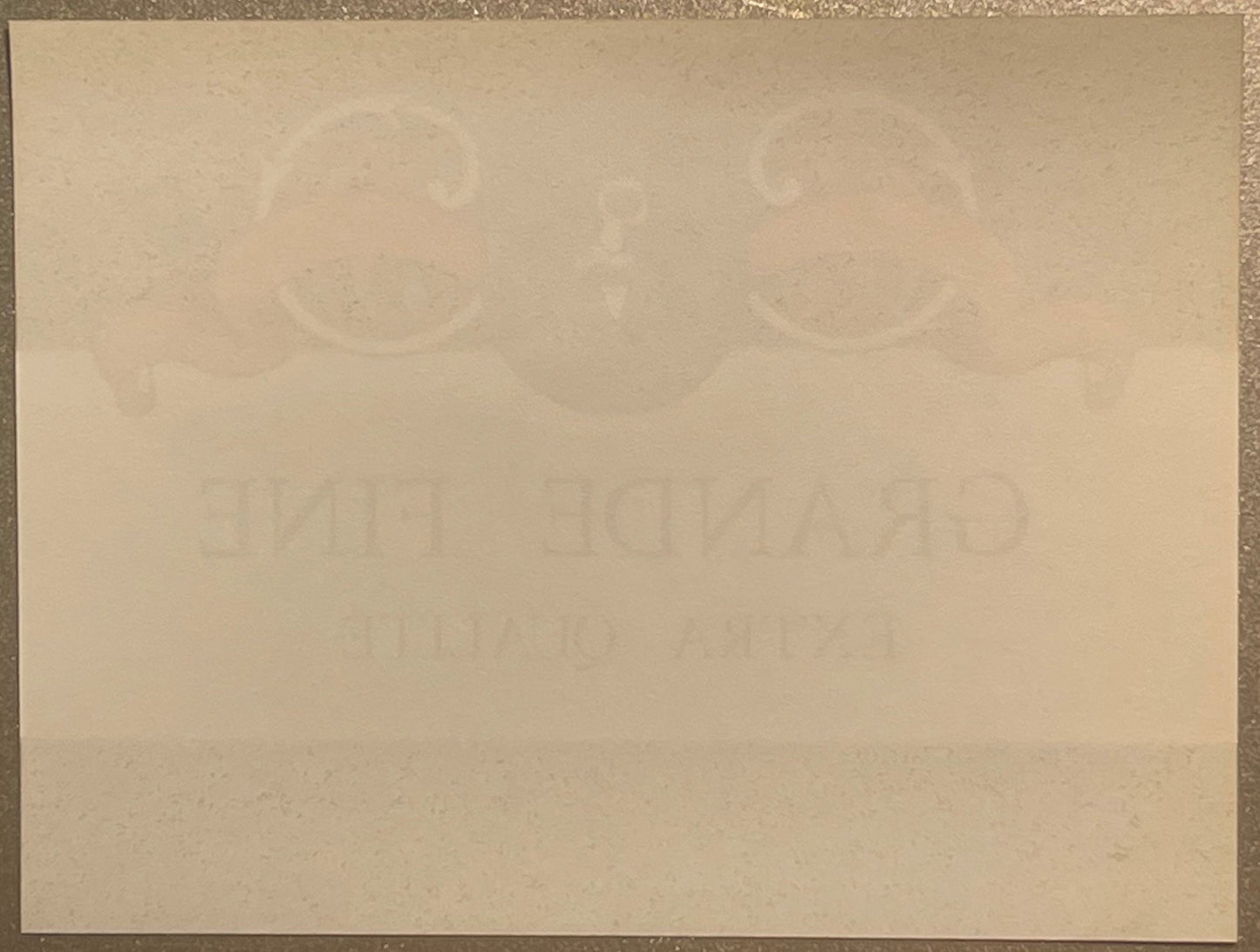
  • The back is plain paper, with the design showing faintly through in reverse

🏡 Rumbeke, West Flanders

Rumbeke is a village of about 15,000 people in the Belgian province of West Flanders, and since the municipal mergers of 1977 it has been part of Roeselare. Its name was first written in the 12th century as Rumbeca, "broad stream." From the 16th century the village lived on flax, with spinning and weaving done in its houses; chicory growing and ceramic kilns came later, and in 1906 Adolf Sioen founded Rumbeke's first mechanical weaving mill. Chicory boomed there in the second half of the 19th century: Rumbeke had only five chicory drying kilns in 1849 and thirty-one by 1866. Its landmark is the Kasteel van Rumbeke, built between 1520 and 1535 and counted among the oldest Renaissance castles in Belgium, beside the Sterrebos woods. After the First World War the village added an outdoor velodrome, later known as the Defraeye-Sercu track.

The phone number on the label still points home: zone 051 is Roeselare's, the city the French called Roulers and the home of the Rodenbach brewery, founded in 1821. Today a number in that zone carries six digits after the 051. The five on this label belong to the older, shorter numbers of the Belgian telephone system.

🗣️ A Flemish House Speaking French

Rumbeke lies in Dutch-speaking Flanders, yet every word on this label is French. The road is the Chaussée de Menin, the road to the town the Flemish call Menen. The road on the label has a long history of its own: the paved highway from Bruges through Roeselare to Menen was laid out between 1751 and 1754, in the Austrian Netherlands of Maria Theresa, in one straight tree-lined line along an older dirt track, and soon carried stagecoaches between Bruges and Menen. The register line names Courtrai, the French name for Kortrijk, the city of the Battle of the Golden Spurs fought on 11 July 1302. Even the product is sold as SPIRITUEUX rather than in Dutch. That small choice is a piece of a bilingual country's long argument with itself: a 1932 law drew Belgium's language areas by the language of the majority, and a 1962 law fixed which municipality belonged to which area.

My favorite bit of small print is down in the right-hand corner: R.C COURTRAI 13.491. That is the house's entry in Belgium's trade register. Belgian law told every trader to put it on his invoices, letters and order forms: R.C. for Registre du commerce (or H.R. for Handelsregister), then the seat of the commercial court that kept his entry, then his number. This house printed it on its labels too. Rumbeke lay in the Kortrijk court's district, so a village spirits house signs itself COURTRAI, and 13.491 was its number on that court's books. The register is gone now. Belgium did away with it in 2003 and folded it into one national database, the Kruispuntbank van Ondernemingen.

🍷 What "Grande Fine" Promised

In French a fine is a brandy of superior quality. The dictionary defines it as grape brandy, especially cognac, of the better kind, the word being a shortening of fine champagne, and Jules Romains put it in a character's mouth in his 1922 novel Les Copains, a man boasting of the fine he keeps. Strictly speaking, a fine is brandy distilled from wine, not from the pressed skins and pips, which give you marc instead, and fines take in armagnac as well as cognac. I like that the very same two words sit in Cognac's own list of names, as Grande Fine Champagne. The label stacks three promises on top of that word: GRANDE, FINE and EXTRA QUALITÉ. Then it files the bottle plainly under SPIRITUEUX, spirits.

Flanders was distilling country. On 27 June 1842 Belgium created the landbouwstokerij, the agricultural distillery: a tax category for a distillery tied to a farm that raised cattle or grain, which paid 15% less excise and made such distilleries a success, especially in Flanders.

⚖️ Belgium's Two-Litre Rule

A Belgian spirits house of the twentieth century sold into one of the strangest drink laws in Europe. On 29 August 1919 the Vandervelde Law banned the sale of spirits in cafés and pubs. Belgians could still buy spirits in shops to drink at home, but only in quantities of at least two liters. The joke of it has become legend: a Belgian caught in the street with one bottle was a criminal, and with two bottles there was no problem. One lasting effect was that small bottles of spirits never became as common in Belgium as in other countries.

The law carried the name of Emile Vandervelde (1866-1938), a socialist of the Belgian Labour Party and a passionate anti-alcohol campaigner who had written L'Alcoolisme et les conditions de travail en Belgique in 1899. As Minister of Justice after the First World War he backed measures against alcoholism, yet he is said to have rejected the honor of the law's name, thinking it too much of a compromise. The rule lasted until it was abolished on 1 January 1984.

It also left a myth behind. Beer lovers still repeat that the Vandervelde Law drove Belgians to strong dubbels and tripels. The numbers say otherwise: the average Belgian beer was 3.29% alcohol in 1900 and only 3.36% in 1930, and dubbel and tripel stayed rare until after 1950.

🔨 Desmet: The Smith

The house name carries its own history. De Smet or Desmet is a Dutch occupational surname, a regional form of "the smith." It was the tenth most common name in all of Belgium in 1997 and is very common in East and West Flanders, which makes MAISON J. DESMET - MAERTENS about as West Flemish a name as a spirits house could have. The double name reads the way the Dutch-speaking Low Countries have long written a married name: the married surname first, then the maiden name after the hyphen. Brandy was not all the house put its name to, either: labels are known for its Rhum Kwango and Rhum Vieux Mouke, a Punch au rhum, another Grande Fine called Mont Doré, and a bottling called Smetje's Oude Klare.

Old-timers around Roeselare still recall a time when every town of any size had its own family spirits house, whose label locals knew as well as the family's face.

🖼️ Living With It

  • Frame it with a cream mat and a thin gold frame so the gold ground and red banners lead.
  • Hang it in a home bar or kitchen beside Belgian beer glasses or an old bottle.
  • Pair it with a map of West Flanders for anyone with roots around Roeselare or Kortrijk.
  • Give it to a Belgian family, a spirits collector, or a lover of European label design.

❓ Questions People Ask

What does Grande Fine mean? "Fine" is French for a superior brandy, and "grande" and "extra qualité" push the promise higher. The label files the bottle under SPIRITUEUX, spirits.

Where was Maison J. Desmet-Maertens? At Chaussée de Menin 165 in Rumbeke, West Flanders, a village that has been part of Roeselare since 1977.

Why is a Flemish label printed in French? The whole label uses French forms, from Chaussée de Menin to Courtrai, in a country that spent the twentieth century legislating its language areas.

What is the "cont" line? A contents line listing volumes in liters, printed in the lower left corner.

What does R.C COURTRAI 13.491 mean? It is the house's trade register entry: R.C. for Registre du commerce, Courtrai for the Kortrijk court that kept the register, and 13.491 for the house's number on it.

Was it ever used? No. It is New Old Stock, never applied to a bottle.

Shipping

🚚 Shipping & Handling

  • Shipping costs and timing are calculated at checkout.
  • Items curated and shipped directly by me include U.S. shipping at no additional cost, professionally packed to ensure safe arrival of your artifact.

Items from Vetted Pro Collectors
Shipping for items offered by vetted Pro Collectors is determined at checkout. All Pro Collector listings are reviewed to ensure fair, reasonable shipping practices.

For full details, please refer to our Shipping Policy.

Returns & Exchange

Take your time — you've got a full six months. If a piece isn't right for you, send it back the way it reached you and we're good.

In the first 30 days your money goes straight back the way you paid. After that it's store credit, so you can put it toward something you'd rather have.

Return shipping we sort out between us, case by case. I don't make this difficult.

If something arrives damaged, or it isn't what I said it was, send me a photo within 48 hours and I'll make it right.

Email info@vintageantiquesgifts.com or call 802-356-9872 — that's me answering, not a call center.

The only things I can't take back are custom or special-order pieces and gift cards.

View full details

Preserving History: Authentic Objects Across Eras

— Curated by Travis Weigel