Skip to product information
1 of 8

Vintage and Antique Gifts

Antique 1924 The Southern Philatelist Vol I No 1 Confederate Stamps Postal History 📬

Antique 1924 The Southern Philatelist Vol I No 1 Confederate Stamps Postal History 📬

Regular price 21.00 USD
Regular price Sale price 21.00 USD
Sale Sold out
Shipping calculated at checkout.
Quantity

Size: 10 x 6.75 inches

📬 The First Issue of a Landmark Confederate Stamp Journal

This is Volume I, Number 1 of The Southern Philatelist — the very first issue, dated November 1924 on its own masthead. It was published in Richmond, Virginia by the Press of the Dietz Printing Company, at 109 East Cary Street, and edited by August Dietz, with August Dietz, Jr. listed as business manager. The interior title page carries the journal's motto, “An Exponent of Advanced Philately,” and prints the terms of the day right on the page: two dollars a year, twenty cents the single copy, advertising rates on request. Everything described here is drawn from the issue itself and from the documented history of Confederate philately; nothing has been invented or added.

The cover alone tells you what this magazine set out to do. At its center sits a Confederate twenty-cent stamp design bearing the portrait of Washington, printed in two colors and framed by the words “Confederate States” and “Twenty Cents,” and struck across it is a bold circular postmark reading RICHMOND · NOV 1 1924 · Va — the capital of the old Confederacy reborn as the capital of its philatelic scholarship. Below runs the imprint of the Dietz Printing Company. It is a quietly brilliant piece of design: a modern cover cancelled as though it had just passed through a nineteenth-century Southern post office. That single image announces the whole editorial mission — the serious, affectionate study of the mails of the Confederacy.


🖋️ August Dietz and “A Come-Back”

The issue opens with an editorial titled “A Come-Back,” and it is a genuinely moving little essay. In it Dietz explains that twenty-seven years earlier — to the very month — he had penned his “Salutatory” in the first number of an earlier journal, The Virginia Philatelist. He recalls being led into “philatelia's enchanted realm” by his schoolmaster somewhere between 1878 and 1880, and how, after an apprenticeship in lithography, typography and engraving and a trip abroad, he realized a young man's ambition to edit a stamp magazine. That first venture, he writes, appeared monthly for three years — three volumes of thirty-six numbers — published by the Virginia Philatelic Publishing Company at 13 North Eleventh Street, which he notes was the very building that had housed the last post office in the Capitol of the Confederacy. He is proud of that old journal, calling it among the first, if not the pioneer, to awaken interest in the stamps of the Confederate States.

So this is not merely a first issue; it is a return. Dietz set aside the editorial chair for a quarter century to build his printing house, and here he steps back into it with the confidence of a man who has been away only long enough to sharpen his purpose. August Dietz would go on to become the foremost authority on Confederate philately, and the serialized history he launches in these pages grew, in the years that followed, into the standard reference work on the postage stamps of the Confederate States. To hold his first number is to hold the starting line of that life's work — the moment the field's founding scholar picked up his pen again.


📯 The Story of the Confederate Post Office — from the Source

The heart of the issue is the first installment of Dietz's great serialized history of the Confederate Post-Office Department and its postage stamps. He begins with a “Prolog” that sets the stage: the Provisional Congress at Montgomery, the reluctant acceptance of the postal portfolio by the Texan John H. Reagan, the first gun at Fort Sumter on April 12, 1861, Lincoln's call for volunteers, and the rapid secession of Virginia and then Arkansas, North Carolina and Tennessee, with Missouri and Kentucky following. A charming engraving in these pages shows the old Statehouse at Columbia, South Carolina, where the state legislature adopted its Ordinance of Secession in December 1860. From that point, Dietz writes, Richmond “became and remained the seat of government of the Confederate States of America.” It is history told by a man who literally worked in the old capital — he notes that the original proposal appeared in the Richmond Enquirer, “in the building where I write.”

The narrative then turns to “The Proposal and the Bidders.” The Postmaster-General issued his call for postage stamps on March 27, 1861, and the advertisement appeared in the Richmond press in the first days of April. The new Post-Office Department received bids from a remarkable roster of printing and engraving houses: Edmund Hoole of New York; Butler & Carpenter of Philadelphia; George F. Nesbitt of New York; the American Bank Note Company; A. Hoen & Company of Baltimore; J. W. Hayes of Newark; and the modest lithographing house of Hoyer & Ludwig of Richmond. Dietz notes that five of these letters still survived in the archives of the United States War Department, first brought to light decades later and published in an earlier philatelic journal. The issue reproduces their correspondence — including A. Hoen & Company's offer to change the designs as desired and to take a portion of its pay, say one-fourth or one-third, in Treasury Notes of the Confederacy, and J. W. Hayes's quotation of perforated, well-gummed stamps in packages of one hundred sheets at twenty cents per thousand in one color and thirty-five cents in two.


🖨️ Hoyer & Ludwig, A. Hoen & Co., and the Rejected Designs

What follows is the crux of the whole Confederate stamp story, and this first issue tells it plainly. Because Virginia had cast her lot with the South, the contract “could not be placed with firms in the enemy's country.” That single fact eliminated every Northern bidder and left the earliest work to Hoyer & Ludwig of Richmond — the firm that would print the first Confederate stamps. Dietz is generous about the losing entries, praising the artistic treatment and workmanship of the samples that survive, and regretting that several of the finer designs were never made part of the general issue.

The pages here illustrate what survives of those competing and preliminary designs: paste-up designs in two colors, a piece labeled “Hoyer & Ludwig's Flag,” three of the four designs offered by A. Hoen & Company (the twenty-cent value already missing when Dietz gathered them), several water-color sketches, a design marked “probably American Bank Note Co.,” and a striking essay attributed to an unknown artist of New Orleans — and the section closes with “To Be Continued.” For anyone drawn to the plate history of Confederate stamps — Hoyer & Ludwig, the Hoen essays, the lithographers of the wartime South — this is primary material, printed and illustrated the way its own author first assembled it. You are reading the essays and proposals through the eyes of the collector who tracked them down.


📪 More Inside: Covers, “Locals,” and the Advertising World of 1924

The issue carries far more than the lead history. A feature called “Unique Confederate Covers — No. 1” illustrates what Dietz calls probably the only used example of a certain Confederate one-cent stamp — “the stamp that was never put in use” — a value that had been prepared for the Confederacy by a London firm and found useless when postage rates changed. A sheet of them, he relates, had come in wartime into the hands of a Federal prisoner at Old Point Comfort and been fashioned, for want of paper, into an envelope: a soldier's letter that later carried a Northern “Due 3” marking. A second article, “What Constitutes a Confederate 'Local'?”, is Dietz weighing in on the vexed question of provisionals and hand-stamped “PAID” envelopes, and where the line of legitimacy should be drawn in the catalogs — the sort of connoisseur's argument that would occupy Confederate specialists for generations.

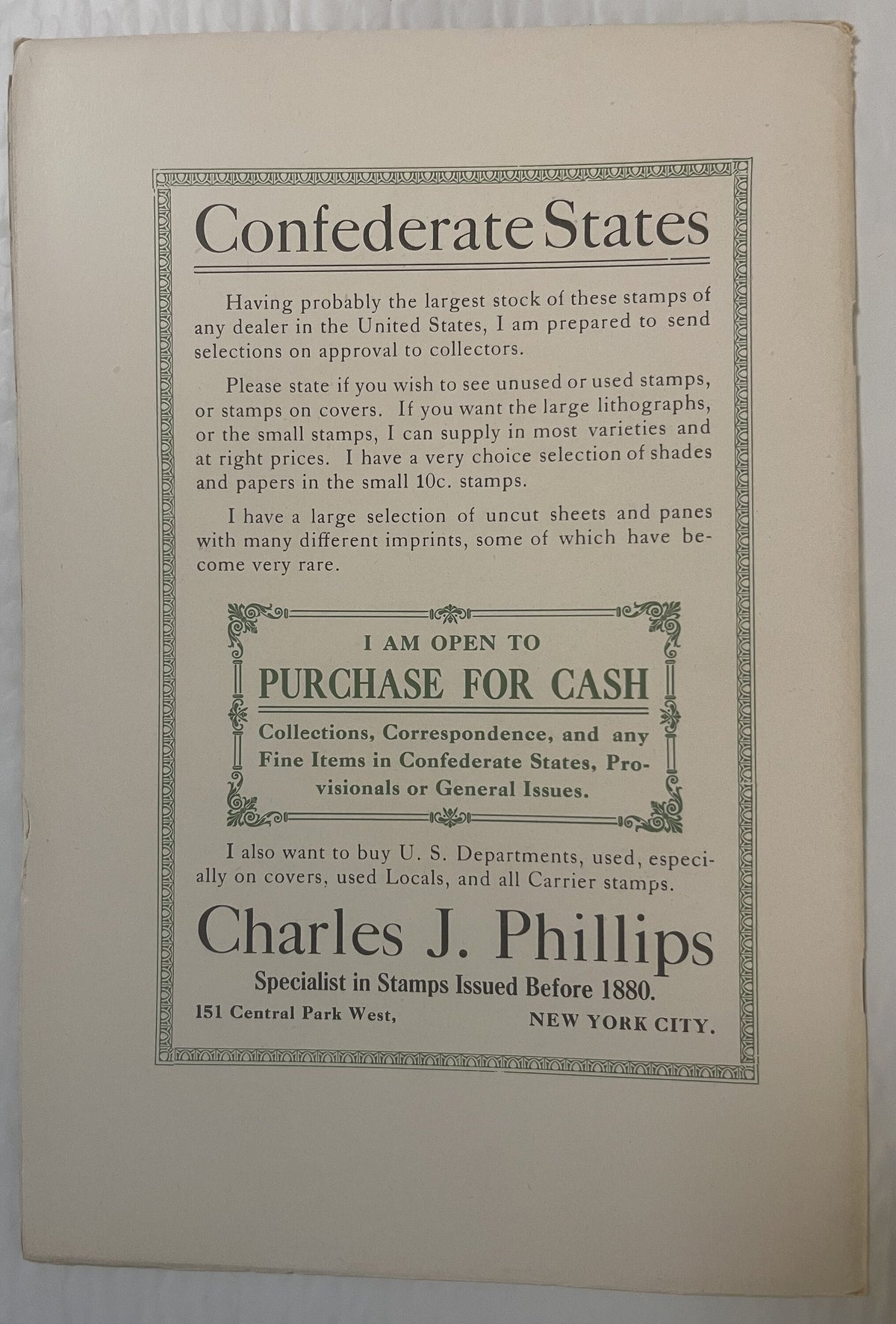
Around these articles run the advertising pages, and they are a time capsule in themselves. There are dealers in New York, Philadelphia, London and Springfield: one styling himself a specialist in stamps issued before 1880 and open to purchase Confederate material for cash; another wanting eight thousand covers; a London house offering a British Colonial Empire bargain and even a British penny black of 1840; and a New York firm pricing a run of Soviet Russia stamps “according to Scott's 1925 Catalogue.” One advertiser remarks on “a new generation of collectors” taking up the town cancellations found on Confederate stamps. There is a warm colophon describing “The House of Dietz” as a “Shop of the Craftsmen,” and a page of “Books for Christmas Presents.” Together they place you squarely in the philatelic world of late 1924.


📐 Condition and What You Receive

This is an original 1924 printing — New Old Stock, not a reproduction, reprint or facsimile. The magazine is complete, with its printed paper covers present front and back, and the interior is clean and fully legible throughout. It shows only the light handling and gentle surface undulation you would expect of an eighty-plus-year-old paper periodical that was made for a small circle of specialists and never intended to be kept. It measures roughly ten inches by six and three-quarter inches, in the original printed paper format. You will receive the single original issue pictured, from the same condition range shown.

✨ Why It Matters

Periodicals like this were printed in small numbers for collectors and researchers, read, and thrown away; a clean, complete first issue is the hard one to find. This is the number where the father of Confederate philately restarted his editorial career and began the serialized history that became the field's foundation stone. It is early reference literature, a beautifully printed artifact of Richmond craftsmanship, and a primary account of how the Confederacy's stamps came to be — the bidders, the rejected designs, the little Richmond lithographers who won the work — all in a single, honest, original copy. For the Confederate specialist, the postal-history reader, or the collector who loves a document that is itself a piece of the story it tells, it is a quietly remarkable thing to own.

Shipping

🚚 Shipping & Handling

  • Shipping costs and timing are calculated at checkout.
  • Items curated and shipped directly by me include U.S. shipping at no additional cost, professionally packed to ensure safe arrival of your artifact.

Items from Vetted Pro Collectors
Shipping for items offered by vetted Pro Collectors is determined at checkout. All Pro Collector listings are reviewed to ensure fair, reasonable shipping practices.

For full details, please refer to our Shipping Policy.

Returns & Exchange

Take your time — you've got a full six months. If a piece isn't right for you, send it back the way it reached you and we're good.

In the first 30 days your money goes straight back the way you paid. After that it's store credit, so you can put it toward something you'd rather have.

Return shipping we sort out between us, case by case. I don't make this difficult.

If something arrives damaged, or it isn't what I said it was, send me a photo within 48 hours and I'll make it right.

Email info@vintageantiquesgifts.com or call 802-356-9872 — that's me answering, not a call center.

The only things I can't take back are custom or special-order pieces and gift cards.

View full details