Skip to product information
1 of 8

Vintage and Antique Gifts

Vintage 1940s Orphan Boy Smoking Tobacco Label 🫏 John Weisert Tob. Co. St. Louis MO Fine Carolina NOS

Vintage 1940s Orphan Boy Smoking Tobacco Label 🫏 John Weisert Tob. Co. St. Louis MO Fine Carolina NOS

Regular price $5.50 USD
Regular price Sale price $5.50 USD
Sale Sold out
Shipping calculated at checkout.

Size: 2 3/4" x 1 3/4"

🚚 Free US Shipping — ships within one business day. International shipping calculated at checkout.

Quantity

Who Was the Underdog Mule of St. Louis? 🫏 A Vintage 1940s Orphan Boy Smoking Tobacco Label, Weisert of St. Louis

Size: 2 1/2" x 1 5/8"

What kind of tobacco company puts a mule on the label instead of a general, a beauty queen, or an eagle? Tobacco men of the day reached for all kinds of imagery to sell a pouch of smoking tobacco — presidents, generals, Native chiefs, racehorses, locomotives, eagles with wings spread wide. The John Weisert Tobacco Company of St. Louis, Missouri, reached for something humbler and, in its own way, far more memorable: a plain brown Missouri mule, standing alone and unbothered in his farmyard. That confident little animal became Orphan Boy, one of the more charming and enduring brand names to come out of a city that, in its heyday, was absolutely thick with tobacco manufacturers competing for the same corner store shelf.

A little unused tobacco label: ORPHAN BOY arched across a red banner over a brown mule standing by a log tobacco barn, then SMOKING TOBACCO. with a big ornamental T, FINE CAROLINA, and MADE BY JOHN WEISERT TOB. CO. ST. LOUIS, MO. At the very bottom is a tiny oval union bug from the Allied Printing Trades Union Label Council of St. Louis, which tells you it came off a union press in town. The back is blank. A seller who has handled plenty of them says they were made for Orphan Boy's cloth tobacco bags, and the dealers who carry this same unused stock put it in the 1940s. One dealer selling unused Weisert labels says the old stock came straight out of the John Weisert Tobacco Company itself.

The name ORPHAN BOY is spelled out in the kind of dimensional, hand-lettered display type that printers of the era were justly proud of, and the whole thing is a dense little halftone color print — screen dots giving the mule's coat and the farmyard real depth and texture, and ornate, drop-shadowed display lettering that turns a simple product name into something closer to a small poster. This was commercial art built to stop a customer's eye on a crowded shelf, and all these decades on, it still does exactly that.

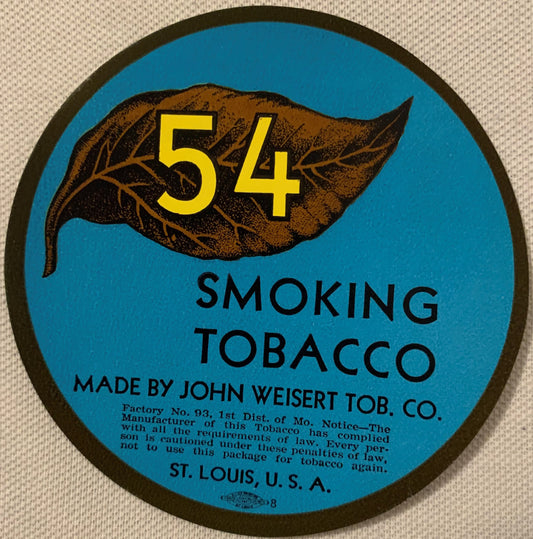
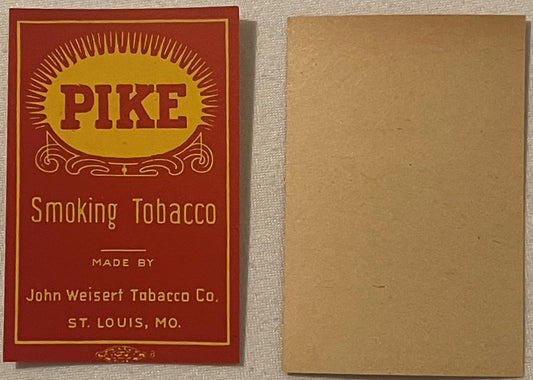
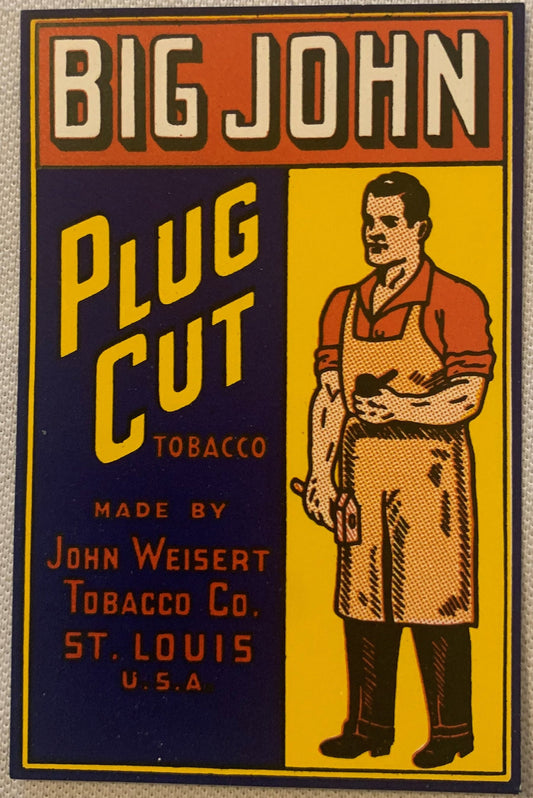
The name is a lot older than this printing. Orphan Boy was already on Weisert's list of union-made brands in 1909, and in January 1911 the company named Orphan Boy granulated among its leading brands, right alongside Pike, Granulated 54, Harp, Big John plug cut and its 93 cigar clippings. In 1915 a Weisert man was out introducing it in Cincinnati. A brand that was still being printed a generation later was a brand people kept asking for.

🫏 The legend of the mule himself

Here's the story the way it has been passed down in tobacciana circles. The legend holds that Orphan Boy was named for an actual Missouri-bred jack - a male donkey - who became something of a local sensation when he swept the mule competitions at the 1904 St. Louis World's Fair, the great Louisiana Purchase Exposition. The story goes that this animal came up without the pedigree and formal backing his rivals carried into the ring - no fancy bloodline, no deep-pocketed owner behind him - and he won anyway. He was the underdog. He was, as the old-timers told it, the orphan. And a stubborn, proud Missouri mule who beat the odds without a name behind him is exactly the kind of story a tobacco man in a crowded market would want on his brand.

Whether every detail of that tale holds up is the sort of thing collectors still argue about over a coffee table full of old labels — and that argument is itself part of the charm. What is not in question is the image the Weisert company put front and center: a mule standing alone, calm, sturdy, entirely unbothered, exactly as an underdog who has already proven his point would stand. Missouri has long called itself the "Show-Me State," and a Missouri mule who showed up and simply won is about as fitting a mascot as that state ever produced for a homegrown product. The 1904 World's Fair put St. Louis on the world stage for a season, and if a homegrown mule really did steal a little of that spotlight in the livestock rings, it's easy to see why a local tobacco company would want his name on every pouch.

🏭 John Weisert, the Big John tobacco man

The Weiserts had been in tobacco since 1855, when John Weisert, a German immigrant, started out in Virginia. Weisert Brothers was making tobacco in St. Louis by 1880, and in 1902 John Weisert Jr. went out on his own as the John Weisert Tobacco Company.

St. Louis was a tobacco town. At one time it was the biggest chewing tobacco supplier in the world, and until the First World War it turned out something like forty percent of the country's sales - Liggett & Myers, Drummond, Christian Peper, and Weisert. When the Tobacco Trust swallowed most of the independents, the John Weisert Tobacco Company was one of the few that not only survived it but thrived, with more than a hundred brands at one time; Big John was the best known, and folks called the outfit the Big John Tobacco Co.

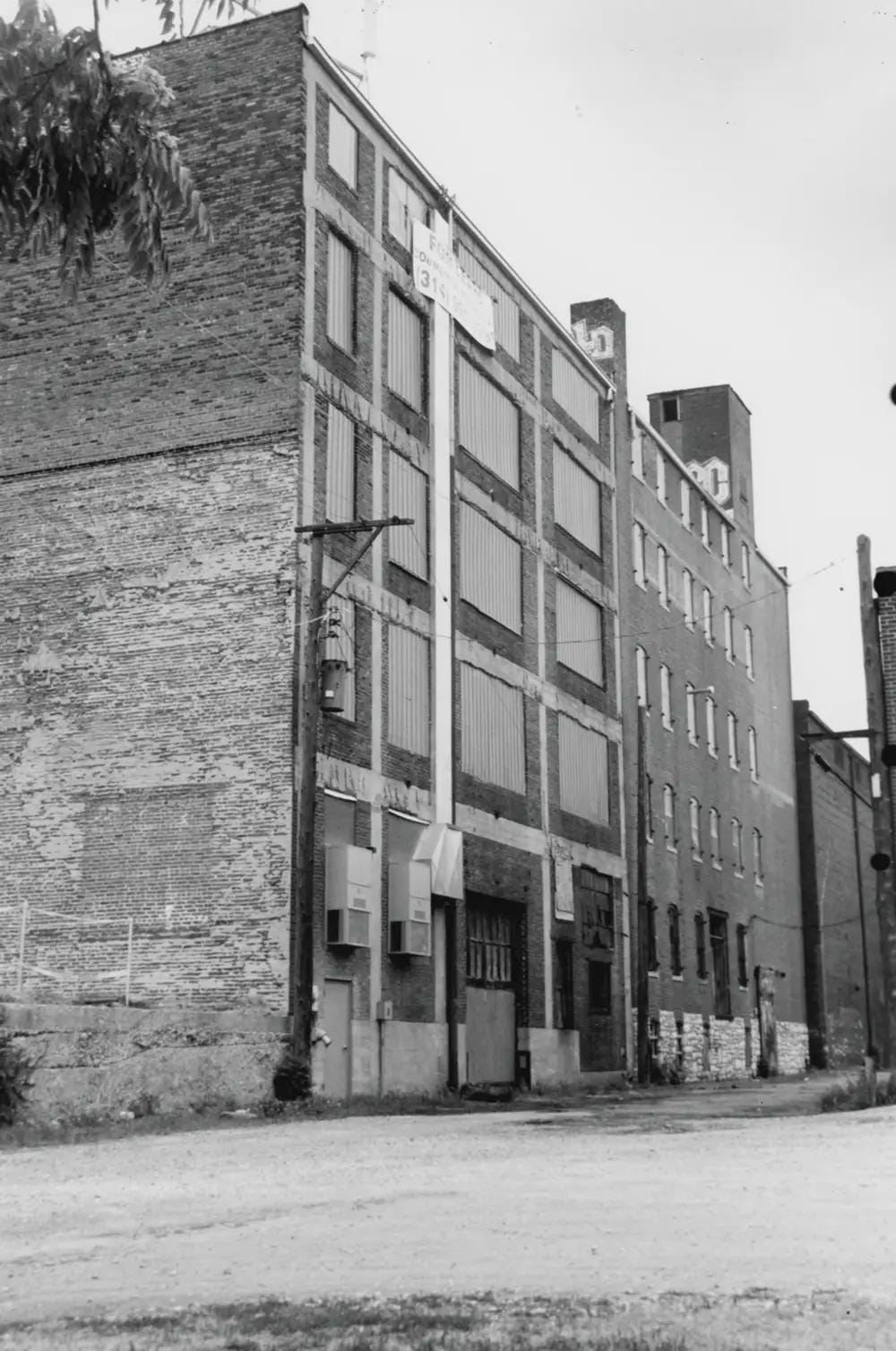
Long before the Gateway Arch defined its skyline, St. Louis was known nationally for tobacco. The building's own National Register nomination says over four hundred tobacco firms were active in the city when the industry peaked at the beginning of the twentieth century. St. Louis was one of the great American tobacco manufacturing centers, alongside Richmond, Durham, and Louisville, and the competition among its firms for shelf space, storefront loyalty, and brand recognition was fierce, colorful, and deeply local. When James Buchanan Duke was consolidating the industry under the American Tobacco Company, using below-cost pricing to drive smaller competitors out, Weisert did the opposite of retreating: it bought the brand names of the failing companies. The nomination lists Orphan Boy among them, alongside Drummer Boy, Joysmoke "the Happy Smoke" and, later, the entire cigar line of the Joseph Menendez Cigar Company. A surviving Weisert cardboard advertising sign shows packages of Orphan Boy, Big John and 54 together under the script headline "Smoker's Dream" — a company betting that a good mascot could carry a brand as far as the tobacco itself.

That factory, at 1120 South Sixth Street, went up in 1903, designed by Anton Rieve, with a warehouse added in 1922 as the business grew. And here's a bit of St. Louis history I can't resist: the ground it stands on was given in 1827 by John Mullanphy, St. Louis' first millionaire, to the Sisters of the Sacred Heart for an orphanage, and the Mullanphy Orphan Asylum, run by Mother Philippine Duchesne, stood there until 1894. So a company with a brand called Orphan Boy made its tobacco where the city's orphans had lived.

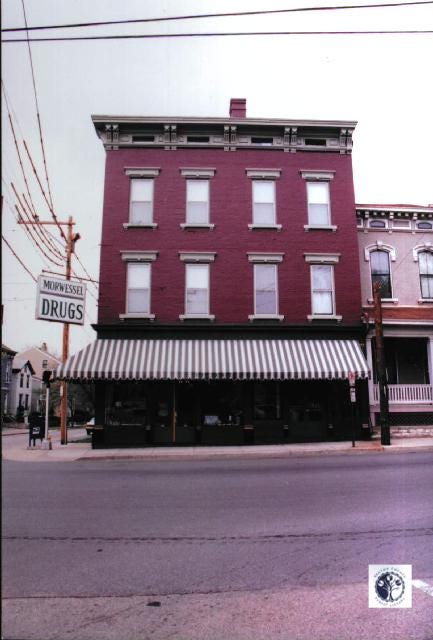
The building is known today as The Weisert Building. It's worth pausing on that, because so few tobacco firms of this size left anything behind at all beyond scattered paper. The bricks and mortar that once housed the leaf and the packing tables are still standing in St. Louis today — repurposed, but recognizably the same building, carrying the family name into the twenty-first century.

Weisert was the last tobacco maker in St. Louis. By the end the founder's grandson was working alone, adding the flavors to the cigars himself, and the company folded in 1989. The end is one of those quietly remarkable St. Louis stories: Weisert had to quit making its own cigars in 1976, when Louis Applestein, the last cigar hand-roller in the city, died at the age of 83. After that the grandson, Walter Weisert, flavored the cigar cuttings himself and was the only employee, working as president, staff and production crew, and the family kept the company until it went out of business - after 133 years in the tobacco business, by the nomination's count. The building was put on the National Register of Historic Places in 2004 and restored. The black-and-white photos of the Weisert factory at the end of my pictures are there for history only and aren't included; you get the label.

🌾 Fine Carolina

FINE CAROLINA was the selling line: bright leaf from the Carolinas was the smoking tobacco everybody wanted, and putting it on the label told a man at the counter what he was getting. A Missouri mule on a pouch of Carolina leaf, made in a St. Louis factory on an old orphanage lot, printed by a union shop - that's a lot of America on a label not three inches tall.

🖨️ The union bug

That little oval at the foot is what printing-trade historians and paper collectors call a "union bug" — a mark unionized print shops stamped onto their work to tell consumers, retailers, and fellow union members that the piece had come off union presses, set by union labor. These small seals were a genuine point of pride in the printing trade when trade unionism was consolidating its footing in American manufacturing cities, and finding one intact is a nice little bonus for anyone who collects not just tobacco ephemera but the story of American organized labor and commercial printing side by side on a single scrap of paper.

📦 The legacy today

Four hundred tobacco firms once called St. Louis home. Almost none of them left a mascot as immediately likeable, or a story as good, as a stubborn Missouri mule who is said to have beaten the odds at a World's Fair. Surviving Weisert material — labels, unused boxes, tins, and the occasional store sign — turns up in the antique advertising world as a genuine touchpoint for collectors of Americana, tobacciana, Missouri and St. Louis regional history, and early commercial printing alike.

🖼️ Display ideas

  • 🖼️ Framed alone under glass, letting the colors do the talking on a wall of early American advertising
  • 🏠 Grouped with other St. Louis or Missouri-made advertising pieces for a regional history corner
  • 🫏 Paired with other mule, donkey, or farm-animal mascot advertising for a themed collection
  • 🚬 Displayed alongside other tobacciana — tins, tags, and cigar box labels — to show the range of the trade
  • 🏛️ Set near a small placard noting the 1904 World's Fair for anyone building a Louisiana Purchase Exposition display
  • 🎁 Given as a gift to a collector of labor history, for the union council seal printed at the bottom

🎁 Who collects these

This label finds its people among several overlapping crowds: collectors of tobacciana and early American advertising ephemera, regional historians and collectors focused on St. Louis and Missouri manufacturing history, folks who collect animal-mascot advertising of any kind — mules, dogs, eagles, roosters — and collectors of American labor and printing-trades history drawn in by the union council seal. It also appeals to anyone simply chasing a bright, well-composed piece of old-time commercial printing for the wall, no deeper collecting habit required.

🫏 About these

Every one I have is unused. Everything I sell is kept in the dark, under 40% relative humidity, at a steady 72°F, climate controlled, so whatever age a piece shows, it had before it came to me. Frame one for a St. Louis wall, a pipe smoker, a mule man, or a shadow box with an old tobacco tin. The supply is finite - Weisert has been gone since 1989, nobody's printing Orphan Boy labels again, and once these last unused ones are gone, they'll be very difficult to acquire.

Shipping

🚚 Shipping & Handling

  • Shipping costs and timing are calculated at checkout.
  • Items curated and shipped directly by me include U.S. shipping at no additional cost, professionally packed to ensure safe arrival of your artifact.

Items from Vetted Pro Collectors
Shipping for items offered by vetted Pro Collectors is determined at checkout. All Pro Collector listings are reviewed to ensure fair, reasonable shipping practices.

For full details, please refer to our Shipping Policy.

Returns & Exchange

Take your time — you've got a full six months. If a piece isn't right for you, send it back the way it reached you and we're good.

In the first 30 days your money goes straight back the way you paid. After that it's store credit, so you can put it toward something you'd rather have.

Return shipping we sort out between us, case by case. I don't make this difficult.

If something arrives damaged, or it isn't what I said it was, send me a photo within 48 hours and I'll make it right.

Email info@vintageantiquesgifts.com or call 802-356-9872 — that's me answering, not a call center.

The only things I can't take back are custom or special-order pieces and gift cards.

View full details
  • 5 stars: 9 (100%)
  • 4 stars: 0 (0%)
  • 3 stars: 0 (0%)
  • 2 stars: 0 (0%)
  • 1 star: 0 (0%)
4
4***_ (60)

Arrived quickly and in perfect condition packaged very well exact to sellers pictures at a good price

_
_***5 (56)

One of the nicest people to deal with..very informative and patient...great price and fast delivery...🙂👍

J
Jeremy Owens (Berea, US)
Excellent!

True works of art. Every piece that I purchased turned out beautiful!

s
scotchverdict28

What a wonderful label for my collection! Super-fast shipping! Item as described! AAAAA+++++

Thank you!

R
Ricky

A+++!!!! Quick shipping and very appreciative of each customer. Definitely a repeat customer!!

p
partridgewhisperer-1

Great experience. Won’t hesitate to buy again

Thank you, we can't wait to work with you again!

g
glenda5648

Great person to buy from

Thank you so much! We really enjoyed working with you also.

g
ghost1928

Thanks very well packed fast shipment

Thank you so much for your review!

o
olde-tymerz

Very nice as presented, well packaged & promptly shipped

We are so happy you like it! Thank you.

Preserving History: Authentic Objects Across Eras

— Curated by Travis Weigel